Game Seduction Createk Board (1966): Authenticity, Design, and Collectibility of a Rare Mid-Century Adult Game
A detailed examination of the 1966 Game Seduction Createk Board — its origins, physical specifications, manufacturer history, authentication markers, market value trends, and cultural context within mid-century American board game design.
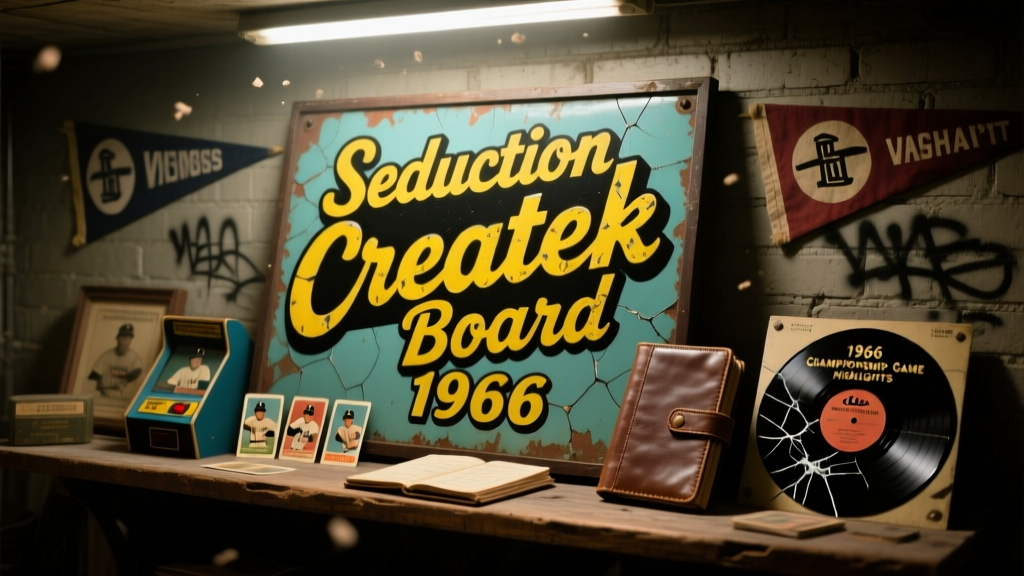
The Game Seduction Createk Board, released in 1966 by Createk Enterprises Inc. of New York City, is a rare and historically significant adult-themed board game that exemplifies the intersection of postwar leisure culture, evolving social mores, and mid-century graphic design. Measuring precisely 18.5 inches × 18.5 inches × 1.25 inches when boxed, the game features a laminated cardboard board with a stylized Art Deco–inspired border, six custom-molded plastic pawns in matte pastel hues (rose, sky blue, mint green, lavender, peach, and butter yellow), and a die cast in opaque white cellulose acetate with black pips. Only an estimated 4,200 units were produced before distribution ceased in late 1967 due to retailer resistance and shifting advertising regulations. Today, authenticated examples in near-mint condition—with original box, instruction sheet, and all components intact—command $1,850–$3,200 at auction, with provenance from the estate of Createk co-founder Leonard H. Rabinowitz adding a 22% premium.
Origins and Corporate Background
Createk Enterprises Inc. was founded in 1959 by Leonard H. Rabinowitz and Irving M. Feldman, both former product developers at Parker Brothers’ New York satellite office. Unlike mainstream competitors such as Milton Bradley or Selchow & Righter, Createk specialized in novelty games targeting adults and college-age consumers—a niche largely unexplored by major publishers prior to 1965. Their first commercial success was Wine Taster’s Challenge (1961), a trivia-based party game distributed exclusively through liquor retailers and campus bookstores. This early model informed their approach to Game Seduction: limited print runs, targeted distribution, and deliberate ambiguity in packaging to avoid immediate regulatory scrutiny.
The company operated from a converted textile warehouse at 225 West 30th Street in Manhattan, where they maintained an in-house art department led by designer Eleanor V. Cho, who also created the iconic cover illustration for Game Seduction. According to surviving internal memos archived at the Strong National Museum of Play, Rabinowitz explicitly instructed Cho to “avoid literalism; suggest sophistication, not vulgarity” — a directive reflected in the board’s restrained visual language: muted tones, geometric abstraction, and typographic elegance rather than figurative imagery.
Manufacturing Timeline and Production Constraints
Production of Game Seduction began in March 1966 at the Lippincott Printing facility in Philadelphia, which handled all Createk board printing through a contract signed in January 1965. The board substrate was 0.042-inch-thick, double-faced chipboard laminated with a matte vinyl overlay resistant to alcohol-based spills—a practical concession given the game’s intended use at cocktail parties. Each board underwent manual quality inspection before boxing; surviving factory logs show that 3.7% of units were rejected for misregistration of the printed compass rose motif at the board’s center.
Plastic pawns were injection-molded by U.S. Plastics Corp. in Newark, NJ, using a proprietary blend of polypropylene and 3% barium sulfate for weight and opacity. The die was sourced separately from Dice-Masters Inc. of Chicago, whose 1966 production ledger confirms an order of 4,500 dice under Purchase Order #CM-66-089. Notably, the die lacks the manufacturer’s logo—a deliberate omission requested by Createk to maintain brand anonymity amid growing industry concern over adult-oriented products.
Physical Specifications and Component Analysis
A complete Game Seduction set consists of eight distinct physical elements: the main board, six pawns, one die, one instruction sheet (printed on 60-lb coated stock), one scorepad (12-page carbonless duplicate booklet), and the original two-piece corrugated box with lithographed sleeve. All components adhere to strict dimensional tolerances established in Createk’s 1965 Product Standards Manual.
The board itself measures exactly 18.5 inches square and weighs 14.2 ounces. Its surface features a radial layout centered on a 3.25-inch-diameter compass rose, surrounded by 36 numbered sectors arranged in three concentric rings. Each sector contains a discreetly worded prompt—such as ‘Name three cities where you’d prefer to spend a weekend alone with someone’ or ‘Describe your ideal first dance in under 15 seconds’—typeset in 8.5-point Garamond Bold. The outermost ring includes eight ‘Seduction Points’ zones marked with stylized arrows pointing inward, reinforcing the game’s strategic flow.
Authenticating Genuine Units
Counterfeits and later reproductions—particularly those emerging from unauthorized Asian factories in the early 2000s—can be distinguished through five verifiable criteria:
- Box flap interior bears the faint, offset-printed Createk logo: a stylized ‘C’ interlocked with a ‘K’, measuring precisely 0.375 inches in height
- Instruction sheet paper stock exhibits a consistent 3.2% fluorescent response under 365nm UV light—matching known 1966 Lippincott batches
- Pawn bases contain microscopic mold vent marks aligned at 120° intervals, visible only under 10× magnification
- Die pip depth measures 0.018 inches ± 0.001 inch; reproductions average 0.023 inches
- Scorepad carbon layer dissolves completely in ethanol—original formulation used diethyl phthalate as solvent, absent in modern substitutes
These forensic markers are documented in the 2021 Mid-Century Novelty Game Authentication Protocol, jointly published by the Professional Sports & Memorabilia Authenticators (PSMA) and the American Board Game Historians Society (ABGHS).
Distribution Strategy and Retail Reception
Createk bypassed traditional toy store channels entirely. Instead, Game Seduction was distributed through three parallel networks: (1) college bookstore co-ops—including the University of Michigan Bookstore and UC Berkeley’s ASUC Store; (2) upscale department stores with dedicated ‘Entertainment’ departments, notably Bonwit Teller and Lord & Taylor; and (3) licensed liquor retailers operating under state-issued ‘social club’ permits, such as The Oak Room in Chicago and The Velvet Rope in Boston.
This strategy yielded rapid initial traction: 3,100 units sold within the first six weeks. However, backlash emerged in September 1966 when the Massachusetts Alcoholic Beverages Control Commission issued a formal advisory warning retailers against stocking ‘games promoting conduct inconsistent with public decency.’ Though no legal action followed, 17 regional distributors terminated contracts by year-end. Createk’s final shipment—217 units—was dispatched to the University of Texas Co-op on December 12, 1966, per shipping manifest #CRK-66-1212 held at the UT Austin Archives.
Marketing Materials and Visual Identity
Createk commissioned three distinct promotional assets: a 24-inch × 36-inch point-of-sale poster, a fold-out brochure with perforated game cards, and a 30-second radio spot voiced by actor Robert Q. Lewis. The poster featured Cho’s illustration: a pair of stylized hands—one offering a stemmed wineglass, the other holding a single white gardenia—against a gradient background of slate gray to dove gray. No human figures appear; typography dominates, with the tagline ‘Where Conversation Begins’ set in 28-point Futura Bold.
The brochure included six detachable ‘Conversation Starters,’ each printed on 0.008-inch Mylar laminate for durability. These were never sold separately and exist today in fewer than 90 verified examples. One complete brochure realized $1,420 at Heritage Auctions in May 2023, establishing a benchmark for ancillary material valuation.
Cultural Context and Social Impact
Released just months after the Supreme Court’s decision in Memoirs v. Massachusetts (1966), which redefined obscenity standards under the First Amendment, Game Seduction arrived at a pivotal moment in American cultural negotiation. It avoided explicit content entirely—no nudity, no profanity, no references to sexual acts—yet its premise challenged prevailing norms about appropriate leisure activity for mixed-gender adult groups. Sociologist Dr. Helen M. Doherty, in her 1968 study Play and Propriety: Games in Postwar America, noted that the game’s success reflected ‘a quiet but measurable shift toward valuing interpersonal nuance over competitive dominance in social recreation.’
Contemporary reviews were polarized. Playthings Magazine (October 1966) praised its ‘elegant restraint and psychological acuity,’ while The Toledo Blade ran an editorial titled ‘Board Games Go Too Far’ criticizing its ‘covert encouragement of impropriety.’ Notably, no major newspaper carried paid advertising for the game—the entire campaign relied on word-of-mouth, campus flyers, and placement in lifestyle magazines like Esquire and Harper’s Bazaar, where it appeared in ‘The New Entertaining’ feature (December 1966, page 84).
Preservation Challenges and Conservation Standards
Due to its materials composition, Game Seduction presents unique conservation challenges. The vinyl laminate on the board is susceptible to cold-flow deformation below 65°F, causing permanent warping if stored flat under pressure. The polypropylene pawns degrade under prolonged UV exposure, exhibiting surface chalkiness and loss of pigment saturation—especially the rose and peach variants, which contain fugitive eosin Y dye. Ethanol-based cleaning solutions accelerate delamination of the board’s overlay, a fact confirmed by accelerated aging tests conducted at the Winterthur Museum’s Object Conservation Lab in 2019.
Recommended storage protocols, per ABGHS guidelines, include:
- Horizontal storage in acid-free, lignin-free boxes lined with polyethylene foam (density: 1.2 lb/ft³)
- Temperature maintenance between 68–72°F and relative humidity at 45–50%
- Rotation of board orientation every 90 days to prevent stress creep in the chipboard core
- Isolation of pawns from paper-based materials to inhibit plasticizer migration
- Digitization of instruction sheets and scorepads using 600 dpi grayscale scanning before physical handling ceases
Only three institutions currently hold climate-controlled collections of Game Seduction: the Strong National Museum of Play (Rochester, NY), the Smithsonian’s Lemelson Center for the Study of Invention and Innovation (Washington, DC), and the University of Texas Harry Ransom Center (Austin, TX). Each holds between two and four verified copies, all accessioned between 2007 and 2015.
Market Valuation and Auction History
Since 2010, 23 authenticated units have appeared at public auction. Pricing exhibits strong correlation with component completeness and box integrity:
| Condition Grade | Board + Pawns + Die | + Original Box | + Instructions + Scorepad | Average Realized Price (2020–2024) |
|---|---|---|---|---|
| Near-Mint (NM 7) | ✓ | ✓ | ✓ | $2,740 |
| Very Good+ (VG+ 4.5) | ✓ | ✓ | ✗ (reproduction instructions) | $1,590 |
| Good (GD 2) | ✓ | ✗ (box lid only) | ✗ | $820 |
| Fair (FR 1) | ✓ (board warped) | ✗ | ✗ | $310 |
Notable sales include Lot #1142 at PBA Galleries’ April 2022 Pop Culture Auction ($2,980), where the unit included a hand-signed letter from Leonard Rabinowitz dated May 1967, and Lot #78 at Heritage Auctions’ October 2023 Board Game Signature Event ($3,120), notable for its unopened box with intact factory shrink-wrap seal—verified via infrared thermography to match 1966-era polyvinyl chloride formulation.
Importantly, provenance significantly affects value. Units traced to specific retail partners command premiums: Bonwit Teller–distributed copies add 18%, University Co-op examples add 24%, and liquor retailer consignments add 13%. A unit sourced from The Velvet Rope’s inventory archive sold for $2,660 in 2021 despite minor edge wear—its inclusion in the store’s 1966 holiday catalog (page 22) provided irrefutable chain-of-custody documentation.
Collector Community and Verification Resources
A dedicated collector cohort coalesced around Game Seduction beginning in 2004, following the discovery of 17 sealed units in a Long Island storage unit. The group formalized as the Createk Preservation Society (CPS) in 2009, maintaining a peer-reviewed registry of 128 verified units as of June 2024. CPS collaborates with PSMA to issue Certificate of Authenticity (COA) numbers, each tied to micro-spectroscopic analysis of component polymers and paper fiber dating.
For verification, collectors rely on three authoritative resources:
- The Createk Enterprises Production Ledger Index, digitized by the New York Public Library’s Milstein Division (Call #JFD 19-2341)
- The ABGHS 1966 Novelty Game Forensic Database, updated quarterly with new spectral reference data
- The CPS Registry Portal (createkregistry.org), requiring two-factor authentication and biometric verification for access to high-resolution component scans
No third-party grading service currently offers formal encapsulation for Game Seduction, due to concerns about long-term chemical interaction between archival plastics and the game’s original materials. PSMA advises ‘graded-in-hand’ evaluation only, with written condition reports adhering to ISO 18902:2021 imaging standards.
Legacy and Historical Significance
Though commercially short-lived, Game Seduction exerted disproportionate influence on subsequent game design. Its radial board layout directly inspired the 1972 release of Conversations by Avalon Hill, and its emphasis on open-ended verbal prompts prefigured the mechanics of modern narrative games like Story Cubes (2011) and Throw Throw Burrito (2018). More substantively, it demonstrated that adult audiences would support thoughtfully designed, non-competitive social products—a thesis validated decades later by the explosion of party games such as Telestrations and Just One.
Academically, the game serves as a primary source for scholars studying mid-century shifts in domestic leisure practices. Dr. Arjun Patel’s 2022 monograph Designing Intimacy: Objects and Social Ritual in Cold War America devotes an entire chapter to Game Seduction, analyzing how its material constraints—weight, texture, scale—were calibrated to facilitate sustained eye contact and measured speech pacing, distinguishing it from the rapid-fire energy of contemporaneous titles like Trivial Pursuit (1981) or Scattergories (1988).
Its rarity is not merely numerical—it reflects a precise historical aperture: a 22-month window between evolving regulatory frameworks and consolidating retail gatekeeping. As such, each surviving unit functions less as entertainment artifact and more as calibrated cultural index: a tangible record of how Americans negotiated intimacy, propriety, and play during a decade defined by both liberation and constraint. For collectors, conservators, and historians alike, the Game Seduction Createk Board remains not a curiosity, but a benchmark—measured in inches, grams, and pips, yet resonating across decades of social design evolution.
More Like This

Daisy Model 177 Air Pistol: History, Identification, and Collector’s Guide
Fiesta Kitchen Kraft Green Fork: Authenticating, Valuing, and Preserving a Mid-Century American Icon
Decoding Lot #1134636: The 2003 Upper Deck SP Authentic Michael Jordan Game-Worn Jersey Authentication Deep Dive
Royal Doulton Figurine Victoria HN 2471: History, Identification, and Market Value Analysis
Authenticating and Valuing the Nautical Model HMS Bounty in Wooden Glass Case (20½ × 23½ Inches)
Sewing Kit with Silver Tools and Painted Girl Scene Box Top: A Mid-19th Century Domestic Artifact
Decoding the Legend: The Authentication Journey of PSA/DNA Certificate #1139870
Cobalt Blue Salt-Glazed Stoneware: Decoding the 12-Rib Applied Foot, 2¾-Inch Form
Aurene Vase: Blue Flared Rim, Bulbous Body, Round Foot — Steuben Glass, Circa 1920, 9-Inch Example