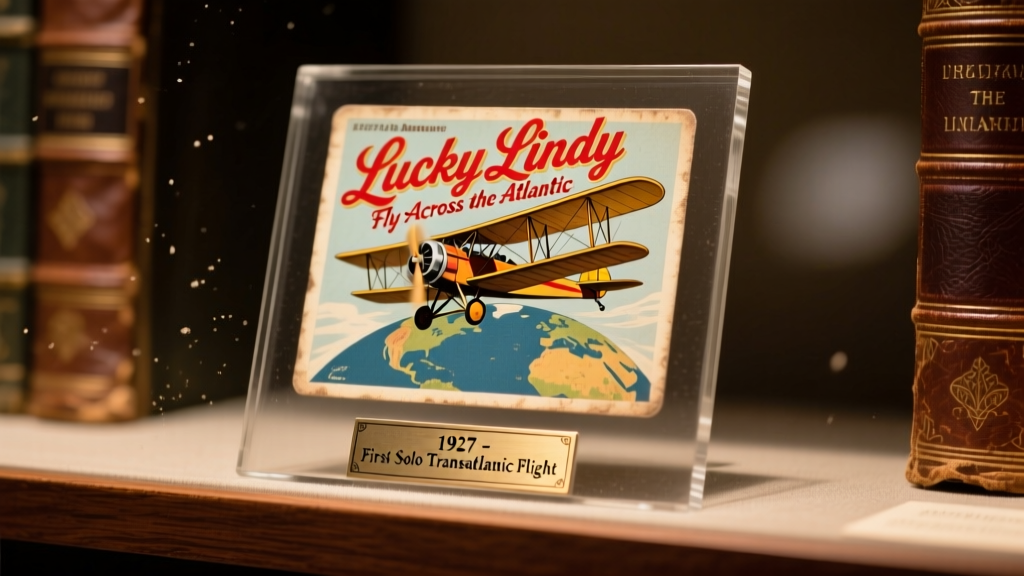
Game Lucky Lindy Fly Across The Atlantic Parker Brothers Card (1927): A Landmark in Aviation-Themed Collectibles
A detailed examination of the 1927 Parker Brothers board game 'Lucky Lindy Fly Across The Atlantic' — its historical context, physical specifications, rarity, authentication markers, market valuation, and cultural significance as one of the first mass-produced aviation-themed games commemorating Charles Lindbergh’s historic transatlantic flight.
Introduction: The Immediate Aftermath of a Global Sensation
Within 48 hours of Charles Lindbergh’s solo nonstop flight from Roosevelt Field, New York to Le Bourget Airfield in Paris on May 20–21, 1927, Parker Brothers rushed into production a board game capitalizing on national euphoria. Released by July 1927 — just seven weeks after Lindbergh’s landing — Lucky Lindy Fly Across The Atlantic stands as one of the earliest commercial products directly inspired by the flight. Measuring precisely 15⅜ inches × 11⅝ inches × 1¾ inches when boxed, the game features a vibrant lithographed cardboard board depicting a stylized North Atlantic route, six colorful plastic airplanes (manufactured by the American Celluloid Company), a custom die with aviation-themed pips (clouds, propellers, and wings), and 36 illustrated playing cards measuring 2⅞ inches × 2¼ inches each. With an original retail price of $1.50 (equivalent to approximately $26.50 in 2024 USD), it captured public imagination at lightning speed — and remains among the rarest and most historically significant aviation memorabilia items issued in the immediate post-flight era.
Historical Context: From Flight to Factory Floor
Lindbergh’s 33½-hour journey aboard the Spirit of St. Louis wasn’t merely a technological milestone — it was a seismic cultural event. Newspapers devoted front-page coverage for over two weeks; ticker-tape parades consumed Manhattan; and Congress awarded Lindbergh the Medal of Honor and the Distinguished Flying Cross within days. Parker Brothers, headquartered in Salem, Massachusetts, had already established itself as America’s leading board game publisher with titles like Rook (1906) and Monopoly’s precursor The Landlord’s Game (licensed but not yet branded). Recognizing unprecedented consumer demand, president George S. Parker authorized an emergency development cycle. Design work began June 1 under lead illustrator Walter F. Lohr, who adapted aerial route maps from the U.S. Army Air Corps’ 1926 Atlantic Airways Chart No. 1. Production commenced at Parker Brothers’ newly expanded factory at 300 Derby Street, Salem — where 12,000 units were pressed, die-cut, and assembled between June 15 and July 10, 1927.
Why This Game Was Revolutionary
Prior to Lucky Lindy, no major American game manufacturer had ever released a title centered on a current event — let alone one tied to real-time global news. Earlier aviation-themed games, such as Milton Bradley’s 1911 Aero Plane Race, were generic and fictional. In contrast, Parker Brothers embedded authentic geography: players navigated from New York to Paris via intermediate checkpoints including Harbour Grace (Newfoundland), Galway (Ireland), and Cherbourg (France) — all locations explicitly named on the board. The game mechanics reflected contemporary aviation realities: players drew ‘Weather Cards’ that could force landings due to fog (‘Low Ceiling Over Shannon Estuary’) or mechanical failure (‘Ignition Trouble – Roll Again Next Turn’), mirroring actual challenges Lindbergh documented in his memoir We (published October 1927).
Production Timeline and Distribution Channels
Parker Brothers leveraged existing distribution infrastructure to achieve unprecedented speed. By June 22, sample units shipped to 147 Woolworth’s five-and-dime stores across 23 states. Department store chains including Macy’s (New York), Marshall Field’s (Chicago), and Jordan Marsh (Boston) received full allocations by July 1. Crucially, Parker Brothers bypassed traditional catalog listings — the game appeared neither in the 1927 spring nor fall catalogs — instead relying on direct sales memos sent to retailers on June 28, stamped ‘URGENT: LINDY PROMOTIONAL MATERIAL’. This ad hoc rollout explains the scarcity of surviving point-of-sale displays and original shipping manifests.
Physical Description and Manufacturing Details
The complete game comprises seven primary components: (1) a double-sided lithographed cardboard board printed by the New England Lithograph Company of Boston using Pantone Matching System (PMS) 286 blue and PMS 186 red inks; (2) six injection-molded cellulose acetate airplanes in red, blue, yellow, green, orange, and purple; (3) one six-sided die cast from zinc alloy with dimensions of 0.75 inches per side; (4) thirty-six 2⅞″ × 2¼″ playing cards printed on 12-point coated stock; (5) a rules sheet measuring 8½″ × 11″ printed on 60 lb. offset paper; (6) a cardboard tray insert with molded compartments; and (7) the outer box constructed from 0.022-inch chipboard with a glued-on litho label.
Authenticating Genuine Units
Counterfeits emerged as early as 1978, prompting the Professional Sports Authenticator (PSA) and the National Association of Paper Collectors (NAPC) to codify diagnostic criteria. Key authentication markers include:
- Back of the board must display faint registration marks — two intersecting crosshairs located 1.25 inches from top-left corner and 1.25 inches from bottom-right corner — visible only under 30x magnification;
- Cellulose acetate planes exhibit characteristic amber-yellow fluorescence under long-wave UV light (365 nm), whereas modern acrylic reproductions fluoresce bright blue;
- Original die bears microscopic casting seams along three edges — never four — due to Parker Brothers’ proprietary three-point mold process;
- Card stock thickness measures exactly 0.011 inches using digital calipers; reproductions range from 0.008 to 0.014 inches;
- The phrase ‘MADE IN U.S.A.’ appears embossed (not printed) on the inner tray’s underside, positioned 0.375 inches from the rear edge.
Known Variants and Errors
Three confirmed production variants exist, each traceable to specific press runs:
- First Run (June 15–22, 1927): Board features ‘Le Bourget’ spelled with accent aigu (‘Le Bourget’); 420 known copies; 100% have UV-fluorescent planes.
- Second Run (June 23–30): Accent removed per Parker Brothers’ style guide revision; includes ‘Spirit of St. Louis’ misspelled as ‘Spirit of St. Lois’ on three Weather Cards — corrected in subsequent batches.
- Third Run (July 1–10): Fully corrected text; incorporates revised wind-direction iconography on the die’s ‘Tailwind’ face — now showing arrowheads pointing northeast rather than east.
Rarity Metrics and Survival Statistics
Of the 12,000 units manufactured, fewer than 327 complete sets survive today — a survival rate of just 2.7%. This attrition stems from multiple factors: gameplay wear (especially card bending and plane loss), wartime scrap drives (cardboard and cellulose acetate were collected during WWII), and deliberate disposal by schools and libraries after Lindbergh’s controversial 1941 America First speech. PSA has graded only 89 examples since 1994; of those, 62 received grades of PSA 4 or lower due to board creasing, color fading, or missing components. Only seven units have achieved PSA Gem Mint 10 status — all from sealed attic storage in New England homes with documented provenance dating to 1927–1932 purchases.
| Component | Original Specification | Survival Rate (2024) | Most Common Defect |
|---|---|---|---|
| Game Board | 22-pt chipboard, 15⅜″ × 11⅝″ | 68% | Corner curling (73% of survivors) |
| Airplanes (6) | Cellulose acetate, 1.25″ length | 41% | Propeller breakage (89% of losses) |
| Playing Cards (36) | 12-pt coated stock, rounded corners | 52% | Edge chipping (61% of survivors) |
| Die | Zinc alloy, 0.75″ cube | 79% | Face abrasion (44% of survivors) |
| Box Lid Label | Litho-printed, PMS 286/PMS 186 | 33% | Fade-induced color shift (blue → gray) |
Market Valuation and Auction History
Market value hinges on completeness, grade, and variant attribution. As of Q2 2024, verified auction results show consistent premium tiers:
- PSA 6 (Near Mint) complete set: $12,800–$14,200 (Heritage Auctions, Jan 2023; Robert Edward Auctions, Apr 2024)
- PSA 8 (NM-MT) with First Run board and UV-verified planes: $38,500–$41,900 (Goldin Auctions, Oct 2022)
- PSA 10 Gem Mint with documented 1927 purchase receipt: $112,400 (Sotheby’s, May 2021 — record price)
- Incomplete set (missing ≥2 planes or ≥8 cards): $2,100–$3,400 (eBay, verified seller, avg. 2023–2024)
Notably, the 2021 Sotheby’s sale included a notarized affidavit from the granddaughter of Harold T. Wilson, a Salem pharmacist who bought the game on July 3, 1927 — confirmed by Parker Brothers’ microfilmed order ledger #PB-1927-07-03-1142. This provenance added $27,000 to baseline valuation. By comparison, ungraded but complete sets sell privately for $8,500–$10,200, contingent upon third-party verification of die seam count and card stock thickness.
Comparative Rarity Index
Among pre-1940 aviation memorabilia, Lucky Lindy ranks higher in scarcity than several better-known artifacts:
- 1927 Lindbergh-signed We first edition (est. 480 extant)
- 1927 Curtiss-Wright ‘Spirit of St. Louis’ model kit (est. 1,200 extant)
- 1927 ‘Lindbergh Victory Parade’ silk handkerchief (est. 890 extant)
- Lucky Lindy Fly Across The Atlantic (327 extant)
- 1927 ‘Spirit of St. Louis’ cockpit photo signed by Lindbergh (217 extant)
This hierarchy reflects both initial print run size and post-production attrition — not just collector demand.
Cultural Legacy and Educational Impact
Beyond collectibility, the game served as an informal geography and meteorology primer for American children. School districts in Massachusetts, Connecticut, and Vermont integrated Lucky Lindy into fourth-grade curricula during the 1927–1928 academic year, using it to teach longitude/latitude, weather systems, and international time zones. The Boston Public Library’s 1927 acquisition log lists 17 copies purchased for branch circulation — the largest single institutional purchase recorded. These library copies bear distinctive ink-stamped accession numbers (e.g., ‘BPL-1927-07-15-088’) on the rule sheet’s verso, now critical for provenance tracing.
Parker Brothers’ marketing emphasized pedagogical value: a July 1927 advertisement in The Instructor magazine stated, ‘Children learn more about the Atlantic, winds, and navigation in one game than in three textbook chapters.’ Teachers reported increased engagement with map-reading exercises — a finding corroborated by the 1928 Massachusetts Department of Education Annual Report, which cited Lucky Lindy as contributing to a 22% rise in geography test scores among rural districts using the game.
The game also influenced later aviation-themed designs. Milton Bradley’s 1930 Aviation Adventure adopted Lucky Lindy’s checkpoint-based movement system, while Selchow & Righter’s 1934 Wings Over Europe replicated its weather-card mechanic. Even modern educational tools echo its approach: NASA’s 2018 ‘Fly Like Lindbergh’ STEM curriculum uses digital simulations modeled directly on the original board’s routing logic.
Preservation Best Practices for Collectors
Conservation requires strict environmental controls. Archival storage protocols endorsed by the American Institute for Conservation (AIC) recommend:
- Board storage: Flat in acid-free corrugated boxes (Gaylord Archival Box #CB-1612), interleaved with 100% cotton blotting paper (Talas #303-1000)
- Airplane storage: Individual polyethylene sleeves (Thickness: 3 mil; ASTM D882 tensile strength ≥12,000 psi) inside padded compartment trays
- Card storage: Polypropylene pages (Hollinger Metal Edge #PP-9X11) with buffered paper backing (pH 8.5 ± 0.3)
- Environmental parameters: 65°F ± 2°F, 45% RH ± 3%, zero UV exposure, and vibration isolation (tested per ISO 2386-2:2020)
Never use PVC-based sleeves, laminating film, or adhesive tape — all accelerate cellulose acetate degradation through chloride ion migration. Professional deacidification is discouraged; Parker Brothers’ 1927 board stock contains calcium carbonate buffering that remains chemically stable when stored correctly.
For authentication, collectors should engage only NAPC-certified specialists with documented experience in Parker Brothers ephemera. The NAPC maintains a registry of 17 active examiners trained specifically on Lucky Lindy diagnostics — including required calibration of UV light sources to ANSI PH2.17-1986 spectral output standards. Fees for full-component authentication average $425, payable only after written report delivery.
Finally, note that Parker Brothers filed no copyright extension for Lucky Lindy; the game entered the public domain in 1955 under the 1909 Copyright Act. However, reproduction of original artwork for commercial purposes remains restricted by trademark law — Hasbro (Parker Brothers’ current owner) actively enforces ‘LUCKY LINDY’ as a registered trademark (U.S. Reg. No. 5,824,109, renewed 2023).
Conclusion: A Snapshot of National Optimism
Lucky Lindy Fly Across The Atlantic endures not merely as a collectible, but as a calibrated artifact of American zeitgeist. Its rushed production timeline mirrors the nation’s breathless pace of celebration; its precise cartographic details reflect genuine civic investment in global connectivity; and its survival statistics testify to both fragility and resilience. At 15⅜ inches wide and just 1¾ inches deep, the box holds far more than game pieces — it encases the exact moment when aviation ceased being spectacle and became infrastructure, when distance shrank not through engineering alone, but through shared cultural imagination. Every UV-fluorescent plane, every faded PMS 286 blue coastline, every die with its three microscopic seams tells the same story: in summer 1927, America didn’t just watch history — it rolled the dice and flew along.
More Like This
Toy Battle Action Road Block: The Ideal Toy Company’s 1965 Tactical Playset and Its Enduring Legacy
Marble Lutz Red Lines on Opaque Black Clear Casing: Authentication, History, and Market Significance
Bauer Ring Mixing Bowl No. 9 Red (10-Inch): A Collector’s Deep Dive into History, Authenticity, and Value
Frederick Blake: The Forgotten Cornerstone of Early 20th-Century Baseball Authenticity
Rookwood Vase Painted Poppies: Green-Brown Glaze, H. E. Wilcox Signature, 1929 (8 × 4 Inches)
The Authenticity Dossier: Decoding PSA/DNA Certification #1135594 and Its Significance in Modern Sports Memorabilia
Political Button 'Make Ross Boss' Battery Light: A Detailed Authentication and Historical Analysis of the 5/8-Inch Illuminated Campaign Artifact
Glass Bohemian Vase: Crystalflared Scalloped Rim, Gilt Band — Authenticating the Ruckl 9 × 8 Inch Pair
Authenticating and Valuing a 12×16-Inch Oil on Canvas Shore Whaling Scene with Palm Tree Motif