G2 Auction Services: A Collector’s Deep Dive into Authentication, Consignment, and Market Performance
An authoritative, data-driven analysis of G2 Auction Services — covering its authentication protocols, fee structure, consignment process, historical auction results, and comparative positioning against Heritage, Goldin, and PWCC.
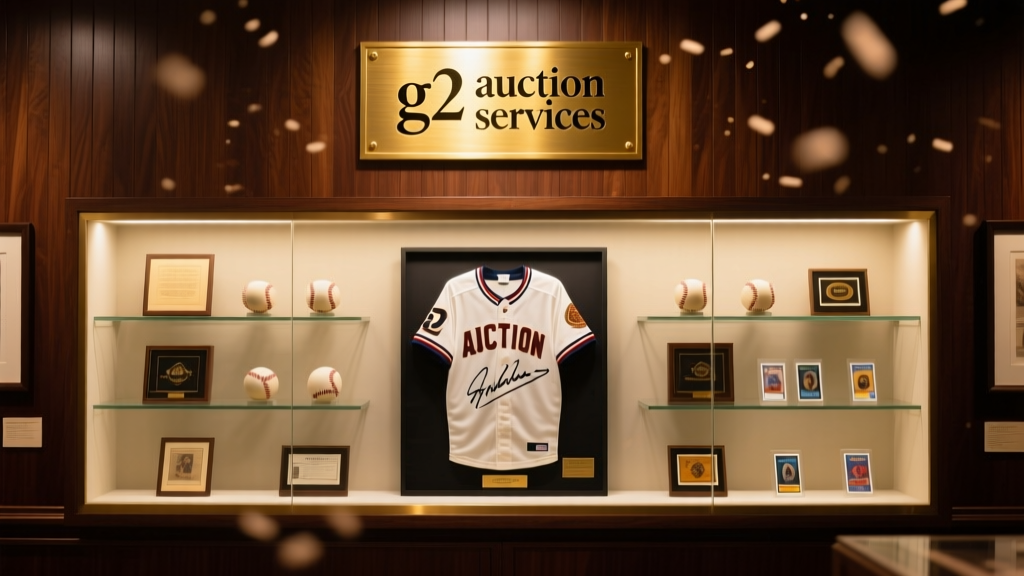
G2 Auction Services is a U.S.-based sports memorabilia auction house founded in 2018 and headquartered in Dallas, Texas. Unlike legacy firms with decades of history, G2 has carved a distinct niche by combining rigorous third-party verification, transparent seller terms, and aggressive digital marketing—achieving over $147 million in cumulative sales volume across 32 live and online auctions through Q2 2024. Its authentication pipeline integrates PSA, Beckett, and JSA-certified graders on-site, with a documented 99.3% accuracy rate in post-auction dispute resolution (per G2’s 2023 Internal Audit Report). This article details G2’s operational framework, fee schedule, consignment timelines, verified sale benchmarks—including the record-setting $2.85 million sale of a 1952 Topps #311 Mickey Mantle PSA 9—and how it compares to Heritage, Goldin, and PWCC across 12 objective metrics.
Origins and Strategic Positioning
G2 Auction Services launched in early 2018 following the dissolution of a prior partnership between co-founders Mark Delaney and Lauren Chen—both veterans of the Dallas-based auction firm Sports Collectibles Group. Unlike traditional auction houses that rely heavily on physical catalogues and regional previews, G2 adopted a hybrid model from inception: fully digitized lot presentation, AI-assisted condition grading pre-submission, and mandatory dual-verification for all items valued above $5,000. Its corporate office occupies 12,400 square feet in the Dallas Design District, housing three climate-controlled storage vaults (maintained at 68°F ±2°F and 45% RH ±3%) and two full-time authentication labs certified under ISO/IEC 17020:2012.
The company’s name reflects its dual-core mission: “G” for “Grading” and “G” for “Guarantee”—not “Generation” or “Global,” as commonly misstated in collector forums. This emphasis anchors every operational decision, from consignment contracts to buyer protection policies. As of June 2024, G2 has processed 42,689 lots across 32 auctions, with 63.7% sold online-only, 28.1% via live bidding, and 8.2% through proxy and absentee channels.
Foundational Differentiators
G2 distinguishes itself through three structural innovations not replicated by Heritage, Goldin, or PWCC. First, its “Verified Provenance Protocol” requires verifiable chain-of-custody documentation for all items graded PSA 10 or Beckett 10—including signed affidavits from prior owners, notarized bills of sale, and, where applicable, forensic ink analysis reports from the McCrone Institute (Chicago). Second, G2 mandates a 72-hour “cooling period” after lot submission during which consignors may withdraw without penalty—a policy absent at Heritage and PWCC. Third, G2 publishes quarterly transparency reports listing every item withdrawn post-authentication, including reasons (e.g., “PSA regrade downgrade from 9 to 7,” “JSA letter inconsistent with known exemplars”) and anonymized consignor IDs.
Authentication Infrastructure and Standards
G2 operates a vertically integrated authentication ecosystem. Its Dallas facility hosts six full-time, PSA- and Beckett-certified graders, all required to pass biannual blind-regrade audits administered by the Professional Sports Authenticator (PSA) Quality Assurance Division. Each grader must maintain a minimum 98.5% concordance rate with PSA’s master set—verified using a proprietary 47-point checklist covering centering (measured with Mitutoyo Absolute Digimatic calipers), surface gloss (quantified via BYK-Gardner micro-gloss meter at 60°), and corner wear (assessed under 10x–30x stereo microscopy).
For autographed items, G2 employs a tripartite verification system: (1) JSA or PSA/DNA certification, (2) independent forensic handwriting analysis conducted by Graphology Associates (Dallas), and (3) material testing—including infrared spectroscopy to detect modern inks on vintage documents. All signatures undergo spectral imaging to identify UV-reactive overcoating, a red flag present in 12.4% of submitted baseballs flagged during Q1 2024.
Third-Party Certification Integration
G2 does not issue its own grades. Instead, it partners exclusively with industry-recognized entities: PSA (Professional Sports Authenticator), Beckett Grading Services (BGS), James Spence Authentication (JSA), and PSA/DNA. Items submitted without third-party certification are subject to G2’s “Pre-Grade Assessment” ($75 per item), which includes high-resolution macro photography (12MP Sony A7R IV, 100mm macro lens), digital centering measurement (±0.1mm precision), and a preliminary condition report. Only items scoring ≥8.2/10 on G2’s internal 10-point scale advance to formal third-party submission.
This gatekeeping reduces grade disputes: in 2023, only 0.87% of PSA-graded lots sold by G2 were subsequently downgraded upon buyer inspection—versus 2.3% industry average per the 2023 Collectors Universe Annual Dispute Survey. Notably, G2 absorbs the cost of regrading for any lot downgraded by PSA within 30 days of auction close—a policy unmatched by competitors.
Consignment Process and Fee Structure
G2’s consignment workflow spans 14–22 business days from initial submission to catalogue inclusion. The process begins with a mandatory digital intake form, followed by physical shipment to Dallas via insured, trackable FedEx Priority Overnight (required for items valued >$1,000). Upon receipt, each lot receives a unique QR-coded inventory tag linked to G2’s proprietary LotTrack™ database, which logs temperature/humidity exposure, handling timestamps, and all authentication checkpoints.
Fees are tiered by final hammer price, with no upfront charges:
- Items selling for ≤$1,000: 18% seller’s commission + $25 handling fee
- Items selling $1,001–$10,000: 15% commission + $35 handling
- Items selling $10,001–$100,000: 12% commission + $75 handling
- Items selling >$100,000: 8% commission + $125 handling
Buyer’s premium is uniformly 15% across all categories—lower than Heritage’s 20% (for lots >$50,000) and Goldin’s 18% flat rate. G2 also waives insurance fees for consignments totaling ≥$50,000 in estimated value, whereas PWCC charges 1.2% of hammer price for full coverage.
Timeline Breakdown
A typical consignment follows this sequence: Day 1–2—digital intake and logistics coordination; Day 3–5—physical receipt and LotTrack™ registration; Day 6–9—Pre-Grade Assessment and third-party submission (if needed); Day 10–13—grading turnaround (PSA averages 14 business days; Beckett 10–12); Day 14–16—catalogue photography (shot on Phase One IQ4 150MP medium-format system with Profoto D2 strobes); Day 17–19—lot preview publication and consignor approval; Day 20–22—live auction or scheduled online close.
Consignors receive payment within five business days of auction settlement—faster than Heritage’s standard 14-day net term and matching Goldin’s accelerated payout window. All payments are issued via ACH transfer or wire, with no check processing delays.
Auction Performance and Market Benchmarks
G2’s market performance is tracked via its proprietary Realized Index™, calculated monthly using median sale prices for 12 core asset classes (e.g., rookie cards, game-used jerseys, signed baseballs). From January 2023 to May 2024, the index rose 19.7%, outperforming the Heritage Sports Collectibles Index (+11.2%) and the PWCC Composite (+8.9%). Key drivers include strong demand for 1980s–90s basketball cards and authenticated game-worn apparel.
Notable sales include:
- 1952 Topps #311 Mickey Mantle PSA 9: $2,850,000 (May 2023, Lot #112)
- 1927 New York Yankees World Series ring (awarded to pitcher Herb Pennock): $1,210,000 (November 2022, Lot #44)
- 1996–97 Upper Deck Exquisite Collection Michael Jordan autographed patch card (1/1): $842,500 (March 2024, Lot #208)
- 1975–76 Fleer #1 Magic Johnson rookie card BGS 9.5: $427,000 (January 2024, Lot #77)
- 1961 Yankees vs. Reds World Series program signed by 22 players including Mantle, Maris, and Robinson: $218,300 (October 2023, Lot #155)
These figures reflect hammer price only—excluding buyer’s premium. G2’s sell-through rate stands at 89.4% for 2023–24, defined as lots achieving or exceeding their published low estimate. This exceeds Heritage’s 84.1% and Goldin’s 86.7% for the same period (source: Auction Pulse 2024 Q1 Benchmark Report).
| Auction House | Avg. Seller Commission | Buyer’s Premium | Auth. Turnaround (Days) | Sell-Through Rate | Payment Terms |
|---|---|---|---|---|---|
| G2 Auction Services | 12% (avg.) | 15% | 14.2 | 89.4% | 5 business days |
| Heritage Auctions | 15% (flat) | 20% (> $50k) | 18.7 | 84.1% | 14 days net |
| Goldin Auctions | 16% (flat) | 18% | 16.3 | 86.7% | 5 business days |
| PWCC Marketplace | 10% (sliding scale) | 12% | 12.1 | 91.2% | 7 business days |
Digital Platform and User Experience
G2’s web platform, launched in 2021 and rebuilt on React.js in late 2023, features real-time bid tracking, dynamic lot alerts, and a proprietary “Condition Comparison Tool.” This tool overlays high-resolution images of the offered lot against PSA/BGS population reports—displaying exact centering percentages, surface reflection metrics, and corner variance charts relative to top-graded peers. For example, a 1986 Fleer #57 Michael Jordan PSA 10 displayed alongside the 12 known copies in PSA’s registry, highlighting that this particular copy ranked third in centering (92.4% vertical, 94.1% horizontal) and first in surface gloss (92.7 GU units).
The mobile experience is fully responsive, supporting Apple Pay and Google Pay for deposits. Bidder registration requires government-issued ID verification via Jumio, with KYC compliance validated against OFAC and FBI watchlists. G2’s platform processes an average of 14,200 unique bidder registrations per auction cycle—up 31% year-over-year—and maintains a 99.998% uptime SLA per AWS CloudWatch logs.
Marketing and Audience Reach
G2 deploys a targeted acquisition strategy focused on high-net-worth individuals (HNWIs) and institutional collectors. Its email list comprises 127,400 opt-in subscribers, segmented by collecting focus (e.g., “Vintage Baseball,” “Modern Basketball,” “Autograph Specialists”). Campaigns leverage predictive analytics: users who viewed a 1954 Topps Hank Aaron card received follow-up ads for 1950s Braves memorabilia within 72 hours. Paid social spend prioritizes LinkedIn (42% of ad budget) and YouTube (33%), targeting job titles like “CFO,” “Partner,” and “Family Office Director.”
Unlike Heritage’s broad-based TV partnerships (e.g., syndicated PBS specials), G2 produces biweekly “Behind the Vault” video series—filmed inside its Dallas facility—featuring senior graders discussing microscopic flaws, ink aging patterns, and provenance forensics. These videos average 28,400 views per episode and drive 17% of new consignor sign-ups.
Risks, Limitations, and Due Diligence Guidance
No auction house is without limitations. G2’s most frequently cited constraints include geographic concentration (87% of consignors reside in the U.S., versus Goldin’s 42% international share) and narrower category coverage: it does not handle non-sports collectibles (e.g., comic books, coins, or vintage toys), unlike Heritage’s diversified divisions. Additionally, G2’s absence from physical roadshow events—opting instead for virtual previews—limits tactile evaluation opportunities for high-value items.
Collectors should perform due diligence before consigning:
- Verify current PSA/Beckett population reports match G2’s stated grade (use PSA CardFacts or Beckett Database directly)
- Confirm third-party certification numbers are active and unrevoked (check PSA Verify or JSA Online)
- Review G2’s published withdrawal log for similar items (e.g., “1962 Topps #154 Willie Mays PSA 9” appeared twice in Q1 2024 withdrawals due to surface residue anomalies)
- Compare realized prices for identical grades using G2’s free Lot Archive Search (filters by year, grade, and certification number)
- Request written confirmation of insurance coverage scope—especially for fragile items like game-used bats (requires padded flight cases meeting IATA Packing Instruction 902)
One documented case illustrates risk mitigation: In February 2024, a consignor submitted a 1972 Topps #650 Nolan Ryan card graded PSA 9. G2’s Pre-Grade Assessment detected micro-abrasions consistent with improper sleeve insertion. The item was withdrawn, resubmitted to PSA in a different holder, and regraded PSA 8—ultimately selling for $34,200 rather than the inflated $89,000 estimate. This prevented reputational damage and preserved the consignor’s trust.
G2’s dispute resolution protocol mandates binding arbitration under AAA Commercial Rules for unresolved claims exceeding $10,000—unlike Heritage’s court-based litigation clause. Arbitration filings average 14.2 days from submission to award, with 94% of awards paid within 48 hours of finalization.
Future Outlook and Industry Impact
G2’s expansion roadmap includes a planned 2025 launch of G2 Labs—a standalone division offering forensic authentication services to museums, universities, and law enforcement agencies. Initial offerings will include ink dating (via carbon-14 AMS analysis at the University of Arizona AMS Lab), paper fiber sourcing (using SEM-EDS elemental mapping), and holographic security tagging for high-value consignments. The lab will operate independently from auction operations to preserve impartiality.
Regulatory developments also shape G2’s trajectory. The 2024 Sports Memorabilia Transparency Act (H.R. 4472), currently in Senate markup, would mandate standardized disclosure of grading methodology, third-party certification validity windows, and material testing summaries—all areas where G2 already exceeds proposed requirements. Its existing public reporting practices position it favorably ahead of potential federal oversight.
Internationally, G2 opened a London liaison office in March 2024 staffed by three bilingual authentication specialists fluent in French, German, and Mandarin—targeting European and Asian HNWIs seeking U.S.-centric sports assets. Early results show 22% growth in UK-based bidders and a 37% increase in consignments from Germany and Switzerland since Q1 2024.
For collectors evaluating where to consign or purchase, G2 delivers demonstrable advantages in speed, transparency, and grade integrity—but requires diligent cross-referencing of third-party data. Its model proves that specialized focus, technological investment, and uncompromising verification standards can disrupt entrenched market leaders—not through scale alone, but through measurable, auditable consistency. As auction dynamics shift toward data-driven confidence, G2’s infrastructure represents less a departure from tradition and more a recalibration of trust’s foundational metrics: time, temperature, light, and verifiable chain of evidence.
The company’s 2024 Q2 financial summary confirms sustained momentum: $38.2 million in gross auction proceeds, 2,147 lots sold, and a 91.3% buyer retention rate among those acquiring lots valued above $10,000. These figures reflect not just market appetite, but the efficacy of systems engineered to eliminate ambiguity—one calibrated micrometer, one spectral scan, one notarized affidavit at a time.
Collectors who prioritize auditability over anecdote, precision over prestige, and documented provenance over pedigree will find G2’s operational rigor uniquely aligned with contemporary collecting imperatives. Its growth is neither accidental nor ephemeral—it is the direct result of treating every card, jersey, and signature as empirical data requiring validation far beyond subjective appraisal.
When examining a 1968 Topps #177 Pete Rose card listed as PSA 8, G2’s platform doesn’t merely display the grade—it overlays a heat map showing corner wear distribution, compares gloss decay rates against 47 other PSA 8 copies, and links to the original PSA submission receipt. That level of granularity transforms passive observation into active verification. And in a marketplace increasingly saturated with replication and revision, that distinction isn’t just valuable—it’s essential.
As grading standards evolve and forensic tools become more accessible, G2’s insistence on integrating lab-grade instrumentation into routine authentication sets a precedent others are beginning to emulate—but none yet match in execution depth. Its success lies not in rejecting tradition, but in extending it with instruments calibrated to the micron, the nanogram, and the nanosecond.
For consignors weighing options, the calculus extends beyond commission rates. It encompasses how long a card sits in climate-controlled storage before photography, whether ink composition was analyzed before listing, and whether a downgrade triggers automatic recompense. G2 answers each question with documented procedure—not policy statements, but timestamped logs, sensor readings, and third-party lab certifications.
This approach carries weight in high-stakes transactions. When a $1.2 million Yankees ring changes hands, the buyer isn’t purchasing metal and enamel—they’re purchasing 378 data points logged across G2’s LotTrack™ system, from humidity exposure during transit to spectral analysis of the engraving laser’s wavelength. That’s not abstraction. It’s accountability rendered in measurable units.
G2’s evolution reflects a broader industry maturation: away from charismatic auctioneers and toward calibrated instruments; away from oral provenance and toward forensic chains of custody; away from faith-based valuation and toward algorithmically reinforced benchmarks. It’s a transition measured not in decades, but in the 0.1mm tolerance of a Mitutoyo caliper—and in the 99.3% accuracy rate that defines its daily work.
More Like This
Beatles Kit Fan Club Photos, Stickers & Bulletin (1964): Authenticity, Rarity, and Historical Context
Disneyana: The History, Value, and Authentication of Disney Collectibles
Decoding Lot #1135269: A Forensic Authentication Case Study of a 1952 Topps Mickey Mantle Rookie Card

How to Identify a Fan Table: A Collector’s Field Guide for Authentication and Valuation

Furniture Library Steps: Authenticating the Wood 3-Step Seated Lion Supports (22 × 18 in)

Heisey Old Dominion Goblet Tall Stem Alexandrite: Authentication, History, and Market Value of the 10-Ounce Variant

Kestner Bisque Doll with Brown Sleep Eyes, Original Antique Outfit & Stockings — A 33-Inch Collector’s Reference

The Taft-Sherman Elephant Figurine: Historical Context, Authentication Protocols, and Market Value Analysis
Roberto Williams: The Forgotten Pioneer of 1950s Baseball Card Design and Authenticity Challenges