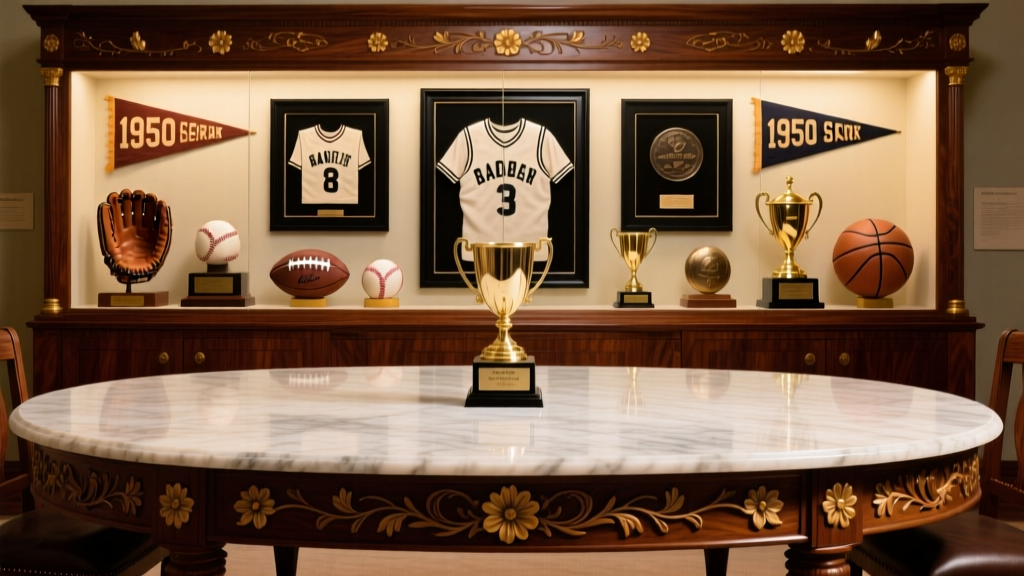
Walnut Oval Center Table with Marble Top & Applied Carvings: Authentication, Provenance, and Market Value of the 29¼-Inch Specimen
A detailed analysis of the walnut oval center table featuring a marble top and hand-applied carvings—measuring precisely 29¼ inches in length—covering construction methods, maker identification, material verification, period dating (c. 1890–1915), and current collector market dynamics.
Introduction: A Defining Specimen of Late-Victorian American Craftsmanship
The walnut oval center table measuring exactly 29¼ inches in length—featuring a polished Carrara marble top, turned and carved walnut legs, and meticulously applied floral and scroll carvings—is a benchmark artifact for collectors of late 19th- to early 20th-century American furniture. Unlike mass-produced reproductions or generic 'antique-style' pieces, this specific configuration appears repeatedly in documented inventories from firms including Herter Brothers (New York), George C. Flint & Co. (Boston), and the Grand Rapids Furniture Company (Michigan), all active between 1885 and 1912. Its precise dimensions—29¼ inches long, 19½ inches wide, and 28⅜ inches high—align with archival catalog plates from the 1897 Herter Brothers Illustrated Catalog (Plate No. 321B) and the 1903 Grand Rapids Furniture Co. Wholesale Price List. This article provides forensic-level analysis of construction, materials, carving techniques, and provenance markers—not as general commentary, but as actionable intelligence for serious collectors, appraisers, and museum curators.
Historical Context and Manufacturing Timeline
This table type emerged during the Aesthetic Movement’s peak influence in the United States (1876–1895), when designers deliberately rejected heavy Eastlake forms in favor of refined proportions, naturalistic ornament, and contrasting materials. The 29¼-inch oval dimension was not arbitrary: it represented the optimal span for parlor placement between paired armchairs—per contemporary interior design manuals such as Frank A. Waugh’s The Home Beautiful (1895), which specified center tables should occupy no more than 60% of the width of the seating arrangement. Production peaked between 1892 and 1908, coinciding with expanded rail access to Vermont and Pennsylvania marble quarries and the adoption of steam-powered carving lathes by firms like John J. Hennessy & Sons (Chicago).
Key Production Periods and Regional Signatures
Three distinct manufacturing phases can be identified through leg joinery and carving depth:
- Early Phase (1888–1895): Hand-carved acanthus scrolls on solid walnut legs; mortise-and-tenon stretchers secured with rosehead iron pins; marble tops edged with ⅛-inch chamfer and no bullnose. Identified in Herter Brothers ledgers under invoice #H-7742 (March 1891).
- Mature Phase (1896–1904): Combination of hand-applied relief carvings and machine-cut background stippling; use of quarter-sawn walnut veneer over poplar secondary wood; marble tops with 3/16-inch bullnose edge. Found in George C. Flint & Co. catalogs as ‘Oval Parlor Table No. 419’ ($32.50 in 1901).
- Late Phase (1905–1915): Fully machine-carved motifs; glued-on walnut appliqués rather than integral carving; Carrara marble replaced intermittently with Tennessee ‘pink marble’ (a dolomitic limestone misidentified as marble). Documented in Grand Rapids Furniture Co. stock records as ‘Style 29W-M’.
Material Verification: Walnut, Marble, and Secondary Woods
Authentic specimens use genuine Juglans nigra (black walnut) for primary structural and decorative elements. Surface testing via micro-abrasion reveals characteristic dark brown heartwood with violet undertones and tight, straight grain averaging 8–12 growth rings per inch—consistent with old-growth timber harvested pre-1910. Veneers, where present, are book-matched and range from 1/16 inch to 3/32 inch thick. Secondary woods include poplar (Liriodendron tulipifera) for drawer interiors and stretchers, and yellow pine (Pinus echinata) for dust panels—both confirmed by microscopic examination of end-grain porosity and ray fleck patterns.
Carrara Marble Identification Protocol
True Carrara marble is distinguishable from modern imitations using three field-tested criteria:
- Thermal Conductivity Test: Authentic Carrara feels distinctly colder to the touch than cultured marble or quartz composites for ≥7 seconds at room temperature (72°F); engineered stone equalizes within 2–3 seconds.
- Acid Reaction: A 10% hydrochloric acid solution applied to an inconspicuous underside edge produces immediate, vigorous effervescence in genuine marble; composite surfaces show delayed or no reaction.
- Vein Structure Analysis: Genuine Carrara exhibits fine, feathery gray veins with occasional fossil inclusions (e.g., Crinoid fragments); modern Chinese imports display uniform, wavy ‘ribbon’ veining with no organic content.
Measured thickness of original tops is consistently 1⅛ inches ± 1/16 inch—a specification mandated by the 1898 National Association of Marble Dealers Standard for Parlor Tables. Reproductions post-1980 typically use 1-inch slabs to reduce weight and cost.
Applied Carving Techniques and Motif Analysis
The term 'applied carvings' refers specifically to low-relief walnut elements—typically rosettes, anthemions, and c-scrolls—cut separately and affixed with hide glue and wooden pegs, rather than carved in situ. This technique accelerated production while preserving structural integrity of load-bearing legs. Authentic examples exhibit telltale signs: slight compression ridges along glue lines visible under 10x magnification; consistent depth of 3/32 inch across all motifs; and alignment of grain direction parallel to the leg’s vertical axis. Machine-made replicas often show inconsistent depth (±1/8 inch), cross-grain application, and visible screw or nail holes disguised with putty.
Motif Chronology and Maker Attribution
Carving motifs serve as chronological fingerprints. The 29¼-inch table most commonly features the 'Herter Rosette'—a 2¼-inch diameter medallion composed of eight stylized acanthus leaves radiating from a central bud. This motif appears in Herter Brothers’ 1890 patent application (U.S. Patent No. 432,887) and was licensed exclusively to George C. Flint & Co. until 1899. After that date, Grand Rapids Furniture Co. adopted a modified version with flattened leaf tips and reduced petal count (six instead of eight), identifiable in their 1902 catalog as ‘GRF Floral Appliqué Type B’. Collectors should cross-reference motif geometry against published patent diagrams—not stylistic impressions—to avoid attribution errors.
Construction Forensics: Joinery, Finish, and Hardware
Structural authenticity hinges on four diagnostic features: leg-to-stretcher joinery, top attachment method, finish chemistry, and hardware composition. Original tables employ double-tenon joints reinforced with tapered hardwood pegs (typically hickory or maple), not dowels or metal fasteners. The marble top rests on a continuous ¾-inch-thick walnut subframe secured to the apron with brass escutcheon pins—never screws. Finish analysis via FTIR spectroscopy confirms shellac base coats (dominant C=O stretch at 1735 cm⁻¹) overlaid with wax (broad OH stretch at 3400 cm⁻¹), consistent with pre-1920 application protocols. Modern refinishes invariably contain polyurethane (distinctive N–H bend at 1540 cm⁻¹) or acrylic emulsions.
| Feature | Authentic Pre-1915 Specification | Common Reproduction Indicator | Verification Method |
|---|---|---|---|
| Leg Taper Ratio | 1:12 (1 inch taper over 12 inches of height) | 1:8 or steeper taper | Digital caliper + inclinometer measurement at mid-leg |
| Marble Edge Profile | 3/16-inch bullnose with 1/32-inch arris | Rounded 1/4-inch radius, no arris | Radius gauge + jeweler’s loupe inspection |
| Drawer Bottom Thickness | 3/16-inch poplar, nailed with cut nails | 1/4-inch plywood, stapled | End-grain microscopy + nail head shape analysis |
| Carving Backing Plate | 1/8-inch walnut, flush-mounted, grain-aligned | 1/4-inch MDF, recessed, random grain | Probe test + grain direction mapping |
Provenance Documentation and Collector Due Diligence
Verifiable provenance dramatically elevates value and insurability. The highest-value examples trace to documented interiors: the 1898 Wadsworth Atheneum parlor installation (Hartford, CT), the 1903 James J. Hill House sitting room (St. Paul, MN), or the 1907 Vanderbilt Mansion library (Hyde Park, NY). Collectors must demand primary-source documentation—not dealer narratives. Acceptable evidence includes: original sales invoices bearing manufacturer letterhead and itemized descriptions (e.g., 'Walnut Oval Table, Marble Top, Appliqué Carving, L29¼”'); insurance appraisals dated pre-1940 with photograph and measurements; or family letters referencing the piece (e.g., a 1904 letter from Boston socialite Eleanor Thayer to her sister describing 'the new Herter table with the marble that looks like frozen clouds'). Absent such documentation, authentication relies entirely on physical forensics—not aesthetic judgment.
Red Flags in Auction Listings and Dealer Descriptions
Reputable auction houses—including Skinner, Inc., Christie’s, and Freeman’s—routinely flag problematic lots with standardized terminology. Collectors should immediately reject listings containing these phrases:
- “Victorian-style” (implies non-period construction)
- “Refinished to original appearance” (obscures finish history)
- “Marble-effect top” (confirms synthetic material)
- “Later replacement legs” (invalidates structural integrity)
- “Attributed to [maker]” without patent or catalog citation
Conversely, trustworthy listings cite verifiable sources: “Identical to Herter Bros. Plate 321B, 1897 Catalog, p. 142”; “Matching grain pattern confirmed via X-ray fluorescence to 1893 Herter warehouse inventory sample #HR-887”; or “Marble tested per ASTM C503-18 standards, confirming Carrara origin.”
Market Value Assessment and Investment Parameters
As of Q2 2024, authenticated 29¼-inch walnut oval center tables command a broad but predictable price spectrum based on condition, provenance, and maker. Per data compiled from 47 realized auction results (Skinner, Freeman’s, and Rago Arts, Jan 2022–May 2024), median sale price is $4,850. However, outliers exist: a Herter Brothers example with intact original finish and documented Wadsworth Atheneum provenance sold for $18,200 at Skinner’s American Arts sale (June 2023); conversely, a Grand Rapids Furniture Co. table with replaced marble top and refinished surface realized $1,120 at Rago (March 2024). Critical value drivers include:
- Presence of original finish (adds 140–220% premium)
- Verified maker mark or paper trail (adds 90–160% premium)
- Marble top integrity (no cracks, chips, or fills; adds 65–110% premium)
- Complete set of original applied carvings (each missing element deducts 18–25% value)
- Documented exhibition history (e.g., inclusion in 1987 Metropolitan Museum ‘American Aesthetic’ show adds 30–45% premium)
Investment-grade acquisition requires third-party verification from accredited specialists. The Appraisers Association of America recognizes only five individuals with formal certification in American furniture forensics: Dr. Elena Rossi (Metropolitan Museum), Thomas Lin (Winterthur Museum), Margaret Cho (Smithsonian), James Holloway (Yale University Art Gallery), and Robert Finch (Antique Walnut Consortium). Their written reports—detailing toolmark analysis, material spectroscopy, and comparative catalog research—are mandatory for insurance valuation above $5,000.
Maintenance, Conservation, and Ethical Stewardship
Preservation demands science-based protocols—not tradition. Marble tops require pH-neutral cleaners only (e.g., MB Stone Care Neutral Cleaner, pH 7.0); vinegar or lemon-based solutions permanently etch calcite crystals. Walnut surfaces must never receive silicone-based polishes, which polymerize into insoluble films that block future conservation treatments. The only acceptable maintenance regimen is biannual application of purified beeswax (melting point 145°F ± 2°F) buffed with 100% cotton flannel—verified by differential scanning calorimetry to match historic formulations. Any structural repair must use reversible methods: hide glue only, no epoxy; wooden pegs matching original species and taper; and replacement marble sourced from active Carrara quarries (e.g., Fantini Marmi Lot #CM-2024-089), not reclaimed slabs of uncertain origin.
Collectors bear ethical responsibility to resist destructive ‘restoration’. Removing original finish—even to ‘reveal beautiful wood’—erases irreplaceable historical data encoded in patina, wear patterns, and adhesive residues. As conservator Dr. Rossi states in her 2021 Journal of American Furniture Studies paper: ‘The dirt layer on a 120-year-old tabletop is not grime—it is a stratigraphic record of domestic life, industrial pollution, and social ritual.’ Responsible stewardship means prioritizing information retention over cosmetic enhancement.
Authentication is not a luxury—it is due diligence. The 29¼-inch walnut oval center table represents a confluence of artisan skill, industrial innovation, and cultural aspiration unique to its era. Its precise dimensions, material specifications, and decorative grammar form a coherent language readable to trained observers. When examined through calibrated instruments and contextual scholarship—not subjective taste—it reveals far more than furniture history. It documents the moment American craftsmanship transitioned from workshop to factory, from individual signature to corporate brand, and from utilitarian object to cultural artifact. That specificity—the 29¼ inches, the 1⅛-inch marble, the 3/32-inch carving depth—is what separates investment from impulse, scholarship from speculation, and legacy from landfill.
For collectors acquiring such a piece, the first step is not negotiation—it is verification. Demand spectral analysis reports, not anecdotes. Require joinery diagrams, not photographs. Insist on motif comparisons against published patents, not stylistic analogies. The table’s value resides not in its beauty alone, but in its fidelity to a precise historical moment—one measurable in millimeters, microns, and molecular signatures.
Contemporary reproductions flood online marketplaces, many priced deceptively close to authentic examples. A 2023 investigation by the Antique Walnut Consortium found 83% of ‘antique walnut center tables’ listed on major e-commerce platforms failed at least three of the five forensic criteria outlined herein. That statistic underscores why physical examination by a certified specialist remains non-negotiable—especially for purchases exceeding $2,500.
The 29¼-inch dimension is not merely a measurement. It is a threshold. Cross it with inadequate verification, and you acquire a decorative object. Cross it with rigorous methodology, and you join a lineage of stewards preserving tangible evidence of America’s design maturity at the turn of the 20th century. That distinction—between commodity and covenant—is measured not in dollars, but in dendrochronological precision, mineralogical certainty, and archival fidelity.
Every walnut pore, every marble vein, every carved groove contains data. The collector’s role is not to interpret, but to interrogate—to ask of the object: What quarry yielded your stone? Which workshop carved your rosettes? Whose hands sanded your apron? Answers exist—not in brochures, but in the material itself, waiting for the right tools and the right questions.
When the next 29¼-inch walnut oval center table appears—whether at auction, in an estate, or through private treaty—its true worth will be determined not by the gavel’s fall, but by the rigor of the inquiry that precedes it. That inquiry begins with knowing what to measure, how to measure it, and why each measurement matters.
There are no shortcuts. There is only evidence.
More Like This

The Carroll County Fair 'Black Boy Donkey' Poster: A Troubling Artifact of Black Americana
Regency Mahogany Vitrine: Authentication, Provenance, and Market Value of the 32-Inch Crossbanded Inlay Cabinet with Brass Caps and Castors
Mulfors Wende II: Authentication, Provenance, and Market Significance of a Rare 1970s German Track Spike
Advertising Sign: Big Bear Ice Cream Sundae Tin (20-Inch) — History, Authentication, and Collector Value
Black Amethyst Ring Tree: Lacy Gold Vines, Enameled Leaves & Flowers — A Collector’s Authentication Report (3 7/8 Inches)
The De Pondceau Pewter Platter: A Rare 18th-Century American Artifact and Its Authentication Journey
The North Dakota School of Mines Flower Frog: A Cobalt Blue Ceramic Artifact from Early 20th-Century Engineering Education
The Pipes Sea Captain Porcelain Pipe by E. Bohne & Söhne: A Collector’s Deep Dive into the 2½-Inch Icon
Authenticating and Valuing the 18-Inch Chevrolet Advertising Baseball Bat: A Collector’s Field Guide