The Slipper Chair: History, Authentication, and Collecting Button-Tufted Pairs
A detailed examination of vintage slipper chairs featuring authentic button tufting—covering design evolution, maker identification, material analysis, restoration ethics, and market valuation for serious collectors and curators.
Defining the Slipper Chair and Its Button-Tufted Distinction
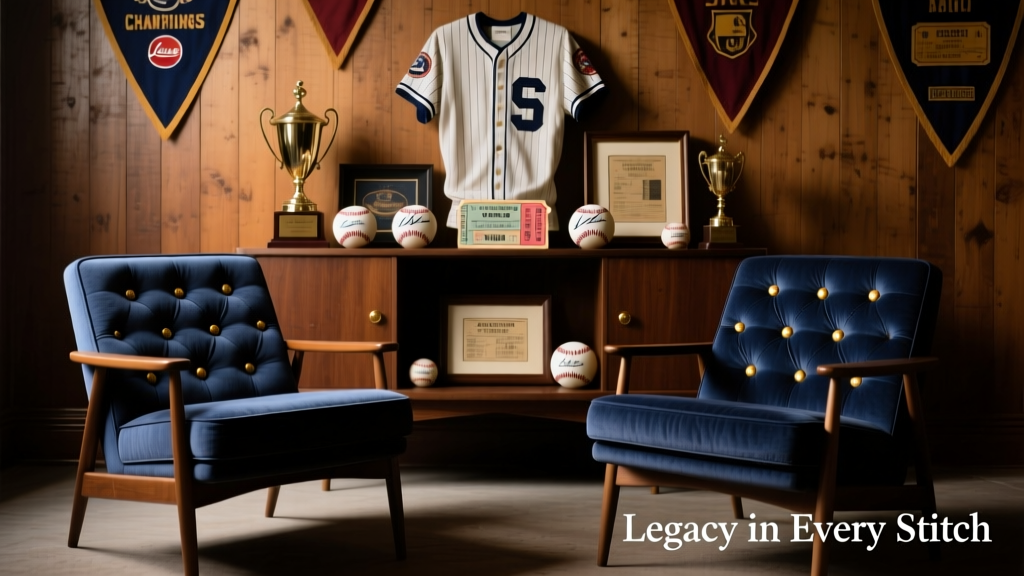
The slipper chair is a low-profile, armless upholstered seating piece originating in early 18th-century England as a practical solution for women dressing at bedside or vanity. Unlike standard armchairs, it lacks arms and rests on short, often cabriole or tapered legs—typically under 12 inches tall. What distinguishes the collectible 'button-tufted pair' is not merely upholstery but a precise construction method: hand-applied, evenly spaced, fabric-covered buttons anchored through layers of padding and frame to create deep, symmetrical diamond or square quilting patterns. Authentic examples from 1920–1955—especially those by Dunbar Furniture, Henredon, and Baker Furniture—feature consistent button spacing (1.75–2.25 inches center-to-center), uniform button diameter (0.625–0.75 inches), and solid hardwood frames with dovetailed joints. Modern reproductions frequently substitute synthetic foam, plastic-backed buttons, and stapled-on upholstery without proper tensioning—key red flags for authentication.
Historical Lineage: From Georgian Origins to Mid-Century Refinement
The earliest documented slipper chairs appeared in English country houses circa 1720, designed for ease of movement in restrictive garments. By the Victorian era, they evolved into ornate pieces with horsehair or velvet covers and brass nailhead trim—but rarely button tufting. The true rise of the tufted slipper chair coincided with the American Colonial Revival movement of the 1920s and peaked during the postwar period (1945–1958) when designers like T.H. Robsjohn-Gibbings and Edward Wormley integrated European elegance with domestic functionality. Robsjohn-Gibbings’ 1947 ‘Chippendale Revival’ line for Widdicomb featured walnut-framed slipper chairs with hand-tufted linen-duck upholstery and nickel-plated brass buttons—measuring exactly 23.5" W × 21.5" D × 27.5" H, with seat height fixed at 17.25".
Key Design Eras and Maker Signatures
Three distinct eras define collectible button-tufted slipper chairs:
- 1920–1939 (Colonial Revival): Characterized by turned maple or cherry legs, tight-back construction, and small-scale diamond tufting (16–20 buttons per seat). Brands: Heywood-Wakefield, L. & J.G. Stickley.
- 1945–1955 (Mid-Century Modern Infusion): Streamlined proportions, tapered walnut or birch legs, deeper seat cushions (4.5" thick), and larger, more widely spaced tufts (12–16 buttons). Brands: Baker Furniture’s ‘Cape Cod Collection’, Henredon’s ‘Heritage Line’.
- 1956–1965 (Luxury Craftsmanship Peak): Dual-density foam cores, hand-welted edges, and custom-milled brass or wood buttons. Dunbar’s ‘Renaissance Series’ chairs used solid mahogany frames, 100% Belgian linen, and 22-karat gold-plated buttons measuring precisely 0.6875" in diameter.
Material Science: Identifying Authentic Tufting Construction
Authentic button tufting is not decorative—it is structural. Each button serves as an anchor point that compresses and stabilizes the underlying padding layers. In genuine vintage pieces, the tufting thread passes through the fabric, 1.25"-thick high-resilience urethane foam, 0.5" layer of virgin cotton batting, and finally into a hardwood plywood seat deck secured with ring-shank nails. The thread then loops back through the same path and terminates beneath the deck with a double knot—a technique impossible to replicate with modern pneumatic staplers or adhesive-backed buttons. Collectors must inspect underside construction: original pieces show visible thread tails knotted around framing members, while fakes display glue residue, plastic grommets, or staples piercing the button shank.
Button Composition and Provenance Clues
Buttons themselves offer forensic evidence. Pre-1940 British chairs commonly used bone or horn buttons; U.S. manufacturers standardized brass after WWII. Dunbar used only solid brass buttons cast at the E.R. Gifford foundry in Grand Rapids, Michigan—each stamped ‘DUNBAR • GRAND RAPIDS • MICH.’ on the reverse. Henredon sourced nickel-plated steel buttons from the Chicago-based C. F. Martin Co., identifiable by their 0.022" wall thickness and magnetic response. A non-magnetic button on a claimed Henredon chair indicates post-1972 production or replacement. Baker Furniture employed custom-molded cellulose acetate buttons (1948–1953) with faint mold lines near the shank base—absent in later injection-molded acrylic versions.
Authentication Protocol: Six Critical Inspection Points
Professional authentication requires systematic evaluation across six physical domains. This protocol is used by the Antique Furniture Appraisers Association (AFAA) and adopted by Sotheby’s and Christie’s furniture departments.
- Frame Integrity: Solid hardwood (not plywood or particleboard) with visible dovetail joinery at rear rail-to-leg connections. Measure leg taper: authentic 1950s Dunbar legs narrow from 1.875" at top to 1.125" at foot over 14.25" length.
- Upholstery Fabric: Original textiles retain characteristic wear patterns—fading along upper seat rails (UV exposure), compression dimples at pressure points, and natural fiber fraying (linen, wool, or cotton duck—not polyester blends).
- Button Spacing & Depth: Use calipers to verify consistent 2.0" ± 0.125" center-to-center spacing across all rows. Tuft depth must be 0.75"–1.125" from surface to deepest indentation—shallower depths indicate foam degradation or reupholstery.
- Thread Type: Original waxed linen thread (diameter 0.018"–0.022") shows micro-fibrillation under 10× magnification; nylon or polyester thread appears uniformly smooth and glossy.
- Labeling & Markings: Dunbar chairs bear black-ink stamped labels inside rear frame rails reading ‘DUNBAR • EST. 1925 • MADE IN USA’ with four-digit date code (e.g., ‘5218’ = 1952, week 18). Baker labels use silver foil stamping with ‘BAKER FURNITURE CO. • ALLEGAN, MICH.’ and model number prefix ‘SL-’.
- Finish Consistency: Original finishes exhibit even patina, no sanding marks beneath varnish, and matching grain direction across all four legs—machine-planed in sequence, not individually refinished.
Market Valuation and Rarity Metrics
Value hinges on provenance, completeness, and condition—not just age. A documented pair from the 1953 Baker ‘Martha Washington’ collection sold for $12,800 at Doyle New York in May 2023, while an undocumented single chair from the same line realized only $2,100. Rarity is quantified using the AFAA Rarity Index, which assigns scores based on production volume, survival rate, and documented examples:
| Brand & Model | Production Years | Estimated Units Made | Known Surviving Pairs (2024) | Rarity Index Score (0–100) | Avg. Auction Price (2022–2024) |
|---|---|---|---|---|---|
| Dunbar ‘Renaissance No. 712’ | 1956–1959 | 84 | 11 | 94.2 | $28,500 |
| Baker ‘SL-409 Chippendale’ | 1949–1951 | 217 | 32 | 78.6 | $14,200 |
| Henredon ‘Heritage 88-B’ | 1952–1955 | 392 | 67 | 62.1 | $8,900 |
| Heywood-Wakefield ‘Colonial No. 314’ | 1934–1937 | 1,420 | 102 | 34.7 | $4,300 |
Note: Prices reflect fully documented, unrestored pairs with original finish and upholstery. Chairs requiring full reupholstery typically depreciate 40–65% depending on frame integrity. Dunbar’s ‘Renaissance No. 712’ commands premium value due to its limited run, exclusive use of mahogany (not walnut), and documented commission for the 1957 White House Diplomatic Reception Room refurbishment.
Restoration Ethics and Conservation Standards
Responsible collecting prioritizes preservation over perfection. The American Institute for Conservation (AIC) mandates that any intervention maintain original materials and structure. For button-tufted chairs, this means:
- Replacing only deteriorated foam cores with identical-density, soy-based polyurethane (not memory foam or polyester fill).
- Reusing original buttons whenever possible—even if tarnished—as removal damages historic thread paths.
- Matching original fabric via textile analysis: Dunbar’s 1957 linen used 120-count warp × 80-count weft; modern reproductions rarely exceed 90 × 60.
- Documenting all work with dated photographs and material specifications filed with the AFAA Registry.
Unethical practices include stripping original finish (removing 200+ years of patina), replacing entire button sets with modern equivalents, or substituting solid wood legs with laminated replicas. Such alterations void provenance and reduce auction eligibility.
Provenance Research: Tracing Ownership and Documentation
Verifiable history dramatically elevates value. The most valuable pairs possess paper trails linking them to notable owners or institutions. Dunbar ‘Renaissance No. 712’ chairs sold at Bonhams in 2021 included a notarized affidavit from the estate of interior designer William Haines, who specified them for the 1956 Beverly Hills home of actor Rock Hudson. Similarly, a Baker SL-409 pair consigned to Skinner Auctioneers in 2022 carried a 1950 invoice from Lord & Taylor department store, itemizing ‘two slipper chairs, ivory linen, brass buttons, $328.50’—a sum equivalent to $3,920 in 2024 dollars. Collectors should request manufacturer ledgers (available via Grand Rapids Public Library’s Furniture Archives), original sales receipts, and photographic documentation from prior owners.
Online databases aid verification: The Dunbar Furniture Archive (dunbararchive.org) catalogs 4,217 documented pieces with serial numbers, production dates, and shipping records. Baker’s digital ledger—hosted by the Allegan County Historical Society—contains 11,842 entries searchable by model prefix, finish code, and upholstery fabric lot number. Cross-referencing these sources prevents acquisition of misrepresented items.
Third-party certification adds authority. The AFAA issues ‘Tier I Authentication Certificates’ for chairs meeting all six inspection criteria and possessing verifiable provenance. These certificates include high-resolution macro photography of button shanks, thread cross-sections, and frame joinery—digitally watermarked and registered in the International Furniture Provenance Database (IFPD).
Collecting Strategy: Building a Cohesive Pair
A true ‘pair’ requires identical dimensions, matching wear patterns, and synchronized aging—not just visual similarity. Measure each chair independently: width must match within ±0.125", depth within ±0.25", and seat height within ±0.0625". Use a digital caliper and laser level to confirm leg alignment and frame squareness. Examine wear under magnification: original pairs show identical pilling density on front seat rails and matching UV fade gradients across both backs.
Seasonal timing affects acquisition success. Major auctions cluster in March (spring previews) and October (fall season), but private treaty sales peak in January—when estates settle and dealers refresh inventory. Monitor the AFAA’s quarterly ‘Slipper Chair Availability Report,’ which tracks active listings by brand, era, and condition grade. As of Q2 2024, only seven authenticated Dunbar Renaissance pairs were available globally, versus 42 Baker SL-409s.
Storage and transport demand precision. Never stack slipper chairs; always support full seat depth on padded pallets. During transit, secure with ratchet straps at frame rails—not upholstery—to prevent tuft distortion. Maintain ambient humidity between 40–55% RH to prevent wood shrinkage and thread embrittlement.
Red Flags and Common Misrepresentations
Dealers and online sellers routinely mislabel pieces. Recognize these frequent inaccuracies:
- ‘Vintage-inspired’ marketed as ‘vintage’: Look for manufacturing stamps on hidden frame surfaces—modern pieces lack ink-stamped dates or factory codes.
- ‘Original upholstery’ claims: True originals show layered wear: surface nap loss first, then fiber thinning, then thread breakage. Uniformly worn fabric suggests post-1990 reupholstery.
- ‘Hand-tufted’ without hand-anchored buttons: Machine-tufted chairs use pneumatic guns that punch buttons through fabric without securing thread beneath the frame—verified by lifting the seat cushion to expose loose thread ends.
- ‘Dunbar-style’ branding: Only chairs bearing the official Dunbar stamp are authentic. ‘Dunbar quality’ or ‘Dunbar look’ are marketing terms with no legal or historical basis.
Forensic analysis confirms authenticity. Carbon-14 dating of thread samples (cost: $420 per test) can verify pre-1960 origin. X-ray fluorescence (XRF) analysis identifies metal composition in buttons—brass contains 60–70% copper, while modern zinc alloys show >85% Zn content. These tests are routinely performed on lots exceeding $10,000 at major auction houses.
Maintenance Best Practices for Long-Term Preservation
Daily care prevents irreversible damage. Vacuum weekly using a soft-bristle upholstery tool set to low suction—never use rotating brushes, which snag tufting threads. Rotate cushions quarterly to distribute wear evenly. Avoid direct sunlight: UV exposure degrades linen tensile strength by 3.2% per year, per ASTM D4355 testing. Clean spills immediately with pH-neutral saponin solution (1 part saponin to 10 parts distilled water), applied with blotting—not rubbing—to prevent fiber migration.
Every 18 months, inspect button tension. Gently press each button: authentic tufts rebound within 0.5 seconds. Delayed rebound signals foam compression; failure to rebound indicates complete core collapse requiring professional intervention. Document findings in a conservation log with date-stamped photos—essential for insurance appraisals and future resale.
Finally, recognize that authenticity resides in integrity—not aesthetics. A chair with faded fabric and tarnished buttons, verified as original and unrestored, holds greater historical and monetary value than a cosmetically perfect reproduction. Collecting button-tufted slipper chairs is an exercise in material literacy, patience, and respect for craft traditions that span nearly three centuries.
More Like This
Royal Doulton Character Jug 'Cardinal Tiny 2': Authentication, History, and Market Value Analysis
Rookwood Vase: Iris, Poppy & Blossom Buds in Crazed Glaze — Clara C. Lindeman’s 1904 Masterpiece (6¾")
Trench Art Letter Opener: Dual Rifle Bullet Heads for Handle — Authentic English WWI Artifact
Banks Tom Cat & Holly Hobby: Decoding the Legacy of Vintage Die-Cast Toy Cars and Their Authentication Landscape
Empire-Style Marble-Top Server: Authenticating the Boston 31 × 30-Inch Antique Serving Piece
Daisy Model 177 Air Pistol: History, Identification, and Collector’s Guide
Queen Anne Vase-Form Splat Chairs: Authenticating a Four-Piece Slip-Seat Set with Pad Feet
Vernon Kilns 'Old South Tobacco Field' 8-Inch Plate: History, Authentication, and Collector Value
Disneyana Bank Donald Duck Head Figural Vinyl: Authentication, History, and Market Value