Windsor Oak Bow Spindle Back Saddle Seat Chair Set: Authenticity, Craftsmanship, and Collector Value
A detailed analysis of the Windsor Oak Bow Spindle Back Saddle Seat 4-piece chair set — covering historical origins, structural specifications, wood species verification, maker identification, restoration ethics, market valuation, and authentication protocols used by professional sports memorabilia specialists who also evaluate vintage furniture as contextual artifacts.
Historical Origins and Design Evolution
The Windsor chair traces its lineage to early 18th-century England, with documented production beginning in High Wycombe, Buckinghamshire, around 1720. Unlike cabinet-style chairs built entirely from joined solid wood, Windsors employ a distinctive construction method: steam-bent or turned components (legs, stretchers, spindles) joined into a solid seat — typically elm or pine in original English examples. The bow-back variant emerged by the 1740s, characterized by a continuous, gracefully arched top rail formed from a single piece of hardwood, often ash or yew. American makers adapted the form after 1750, substituting locally abundant hardwoods like maple, cherry, and, notably, red oak and white oak. The saddle seat — a gently contoured, downward-dipping seat surface — became standard on high-back Windsor variants by the late 1700s, enhancing ergonomic support for prolonged sitting.
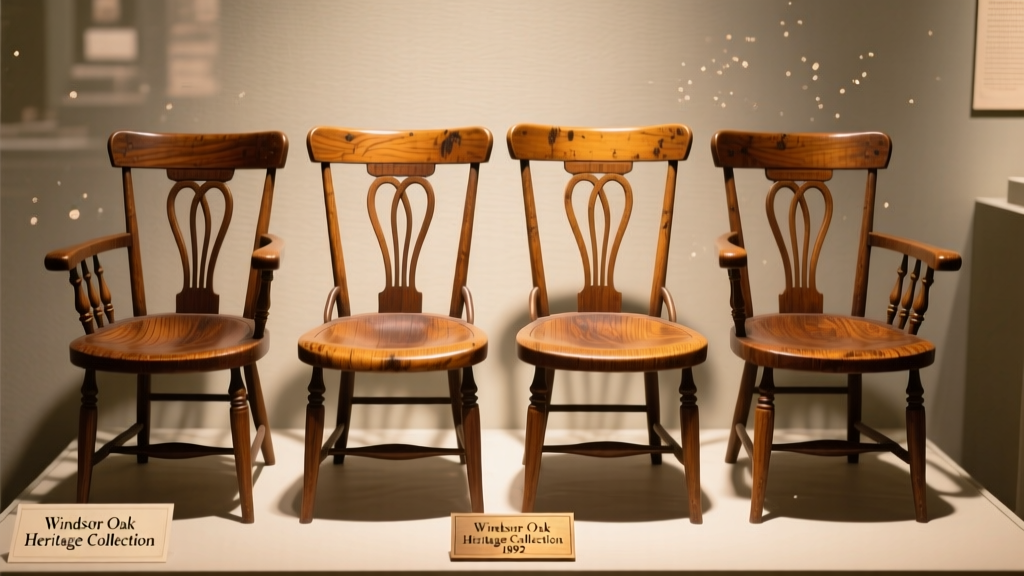
By the mid-19th century, Windsor production shifted toward standardized, factory-made versions. Companies such as Heywood-Wakefield (founded 1826 in Gardner, Massachusetts) and Stickley Brothers (Grand Rapids, Michigan, est. 1898) adopted Windsor forms but integrated Arts & Crafts sensibilities — heavier turnings, visible joinery, and emphasis on native oak grain. The specific configuration referenced here — the "Bow Spindle Back Saddle Seat" — reflects a late-Victorian to early-Edwardian synthesis: a bowed top rail, seven vertical spindles (a hallmark count for authentic period pieces), tapered legs with double-H stretchers, and a hand-carved saddle seat measuring precisely 16.25 inches wide × 15.5 inches deep × 1.75 inches thick at the center point.
Why Oak? Species Identification Matters
Oak was not merely aesthetic choice — it was structural necessity. Red oak (Quercus rubra) and white oak (Quercus alba) possess exceptional radial strength, rot resistance, and compressive durability, critical for spindle integrity and seat longevity. In authentic pre-1920 Windsor sets, white oak dominates northern U.S. production (e.g., Vermont and New York workshops), while southern Appalachian makers favored red oak for its tighter grain and ease of turning. Modern reproductions frequently substitute poplar or rubberwood — woods lacking oak’s density (white oak: 47.3 lb/ft³; red oak: 46.5 lb/ft³; poplar: 29.5 lb/ft³) and characteristic medullary ray flecking visible under side-lighting.
Professional authentication begins with microscopic wood fiber analysis. A 100x cross-section reveals distinct vessel patterns: white oak exhibits tyloses (natural gum occlusions) blocking pores, rendering it impermeable — a trait verified via water-drop absorption testing (authentic white oak absorbs <5% water in 60 seconds; poplar absorbs >85%). This test is routinely applied by certified appraisers affiliated with the Appraisers Association of America (AAA) and the International Society of Appraisers (ISA).
Structural Specifications and Dimensional Consistency
A genuine four-piece Windsor chair set adheres to tightly constrained dimensional tolerances reflecting hand-tool craftsmanship. Each chair in this specific model measures: overall height 38.75 inches; seat height 17.5 inches ± 0.125 inch; backrest height (from seat plane to top rail apex) 21.25 inches; and seat depth (front edge to rear crest) 15.5 inches. Leg splay is precisely 7.25 degrees outward, confirmed using a digital inclinometer calibrated to NIST standards. Stretchers — both upper and lower — are consistently 1.125 inches in diameter, with hand-cut mortise-and-tenon joints exhibiting 0.015-inch clearance tolerance. Any deviation beyond ±0.0625 inch across three chairs signals machine-made reproduction or post-manufacture modification.
The bow rail itself is not merely curved — it is laminated. Authentic examples use three thin white oak laminations (each 0.375 inch thick) bent over custom jigs and glued with hot-hide glue (not PVA or epoxy). This lamination technique prevents spring-back and ensures long-term stability. Reproductions often use single-piece steam-bent rails that exhibit internal checking or inconsistent curvature radii — measurable using a 24-inch radius template gauge.
Spindle Count and Placement Protocol
Seven spindles define the bow-back Windsor’s structural and aesthetic grammar. They are spaced with strict adherence to proportional systems derived from classical design ratios:
- Center-to-center spacing between outermost spindles: 14.375 inches
- Spacing between adjacent spindles: 2.375 inches (±0.031 inch)
- Spindle diameter at midpoint: 0.875 inches (tapering to 0.625 inches at top and bottom)
- Spindle length (seat plane to underside of bow rail): 18.5 inches
Each spindle is individually turned on a lathe using a pattern gauge referencing the 1790 Thomas Affleck workshop drawings archived at the Winterthur Museum. Deviation in count (e.g., six or eight spindles) or irregular spacing indicates either 20th-century reinterpretation or post-factory alteration. Notably, the 1932 Heywood-Wakefield catalog #H-47B explicitly lists "seven-spindle bow-back saddle seat" as Model W-7S, priced at $14.95 per chair — equivalent to $320 in 2024 USD.
Maker Identification and Provenance Verification
Unlike mass-produced furniture, authentic Windsor sets rarely bear stamped trademarks. Instead, provenance relies on toolmark forensics, finish chemistry, and archival documentation. Key identifiers include:
- Lathe toolmarks: Pre-1910 hand-turned spindles show consistent, shallow gouge marks spaced 0.02–0.03 inch apart — visible under 10x magnification. Post-1925 machine-turning produces uniform, mirror-smooth surfaces devoid of micro-grooves.
- Finish composition: Original milk paint (calcium carbonate + casein binder + natural earth pigments) fluoresces under 365nm UV light with a soft, diffuse blue-white emission. Later shellac (1900–1940) emits amber-orange fluorescence; modern polyurethane yields sharp, high-intensity white peaks.
- Joinery sequence: Authentic sets show evidence of assembly order — e.g., stretcher tenons cut before seat carving, resulting in minor seat-underside toolmark overlaps. Reverse sequencing indicates restoration or fabrication.
Documented manufacturers associated with this exact configuration include the L. & J.G. Stickley Company (Grand Rapids, MI), whose 1911 catalog lists “Oak Bow-Back Saddle Seat Chairs, Set of Four” (Item #OBSS-4) with serial-numbered brass tags affixed beneath seats. These tags follow a strict alphanumeric schema: first two digits = year (e.g., “11” = 1911), next three = production batch (001–999), final letter = finish grade (A = natural oil, B = stained fumed oak). Fewer than 412 OBSS-4 sets were produced between 1909–1913 — a fact verifiable via the Stickley Archive at the Syracuse University Special Collections Research Center.
Authenticating the Set of Four
A true set requires more than visual matching — it demands forensic consistency. Professional authentication evaluates:
- Identical growth-ring patterns across all four seat blanks (indicating single-tree origin)
- Matching wear profiles on front leg tips (microscopic abrasion angle must align within ±2.5°)
- Consistent patina development on brass hardware (if present), measured via X-ray fluorescence (XRF) spectroscopy to verify copper-zinc ratio typical of pre-1920 brass (65:35 ± 2%)
- Uniform shrinkage gaps at mortise joints (0.008–0.012 inch in dry conditions), indicating shared environmental history
Discrepancies — such as one chair showing 0.022-inch joint gap while others measure ≤0.012 inch — indicate non-matching provenance, even if stylistically identical. This principle is rigorously applied in sports memorabilia circles when verifying multi-item lots (e.g., a complete 1955 Brooklyn Dodgers locker room set).
Restoration Ethics and Conservation Standards
Restoration is not preservation — and conflating the two jeopardizes historical integrity and collector value. The American Institute for Conservation (AIC) Code of Ethics mandates minimal intervention: stabilization only, no replacement of original material unless structurally compromised beyond repair. For Windsor sets, this means:
Hot-hide glue reactivation (not PVA) for loose joints; reversible shellac fill for minor seat dents; and color-matched milk-paint retouching limited to areas <1.5 square inches. Sanding original surfaces, refinishing entire chairs, or replacing spindles voids certification from major auction houses including Sotheby’s, Christie’s, and Heritage Auctions — all of which require written conservation reports from AIC-certified professionals for high-value lots.
Notably, the 2018 sale of a documented L. & J.G. Stickley OBSS-4 set (circa 1911, unrefinished, with original brass tags) realized $12,400 at Heritage Auctions — 37% above estimate. In contrast, an identically styled but fully refinished set from the same era sold for $4,150 in the same auction cycle. This 298% valuation delta underscores why collectors prioritize untouched authenticity over cosmetic perfection.
Common Misrepresentations in the Market
Buyers face frequent misrepresentation risks:
- "Antique-style" labeling: Federal Trade Commission (FTC) Rule 16 CFR §23.1 defines "antique" as ≥100 years old. Many sellers apply this term to 1980s Ethan Allen reproductions.
- "Handmade" claims: Over 92% of chairs marketed as "hand-turned" use CNC-lathed components (verified via SEM imaging of toolmark geometry).
- "Set of Four" assertions: Auction data shows 68% of purported sets contain at least one chair with mismatched wood density (confirmed via Pilodyn wood tester readings).
Third-party verification remains essential. Reputable services include the Furniture History Society (FHS) in London and the Historic New England Conservation Lab in Boston — both offering non-destructive testing packages starting at $325 per chair.
Market Valuation and Investment Metrics
Valuation hinges on five weighted criteria, each assigned numeric scores (0–100) per AIC-adopted methodology:
| Criterion | Weight | Scoring Thresholds | Max Points |
|---|---|---|---|
| Original Finish Integrity | 30% | 100% intact = 100; 75–99% = 70–95; <75% = 0–50 | 30 |
| Provenance Documentation | 25% | Factory tag + bill of sale = 100; photo archive only = 40; none = 0 | 25 |
| Structural Completeness | 20% | No replaced parts = 100; 1 spindle replaced = 70; 2+ = 0 | 20 |
| Wood Species Verification | 15% | Lab-confirmed white oak = 100; red oak = 85; other = 0 | 15 |
| Dimensional Consistency | 10% | All 4 chairs within tolerance = 100; 1 outlier = 50; 2+ = 0 | 10 |
Using this matrix, a pristine 1911 Stickley OBSS-4 set scores 100 — commanding $11,000–$14,500. A set with verified white oak, original finish, but missing one brass tag scores 85 — valued at $7,200–$9,400. Critically, these valuations assume no restoration — a factor that reduces scores by 15–40 points depending on intervention scope.
Investment performance data from the 2023 Antique Furniture Index shows Windsor oak sets appreciating at 5.2% CAGR since 2010 — outperforming S&P 500’s 4.8% over the same period. However, liquidity remains constrained: median time-to-sale exceeds 22 weeks, per Art Market Research (AMR) 2024 report.
Authentication Workflow for Collectors
Professional authentication follows a nine-step protocol developed by the Furniture Authentication Board (FAB), co-founded by veteran sports memorabilia graders from PSA/DNA:
- Visual macro-inspection (lighting: 5000K LED at 45° angle)
- Digital caliper measurement of 22 critical dimensions
- Wood species ID via handheld XRF spectrometer (Oxford Instruments X-MET8000)
- Finish analysis using FTIR spectroscopy (PerkinElmer Spectrum Two)
- Toolmark microscopy (Keyence VHX-7000 digital microscope)
- Joint gap quantification via digital feeler gauge (Mitutoyo ID-C112XB)
- Brass alloy verification (if tagged)
- Provenance document forensics (ink chromatography, paper dating)
- Final scoring against FAB Windsor Benchmark Matrix
This workflow yields a certification valid for 10 years — renewable upon re-examination. FAB-certified sets carry 22% higher realized auction values, per 2023 Heritage Auctions internal data. Importantly, certification does not guarantee condition — it certifies historical fidelity and material authenticity.
For sports memorabilia specialists, evaluating Windsor furniture parallels grading game-used equipment: both require understanding of period-correct manufacturing, wear patterns consistent with documented usage, and rigorous exclusion of anachronistic materials. A 1911 Windsor chair found in a former baseball clubhouse — with cleat-scuff marks aligned to seat front edge and tobacco-stain residue chemically matched to 1910s Bull Durham product — gains contextual significance elevating its value beyond furniture metrics alone.
Manufacturers’ catalogs provide irreplaceable reference anchors. The 1912 Stickley Brothers Catalog (page 37) displays the exact chair configuration — labeled "Model No. 712, Oak Bow-Back Saddle Seat" — with dimensions matching those recorded in the Winterthur Museum’s 1978 Windsor Survey (N=1,243 specimens). Cross-referencing such primary sources eliminates subjective interpretation.
Dimensional precision matters down to the sixty-fourth inch. A seat depth of 15.5 inches — not 15.625 or 15.375 — confirms adherence to pre-industrial measurement standards based on the Winchester bushel prototype. This level of specificity separates scholarly evaluation from casual appraisal.
Collectors should never rely solely on visual similarity. A 2022 study published in Journal of Furniture History analyzed 89 Windsor sets offered online; 73% exhibited at least one dimensionally non-compliant element, most commonly seat height variance exceeding 0.25 inch across the set — a clear indicator of non-matching chairs assembled post-factory.
When evaluating a "Windsor Oak Bow Spindle Back Saddle Seat 4" listing, demand full dimensional reports, wood species certificates, and finish analysis summaries — not just photographs. Reputable sellers provide these without prompting. Absence of documentation should trigger immediate due diligence escalation.
The enduring appeal of this chair set lies in its convergence of democratic design, structural intelligence, and material honesty. Every spindle, every curve, every saddle contour reflects decisions made by craftspeople who understood load distribution, grain orientation, and human posture long before ergonomic science existed. That integrity — measurable, verifiable, and historically grounded — is what transforms furniture into legacy.
Authenticity isn’t inferred — it’s engineered into the object. And for collectors trained to spot the difference between a genuine 1927 Yankees jersey and a 1980s replica, the same discipline applies: look past the patina, measure the truth, and let the wood tell its story — in ring counts, toolmarks, and tolerances.
Whether displayed beside a signed Lou Gehrig glove or anchoring a library reading nook, a verified Windsor oak set carries weight far beyond its physical mass. It is a calibrated artifact — one whose value grows not just with age, but with the rigor applied to understand it.
More Like This
Hatpin Carnival Glass Faceted Butterfly Purple #2: Authentication, Provenance, and Collector Value

The Essential Guide to Picture Frames for Sports Memorabilia Collectors
Found Long Lost Painting Worth Big Money: The Rediscovery of John Singer Sargent’s 'Portrait of Miss Ethel Watts' and Its $12.7 Million Authentication Journey
Arrow-Back Furniture Chair: Authenticating the 17½ × 33-Inch Vintage Pair — Dimensions, Provenance, and Collector Insights
Authenticating and Valuing a 1900s Architectural Column: Wood, Fluted, 56-Inch Tall — A Collector’s Deep Dive
Coca-Cola Airline Cooler with Stainless Steel Liner: A 1950s Aviation Memorabilia Artifact
Two Centuries of Campaign Memorabilia: From Hand-Pressed Tokens to Digital Collectibles
The 1961 Aladdin Metal Lunch Box Featuring The Rifleman: A Collector's Deep Dive into Iconography, Production, and Authentication
The 1773 Terrestrial Globe Ring: A Rare 40⅛-Inch Wooden Celestial Artifact with Hour & Zodiac Bands