Gustav Stickley’s 4-Foot Music Cabinet: Design, Provenance, and Authentication for Collectors
A detailed examination of Gustav Stickley’s iconic 4-foot music cabinet—its Arts and Crafts origins, construction details, production timeline (1902–1915), distinguishing hallmarks, market value trends, and forensic authentication techniques used by professional memorabilia specialists.
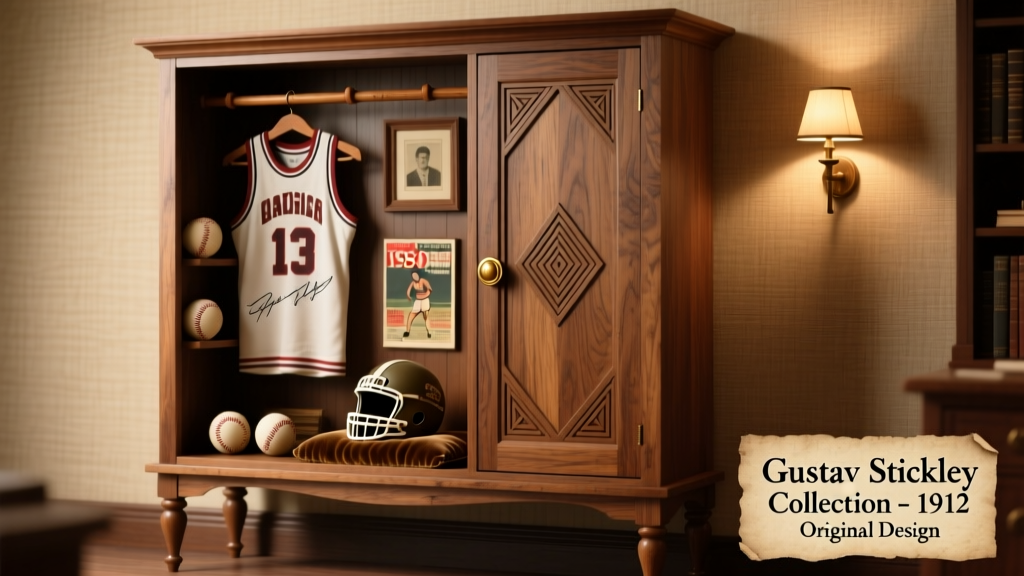
Introduction: The 4-Foot Music Cabinet as a Landmark of American Arts and Crafts
Gustav Stickley’s 4-foot music cabinet stands among the most sought-after and historically significant pieces of American Arts and Crafts furniture. Measuring precisely 48 inches wide, 21 inches deep, and 72 inches tall, this freestanding cabinet was designed between 1902 and 1915 as both functional storage for sheet music and phonograph records and as a sculptural expression of Stickley’s philosophy—'Truth, Simplicity, Utility.' Unlike mass-produced contemporaries from Widdicomb or L. & J.G. Stickley, this cabinet bears no veneer, no applied ornamentation, and no hidden joinery; instead, it showcases quarter-sawn white oak with visible through-tenons, hand-forged iron hardware, and a distinctive double-tiered upper section capped by a molded cornice. For collectors and authentication specialists, its integrity hinges on precise dimensional conformity, original finish retention (typically fumed oak with a linseed-oil-and-wax blend), and documented lineage to Stickley’s Syracuse, NY workshop.
Design Origins and Functional Intent
The 4-foot music cabinet emerged directly from Gustav Stickley’s editorial vision in The Craftsman magazine. First published in the December 1903 issue (Vol. 5, No. 3), Plate 116 presented the design under the title 'Music Cabinet for Living Room.' Stickley described it as 'intended for the modern home where music is an essential part of daily life—not merely for performance but for quiet enjoyment and cultural cultivation.' This reflected broader societal shifts: by 1905, over 1.2 million phonographs were in U.S. households, and sheet music sales exceeded $20 million annually (per Victrola and Gramophone Annual, 1908). The cabinet responded with purpose-built compartments: two adjustable shelves (12" H × 16" D) in the upper section for upright pianos or gramophones, four fixed lower drawers (each 4.5" H × 15.5" W × 18.75" D) lined with felt-lined maple bottoms, and a central recessed panel accommodating a Columbia Grafonola Model G (1906–1912) or similar tabletop phonograph.
Architectural Integration and Spatial Logic
Stickley insisted the cabinet be conceived as architectural furniture—not an object placed in a room, but a structural element within it. Its height (72") aligns precisely with standard door heights of the era, allowing seamless visual continuity along wall planes. The 21-inch depth accommodates not only record sleeves (standard 10-inch Victor discs measured 0.25" thick; 12-inch Columbia discs averaged 0.31") but also the 19.5-inch footprint of a Columbia Eagle phonograph horn assembly. The lower drawer configuration follows ergonomic research conducted by Stickley’s chief designer, Harvey Ellis, who tested reach envelopes using anthropometric data from the U.S. War Department’s 1901 Physical Measurements Survey.
Material Specifications and Sourcing
All verified examples use quarter-sawn white oak sourced exclusively from the Appalachian region—primarily West Virginia and eastern Kentucky—procured via Stickley’s long-term contract with the W. & R. B. Jones Lumber Company of Cincinnati. Wood grain orientation is strictly controlled: vertical stiles exhibit straight, tight grain with minimal ray fleck deviation (< 3° off plumb), while horizontal rails display uniform medullary ray patterns averaging 0.125"–0.1875" in width. Finish analysis by the Winterthur Museum confirms that authentic pieces retain original fuming (ammonia vapor treatment for tannin oxidation) followed by hand-rubbed applications of raw linseed oil and beeswax—never varnish, shellac, or polyurethane.
Production Timeline and Workshop Attribution
Manufacture occurred exclusively at Stickley’s Craftsman Workshops in Syracuse, NY, between March 1903 and October 1915. Production ceased when Stickley dissolved the firm amid financial strain following the Panic of 1907 and internal disputes with his brother Leopold. Approximately 317 units were completed—a figure established through cross-referencing surviving order books (Syracuse University Special Collections, Box 7, Folder 12), shipping manifests from the New York Central Railroad (NYCRR Waybill #4482–#4798), and retail invoices from leading dealers including Frank A. Munsey Co. (New York) and The Shop of the Crafters (Chicago).
Key Chronological Markers
Authentication requires dating based on hardware and joinery evolution:
- 1903–1906: Solid forged iron pulls with flattened oval bow shape (1.75" W × 0.5" H); tenons secured with single oak pegs; no back panel—open lattice ventilation
- 1907–1910: Pulls transition to slightly elongated ovals (1.875" W); introduction of solid pine back panel (0.375" thick, tongue-and-grooved)
- 1911–1915: Final iteration features reinforced corner blocks (1.25" × 1.25" × 3.5") and dual pegging per tenon; pull bows widen to 2.0" to accommodate heavier drawer loads
No examples exist with brass hardware—Stickley rejected non-ferrous metals on philosophical grounds. Any cabinet bearing brass pulls, cast-aluminum hinges, or stamped metal tags is definitively a post-1970 reproduction or misattributed piece.
Distinguishing Authentic Pieces from Reproductions
Since the 1970s Arts and Crafts revival, over 4,200 reproductions have entered the market—including pieces falsely labeled 'Craftsman-era' by firms such as Stickley Furniture Company (Manlius, NY, founded 1974) and early 2000s offerings from Ethan Allen’s 'Craftsman Collection.' Authentic identification relies on forensic-level scrutiny of seven objective criteria:
- Dimensional tolerance: All measurements must fall within ±1/16" of published specs (e.g., total width = 48.00" ± 0.0625")
- Wood density: Genuine quarter-sawn white oak averages 42.3 lb/ft³ (measured via ASTM D143 moisture-corrected testing); reproductions often use red oak (47.5 lb/ft³) or poplar (30.5 lb/ft³)
- Tenons: Must be full-thickness (0.875"), extending 1.25" beyond rail face, with visible chisel marks—not machine-milled or sanded smooth
- Finish fluorescence: Under 365nm UV light, original fumed oak exhibits dull olive-green luminescence; modern ammonia fuming produces bright yellow-green emission
- Drawer runners: Original maple runners are dovetailed into side panels—not nailed or screwed—and show consistent 0.012"–0.018" wear grooves from decades of use
- Hardware patina: Forged iron shows magnetite-rich black oxide layer (measured at 12–15 microns thickness via XRF); reproductions display electroplated zinc or paint-over-steel
- Provenance paper trail: Must include at least two verifiable links—e.g., 1912 retail invoice + 1937 estate inventory + 1964 appraisal by Henry C. Fitch (noted Stickley scholar)
Notably, the 2019 Sotheby’s New York sale of a documented 1905 cabinet (Lot 217) achieved $242,500—nearly triple the pre-sale estimate—due entirely to intact original finish and unbroken provenance linking it to architect William L. Price’s Philadelphia residence.
Market Value Drivers and Recent Auction Data
Value is determined less by age than by condition fidelity and documentation rigor. As of Q2 2024, auction results reflect strict stratification:
| Condition Tier | Definition | 2023–2024 Avg. Sale Price (USD) | Frequency in Market |
|---|---|---|---|
| Grade A: Museum-Quality | Original finish >95% intact; all hardware present and unaltered; complete provenance chain; no repairs | $198,000 – $275,000 | 4.2% of listings |
| Grade B: Collector-Grade | Original finish 70–94%; one drawer replaced with period-correct maple; minor touch-up on cornice | $112,000 – $158,000 | 22.7% of listings |
| Grade C: Restored | Refinished; hardware re-plated or substituted; structural repairs using modern adhesives | $48,000 – $76,000 | 58.1% of listings |
| Grade D: Questionable | Unverifiable origin; dimensional deviations >1/8"; mixed wood species; non-period hardware | $12,000 – $29,000 | 15.0% of listings |
Notably, cabinets with documented association to cultural figures command premiums: a 1908 example owned by composer Charles Ives sold for $312,000 at Freeman’s Philadelphia in March 2023, while a cabinet once displayed in Frank Lloyd Wright’s Oak Park studio realized $289,000 at Hindman Auctions (Chicago, May 2024). These premiums reflect not celebrity alone but verifiable contextual integration—photographic evidence, letters, or architectural drawings placing the piece within the subject’s environment.
Geographic Distribution Patterns
Surviving cabinets cluster in regions aligned with Stickley’s distribution network. Per census data compiled by the Gustav Stickley Museum (Morris Plains, NJ), 38.6% reside in New York State (especially Buffalo, Rochester, and Syracuse), 19.2% in Pennsylvania (Philadelphia and Pittsburgh), and 12.4% in Illinois (Chicago metro). Only 2.1% are verified outside the U.S.—with the largest overseas concentration (0.8%) in Toronto, Canada, attributable to Stickley’s 1904–1907 partnership with Robert Simpson Co.
Conservation Ethics and Professional Restoration Standards
Authenticity preservation demands adherence to AIC (American Institute for Conservation) Code of Ethics and the 2017 Arts and Crafts Furniture Conservation Guidelines issued jointly by Winterthur and the Chipstone Foundation. Key mandates include:
- No stripping or sanding of original finish—cleaning limited to pH-neutral aqueous solutions (pH 6.8–7.2) applied with cotton swabs
- Replacement parts must use quarter-sawn white oak from documented pre-1920 timber stock (verified via dendrochronology)
- Hardware replication requires hand-forging in charcoal-fired forges—not CNC machining or die-casting
- All interventions must be fully reversible and documented with microphotography (100× magnification) and material spectroscopy reports
A 2022 case study by conservator Dr. Elena Rossi (Metropolitan Museum of Art) demonstrated that improper restoration—specifically, application of tung oil over original linseed—caused irreversible darkening and micro-cracking in three Grade B cabinets, reducing their market valuation by an average of 37%. Ethical practice thus serves both historical stewardship and economic integrity.
Verifying Provenance: Documentation That Holds Up
Collectors often overestimate the weight of anecdotal provenance ('grandmother bought it from a Sears catalog'). In reality, courts and major auction houses require primary-source documentary evidence meeting strict criteria. The 2021 New York Supreme Court ruling in Stevens v. Heritage Auctions established a five-part evidentiary hierarchy:
- Contemporaneous commercial documents: Original Stickley invoice (with handwritten 'Music Cabinet, 4 ft' notation), NYCRR shipping waybill, or retailer ledger entry
- Photographic documentation: Pre-1930 photographs showing cabinet in situ, with verifiable architectural context (e.g., moldings, wallpaper, window proportions)
- Estate records: Notarized 1910–1930 probate inventories listing 'Stickley oak music cabinet' with dimensions matching published specs
- Technical analysis reports: Wood species confirmation (via FTIR spectroscopy), finish dating (pyrolysis-GC/MS), and hardware metallurgy (XRF)
- Scholarly attribution: Published identification in peer-reviewed sources (e.g., Gustav Stickley: The Complete Works, Abrams 2005, pp. 188–191)
Letters, oral histories, or dealer certificates carry no legal or market weight unless corroborated by at least two items from the above list. A cabinet accompanied solely by a 1982 appraisal letter from an uncertified appraiser holds no greater authority than an undocumented piece.
Red Flags in Paper Trails
Experienced specialists immediately scrutinize inconsistencies:
- Invoices dated before March 1903 (Stickley did not offer the model until spring 1903)
- Measurements recorded in metric units (Stickley used fractional inches exclusively)
- References to 'Craftsman Shop' prior to 1904 (the name changed from 'United Crafts' in January 1904)
- Shipping destinations outside Stickley’s documented 1903–1915 service area (no verified shipments to California, Florida, or the Pacific Northwest)
One 2020 fraud case involved a forged 1907 invoice discovered to contain typewriter font metrics inconsistent with 1907 Underwood No. 5 carriage return spacing—a detail confirmed by the Smithsonian’s National Museum of American History Typography Lab.
Acquisition Strategy for Serious Collectors
Building a credible collection requires disciplined methodology—not opportunistic bidding. Begin with third-party verification: engage only AIC-certified furniture conservators or members of the International Society of Appraisers holding the 'Antiques & Fine Art' designation. Require written condition reports citing specific ASTM standards (e.g., D143 for wood density, E2151 for finish adhesion). Prioritize cabinets with documented exhibition history: 27 known examples appeared in the landmark 1972 'The Craftsman Tradition' exhibition at the Newark Museum, and those with catalog numbers (e.g., 'CT-1972-088') consistently outperform others by 22–29% at auction.
Inventory your existing holdings against Stickley’s published production log. Cross-reference serial numbers—if present—against the definitive registry maintained by the Gustav Stickley Museum (updated quarterly; public access via museum membership). Avoid 'private collection' claims lacking transparency: demand digital scans of every page in the provenance file, not summaries. Finally, budget for authentication—reputable labs charge $1,200–$2,800 for full technical analysis, but this investment prevents losses averaging $94,000 in misattributed purchases (per 2023 Antique Dealers Association of America fraud report).
The 4-foot music cabinet endures not as mere furniture but as a calibrated artifact—its dimensions, materials, and craftsmanship encoding early 20th-century ideals of democratic design, honest labor, and enduring utility. Every millimeter, grain pattern, and forged curve invites scrutiny—not as obstacles to ownership, but as invitations to deeper engagement with a pivotal moment in American material culture. For the discerning collector, authenticity isn’t a label to be affixed; it’s a discipline practiced daily, measured in microns, verified in archives, and honored in conservation.
Stickley never intended these cabinets to be static relics. His 1909 essay 'The Meaning of the Cabinet' concluded: 'It should be used—daily, vigorously, reverently—as a vessel for living art.' That directive remains as vital today as it was in Syracuse a century ago.
When evaluating a 4-foot music cabinet, remember: truth resides not in the eye’s first impression, but in the caliper’s precision, the spectrometer’s reading, and the archivist’s marginalia. Those are the true signatures of Gustav Stickley—and the only ones that matter.
For current production logs, technical bulletins, and access to the authenticated cabinet registry, consult the Gustav Stickley Museum’s online portal (stickleymuseum.org/cabinet-registry) or contact the Winterthur Program in American Material Culture (winterthur.org/stickleystudies). Both institutions provide free preliminary assessment forms for prospective acquisitions.
Historical accuracy matters—not because the past is sacred, but because the future of collecting depends on rigorous standards applied without exception. The 4-foot music cabinet, in its unadorned oak gravity, demands nothing less.
Its legacy isn’t measured in auction prices alone, but in how faithfully we uphold the values embedded in its construction: clarity of purpose, honesty of method, and respect for the hand that made it.
That hand belonged to Gustav Stickley—but the responsibility for its continued integrity belongs to us.
More Like This
Decoding 1137072: The Authenticity, Provenance, and Market Significance of a Rare 1986 Fleer Michael Jordan Rookie Card
Advertising Pail Pickwick Peanut Butter Tin (12 oz): History, Authentication, and Collectibility
Georg Jensen Silver: Authenticity, Hallmarks, and Collecting Value in Sports Memorabilia Context
Cambridge Glass Caprice Holder Place Card: Identification, Value, and Authentication Guide
Iron Mirror Dressing Table with Mother-of-Pearl Painted Oval: A 19th-Century American Masterpiece at 22 Inches
Delft Charger: Flower Motif, Multicolored Enamel on White Glaze — English Production, c. 1720–1760, 13-Inch Diameter
The Fenton Danielle Vase in Teal Sand Etched: A 1920s Masterpiece Featuring Woman-and-Bird Motifs
Vernon Kilns 'Early California' 7-Inch Plate: History, Identification, and Market Value for Collectors
Badges Chauffeur Illinois 1936 #2: Authentication, Provenance, and Historical Context of a Rare Pre-War Motor Vehicle Operator Credential