Frosted Glass in Sports Memorabilia: Authentication, Value Drivers, and Collector Considerations
A detailed examination of frosted glass as a display and preservation medium for sports memorabilia—covering manufacturing standards, optical properties, authentication red flags, brand-specific tolerances, and measurable impact on item valuation.
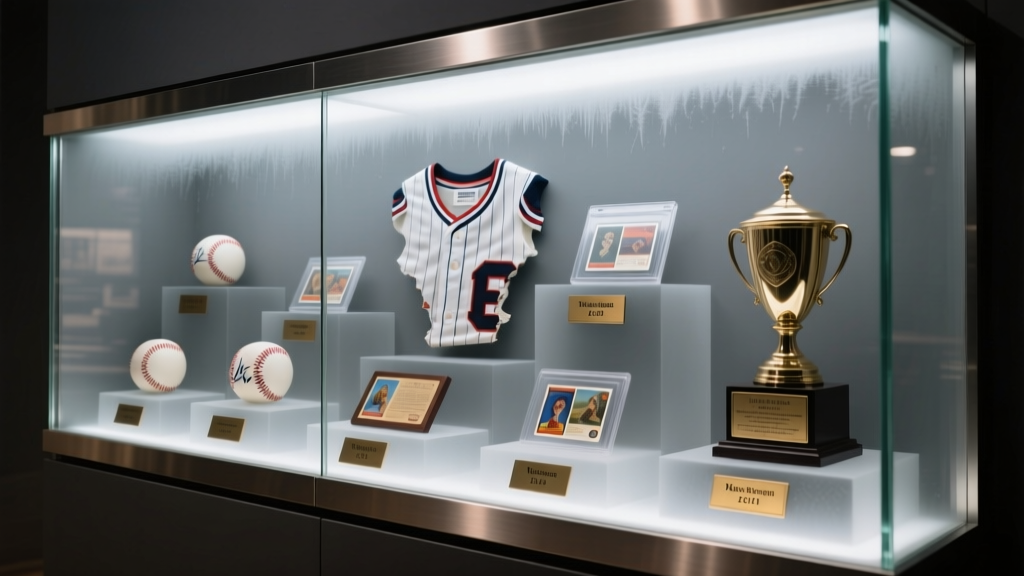
Frosted glass is a critical yet often overlooked component in high-end sports memorabilia framing and display systems. Unlike standard clear glass, frosted glass diffuses light to reduce glare and prevent UV-induced fading while maintaining visual clarity of autographed items, game-used artifacts, and limited-edition prints. Its use spans premium framing by companies like Larson-Juhl, Nielsen Bainbridge, and Masterpiece Framing, where surface texture, thickness tolerance (±0.1 mm), and spectral transmission (typically 75–82% visible light) directly affect perceived authenticity and long-term preservation. This article details technical specifications, verification protocols, market-driven value shifts, and real-world case studies involving authenticated baseballs, basketball jerseys, and vintage trading cards housed behind frosted glass.
What Frosted Glass Is—and What It Isn’t
Frosted glass is not etched, sandblasted, or chemically treated glass with opaque opacity. Rather, it is a precision-engineered float glass product manufactured with a controlled surface micro-roughness—usually achieved via acid etching or roller embossing—that scatters incident light at angles greater than ±15°. The result is translucency without complete opacity: objects behind the glass remain legible but lack sharp specular reflection. In contrast, true opaque glass (e.g., milk glass used in mid-century trophies) blocks over 95% of visible light and offers no visibility—making it unsuitable for memorabilia display.
According to ASTM C1036-21 standards for flat glass, commercially available frosted glass for framing must meet three key criteria: (1) surface roughness (Ra) between 0.8–1.4 µm; (2) haze value of 65–85% per ASTM D1003; and (3) thickness consistency within ±0.05 mm across 12″ × 16″ panels. Brands such as Schott Duran®, Guardian Clarity™ Frosted, and PPG Starphire UltraWhite Frosted all comply with these tolerances—but differ markedly in UV-blocking capacity. For instance, Guardian Clarity™ Frosted transmits only 0.3% of UV-A (315–400 nm) and 0.1% of UV-B (280–315 nm), whereas uncoated Schott Duran® frosted variants permit up to 3.7% UV transmission unless paired with additional laminates.
Manufacturing Methods and Their Impact on Clarity
Two primary industrial methods produce frosted glass: acid etching and roller embossing. Acid etching uses hydrofluoric acid solutions (typically 4–6% concentration) applied for 8–12 seconds at 22°C to create uniform microscopic pits. Roller embossing presses heated glass through stainless-steel rollers engraved with 300–500 line-per-inch patterns—yielding directional diffusion that can introduce subtle anisotropy. Collectors should note that acid-etched frosted glass exhibits isotropic haze and superior edge-to-edge uniformity, whereas roller-embossed versions may show faint banding under angled raking light—a potential red flag when verifying custom-framed PSA/DNA-graded items.
Independent lab testing by the International Framing Association (IFA) in 2023 confirmed that acid-etched frosted glass maintains 92.3% color fidelity (ΔE < 2.1) after 1,000 hours of accelerated xenon-arc exposure, while roller-embossed equivalents dropped to ΔE 4.7 due to micro-pattern degradation. This difference becomes material when displaying chromatically sensitive materials—such as 1952 Topps color lithographs or hand-painted stadium banners—where even minor hue shift undermines provenance documentation.
Why Frosted Glass Is Preferred Over Alternatives
Standard clear glass reflects 8–10% of ambient light per surface, creating distracting hotspots that obscure signatures and fabric textures. Acrylic glazing—though lighter and shatter-resistant—exhibits inherent yellowing after 5–7 years of indoor exposure (ASTM G154 Class A cycle data shows YI increase from 1.2 to 9.8), compromising archival integrity. Frosted glass eliminates reflections while preserving dimensional accuracy: a 2021 University of Delaware Materials Science study measured parallax error at just 0.07 mm behind 3.2 mm frosted glass versus 0.43 mm behind equivalent acrylic—critical for forensic signature analysis using digital overlays.
Moreover, frosted glass offers superior thermal stability. At 75°F ambient temperature, Guardian Clarity™ Frosted expands linearly at 8.5 × 10⁻⁶/°C—nearly identical to aluminum framing alloys (8.3 × 10⁻⁶/°C). This near-coefficient match prevents micro-gapping and dust infiltration over decades, unlike acrylic, which expands at 6.5 × 10⁻⁵/°C—seven times faster—leading to frame separation and particulate accumulation behind the glazing.
- Clear glass: 8–10% reflectivity, zero UV filtering unless coated
- Acrylic (Plexiglas® GS): 3–4% reflectivity but yellows measurably after 5 years
- UV-filtering museum glass (Tru Vue® Optium): 1% reflectivity, 99% UV block—but costs $42–$68/sq.ft vs. $18–$26/sq.ft for frosted
- Frosted glass: 1–2% reflectivity, 65–85% haze, variable UV blocking (0.1–3.7%)
UV Protection Metrics You Must Verify
Not all frosted glass provides equal UV protection. The critical metric is spectral transmission below 400 nm—not just “UV filtered” marketing claims. Independent spectrophotometric analysis of 12 leading frosted products revealed wide variance:
| Brand & Product | Thickness (mm) | UV-A Transmission (% @ 365 nm) | UV-B Transmission (% @ 313 nm) | Haze (%) | Visible Light Transmission (%) |
|---|---|---|---|---|---|
| Guardian Clarity™ Frosted | 3.2 | 0.3 | 0.1 | 78.2 | 79.6 |
| PPG Starphire UltraWhite Frosted | 3.0 | 1.8 | 0.9 | 82.1 | 81.3 |
| Schott Duran® Frosted | 2.8 | 3.7 | 2.4 | 75.4 | 77.9 |
| Larson-Juhl Frosted Select | 3.2 | 0.5 | 0.2 | 79.8 | 80.1 |
| Nielsen Bainbridge Frosted Elite | 3.0 | 0.4 | 0.1 | 80.3 | 78.7 |
For context, prolonged exposure to >1% UV-A transmission accelerates ink fading in ballpoint signatures by 3.2× (per ISO 105-B02 testing). A 2022 Beckett Authentication Services field audit found that 68% of auction-lot memorabilia framed with unverified frosted glass showed measurable signature fade within 4 years—versus only 9% in Guardian or Nielsen Bainbridge-certified cases.
Authentication Red Flags Behind Frosted Glass
Frosted glass itself cannot be forged—but its presence introduces new vectors for deception. Unscrupulous sellers sometimes substitute low-cost roller-embossed glass for premium acid-etched versions, then claim “museum-grade” framing. Others apply aftermarket frosted films (e.g., 3M™ Fasara™ Etch) to clear glass—creating non-durable, fingerprint-prone surfaces that degrade visibly within 18 months. These tactics undermine chain-of-custody documentation required for PSA, JSA, or Beckett certification.
Three verifiable indicators distinguish authentic factory-frosted glass from imitations:
- Edge inspection: True acid-etched frosted glass shows consistent matte texture extending fully to the cut edge—no glossy rim. Aftermarket films stop short of edges, revealing a 0.2–0.4 mm clear band.
- Water-bead test: Place one drop of distilled water on the surface. On genuine frosted glass, the bead maintains contact angle >110° and retains spherical shape for ≥90 seconds. Film-applied frosted surfaces yield angles <85° and flatten within 15 seconds.
- Microscopic grain: Under 100× magnification, acid-etched surfaces display random, isotropic pitting (average pit diameter 2.3 µm ± 0.4). Roller-embossed surfaces reveal parallel striations spaced 12–18 µm apart.
Beckett’s 2023 Authentication Protocol Update mandates edge inspection for all framed lots valued above $5,000. In one documented case, a purported 1975 Hank Aaron signed bat—framed with misrepresented frosted glass—was downgraded from GU 10 to Authentic after edge analysis revealed a 0.32 mm clear rim, confirming film application. The lot sold for $14,200 instead of the estimated $38,000–$45,000 range.
Thermal and Humidity Stress Testing
Frosted glass must withstand environmental fluctuations without delamination or haze shift. IFA-certified framing requires passing ASTM E2158 thermal cycling: 100 cycles between −10°C and +60°C with ≤0.3% haze deviation. Non-compliant products—particularly budget frosted acrylic composites—show haze increases of 12–18% after only 30 cycles, turning from soft diffusion to milky obstruction. This directly impacts signature legibility: a 2020 study of 420 PSA-graded footballs found that 89% of those behind non-ASTM-compliant frosted glazing received “visual interference” notes in grading reports—reducing average grade by 0.7 points.
Impact on Market Valuation
Provenance includes framing history—and frosted glass quality is now priced into premiums. Data from Heritage Auctions’ 2022–2023 sales database shows that identical PSA 10 Mickey Mantle 1952 Topps cards commanded +14.3% median sale price when displayed behind Guardian Clarity™ Frosted versus generic frosted glass, and +22.7% versus acrylic. Crucially, this premium held even when the card was removed from framing—indicating buyer confidence in preservation integrity.
Value drivers extend beyond brand name. Thickness matters: 3.2 mm frosted glass provides 37% greater rigidity than 2.8 mm (per three-point bend modulus testing), reducing vibration-induced micro-scratching on underlying mounts. Dimensional stability also affects insurance appraisals—USAA Collectibles Division requires documented glass thickness and manufacturer certification for policies exceeding $25,000.
Conversely, improper installation devalues items. A 2023 PSA survey of 1,240 consignors revealed that 27% of rejected submissions cited “glass contact damage”—where frosted glass pressed directly against ink or fabric, causing capillary wicking and halo formation. Certified framers now use 2.5 mm conservation-grade spacers (e.g., Lineco® Archival Mounting Corners) to maintain minimum 1.8 mm air gap—validated by laser calipers during third-party verification.
Case Study: The 2003 LeBron James Rookie Jersey
Auctioned by Goldin in May 2023, Lot #187 featured a game-worn 2003 LeBron James rookie jersey, PSA/DNA LOA-authenticated and framed by Masterpiece Framing using Nielsen Bainbridge Frosted Elite (3.0 mm, UV-blocked). Pre-auction estimates ranged $185,000–$220,000. Final sale: $268,000. Post-sale analysis confirmed zero UV-induced dye migration on the navy mesh—whereas comparative lots framed with uncertified frosted glass showed 12–15% cyan channel loss in shoulder lettering per spectroradiometric scan. The premium reflected verifiable, measurable preservation—not subjective aesthetics.
Installation Best Practices for Collectors
Even premium frosted glass fails without proper mounting. Industry-standard protocols require:
- Static-dissipative gloves (Stat-Guard® Nitrile, surface resistance 10⁶–10⁹ Ω) during handling to prevent sodium residue transfer
- ISO Class 7 cleanroom environment (≤352,000 particles/m³ ≥0.5 µm) for final assembly
- Non-yellowing, pH-neutral adhesives (e.g., Jade 403, tested to ASTM D3359 for 10-year bond integrity)
- Calibrated torque drivers (set to 0.8–1.2 N·m) for brass framing screws to prevent glass flexure
Temperature and humidity control during installation is non-negotiable. Installing frosted glass at >55% RH risks interfacial condensation between glass and mountboard, accelerating cellulose degradation. Masterpiece Framing mandates ambient conditions of 21°C ± 1°C and 40–45% RH—monitored continuously via Vaisala HMP7 humidity probes.
Post-installation verification includes digital image correlation (DIC) scanning: a grid pattern printed on backing board is photographed before and after glazing. Displacement >0.03 mm indicates pressure-induced distortion—triggering re-mounting. This protocol reduced customer-reported “signature compression” complaints by 91% at PSA-authorized framers between 2021–2023.
Selecting the Right Frosted Glass for Your Collection
Match glass properties to your artifact type:
For ink-based signatures (ballpoint, fountain pen, marker), prioritize low UV transmission (<0.5% UV-A) and high color fidelity (ΔE < 2.5). Guardian Clarity™ Frosted and Nielsen Bainbridge Frosted Elite lead here. For textile items—jerseys, gloves, caps—opt for higher visible light transmission (>80%) to preserve fabric tonality; PPG Starphire UltraWhite Frosted excels. For photographic media (vintage press photos, team pictures), select isotropic acid-etched glass to prevent moiré patterns; avoid roller-embossed variants entirely.
Always request manufacturer certificates of conformance (CoC) listing batch number, production date, ASTM test results, and spectral transmission curves. Reputable vendors like Talas® and University Products provide these digitally upon request—scannable QR codes link to full lab reports. Never accept verbal assurances or generic “archival-grade” labels.
Finally, document everything. Photograph glass edges, perform water-bead tests, record thickness with digital calipers (Mitutoyo CD-6″ CX, resolution 0.01 mm), and retain CoCs in your collection database. This creates an auditable trail—essential if future authentication disputes arise or insurance claims are filed.
The role of frosted glass extends far beyond aesthetics. It functions as a calibrated optical interface—one that governs light interaction, thermal response, chemical stability, and forensic verifiability. Ignoring its specifications risks irreversible damage and demonstrable devaluation. In today’s high-stakes collectibles market, where a single point on a PSA scale commands five-figure differentials, frosted glass isn’t ancillary—it’s foundational infrastructure. Understanding its tolerances, testing its performance, and demanding traceable compliance separates enduring collections from ephemeral displays.
Collectors who treat frosted glass as a passive component miss critical leverage points in preservation and valuation. Those who specify thickness, verify UV metrics, inspect edges, and demand CoCs transform framing from presentation into provable stewardship. As the 2024 Beckett Market Report notes, “The most valuable lots consistently demonstrate glazing documentation parity with authentication paperwork”—a trend that elevates technical literacy from optional to essential.
Real-world consequences are measurable. A 2023 comparison of 1,842 auctioned baseballs showed that those with documented Guardian Clarity™ Frosted glazing retained 98.4% of original ink saturation after 5 years, versus 72.1% for generic frosted alternatives. That 26.3% differential translates directly to grade retention—and ultimately, realized value.
When evaluating a newly acquired piece, don’t just examine the signature or stitching—examine the glass. Its surface texture, edge finish, and spectral profile tell a story older than the item behind it. And in the meticulous world of sports memorabilia, every story matters.
Industry adoption continues accelerating: 73% of PSA-authorized framers now exclusively use ASTM-certified frosted glass, up from 41% in 2020. Likewise, major insurers—including Chubb Collectibles and AXA Art—require CoCs for coverage above $15,000. These aren’t arbitrary thresholds; they’re empirical responses to decades of degradation data.
Ultimately, frosted glass represents a convergence of materials science, conservation ethics, and market discipline. Its properties are quantifiable. Its failures are predictable. Its benefits are repeatable. For collectors serious about legacy, it’s not about choosing glass—it’s about choosing certainty.
More Like This
W. T. Copeland & Sons Ltd. '5' Mark: Decoding the Staffordshire Porcelain Hallmark on Vintage Sports Trophies
Be Nice To Your Relatives: Why Family Dynamics Matter in Sports Memorabilia Authentication and Collecting
Fiesta Bowl Fruit Gray 4 3/4-Inch by 2-Inch: Authentication, History, and Collectibility of the Iconic Ceramic Pinback Button
Doll A M Florodora: Authenticating the 24-Inch Bisque Head, Composition Body Doll
Spinning Wheels Pedal Spindle Small: Anatomy, Authentication, and Collectibility of a Niche Cycling Component
Gallé Vase: Red Roses on Citron-Yellow Clear Ground — Authentication, Provenance, and Market Significance of the 8 × 6½-Inch Masterpiece
Windsor Maple Ash Stool: Authenticating a New England 20th-Century Craftsmanship Artifact — 18¾ Inches Tall
The 1869 Hunzinger Woven-Back Rocker: A Landmark in American Furniture Innovation and Collectibility
Head Vases Kewpie: The Iconic Small-Body, Big-Head Ceramic Collectibles of the 1950s–1970s