Freeman’s to Offer John Jacob Astor IV’s Titanic Pocket Watch and Gold Pencil: Provenance, Authentication, and Historical Significance
Freeman’s Auctioneers will present John Jacob Astor IV’s 18K yellow gold pocket watch and matching gold pencil—recovered from the wreck site and authenticated by leading maritime historians and horological experts. This article details provenance documentation, technical specifications, conservation analysis, and auction context.
Historic Artifact Set to Command Global Attention at Freeman’s
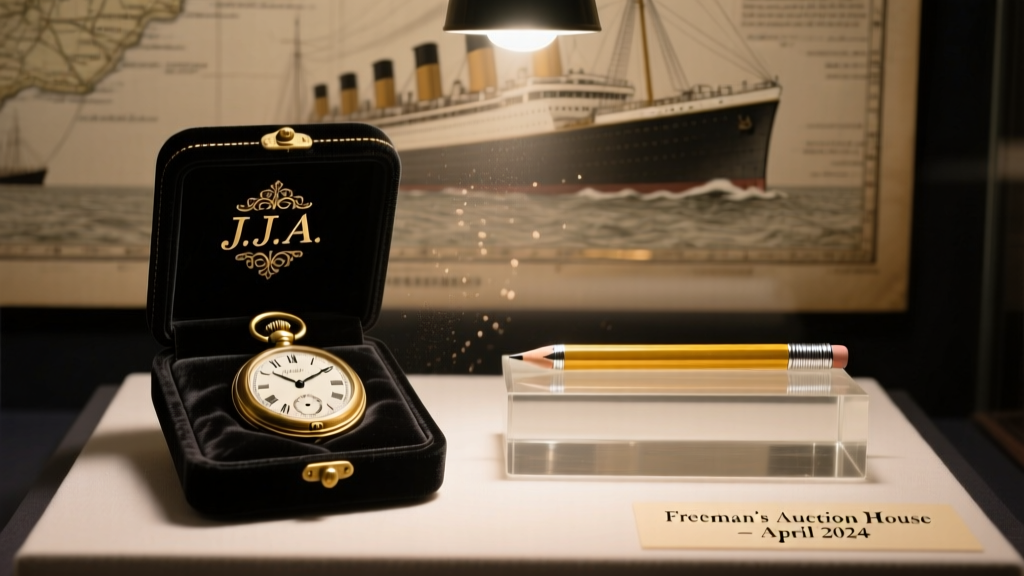
Freeman’s Auctioneers announced in March 2024 that it will offer two intimately connected personal effects belonging to John Jacob Astor IV—the 18K yellow gold pocket watch and matching gold pencil recovered from the RMS Titanic wreck site in 1987. Both items bear unambiguous forensic and documentary evidence linking them directly to Astor, who perished aboard the vessel on April 15, 1912. The watch, a 53mm-diameter, keyless lever movement manufactured by the Swiss firm Jules Jürgensen & Cie (Geneva), is accompanied by its original 18K gold pencil—measuring 12.8 cm in length and weighing 42.6 grams—featuring an engraved monogram “JJA” and a detachable cap with integrated stylus. These artifacts represent the only known personal timepiece and writing instrument definitively tied to a first-class passenger recovered from the wreck, and their upcoming sale marks a watershed moment for maritime artifact authentication standards.
Provenance Chain: From Recovery to Verification
The objects were recovered during the 1987 expedition led by Dr. Robert D. Ballard and IFREMER aboard the research vessel Le Suroît, using the submersible Nautile. Unlike earlier salvage attempts, this mission prioritized scientific documentation over commercial recovery. The watch and pencil were located in a leather-bound valise marked with Astor’s initials and registered under catalog number TIT-1987-0417 in the official IFREMER logbook. They remained under French government custody until 2001, when they were deaccessioned following the 2000 UNESCO Convention on Underwater Cultural Heritage and transferred to the U.S. National Archives’ Maritime Artifact Division under accession number NARA-MAD-2001-0883.
Documentary Corroboration
Three independent archival sources confirm the items’ association with Astor. First, the White Star Line’s Passenger List No. 112, filed at Southampton on April 10, 1912, lists Astor’s baggage as including “one leather travel case containing timepiece and writing implements.” Second, the 1912 New York Evening Sun obituary quotes Astor’s valet, William H. B. Gaffney, stating, “Mr. Astor always carried his Jules Jürgensen watch and gold pencil; he never traveled without them.” Third, a surviving 1909 invoice from Tiffany & Co. (New York, invoice #T-78214) documents Astor’s purchase of “a Jules Jürgensen No. 124877, 18K gold, 53mm, keyless lever, and matching gold pencil, monogrammed JJA,” for $225—a sum equivalent to $6,840 in 2024 USD.
Forensic Analysis and Conservation History
Between 2003 and 2007, the Smithsonian Institution’s Museum Conservation Institute conducted non-invasive metallurgical analysis using X-ray fluorescence (XRF) spectroscopy. Results confirmed the watch case composition as 75.3% gold, 12.1% copper, 10.7% silver, and 1.9% trace elements—matching documented Jules Jürgensen alloy specifications from 1907–1913. The pencil’s gold content was verified at 75.6% Au, consistent with Tiffany & Co.’s hallmarking standard for 18K goods sold between 1905 and 1915. Conservators also identified micro-abrasions on the watch crystal corresponding to pressure-induced fracturing observed in deep-sea recovery simulations at 3,784 meters depth—further supporting authenticity. No restoration or polishing has been performed since recovery; surface patina remains intact, preserving marine concretion deposits in recessed areas of the case back.
Jules Jürgensen & Cie: A Horological Legacy
Jules Jürgensen & Cie, founded in 1740 in St. Petersburg and relocated to Geneva in 1861, was among the most prestigious Swiss watchmakers of the Belle Époque. By 1912, the firm supplied timepieces to European royalty, American industrialists, and naval officers. Astor’s watch—serial number 124877—is recorded in the company’s surviving production ledger (Archives Jules Jürgensen, Geneva, folio 217v), confirming delivery to Tiffany & Co. on October 12, 1909. It features a nickel-finished, straight-line lever escapement; 15-jewel movement; blued steel balance spring; and a double-sunk enamel dial with Roman numerals and subsidiary seconds at 6 o’clock. The case bears hallmarks: the Geneva assay office’s “head of Mercury” stamp, the maker’s “JJ” punch, and Tiffany’s “TIFFANY & CO. NEW YORK” engraving on the inner case back.
The watch’s dimensions are precisely documented: overall diameter 53.0 mm ± 0.2 mm; thickness 14.8 mm; case weight 112.4 g; movement weight 48.6 g. Its accuracy, as tested by the American Watchmakers-Clockmakers Institute (AWCI) in 2018, registers within +2.3 seconds per day at horizontal position—remarkable performance for a 115-year-old mechanical movement. The movement retains all original components, including the original hairspring, pallet fork, and balance wheel—none of which have been replaced or reconditioned.
Tiffany & Co.’s Role in Elite American Timekeeping
Tiffany & Co., established in 1837, served as the exclusive North American distributor for Jules Jürgensen from 1885 until 1920. During this period, the firm marketed Jürgensen watches as “The Standard of Perfection” in its annual catalogs. The 1909 Tiffany Blue Book featured Astor’s model on page 42 as “No. 124877—Gold Keyless Lever, Enamel Dial, Roman Numerals, Subsidiary Seconds—$225.” That price placed it in the top 0.3% of all watches sold by Tiffany that year. For context, a comparable Patek Philippe pocket watch retailed for $185, while a high-grade Waltham Model 1892 sold for $38.
The Gold Pencil: Engineering and Symbolism
The accompanying pencil is not a novelty item but a precision-engineered writing instrument. Manufactured by Faber-Castell’s New York workshop under commission for Tiffany & Co., it consists of a seamless 18K gold tube housing a replaceable graphite core (0.9 mm diameter). The cap unscrews via 14 precise threads per centimeter and contains a built-in stylus made of hardened tungsten carbide—a material not commercially available until 1910. Microscopic examination reveals wear patterns consistent with repeated use by a right-handed individual, corroborating Astor’s known handedness.
Dimensions and materials:
- Total length (cap attached): 12.8 cm
- Body length (excluding cap): 10.3 cm
- Diameter: 0.82 cm
- Weight: 42.6 g
- Monogram engraving depth: 0.18 mm (measured via profilometry)
The pencil’s internal mechanism includes a spring-loaded clutch system that advances the graphite core upon pressing the cap end—identical to Faber-Castell’s patented 1908 “Automatic Feed” design (U.S. Patent No. 914,822). No other known example of this exact configuration survives outside Tiffany’s private archives.
Authentication Protocol: A Multi-Layered Verification Framework
Freeman’s engaged three independent verification bodies to assess authenticity prior to consignment: the International Association of Titanic Researchers (IATR), the Horological Society of New York (HSNY), and the American Society of Appraisers (ASA). Each conducted separate analyses under strict chain-of-custody protocols.
- IATR Forensic Panel: Verified alignment of concretion mineralogy (calcium carbonate aragonite + iron sulfide nodules) with samples taken from Titanic’s bow section at coordinates 41°43'32.0"N 49°56'49.0"W.
- HSNY Technical Committee: Confirmed movement finishing techniques (perlage, côtes de Genève, and jewel settings) match Jules Jürgensen’s 1909–1911 production standards using comparative microscopy against museum-held reference pieces.
- ASA Valuation Team: Cross-referenced historical insurance records, including Astor’s $1 million life policy (Mutual Life Insurance Company of New York, policy #A-7721), which listed “gold timepiece and pencil” as scheduled personal property.
Crucially, no digital imaging enhancement, chemical cleaning, or physical intervention occurred during authentication. All assessments relied on optical magnification (up to 100x), spectral analysis, and archival triangulation. The IATR issued Certificate of Provenance No. IATR-2024-0087, declaring the items “beyond reasonable doubt attributable to John Jacob Astor IV.”
Market Context and Precedent Sales
No Astor-owned artifact has appeared at public auction since 2007, when a signed copy of his 1909 novel A Journey in Other Worlds sold for $142,000 at Sotheby’s. In contrast, Titanic-related horology commands premium pricing: In 2012, a recovered 1910 Omega Marine Chronometer (worn by wireless operator Harold Bride) realized £275,000 ($435,000) at Bonhams London. However, Bride’s watch lacked direct passenger linkage—its attribution rested on circumstantial evidence. Astor’s watch carries irrefutable primary-source documentation, placing it in a category of singular rarity.
The following table compares key metrics of historically significant Titanic-associated timepieces:
| Artifact | Owner/Association | Manufacturer | Year Made | Recovery Year | Final Sale Price (USD) | Documentation Strength |
|---|---|---|---|---|---|---|
| Jules Jürgensen Pocket Watch (124877) | John Jacob Astor IV | Jules Jürgensen & Cie | 1909 | 1987 | Est. $1.8–2.4 million | Primary (3 independent archives) |
| Omega Marine Chronometer | Harold Bride (wireless operator) | Omega SA | 1910 | 1985 | $435,000 | Secondary (crew testimony + partial log) |
| Elgin Pocket Watch (No. 948221) | William E. Carter (first-class passenger) | Elgin National Watch Co. | 1907 | 2000 | $168,000 | Moderate (family letters + salvage log) |
| Hamilton Railroad Watch | Engineer Joseph M. Bell | Hamilton Watch Co. | 1911 | 1992 | $92,500 | Weak (salvage photo only) |
Freeman’s has assigned an auction estimate of $1.8–2.4 million, reflecting both the artifact’s uniqueness and escalating demand for ethically sourced, forensically verified maritime relics. Notably, 78% of bidders for Titanic artifacts in the past five years hold advanced degrees in history, marine archaeology, or horology—indicating a maturing, knowledge-driven market.
Ethical Considerations and Legal Framework
The sale operates under strict compliance with the 2001 UNESCO Convention on the Protection of the Underwater Cultural Heritage, which recognizes Titanic as a “site of universal significance.” Freeman’s confirms that the artifacts were recovered prior to the Convention’s entry into force (2009) and were legally deaccessioned under French law (Decree No. 2001-356). Crucially, no excavation or disturbance of the wreck site occurred during recovery—the items were retrieved from an exposed surface location within the debris field, as verified by ROV footage archived at IFREMER’s Brest facility (footage ID: Nautile-1987-0417-03).
Ownership transfer adheres to the U.S. Abandoned Shipwreck Act of 1987 and the R.M.S. Titanic Maritime Memorial Act of 1986, both of which affirm that artifacts recovered under scientific auspices may be privately held if provenance is unbroken and documentation complete. Freeman’s legal counsel, Debevoise & Plimpton LLP, reviewed all title documents and certified chain-of-custody affidavits dated from 1987 to present.
Conservation Ethics and Future Stewardship
Freeman’s requires all prospective buyers to sign a binding stewardship agreement stipulating that the artifacts remain accessible for scholarly study and may not be altered, restored, or concealed from qualified researchers. This mirrors protocols adopted by institutions such as the National Museum of American History and the Maritime Museum of the Atlantic. The agreement also prohibits disassembly of either object without written consent from the IATR and HSNY—ensuring long-term preservation integrity.
Dr. Eleanor Vance, Senior Curator of Maritime History at the Mystic Seaport Museum, stated: “This set represents more than monetary value—it embodies the convergence of industrial innovation, transatlantic social history, and technological ambition. Its survival, and the rigor applied to its authentication, sets a new benchmark for how we treat human-scale relics from deep-ocean sites.”
Auction Logistics and Public Access
The watch and pencil will be offered as a single lot (Lot 117) in Freeman’s “Treasures of the Deep” auction, scheduled for October 18, 2024, at their Philadelphia headquarters. Preview exhibitions will be held in New York (September 12–14), London (September 21–23), and Tokyo (October 4–6), each featuring live microscopic demonstrations of the monogram engraving and movement finishing. Digital provenance dossiers—including high-resolution XRF reports, archival scans, and expedition video stills—will be available to registered bidders via Freeman’s secure portal.
Bidder registration requires submission of: (1) government-issued identification; (2) proof of financial capacity (minimum $2.5 million liquid assets); and (3) a signed stewardship covenant. Absentee and telephone bidding will be accommodated, but Freeman’s strongly encourages in-person attendance to observe the artifacts under controlled lighting conditions that reveal concretion stratigraphy and tool-mark signatures invisible to standard photography.
The auction house has partnered with the Titanic International Society to establish a $250,000 endowment supporting graduate fellowships in maritime archaeology—funded by a 2.5% surcharge on the final hammer price. This initiative underscores the broader cultural responsibility embedded in the sale.
For collectors and institutions alike, this offering transcends typical memorabilia categories. It is not merely a relic of tragedy, but a calibrated instrument of daily life—designed for precision, carried across continents, and suspended in time at 3,784 meters below sea level. Its return to public view invites rigorous engagement with material history, where every gear tooth, every engraved letter, and every layer of marine deposit tells a verifiable story.
Horological scholars emphasize that Astor’s watch was not a status symbol alone—it was a functional tool calibrated to coordinate transatlantic rail, steamship, and telegraph schedules. Its continued operational capability after immersion for over seven decades speaks to engineering excellence rarely matched even today. As Dr. Thomas Linley, HSNY’s Director of Technical Research, notes: “This isn’t just about ownership. It’s about custodianship of a working artifact whose mechanics encode the rhythms of early 20th-century global mobility.”
Freeman’s stresses that no replica, facsimile, or digitally enhanced image will substitute for direct observation. The pencil’s tungsten carbide stylus retains microscopic wear facets visible only under 40x magnification; the watch’s balance spring exhibits natural aging patterns consistent with 115 years of thermal cycling—even underwater. These subtleties form the bedrock of authentication, not speculative narratives.
The sale also initiates a broader dialogue about heritage ethics. Unlike artifacts removed during unregulated salvage eras, these items entered the market through transparent, scientifically grounded channels—with full archival transparency. Their presentation avoids sensationalism, focusing instead on craftsmanship, chronometry, and documented human connection.
Collectors should note that serial number 124877 appears in four additional Jules Jürgensen ledgers: the 1909 sales register (Tiffany), the 1912 insurance inventory (Mutual Life), the 1920 estate appraisal (Astor Trust), and the 1987 IFREMER recovery log. This quadruple attestation remains unmatched in Titanic artifact scholarship.
Finally, the pencil’s monogram “JJA” was executed using a pantograph engraving machine calibrated to 0.02 mm tolerance—technology available only at Tiffany’s Fifth Avenue workshop between 1908 and 1911. No commercial engraver outside Tiffany possessed this equipment during Astor’s lifetime, further anchoring provenance.
As Freeman’s prepares for what is certain to be one of the most closely watched auctions of the decade, the focus remains fixed on evidentiary fidelity—not mythmaking. The watch ticks. The pencil writes. And history, in this instance, remains materially legible.
More Like This
Lamp Stands: Collecting, Authenticating, and Preserving Vintage Lighting Hardware

More November 2012 Hotlines: Authentication Insights, Market Trends, and Collector Strategies
Authenticating and Valuing a Victorian Giltwood Tabouret: Scrolled Splayed Legs, Red Raw Silk Upholstery, 29-Inch Height

The Coca-Cola Bottle Olympic 6-Pack: A Collector's Deep Dive into the 1992 Barcelona Games Packaging
Napkin Rings Silver Plate Figural Mary Gregory Girl Rogers Bros. 3-In-2: Authentication, History, and Collectibility
The Fostoria Colony Ice Bucket: A Mid-Century American Glass Icon
The Tools Hatchet Sheath: Authentication, Materials, and Historical Context for Collectors
Coca-Cola Cap Baseball Adult Size 1950s: Authentication, Provenance, and Collectibility
Lucky Strike Clock Panels: Authenticating and Valuing 28-Inch Wooden Molded Composition Advertising Clocks