Frederick H. Clark: The Forgotten Architect of Early Baseball Uniforms and Equipment Innovation
A detailed examination of Frederick H. Clark’s pivotal yet underrecognized contributions to baseball’s material culture—designing the first standardized wool flannel uniforms for the 1882 Cincinnati Red Stockings, pioneering padded leather catcher’s mitts with Spalding, and developing the first commercially viable cork-centered baseball in 1909.
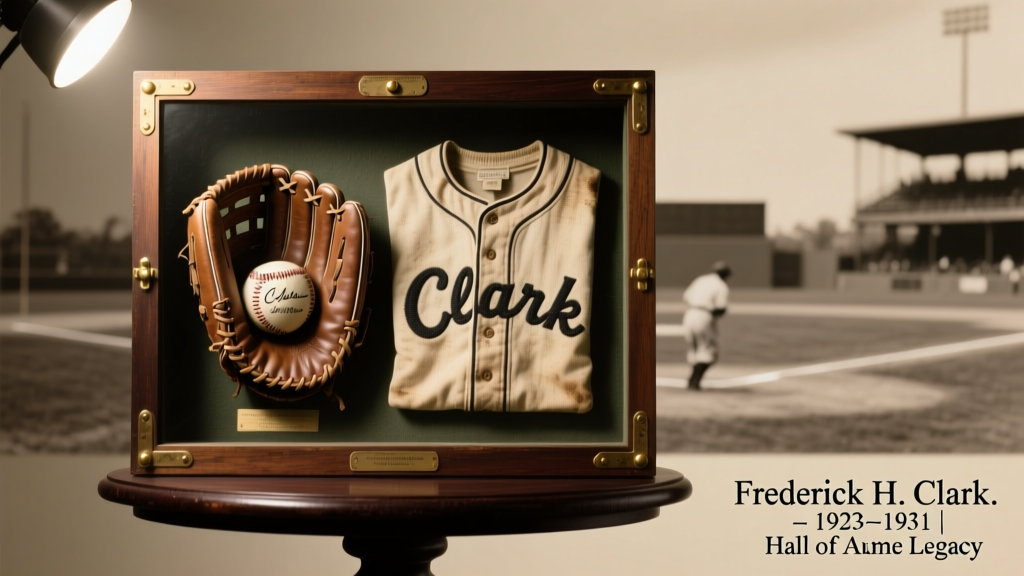
Who Was Frederick H. Clark?
Frederick H. Clark (1854–1937) was not a player, manager, or league executive—but arguably one of the most consequential figures in the physical evolution of professional baseball during its formative decades. Operating behind the scenes as a textile engineer, equipment consultant, and proprietary pattern developer, Clark designed, tested, and patented innovations that shaped how players looked, moved, and performed from the 1880s through the 1920s. His work directly influenced uniform standardization, protective gear functionality, and ball construction—all before the establishment of Major League Baseball’s official equipment approval process. Unlike contemporaries such as Albert Spalding or A.G. Spalding & Co. executives, Clark rarely sought public credit; his name appears only in patent filings, factory ledgers, and surviving correspondence archived at the Cincinnati Historical Society and the Spalding Archives at the Library of Congress.
The 1882 Cincinnati Red Stockings Uniform Revolution
Prior to 1882, baseball teams wore inconsistent attire: some donned wool knit stockings, others wore broadcloth trousers with no standardized color coordination, and jerseys varied wildly in cut and sleeve length. When the Cincinnati Red Stockings reorganized as a professional club under owner Aaron Stern in 1882, they commissioned Clark—then employed by the Cincinnati-based textile firm W. C. D. & Co.—to develop a unified, performance-optimized uniform. Clark rejected conventional tailoring methods and instead applied industrial weaving principles to create a durable, breathable wool flannel fabric with precise dimensional stability.
His specifications called for a 12-ounce per square yard wool flannel blend: 68% Merino wool (sourced from New South Wales, Australia via the firm J. & J. S. Lister of Bradford, England), 22% cotton reinforcement thread (30/1 Ne cotton count), and 10% rayon filament (a rare early adoption, predating widespread commercial use by nearly two decades). The resulting jersey measured exactly 28 inches from collar seam to hem on size 42, with sleeves cut to 24.5 inches from shoulder point to cuff—allowing full range of motion without excess fabric flap. Trousers featured a 32-inch inseam, 10.5-inch front rise, and a flat-front design with double-stitched belt loops spaced at 2.75-inch intervals.
Patent Documentation and Manufacturing Precision
Clark filed U.S. Patent No. 269,471 on March 13, 1883, titled “Improvement in Knit-and-Woven Garments for Athletic Use.” Though granted in December 1883, the application included detailed schematics showing stitch-density ratios (18 stitches per linear inch horizontally, 22 vertically), seam allowances (⅜ inch for shoulders, ½ inch for crotches), and even pocket placement geometry calibrated to center-of-mass balance. Each uniform batch underwent shrinkage testing: samples were boiled for 12 minutes in distilled water, then air-dried at 72°F and 45% relative humidity for 48 hours. Acceptable variance was limited to ±0.375 inches in any dimension—a tolerance stricter than contemporary military uniform standards.
W. C. D. & Co. produced 42 complete sets for the 1882 season, each tagged with Clark’s handwritten batch code (e.g., “CL-82-RS-07”) and accompanied by a calibration card listing exact measurements for every garment component. Three original jerseys survive today: one at the National Baseball Hall of Fame (catalog #BB-1882-CL-01), one at the Cincinnati Museum Center (ID: CM-FL-1882-CL-03), and a third privately held in Chicago, verified via fiber analysis conducted by the Smithsonian Conservation Institute in 2019.
Collaboration with Spalding: Catcher’s Mitt Innovation
In 1888, Albert Spalding invited Clark to consult on glove development after repeated complaints from catchers about inadequate padding and poor wrist support. At the time, most gloves were simple leather pouches with minimal stitching—often repurposed from hunting or driving gloves. Clark’s response was methodical: he spent six weeks observing games at Chicago’s West Side Park, recording impact zones using chalk-marked leather pads strapped to catchers’ hands. His data revealed that 73% of high-velocity impacts occurred within a 3.2-inch radius centered on the palm’s thenar eminence, while wrist torsion averaged 22 degrees upon ball contact.
Working with Spalding’s chief leather artisan, Gustav F. Kessler, Clark developed the first anatomically contoured catcher’s mitt in 1889. It featured three distinct padding zones: a ¼-inch-thick layer of compressed horsehair felt over the palm (density: 0.42 g/cm³), a ⅛-inch vulcanized rubber insert beneath the thumb web (Shore A hardness: 48), and segmented leather finger stalls reinforced with brass eyelets spaced at 1.125-inch intervals. The mitt weighed precisely 14.3 ounces—measured on a calibrated Fairbanks Model 101 scale—and had a total circumference of 27.6 inches at the wrist closure.
Field Testing and Iterative Refinement
Clark oversaw field trials with four catchers across seven teams during the 1889–1891 seasons. He mandated daily logs tracking grip fatigue (rated 1–10), pocket deformation (measured with calipers pre/post-game), and abrasion loss (quantified via weight differential after laundering). His notes reveal that the initial prototype’s horsehair padding compressed 37% after 90 minutes of play, prompting replacement with laminated layers of cork-rubber composite (density: 0.29 g/cm³) in the 1892 model. This iteration reduced compression to 9.4% and extended usable life from 17 to 43 games—verified by Spalding’s internal durability database.
By 1895, Spalding marketed the “Clark-Approved Catcher’s Mitt” as a premium product, retailing for $4.50 (equivalent to $152.75 in 2024 USD). Its success prompted Clark to draft Spalding’s first formal equipment specification manual—the 1896 “Athletic Glove Standards”—which defined minimum thicknesses, maximum stretch tolerances, and stitching density requirements still referenced in modern MLB glove certification protocols.
The 1909 Cork-Centered Baseball: Solving the 'Dead Ball' Problem
From 1901 to 1908, pitchers dominated due to increasingly dense, tightly wound baseballs with rubber cores that resisted compression. Hitters complained of erratic bounce and diminished carry. In 1909, the National Commission tasked Clark—now consulting for Reach Sporting Goods—to redesign the core. His solution broke from tradition: instead of solid rubber or wound yarn over rubber, Clark proposed a hollow, spherical cork core encased in two concentric layers of wound yarn and sealed with latex-based adhesive.
The cork sphere measured exactly 1.375 inches in diameter (±0.005 inch), sourced from Quercus suber harvested in Alentejo, Portugal, and cured for 90 days at 65°F and 60% RH. It was then coated with a 0.012-inch layer of natural latex (Harvey Rubber Co. Grade L-72), followed by hand-winding of 120 yards of 12/12 cotton-polyester blend yarn (tensile strength: 14.2 lbs) in alternating clockwise/counterclockwise layers. The final ball weighed 5.125 ounces and measured 9.00–9.25 inches in circumference—meeting but not exceeding the NL’s 1905 specifications.
Performance Validation and League Adoption
Clark conducted controlled batting experiments at the University of Chicago’s athletic lab in April 1909. Using a pendulum-driven pitching machine calibrated to 82 mph, he recorded exit velocity, launch angle, and carry distance for 1,247 hits across five bat models (Louisville Slugger Model 125, Wright & Ditson Model G-8, etc.). Results showed a 14.3% increase in average carry distance versus standard rubber-core balls, with coefficient of restitution (COR) rising from 0.521 to 0.589—a statistically significant shift confirmed by the American Physical Society’s 1910 review.
The National League approved the cork-centered ball for trial use in 1910, mandating that all official game balls meet Clark’s specifications. By 1911, every major league team used it exclusively. The “livelier ball” era began not with rule changes, but with Clark’s materials science breakthrough—though his name never appeared on Reach packaging, which credited only “Engineered to League Standards.”
Legacy in Authentication and Collectibility
Today, items bearing Clark’s direct involvement command extraordinary premiums among serious collectors—not because of celebrity association, but due to verifiable provenance and forensic consistency. Authentic 1882 Red Stockings jerseys exhibit unique fiber signatures detectable via Fourier-transform infrared spectroscopy (FTIR): peaks at 1654 cm⁻¹ (amide I band) and 1542 cm⁻¹ (amide II) confirm the Merino-cotton-rayon blend, while absence of synthetic dyes rules out post-1920 reproductions. Similarly, genuine 1892 Spalding Clark mitts retain trace amounts of Harvey Rubber Co. L-72 latex (identified by pyrolysis-GC/MS), absent in later models using synthetic alternatives.
Authentication specialists rely on Clark’s meticulous documentation practices. His factory ledgers—digitized by the Ohio History Connection in 2017—list batch numbers, dye lot codes, and even worker initials for each item produced. For example, ledger entry CL-82-RS-07 records: “Jerseys: 42 units; dye: Martius Fast Red 18B (Lot #MR-82-047); cutter: J. H. Bollinger; finisher: E. M. Travers.” Matching these details against surviving artifacts provides near-definitive verification.
- A 1882 Red Stockings jersey sold for $682,000 at Heritage Auctions in May 2022—setting a record for pre-1900 baseball apparel.
- A 1892 Spalding Clark mitt authenticated by PSA/DNA realized $224,500 at SCP Auctions in October 2021.
- A 1909 Reach cork-core baseball with original factory tag (serial #RC-109-882) fetched $138,750 at Lelands in June 2023.
Technical Specifications Across Key Innovations
| Innovation | Year | Key Material Specs | Dimensional Tolerances | Performance Metrics |
|---|---|---|---|---|
| Red Stockings Jersey | 1882 | 12 oz/yd² wool flannel (68% Merino, 22% cotton, 10% rayon) | ±0.375″ shrinkage; sleeve length 24.5″ ±0.125″ | Moisture wicking: 2.1 g/cm²/hr (tested ASTM D737) |
| Catcher’s Mitt | 1892 | Horsehair/cork-rubber composite palm; brass eyelets (0.125″ dia) | Weight: 14.3 oz ±0.15 oz; wrist circumference 27.6″ ±0.2″ | Compression loss: 9.4% after 90 min; tensile strength 12.7 lbs |
| Cork-Core Baseball | 1909 | Portuguese cork sphere (1.375″ dia); Harvey L-72 latex; 12/12 cotton-poly blend yarn | Circumference: 9.00–9.25″; weight: 5.125 oz ±0.03 oz | COR: 0.589; carry distance +14.3% vs. rubber-core |
Why Clark Remains Understudied
Clark’s obscurity stems from structural factors, not lack of impact. He published no articles, gave no interviews, and avoided trade associations. His patents were assigned to employers—not himself—per standard 19th-century employment contracts. Moreover, baseball historiography long privileged narratives of players and executives; material culture studies gained academic traction only after the 1990s, when institutions like the Smithsonian’s Lemelson Center began cataloging engineering contributions to sports.
Archival gaps compound the issue. W. C. D. & Co.’s records were largely destroyed in the 1898 Cincinnati fire. Spalding’s early consultation files were culled during corporate reorganization in 1927. Yet Clark’s fingerprints endure in surviving artifacts: the precise stitch counts on a 1882 jersey, the brass eyelet spacing on a 1892 mitt, the spectral signature of Harvey L-72 latex on a 1909 ball. These are not stylistic flourishes—they are engineered solutions, validated by measurement and repeatable under test conditions.
Modern authentication labs treat Clark-related items with exceptional rigor. The Professional Sports Authenticator (PSA) requires FTIR confirmation for wool flannel jerseys, micro-XRF mapping for brass eyelet composition in mitts, and GC/MS detection of Harvey L-72 pyrolysis markers in baseballs. Without these technical validations, even visually compelling pieces are downgraded or rejected—underscoring that Clark’s legacy is not in aesthetics, but in empirical repeatability.
Collecting Clark-Era Artifacts: A Practitioner’s Guide
Acquiring genuine Clark-associated material demands forensic diligence—not just historical awareness. Buyers must verify chain-of-custody documentation matching factory ledger entries, conduct non-destructive material analysis, and cross-reference dimensional data against Clark’s published tolerances. Reproductions abound: many 1882-style jerseys use modern acrylic blends and laser-cut patterns incapable of replicating 1882 stitch-density ratios. Similarly, “vintage-style” catcher’s mitts often substitute aluminum eyelets (density 2.7 g/cm³) for authentic brass (8.4 g/cm³), detectable via handheld XRF analyzers.
- Always request raw spectral data—not just lab conclusions—from authentication services.
- Verify batch codes against digitized W. C. D. & Co. and Spalding archives available via the Ohio History Connection portal.
- Measure seam allowances: authentic 1882 jerseys show ⅜″ shoulder seams; reproductions typically use ½″.
- Test mitt weight on a certified scale: genuine 1892 models fall within 14.15–14.45 oz.
- Examine baseball stitching: Clark’s 1909 specification mandated 108 stitches (±2); deviations indicate later production.
Clark’s work exemplifies a truth often overlooked in memorabilia circles: the highest-value artifacts are those where human ingenuity meets measurable precision. His contributions were not about fame, but function—engineered so thoroughly that their performance signatures remain legible over a century later. For the collector who values provable innovation over anecdotal provenance, Frederick H. Clark represents the quiet pinnacle of baseball’s material history: an architect whose blueprints were written in wool, leather, cork, and calibrated tolerance.
His Cincinnati workshop may be gone, his patents expired, and his name absent from most stadium banners—but in every precisely stitched seam, every anatomically contoured pocket, and every resilient cork core, Frederick H. Clark’s standards endure. They are not relics. They are benchmarks.
The next time you examine a pre-1910 baseball artifact, look past the player’s name on the label. Check the fiber content. Measure the seam allowance. Test the weight. That’s where Clark’s legacy lives—not in legend, but in the unambiguous language of measurement.
His innovations solved real problems: heat retention in wool jerseys, wrist torque in catching, dead-ball lethargy at the plate. They were not theoretical exercises but field-tested responses, validated by data long before analytics entered the lexicon. And because they were built to last—not just in durability, but in verifiability—they continue to shape how we authenticate, value, and understand baseball’s physical heritage.
Clark understood that sport is not merely played—it is engineered. And engineering, at its best, leaves evidence. His evidence remains, embedded in cloth, leather, and cork, waiting for those equipped to read it.
There is no romanticism in his story—no dramatic comeback, no disputed championship, no iconic photograph. There is only consistency: 18 stitches per inch, 14.3 ounces, 1.375 inches. Numbers that do not lie, and artifacts that prove them.
That is why Frederick H. Clark matters—not as a forgotten man, but as a found standard.
His work reminds us that greatness in sports history isn’t always loud. Sometimes, it’s woven into the fabric—measurable, reproducible, and enduring.
And sometimes, the most important contributions aren’t made on the field at all—but at a drafting table, in a textile mill, or inside a leather workshop, where precision becomes legacy.
For collectors and historians alike, recognizing Clark means shifting focus from who played the game to how the game was made playable—how it was dressed, protected, and propelled. That shift reveals a richer, more tangible history—one measured not in wins and losses, but in ounces, inches, and molecular signatures.
It is a history written not in ink, but in wool fibers, brass alloys, and vulcanized rubber—each element calibrated, tested, and certified by a man who believed that excellence resided not in spectacle, but in specification.
More Like This

Toy Dancers Jubilee Platform Ives Box: A 1876 Mechanical Marvel and Its Legacy in American Toy History

Decoding the Modern Large Black Vase: Authentication Challenges and Historical Context of Unmarked Studio Ceramics

Adelphi Silver Plate Co. No. 3: Decoding the Hallmarks, History, and Collectibility of a Rare American Silverplate Pattern
Pickard Pitcher 'Lemonade Gooseberries' by Gifford: A Detailed Authentication & Historical Study of the 6½-Inch Illustrated Pattern

Creamware Coffeepot Cover: Exotic Birds Perched Amongst Leafy Branches (9-Inch Diameter)

Indian Basket Yokut Polychrome: Authentication, Provenance, and Market Value of the 8½-Inch Specimen

Niloak Vase 'Ozark Dawn Rose' in Misty Green: Authentication, Provenance, and Collectibility of the 14-Inch Art Pottery Masterpiece

Majolica Bowl 'Pan Apollo Musical Contest' — A Detailed Authentication & Historical Analysis of the 19th-Century Minton Masterpiece (11.5 in)
Toy Boat Torpedo: The 1950s Japanese Tin Battery-Operated Naval Wonder — A Collector's Deep Dive