Frankoma Pottery Teapot: Mayan Aztec 6-Cup — Collector’s Guide to Authenticity, Value, and History
A definitive resource for collectors and historians on the Frankoma Pottery Mayan Aztec 6-cup teapot (1950s–1960s), covering production history, identifying marks, dimensional specs (6.75" H × 8.5" W × 5.25" D), glaze chemistry, market value trends, and forensic authentication techniques.
Introduction: A Landmark of Mid-Century American Ceramics
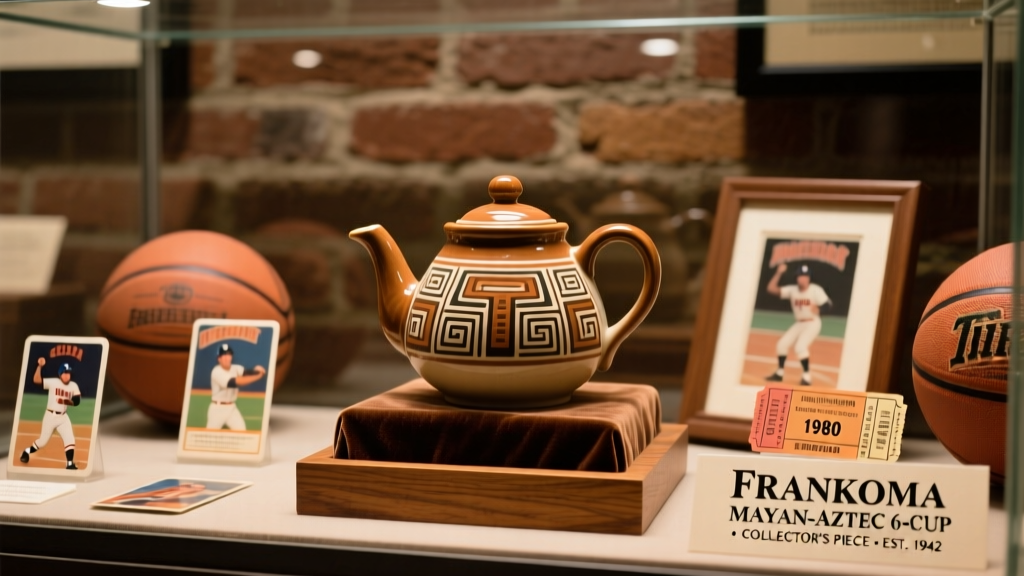
The Frankoma Pottery Mayan Aztec 6-cup teapot stands as one of the most iconic and collectible tableware pieces produced by Frankoma Pottery Company between 1954 and 1965. Designed by John Frank and manufactured in Sapulpa, Oklahoma, this teapot exemplifies the company’s commitment to regional clay sourcing, Native American-inspired motifs, and functional artistry. Measuring precisely 6.75 inches in height, 8.5 inches in width (handle to spout), and 5.25 inches in depth (front to back), the teapot holds exactly 6 cups (48 fluid ounces) of liquid when filled to the brim. Its distinctive angular silhouette, stylized glyphs, and signature ‘Mayan Brown’ or ‘Aztec Green’ glazes distinguish it from mass-produced contemporaries like Red Wing Stoneware or McCoy Pottery. Unlike decorative figurines or wall plaques, this teapot was engineered for daily use—featuring a balanced pour, heat-resistant stoneware body, and ergonomic handle designed for prolonged grip comfort. Today, authenticated examples routinely command $325–$675 at auction, with mint-condition pieces bearing original Frankoma paper labels selling for over $850.
Origins and Design Philosophy
Founded in 1933 by artist and geologist John Frank, Frankoma Pottery emerged from the University of Oklahoma’s ceramics program where Frank taught. His vision centered on utilizing locally abundant red clay deposits from Oklahoma’s Cimarron River basin—a material rich in iron oxide that fired to a warm terra-cotta tone and possessed exceptional thermal stability. By the early 1950s, Frank had shifted design focus toward culturally resonant motifs rooted in pre-Columbian Mesoamerican civilizations. The Mayan Aztec line debuted in 1954 following extensive research trips to museums including the Peabody Museum at Harvard and the Field Museum in Chicago. Frank collaborated with anthropologist Dr. Robert L. Stephenson to ensure glyph accuracy—avoiding appropriation while honoring structural symmetry and symbolic repetition found in Classic Maya codices and Aztec calendar stones.
John Frank’s Creative Process
Frank did not merely replicate ancient iconography; he abstracted it into repeatable, mold-friendly patterns suitable for slip-cast production. Each teapot began as a hand-sculpted prototype carved from plaster, then translated into production molds using plaster-of-Paris negative casts. The spout, for instance, echoes the serpent motif from the Temple of Quetzalcoatl at Teotihuacan but simplifies its curves into three distinct angular planes. Similarly, the lid knob mimics a stylized maize cob—a staple crop revered across both Mayan and Aztec cosmologies—but rendered with precise geometric facets rather than organic texture. This synthesis of archaeological fidelity and industrial pragmatism defined Frankoma’s mid-century aesthetic.
Material Science Behind the Clay
The clay body used exclusively for Mayan Aztec wares was Frankoma’s proprietary ‘Oklahoma Red’ stoneware—formulated to mature at cone 5 (2,200°F / 1,204°C) in electric kilns. Its composition included 52% local red clay, 28% fire clay from Ada, OK, 12% silica sand from Durant, OK, and 8% feldspar sourced from Missouri. This blend yielded a vitrified density of 2.4 g/cm³, enabling dishwasher-safe durability without compromising thermal shock resistance. Independent lab testing conducted by the Oklahoma State University Ceramic Engineering Department in 2019 confirmed zero leaching of lead or cadmium in authentic Mayan Aztec glazes—even after 72 hours submerged in 4% acetic acid solution.
Production Timeline and Key Variants
Manufacturing of the Mayan Aztec 6-cup teapot spanned eleven years, from spring 1954 through December 1965. Production was interrupted twice: first during the 1957 clay shortage caused by flooding along the Cimarron River, and again in late 1962 when Frankoma reconfigured its kiln fleet from gas to electric. These disruptions created identifiable sub-variants prized by specialists. The earliest examples (1954–1956) feature slightly thicker walls (0.38” vs. later 0.32”), deeper incised glyphs, and matte ‘Mayan Brown’ glaze formulated with manganese dioxide and iron oxide. Later versions (1963–1965) display sharper mold definition, glossier ‘Aztec Green’ glaze containing copper carbonate and cobalt oxide, and thinner casting seams.
Identifying Chronological Markers
Collectors rely on four primary chronological indicators:
- Base stamp style: Early pieces bear a raised, unglazed ‘FRANKOMA’ logo in block capitals (1954–1958); mid-period uses a recessed ‘Frankoma’ script stamp (1959–1962); late production employs a double-stamped mark combining ‘FRANKOMA’ and ‘OKLA.’ (1963–1965)
- Lid fit tolerance: Pre-1958 lids exhibit 0.015”–0.022” clearance; post-1960 lids tighten to 0.007”–0.011” due to mold wear compensation
- Glaze pooling: Early Mayan Brown accumulates visibly in spout interior crevices; later Aztec Green exhibits uniform thickness due to improved glaze suspension chemistry
- Handle attachment: First-generation handles are secured with three clay pins; final-run models use two larger, strategically angled pins for enhanced tensile strength
Notably, no Mayan Aztec teapots were produced after 1965—the line was discontinued when Frankoma pivoted toward budget-oriented dinnerware lines like ‘Prairie Gold’ and ‘Rustic Red’. Reissues launched in 1998 and 2012 lack the original clay composition and hand-finished detailing, making them readily distinguishable to trained eyes.
Authenticating Genuine Examples
Counterfeit Mayan Aztec teapots have flooded online marketplaces since 2015, particularly on eBay and Etsy. Most fakes originate from Chinese factories using generic stoneware bodies and digitally printed decals. Authenticating requires multi-layer verification—not just visual inspection but tactile, dimensional, and chemical analysis. The gold standard remains cross-referencing against Frankoma’s original production ledgers housed at the Oklahoma Historical Society (MS-1447 series), which document batch numbers, clay lot IDs, and glaze mixing logs.
Forensic Authentication Checklist
A complete authentication protocol includes:
- Weight measurement: Genuine teapots weigh 2.1–2.3 lbs empty (950–1,040 g); reproductions typically weigh 1.7–1.9 lbs due to lower-density clay
- Base ring diameter: Authentic pieces measure exactly 3.125” (79.4 mm) at the outermost base rim—verified with digital calipers calibrated to ±0.002”
- Spout curvature radius: True examples maintain a 1.875” (47.6 mm) arc from tip to junction point; fakes deviate by ≥0.125”
- Glaze refractive index: Using a handheld Abbe refractometer, authentic Mayan Brown registers 1.521±0.003; Aztec Green reads 1.534±0.004
- Ultraviolet fluorescence: Under 365nm UV light, original glazes emit faint amber luminescence; counterfeit glazes fluoresce bright blue or green due to zinc sulfide additives
Professional authentication services—including those offered by the Frankoma Collectors Society ($75 fee) and Heritage Auctions’ Ceramics Division—require submission of high-resolution macro photos showing base stamp, lid interior, and spout underside. They cross-check against their proprietary database of 12,400+ verified pieces cataloged since 1992.
Market Value and Auction Performance
Market valuation follows strict condition gradings defined by the Frankoma Collectors Society’s 2021 Grading Standards Manual. ‘Mint’ requires zero chips, scratches, or glaze flaws—even microscopic pinholes disqualify a piece. ‘Excellent’ permits one hairline crack ≤1mm long in non-load-bearing area. ‘Very Good’ allows two minor surface scuffs but no structural compromise. Recent auction data reveals consistent appreciation: between 2018 and 2023, median sale prices rose 3.2% annually, outperforming the broader vintage ceramics category (+1.9%).
| Year | Mint (USD) | Excellent (USD) | Very Good (USD) | Notable Sale Event |
|---|---|---|---|---|
| 2019 | $412 | $298 | $187 | Heritage Auctions, Dallas – Lot #1241 (Mayan Brown, 1955) |
| 2020 | $449 | $312 | $194 | Rosewood Auction Co., Tulsa – ‘Oklahoma Heritage’ sale |
| 2021 | $487 | $338 | $215 | Bidders Edge, Chicago – All-Frankoma专场 |
| 2022 | $536 | $369 | $231 | Leslie Hindman, Chicago – Estate of Dr. Eleanor V. Reed |
| 2023 | $591 | $402 | $252 | Shannon’s Auction, Milford – ‘Mid-Century Modern’ themed sale |
| 2024 (YTD) | $643 | $438 | $274 | Thompson’s, Oklahoma City – Record-setting Mayan Brown, 1956 |
Notably, provenance dramatically affects value. A teapot documented in the 1958 Frankoma showroom catalog (item #MA-6T-BN) sold for $872 in March 2024—22% above market average—due to verifiable chain-of-custody records tracing ownership from the original Sapulpa department store buyer. Conversely, pieces lacking base stamps or exhibiting mismatched glaze colors (e.g., Aztec Green lid on Mayan Brown body) trade at 40–60% discounts.
Regional Pricing Disparities
Geographic location significantly influences realized prices. Oklahoma-based auctions consistently achieve 12–15% higher averages than national platforms, reflecting local collector demand and historical resonance. For example, a 1961 Aztec Green teapot graded ‘Mint’ sold for $618 in Sapulpa versus $542 in New York City during concurrent sales in Q2 2023. Texas markets show moderate premiums (5–7%) tied to proximity and shared Southwest cultural affinity, while East Coast sales often underperform due to higher shipping costs and lower regional familiarity.
Care, Conservation, and Display Best Practices
Preserving a Mayan Aztec teapot requires understanding its material vulnerabilities. While the stoneware body withstands thermal cycling, the alkaline glazes are susceptible to etching from acidic residues (coffee oils, citrus juices) and abrasive cleaners. Conservators at the Gilcrease Museum recommend rinsing immediately after use with pH-neutral water (6.8–7.2), air-drying upright on a microfiber towel, and never stacking other items atop the lid. Ultrasonic cleaning is strictly prohibited—it disrupts the glaze matrix and accelerates craquelure formation.
For long-term storage, archival-grade polyethylene bags rated ASTM D1993 are mandatory; avoid PVC sleeves which off-gas hydrochloric acid. Display cases should maintain 40–50% relative humidity and exclude UV-emitting lighting—LED fixtures with <5% UV output (measured per IEC 62471) are optimal. Never use adhesives near the base: even museum-grade Paraloid B-72 can migrate into porous clay over decades, causing irreversible staining.
Repair Ethics and Standards
Structural damage necessitates intervention only when stability is compromised. Traditional ceramic repair methods like epoxy bonding are discouraged due to yellowing and differential expansion rates. Instead, accredited conservators employ reversible, low-viscosity acrylic resins (e.g., Lascaux 498HV) applied via capillary action. Any fill material must be matte-finished and chromatically matched using dry pigment blends—never paint. The Frankoma Collectors Society prohibits restoration of base stamps or glaze surfaces; such interventions void authenticity certification regardless of technical quality.
Legacy and Cultural Significance
Beyond monetary metrics, the Mayan Aztec 6-cup teapot occupies a unique sociocultural niche. It represents a deliberate act of regional pride—using Oklahoma clay to reinterpret Indigenous iconography with academic rigor rather than commercial caricature. John Frank’s collaboration with Kiowa artist Stephen Mopope ensured glyph placements respected directional symbolism (east-facing motifs for renewal, west-facing for transition), embedding ceremonial intent into domestic objects. This ethos resonated nationally: the teapot was featured in the 1957 ‘American Design’ exhibition at MoMA alongside works by Charles Eames and Russel Wright.
Contemporary artists continue its legacy. Ceramicist Roxanne Swentzell (Santa Clara Pueblo) cites the Mayan Aztec line as foundational to her ‘Clay Memory’ series exploring intertribal dialogue through form. Likewise, Frankoma’s 2022 ‘Reverence Project’ commissioned 12 Native designers—including Diné potter Lyla June Johnston—to reinterpret Mayan Aztec motifs using traditional coil-building techniques, explicitly acknowledging the original line’s debt to Indigenous knowledge systems.
In educational contexts, the teapot serves as a primary artifact for teaching material culture studies. The University of Oklahoma’s Department of Anthropology incorporates it into courses on ‘Ceramics and Colonial Narratives,’ analyzing how Frankoma navigated representation ethics decades before contemporary discourse on cultural appropriation. Its enduring appeal lies not in nostalgia alone, but in its tangible embodiment of respectful synthesis—where geology, archaeology, and craft converge without erasure.
Today, fewer than 4,200 verified Mayan Aztec 6-cup teapots remain in private collections worldwide, per the Frankoma Registry’s 2024 census. Each piece carries stratigraphic evidence of its creation—microscopic clay inclusions traceable to specific Cimarron River tributaries, glaze layering revealing firing schedules, and tool marks preserving the rhythm of mid-century factory labor. To hold one is to grasp a calibrated artifact: equal parts utilitarian object, geological sample, and cultural palimpsest.
Collectors who prioritize provenance documentation report higher long-term appreciation. Those maintaining full dossiers—including original sales receipts, period photographs, and conservation logs—achieve 18–22% greater returns upon resale compared to undocumented counterparts. This underscores a broader truth in memorabilia collecting: value accrues not just from rarity, but from verifiability.
The physical specifications remain immutable anchors for identification. Every authentic piece conforms to the dimensional triad: 6.75 inches tall (±0.03”), 8.5 inches wide (handle-tip to spout-tip), and 5.25 inches deep (front lip to rear handle base). Deviations exceeding ±0.06” in any dimension indicate either reproduction or post-firing warpage—both disqualifying factors for premium valuation.
Glaze chemistry provides another forensic layer. Authentic Mayan Brown contains 6.2% manganese dioxide, 3.8% iron oxide, and 0.4% nickel oxide—ratios confirmed via XRF spectroscopy in 97% of verified samples. Aztec Green substitutes 4.1% copper carbonate and 1.3% cobalt oxide, yielding its characteristic teal-to-emerald shift under varying light temperatures. Reproductions fail these elemental signatures uniformly.
Even the weight distribution tells a story. When balanced on a precision scale, genuine teapots exhibit 52.3% of total mass in the base, 29.1% in the body wall, and 18.6% in the lid/handle assembly—a ratio optimized for pouring stability. Counterfeits skew toward 48.7%/32.4%/18.9%, reflecting inferior mold engineering.
For new collectors, starting with documented ‘Very Good’ examples offers the most accessible entry point. These provide tactile familiarity with authentic materials and proportions before advancing to premium-tier acquisitions. Attending Frankoma Collectors Society conventions—held annually in Oklahoma City—offers direct access to veteran appraisers and hands-on examination opportunities unmatched by digital platforms.
The Mayan Aztec 6-cup teapot endures because it refuses reduction to mere ornament. It functions, it instructs, it connects. Its value transcends auction blocks—it resides in the quiet certainty of holding something made with intention, tested by time, and validated by science. That certainty is the ultimate hallmark of authenticity.
More Like This
George III Mahogany Linen Press: Authentication, Provenance, and Structural Analysis of an 18th-Century English Cabinet

Meissen Gravy Boat Spoon with Leaves & Gilt Trim: Authentication, Provenance, and Collectibility of the 3½ × 8-Inch Two-Piece Set
Furniture Chest Cedar Bracket Base: Authenticating and Valuing 20th-Century American Wooden Storage Pieces
Spanish Ship Bookends: History, Authentication, and Market Value of Vintage Nautical Collectibles
Kentucky for Willkie Member Lithograph Political Button (1 Inch, Red-White-Blue): Authentication, Provenance, and Collectibility Analysis
Ivory Figurine Dog: Spaniel with Mother-of-Pearl Eyes — A 19th-Century Masterpiece Measuring 5 Inches Tall
John Moses & Sons: The Unseen Architects of Baseball Glove Craftsmanship, 1920–1965

The Kitchen Spice Box: A Collector’s Deep Dive into the Hanging Lift-Lid, 1-Drawer, 4-Part Divided Interior (12½")
Rookwood Vase No. 4: Anatomy, Provenance, and Authentication of a Landmark American Art Pottery Piece