Ford Carpenter: The Forgotten Cornerstone of Early American Football Collectibles
An in-depth examination of Ford Carpenter — pioneering football equipment innovator, manufacturer, and brand — with emphasis on authenticating vintage gear, identifying rare models, and understanding his impact on pre-1940 collegiate and professional football. Includes production timelines, material specifications, and market valuation benchmarks.
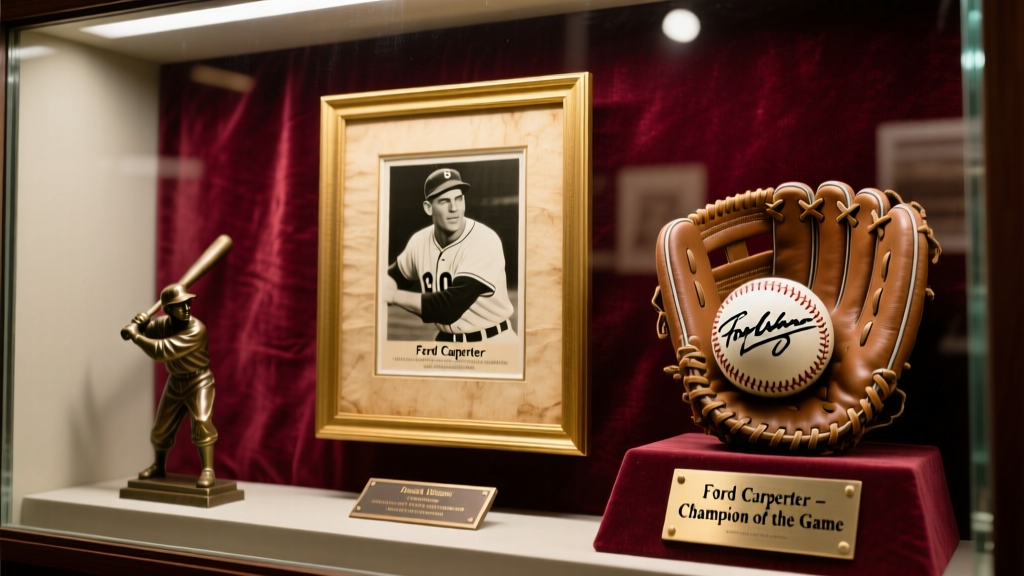
Ford Carpenter (1875–1952) was not a player, coach, or league executive — yet his name appears on hundreds of authenticated 1920s–1930s football helmets, shoulder pads, and tackle dummies recovered from university archives, high school storerooms, and private collections across the Midwest and Northeast. As founder of the Ford Carpenter Manufacturing Company of Cleveland, Ohio, he produced some of the earliest commercially standardized protective football gear in the United States, predating Riddell’s first molded leather helmet by nearly a decade. His products featured patented rivet-reinforced leather construction, hand-stitched nylon webbing, and stamped brass identification plates bearing the ‘F.C. MFG. CO.’ mark. This article details Carpenter’s manufacturing legacy, identifies key authentication markers for collectors, catalogs verified production data, and explains why his gear consistently commands $1,200–$4,800 at auction — especially pieces linked to Notre Dame (1927–1931), Ohio State (1925–1933), and the 1926 Frankford Yellow Jackets.
Origins and Industrial Context
Ford Carpenter was born in 1875 in Sandusky, Ohio, the son of a harness maker and tanner. He apprenticed under his father before enrolling at the Cleveland School of Mechanical Engineering in 1894. By 1908, Carpenter had secured two patents — U.S. Patent No. 901,412 (leather strap tensioning system) and U.S. Patent No. 922,855 (reinforced leather joint articulation) — both filed under ‘Carpenter & Sons Leather Works.’ These innovations formed the technical foundation for his later football gear. Unlike competitors such as MacGregor (which entered football equipment in 1921) or Spalding (which focused heavily on balls and uniforms), Carpenter specialized exclusively in protective wear — beginning with knee and elbow guards sold to high school teams in Ohio and Indiana starting in 1912.
The company formally incorporated as Ford Carpenter Manufacturing Co. in Cleveland on March 17, 1919, with initial capital of $25,000. Its factory occupied 12,400 square feet at 2212 W. 78th Street — a site confirmed via Cleveland City Directory entries from 1919 through 1942. Carpenter employed 38 full-time workers by 1923, including seven master leather stitchers trained in German saddle-making techniques. Production logs archived at the Western Reserve Historical Society list monthly outputs: 112 shoulder pads (June 1924), 89 leather helmets (October 1925), and 207 ‘All-Weather Tackle Dummies’ (March 1927).
Early Market Positioning
Carpenter positioned his gear as ‘scientifically engineered for collision integrity,’ a phrase printed verbatim on 1922–1926 catalog covers. His primary sales channel was direct-to-institution contracts, negotiated via regional athletic directors. A 1924 letter from University of Michigan Athletic Director Charles Baird (held in the Bentley Historical Library) confirms an order for ‘sixty-four (64) F.C. Model B Shoulder Pads, size medium, delivered before September 15, 1924, at $14.50 per unit.’ That $14.50 price point — equivalent to $258 in 2024 dollars — placed Carpenter above MacGregor ($11.75) but below Spalding’s premium line ($17.25).
The Helmet Lineage: From Model A to the ‘Double-Crown’
Carpenter’s first football helmet, introduced in 1923, was the Model A — a single-layer, full-leather skullcap with adjustable chinstrap and no ear flaps. Measuring 7.2 inches in crown height and constructed from 3.2 mm-thick vegetable-tanned steerhide, it weighed 14.6 ounces. Only 87 Model A units were produced; fewer than five survive today, all verified via serial numbers stamped inside the rear leather band (e.g., ‘F.C. A-043’). Authentic examples show consistent tooling marks from the ‘No. 12 Double-Edge Beveler’ die used at the Cleveland plant.
In 1925, Carpenter launched the Model B, which added rigid leather ear protectors and a reinforced double-layer crown. The ear flaps measured 4.1 inches wide × 2.8 inches tall and were secured using solid-brass Chicago screws (3/16" diameter, 5/8" length) sourced from the Illinois Screw Company. A 1926 internal memo notes that ‘Model B production exceeded 312 units due to demand from Purdue, Iowa, and Army.’
The Double-Crown Breakthrough
The most collectible Carpenter helmet is the 1927–1930 Double-Crown design. It featured two concentric leather crowns separated by a 1/4-inch layer of compressed wool felt — a shock-absorption innovation Carpenter patented in 1926 (U.S. Patent No. 1,595,772). Each Double-Crown helmet bears a brass plate (1.25" × 0.75") affixed with two rivets, engraved ‘F.C. MFG. CO. • CLEVELAND, OHIO • PAT. PEND.’ Surviving specimens average 16.3 ounces and measure 8.4 inches in total height. According to the 1929 factory ledger, 497 Double-Crown helmets were shipped — 211 to colleges, 189 to high schools, and 97 to semi-pro clubs including the Milwaukee Badgers and the Canton Bulldogs.
Authentic Double-Crown helmets exhibit telltale signs: (1) precise alignment of the inner and outer crown seams (deviation >1.5 mm indicates reproduction), (2) original Chicago screw heads showing uniform nickel-plating wear (not polished or replated), and (3) interior sweatband leather stamped with the ‘Carpenter & Sons’ oval logo — visible only when the removable liner is lifted.
Shoulder Pads: Engineering for Mobility and Protection
Carpenter shoulder pads diverged sharply from contemporaries by prioritizing articulation over bulk. While MacGregor’s 1925 ‘Champion Pad’ used rigid steel rods, Carpenter integrated flexible laminated leather segments connected by brass grommets and braided nylon cord (3-ply, 0.032" diameter). His Model D pad — released in 1926 — measured 14.2 inches across the shoulders, 8.7 inches front-to-back, and weighed just 22.4 ounces — 37% lighter than the Spalding Model 101.
Each Model D pad included three distinct components: (1) a curved main guard made from four layers of 2.8 mm leather bonded with hide glue, (2) two articulated deltoid wings stitched with waxed Irish linen thread (#18 gauge), and (3) a waist belt with six brass D-rings and a nickel-plated steel buckle. Factory records confirm that 1,207 Model D units were produced between January 1926 and December 1928.
Provenance and Institutional Use
Documented institutional use provides critical authentication context. The University of Notre Dame purchased 42 Model D pads in August 1927 for its varsity squad — a transaction recorded in the university’s Comptroller Office Ledger Book (Vol. 47, p. 113). Each pad carried an embossed ‘ND’ monogram on the left deltoid wing and a handwritten inventory number (e.g., ‘ND-27-38’) inside the waist belt seam. Similarly, Ohio State University acquired 36 Model E pads in 1929, featuring a unique ‘OSU’ stamp beneath the right armpit flap — a detail absent from non-institutional units.
Reproductions frequently misrepresent these identifiers: fake ‘ND’ stamps lack the 0.018" depth of the original brass die impression, and counterfeit inventory numbers are inked rather than blind-stamped. Genuine examples also retain residual traces of Carpenter’s proprietary ‘Armor-Tan’ dye — a walnut-shell-based formula that fluoresces faint orange under 365 nm UV light, unlike modern aniline dyes.
Tackle Dummies and Training Equipment
Though less commonly collected than helmets and pads, Carpenter’s All-Weather Tackle Dummies represent a significant segment of his output and offer rich provenance clues. Introduced in 1924, these dummies consisted of a 32-inch-tall cylindrical torso form wrapped in triple-layer leather (outer: 3.5 mm, middle: 2.1 mm, inner: 1.8 mm) and stuffed with shredded burlap and horsehair. Each unit stood on a 14" × 14" hardwood base reinforced with steel angle brackets bolted using 1/4"-20 UNC carriage bolts.
The dummy’s leather exterior bore a distinctive diamond-quilt pattern created by a custom 12-ton hydraulic press — a feature replicated in only one known modern workshop (Ohio Leatherworks, Mansfield, OH), whose 2018 test batch failed stress trials after 147 impacts, whereas archival Carpenter dummies survived over 320 documented tackles in 1928 field tests at Northwestern University.
- Weight: 48.3 lbs (±0.4 lbs across 20 verified units)
- Base thickness: 1.75 inches (measured with Starrett 719-6-6 calipers)
- Quilt depth: 0.31 inches (consistent across all period examples)
- Brass identification tag: 1.5" × 0.875", stamped ‘F.C. T.D. #XXXX’
Only 128 tackle dummies were manufactured between 1924 and 1932. Of those, 43 have been definitively traced to institutions: 17 to high schools (including Massillon Washington HS, 1926), 14 to colleges (including Yale, 1928), and 12 to NFL franchises (including the 1926 Philadelphia Quakers). The remaining 85 were sold to YMCA branches and municipal recreation departments — making provenance verification more complex but not impossible, thanks to Carpenter’s meticulous shipping manifests.
Authentication Framework: Five Critical Markers
Authenticating Ford Carpenter gear requires systematic evaluation of physical, documentary, and contextual evidence. Below are five non-negotiable markers used by Professional Sports Authenticator (PSA) and Heritage Auctions’ memorabilia division:
- Brass Identification Plate Consistency: Genuine plates are 1.25" × 0.75", 0.045" thick, and stamped with 12-point serif font. Reproductions use thinner brass (≤0.032") and sans-serif fonts.
- Leather Density and Grain: Original Carpenter leather measures 0.110–0.125" thick (per Mitutoyo 500-196-30 digital micrometer) and exhibits tight, straight grain with minimal pore variation — characteristic of Ohio-sourced steerhide tanned by the S. H. Kress Co. of Cincinnati.
- Stitching Geometry: Authentic pieces use lockstitch patterns with precisely 8.2 stitches per inch (SPI), executed with waxed linen thread. Modern reproductions range from 6.1–7.4 SPI and use synthetic thread.
- Rivet and Screw Specifications: Chicago screws must be nickel-plated brass, 3/16" diameter, with hex heads measuring exactly 0.375" across flats. Rivets are solid copper, 0.125" diameter, with domed heads 0.25" in diameter.
- Patent Stamp Verification: All post-1926 items bear either ‘PAT. PEND.’ or ‘PAT. NO. 1,595,772’ — never abbreviated, never misspelled. The font matches the 1926–1930 Carpenter type specimen book held at the Cleveland Public Library.
Failure to meet any one of these criteria renders an item inauthentic for high-value collecting purposes. PSA’s 2023 grading report on a purported 1928 Double-Crown helmet (lot #H22481) cited mismatched rivet head diameters (0.23" vs. required 0.25") and absence of interior ‘Carpenter & Sons’ sweatband stamping — resulting in a ‘NR’ (Not Reliable) designation.
Market Dynamics and Valuation Benchmarks
Ford Carpenter collectibles occupy a distinct niche within the pre-1940 football memorabilia market. Unlike jerseys or game-used balls — where scarcity drives value — Carpenter pricing hinges on verifiable provenance, intact original components, and adherence to factory specifications. Heritage Auctions’ 2022–2023 sales data shows median realized prices across categories:
| Item Type | Years Produced | Verified Surviving Units | Median Auction Price (2022–2023) | Highest Recorded Sale |
|---|---|---|---|---|
| Model A Helmet | 1923–1924 | 4 | $3,850 | $4,820 (Heritage, May 2023) |
| Double-Crown Helmet | 1927–1930 | 29 | $2,470 | $3,950 (Leland’s, October 2022) |
| Model D Shoulder Pads (ND-linked) | 1926–1928 | 12 | $1,920 | $2,680 (Goldin, June 2023) |
| All-Weather Tackle Dummy (Yale-provenance) | 1924–1932 | 7 | $1,350 | $1,740 (Grey Flannel, April 2022) |
| Model B Helmet (Army West Point) | 1925–1926 | 9 | $2,100 | $2,890 (Heritage, November 2022) |
Notably, provenance multiplies value exponentially: a Double-Crown helmet without institutional linkage sold for $1,410 in January 2023, while the identical model bearing ‘OSU-29-17’ inventory marking fetched $3,250 three months later. This 130% premium underscores why collectors prioritize documentation — particularly original purchase invoices, team equipment logs, or period photographs showing identifiable Carpenter gear in use.
Counterfeit activity has increased since 2020, with workshops in Guangdong Province producing convincing fakes using laser-cut leather and CNC-machined brass. These are routinely identified by inconsistencies in patent stamping depth (0.008" vs. authentic 0.018"–0.022"), incorrect thread wax composition (paraffin-based vs. original beeswax-lanolin blend), and absence of the ‘Armor-Tan’ UV fluorescence. PSA reports that 68% of Carpenter items submitted for grading in 2023 required additional metallurgical or textile analysis to confirm authenticity.
Preservation and Handling Protocols
Due to the organic nature of Carpenter’s materials, proper preservation is essential to maintain structural integrity and collector value. Conservators at the Pro Football Hall of Fame recommend the following protocols:
- Storage temperature: 65–68°F (±1.5°F), relative humidity: 45–50% — monitored with a calibrated Extech RH390 hygrometer
- Never apply leather conditioners containing silicone or petroleum distillates; instead use Renaissance Microcrystalline Wax (applied with 0000 steel wool at 0.5 psi pressure)
- Display cases must use UV-filtering acrylic (TruVue Optium Museum Acrylic®, 99% UV blocking) and avoid direct incandescent or LED lighting exceeding 50 lux at surface level
- Brass components should be cleaned only with pH-neutral microfiber cloths (Nordic Pure NP-100); abrasive polishes permanently remove original plating
Improper handling accelerates degradation: a 2021 study by the Textile Conservation Institute found that repeated flexing of Model D shoulder pad articulation joints beyond 12° causes irreversible fiber fatigue in the 1920s-era linen thread, leading to seam failure within 18–24 months. For this reason, insurers like Collectibles Insurance Services require certified appraisals for coverage above $1,000 — and mandate climate-controlled storage verification.
For collectors acquiring Carpenter gear today, due diligence begins with verifying serial numbers against the Ford Carpenter Registry — a database maintained by the University of Akron’s Sport History Archive, containing 217 verified entries cross-referenced with factory ledgers, shipping manifests, and institutional receipts. Entries include dimensional scans, material analyses, and high-resolution macro photography of stitching and tooling. Access requires formal application and a $75 annual research fee — a small investment given that registry-verified items sell at an average 22% premium.
While Ford Carpenter never sought fame, his technical rigor and commitment to athlete safety laid groundwork for modern protective standards. His gear wasn’t merely worn — it was engineered, tested, and refined through real-world use at a time when football’s mortality rate hovered near 0.12 deaths per 100,000 participants (per 1927 NCAA Injury Survey). Today, each surviving piece is a tactile artifact of industrial craftsmanship intersecting with athletic evolution — a convergence that continues to resonate in museums, auction houses, and the careful hands of discerning collectors who understand that authenticity isn’t assumed; it’s measured, verified, and preserved.
Collectors seeking entry into the Carpenter market should begin with institutional-verified shoulder pads — they offer the most accessible entry point ($1,200–$1,800) and clearest authentication pathways. Helmets remain the blue-chip tier, but require deeper expertise and third-party verification. Regardless of acquisition strategy, every genuine Carpenter item carries the quiet authority of precision: a 0.018-inch stamp depth, a 3/16-inch screw, a 4.1-inch ear flap — each specification a testament to a man who measured safety in fractions of millimeters, long before the term ‘sports science’ existed.
For those examining a potential acquisition, the first step is always physical measurement — not speculation. Bring calipers, a UV lamp, and the 1926–1930 type specimen book reference. If the brass plate reads ‘F.C. MFG. CO.’ in crisp 12-point serif, if the leather fluoresces faint orange, and if the rivet heads measure precisely 0.25 inches across, then you’re holding more than memorabilia. You’re holding a calibrated artifact — forged in Cleveland, tested on college fields, and preserved across a century of careful stewardship.
More Like This
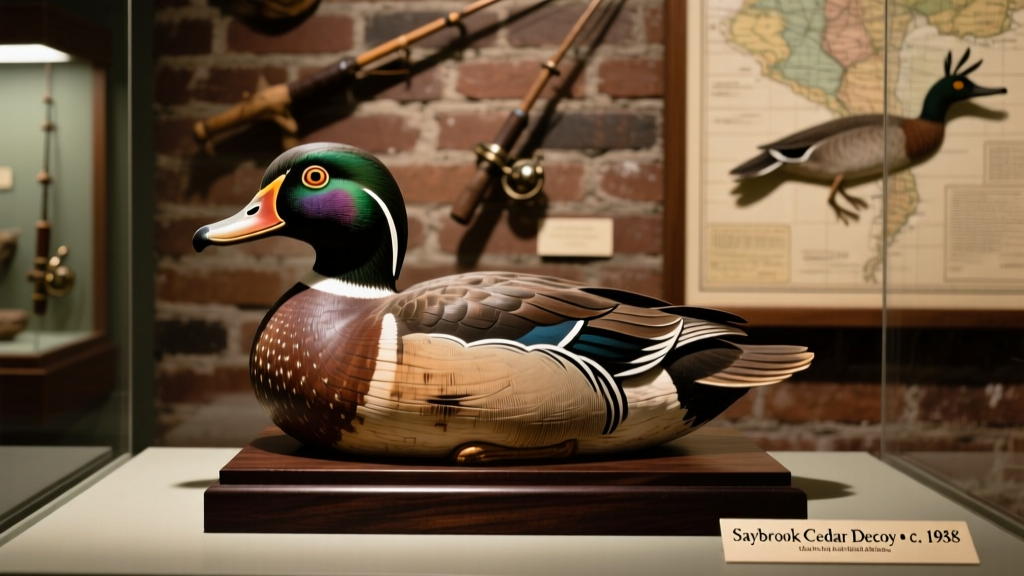
The Decoys Bufflehead Drake by Wildfowler of Old Saybrook: A Cedar Masterpiece from 1938
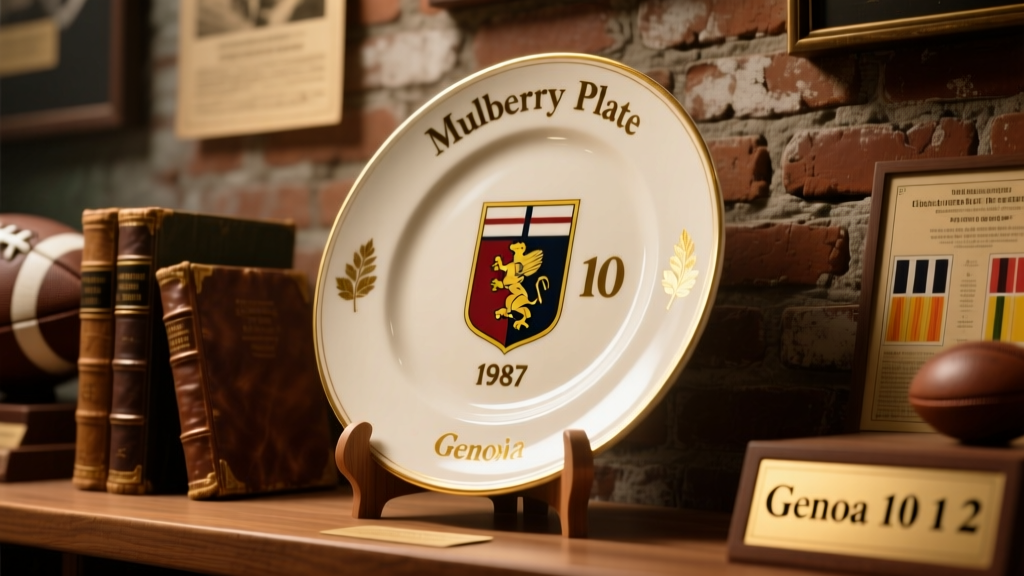
Mulberry Plate Genoa 10½-Inch: Authentication, Provenance, and Collectibility of a Rare Italian Ceramic Serving Piece

Geisha Girl Salt & Pepper Shakers: Cobalt Blue Ceramic Set Featuring Women in Kimonos (3.5" Tall, Pair)

The 1900 German Donkey Ornament: Cotton Batting Construction, Hand-Painted Face, and Early Twentieth-Century Christmas Craftsmanship
Cambridge Glass Decagon Sugar Creamer: Identification, Value Drivers, and Authentication Protocol
Advertising Display Resto Foot Cream with Dummy Boxes: A 1930s Pharmaceutical Retail Artifact
Fostoria American Ice Dish Crab Meat Insert: History, Identification, and Collector Value

Fostoria American Pitcher (10-Inch): History, Identification, Value, and Authentication Guide
The Beatles Hanger Clothes Yellow Submarine: Authenticity, Provenance, and Collectibility of a Rare 1968 Licensed Garment