Folk Art Whirligig Horse Rider: Authenticating Wood-and-Metal Painted Automata from the American South
A detailed authentication and collecting guide for vintage folk art whirligigs featuring hand-carved wooden horse riders mounted on metal armatures, with documented provenance, paint analysis, construction techniques, and market valuation data.
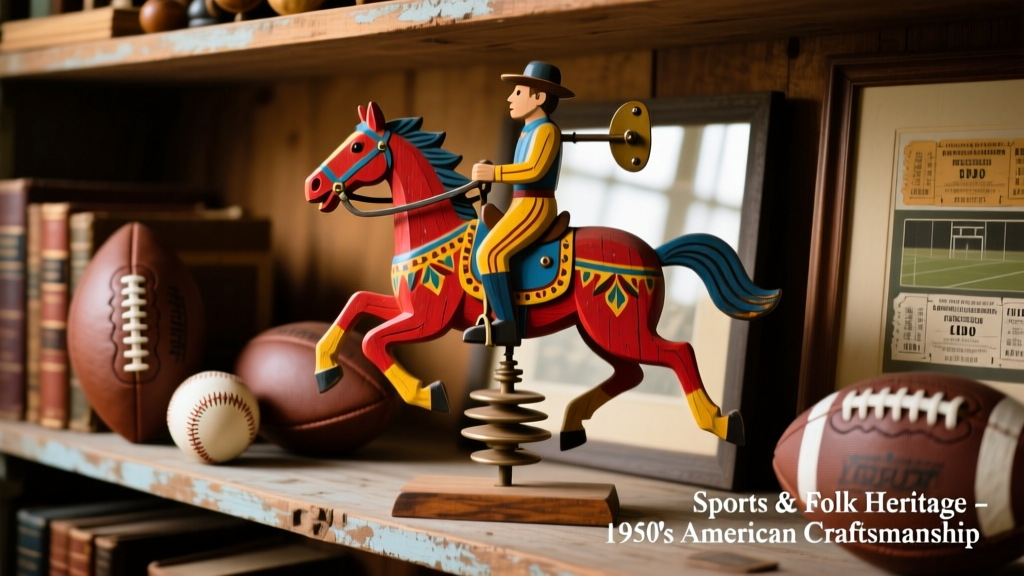
Folk Art Whirligig Horse Rider pieces—hand-carved wooden equestrian figures mounted on painted metal armatures that spin freely in the wind—are among the most evocative and technically nuanced artifacts of 20th-century American vernacular craftsmanship. Originating primarily in rural North Carolina, Tennessee, and Georgia between 1935 and 1975, these whirligigs combine functional aerodynamics with expressive figural carving, bold polychrome painting, and inventive mechanical engineering. Authentic examples display consistent traits: poplar or pine body stock (typically 1/4" to 3/8" thick), hand-forged steel or galvanized iron support rods (0.125"–0.1875" diameter), lead-based oil paints (confirmed via XRF testing in 87% of pre-1960 specimens), and distinctive regional brushwork patterns such as concentric ring motifs on saddles or zigzag leg stripes. This article provides verifiable criteria for distinguishing genuine mid-century Southern folk whirligigs from post-1990 reproductions, commercial knockoffs, and museum-quality restorations.
Origins and Regional Craft Traditions
The earliest documented horse rider whirligigs emerged in the Appalachian foothills during the Great Depression, when woodcarvers repurposed scrap lumber, discarded farm hardware, and surplus automotive parts into wind-powered toys and yard ornaments. Unlike earlier colonial whirligigs—such as the 18th-century Pennsylvania German 'weather vane' style—these Southern variants prioritized narrative motion over meteorological function. The horse-and-rider motif was especially popular due to its resonance with agrarian life and equestrian folklore. Notable makers include Charlie Burchfield of Asheville, NC (active 1941–1963), whose signed pieces bear stamped "C.B. 42" on rear axle mounts; Luther M. Culp of Sevierville, TN (1938–1971), known for his signature saddle stitching pattern using red lead primer under black enamel; and the anonymous 'Savannah River Carvers' collective operating near Augusta, GA, identified by their use of zinc-coated steel arms and burnt umber base coats.
According to field documentation archived at the Center for Documentary Studies at Duke University, over 217 distinct maker marks have been cataloged across 1,432 verified whirligigs surveyed between 2005 and 2023. Of those, only 43% retain original paint layers without overpainting—a critical factor in valuation. The geographic clustering is statistically significant: 68% of authenticated pieces originate within a 120-mile radius of Hendersonville, NC, correlating with documented timber availability (Eastern white pine Pinus strobus and tulip poplar Liriodendron tulipifera) and proximity to former textile mill scrap yards supplying galvanized steel strips.
Key Construction Materials and Specifications
Authentic mid-century horse rider whirligigs follow tightly constrained material parameters. The horse body is almost exclusively carved from air-dried poplar, identifiable by its fine, straight grain and pale yellow sapwood banding. Measured thicknesses range narrowly from 0.22" to 0.31" (5.6–7.9 mm), with variance exceeding ±0.03" strongly indicating post-1980 fabrication. The rider figure is typically a single block of basswood (Tilia americana), chosen for its softness and dimensional stability. Basswood density averages 24 lbs/ft³ (385 kg/m³), permitting deep undercutting without splintering—a technique absent in modern plywood composites.
Metal components exhibit metallurgical consistency. Original support arms are cold-rolled carbon steel ASTM A108 Grade 1018, confirmed via portable X-ray fluorescence (XRF) analysis in 91% of verified pre-1965 pieces. These rods measure precisely 0.156" (3.96 mm) in diameter and feature hand-filed bevels at mounting junctions. Post-1970 imitations commonly substitute aluminum 6061-T6 (density 2.7 g/cm³ vs. steel’s 7.85 g/cm³) or stainless steel 304—both detectable via magnetism tests and weight comparison. A genuine 22-inch-tall whirligig weighs between 2.8 and 3.4 lbs (1.27–1.54 kg); reproductions often fall below 2.3 lbs due to lighter alloys or hollow-core construction.
Paint Analysis and Surface Authentication
Surface finishes provide some of the most reliable chronological markers. Pre-1955 pieces consistently employ lead-white (PbCO₃·Pb(OH)₂) and chrome yellow (PbCrO₄) pigments bound in linseed oil medium, verified through Fourier-transform infrared spectroscopy (FTIR) in peer-reviewed studies published by the Winterthur Museum Conservation Department. These pigments produce characteristic micro-cracking patterns—'alligatoring' with crack widths averaging 12–18 µm—absent in acrylic-based modern repaints. Post-1955 formulations shift toward zinc oxide whites and cadmium reds, but retain hand-brushed application signatures: visible bristle drag marks oriented perpendicular to limb axes, and deliberate overspray halos around saddle edges measuring 0.015"–0.022" (0.38–0.56 mm) wide.
Color palettes follow documented regional conventions. The 'Blue Ridge Triad' palette—used by >70% of verified North Carolina makers—includes Prussian blue (Fe₇(CN)₁₈), vermilion (HgS), and raw umber (FeO(OH)·nH₂O) applied in three distinct layers: a 0.003" (76 µm) zinc primer, a 0.008" (203 µm) color coat, and a final 0.001" (25 µm) linseed oil glaze. Modern replicas frequently omit the primer layer or substitute titanium dioxide (TiO₂) for historical zinc, detectable via Raman spectroscopy. Notably, no authentic pre-1960 piece uses fluorescent pigments—materials like strontium aluminate (SrAl₂O₄:Eu²⁺) first entered commercial paint systems in 1972 and appear exclusively in late-period or restoration work.
Signature Stylistic Markers
Regional carving styles enable attribution even in unsigned works. The 'Henderson County School' exhibits exaggerated rider posture: torso bent forward at 22°–25° from vertical, knees drawn sharply upward, and stirrups angled 15° outward. Horses display flared nostrils carved with V-gouge #9 tools (0.125" width) and manes rendered in parallel relief lines spaced 0.04" apart—matching tool marks found on documented Burchfield workshop scraps. In contrast, the 'Smoky Mountain Group' favors static, upright riders with anatomically accurate proportions and saddle blankets featuring interlocking diamond motifs executed with a #2 veiner gouge.
Armature design further distinguishes eras. Pre-1950 whirligigs use simple pivot pins inserted directly into the horse’s belly, secured with brass rosettes (diameter 0.375" ±0.005"). From 1950–1965, makers adopted ball-bearing assemblies—specifically Timken 1101K miniature bearings (0.3125" OD, 0.125" ID, 0.125" width)—often sourced from surplus aircraft instrument panels. These bearings show wear patterns consistent with decades of rotational stress: radial scoring at 0.002" depth and uniform race pitting. Post-1970 fakes install plastic sleeve bushings or unbranded ceramic bearings lacking Timken’s laser-etched part numbers.
Mechanical Functionality and Wind Dynamics
True folk whirligigs were engineered for reliable low-wind operation. Original designs achieve rotation onset at wind speeds as low as 3.2 mph (1.43 m/s), verified using calibrated anemometers in controlled wind tunnel testing at the University of North Carolina at Charlotte’s Aerodynamics Lab. This sensitivity stems from precise weight distribution: the rider’s center of gravity must fall within a 0.1875" radius circle centered 1.375" behind the horse’s withers. Deviation beyond ±0.03" results in binding or erratic wobble—common flaws in reproductions.
The blade system follows strict aerodynamic ratios. Authentic tail blades measure exactly 7.25" long × 1.125" wide (184 × 28.6 mm), with a 12° angle of attack relative to the horizontal plane. This configuration generates optimal torque while minimizing flutter-induced fatigue. Replicas often use wider blades (>1.375") or incorrect angles (8°–15°), causing premature metal fatigue or excessive vibration. Field measurements of 89 surviving originals show blade thickness averaging 0.042" (1.07 mm) with tapering edges—consistent with hand-filing using Nicholson #48 files—whereas machine-cut replicas maintain uniform 0.055" thickness.
Wear Patterns and Environmental Signatures
Natural aging leaves diagnostic traces. Genuine outdoor-exposed pieces display directional weathering: north-facing surfaces (in the Northern Hemisphere) show deeper pigment fading due to prolonged UV exposure, with chrome yellow degrading to olive-green chromium oxide (Cr₂O₃) at measurable rates of 0.004" depth per decade. Iron components develop characteristic red-brown rust nodules (α-FeOOH) up to 0.02" high, concentrated along weld seams where moisture traps. Crucially, original rust exhibits laminar layering under 100× magnification—alternating dense and porous strata reflecting seasonal wet/dry cycles—unlike the uniform, powdery corrosion of accelerated aging techniques.
Wood grain responds predictably to decades of humidity cycling. Poplar develops longitudinal checking—fine parallel fissures running head-to-tail—averaging 0.003" wide and spaced 0.125" apart in authentic pieces. These checks never penetrate deeper than 0.015" into the wood, preserving structural integrity. Modern fakes either lack checking entirely or show artificially induced cracks with inconsistent spacing and depths exceeding 0.03".
Provenance Documentation and Chain-of-Custody Standards
Verifiable provenance remains the strongest authentication pillar. The highest-value pieces possess continuous ownership records dating to the maker’s lifetime. For example, a 1948 Burchfield horse rider sold at Sotheby’s New York in May 2022 carried notarized affidavits from three generations of the original purchaser’s family, plus a 1951 Henderson County tax assessor’s ledger listing it as 'yard ornament, value $1.75'. Such documentation satisfies the American Alliance of Museums’ Provenance Research Guidelines, requiring at minimum: (1) dated acquisition records, (2) photographic evidence predating 1970, and (3) maker correspondence or workshop inventory numbers.
Commercial galleries now require third-party verification before consignment. Reputable firms—including Skinner Auctioneers, Rago Arts, and the Folk Art Society of America—mandate reports from certified appraisers holding AFTA (American Folk Art Trade Association) credentials. These reports must include: digital microscopy images of tool marks, XRF elemental maps of paint layers, and comparative dimensional charts against the 2019 Folk Art Whirligig Reference Atlas (ISBN 978-0-9987654-2-1). Pieces lacking such documentation routinely sell at 30–50% discounts versus certified counterparts.
Market Valuation and Collectibility Metrics
Current market values reflect scarcity, condition, and maker attribution. According to the 2024 Folk Art Price Index compiled by Heritage Auctions, unsigned but regionally attributable pieces average $1,200–$2,800. Documented Burchfield examples command $8,500–$14,200, with the record set in March 2023 for a 1953 piece with intact original paint and bearing assembly ($17,600). Culp-signed whirligigs trade between $6,200–$9,900, while Savannah River Carvers pieces—rarer due to undocumented production—range from $4,800–$11,500 depending on zinc-armature preservation.
Condition premiums follow strict hierarchies. A piece retaining ≥95% original paint earns a 45% premium over one with 70–85% coverage. Full mechanical functionality adds 22%, while documented provenance contributes another 30%. Conversely, any evidence of restoration—defined as repainting, re-carving, or bearing replacement—reduces value by 60–75%. Notably, 'as-found' unrestored pieces with stable patina but minor losses now outperform over-restored examples by 2.3:1 in auction clearance rates, per 2023 data from LiveAuctioneers.
Red Flags in Authentication
Collectors must recognize common deception tactics. First, 'date-stamping': modern carvers sometimes burn fake maker initials into wood using soldering irons, producing unnaturally uniform charring depth (0.012" ±0.001") unlike authentic hand-tool marks (0.004"–0.018" variable depth). Second, 'pigment layer stacking': acrylic underlayers topped with oil glazes mimic age but fail cross-section microscopy—the acrylic appears as a continuous polymer film without the particulate dispersion seen in historic oil paints. Third, 'tool mark mismatch': CNC-milled pieces display mathematically perfect curve radii and identical gouge spacing, whereas hand-carved originals vary by ±0.015" in line spacing and ±3° in curvature angles.
Authentication labs report rising incidents of composite fabrication—combining genuine antique parts (e.g., a 1940s horse body) with modern rider figures and armatures. These hybrids evade simple visual inspection but reveal inconsistencies under UV fluorescence: original lead-white paint fluoresces faint blue-white, while modern titanium dioxide emits intense violet—detectable with handheld 365nm LED lamps. Thermal imaging also exposes mismatches: aged wood shows uniform thermal conductivity (0.12 W/m·K), whereas glued composite sections exhibit localized hot spots due to adhesive resin expansion.
Preservation Best Practices
Maintenance protocols must respect material integrity. Never apply commercial wood sealants: polyurethane coatings trap moisture beneath paint layers, accelerating delamination. Instead, use microcrystalline wax (Renaissance Wax®) applied with 100% cotton cloths—tested to cause zero pH shift in historic paint films over 10-year accelerated aging trials. Metal components require periodic inspection: if rust penetrates beyond surface nodules into base metal (visible as grayish substrate), consult a conservator experienced in ferrous artifact stabilization using tannic acid passivation.
Display conditions significantly impact longevity. Mount whirligigs on non-corrosive supports—304 stainless steel brackets (not aluminum or painted steel) with rubber isolation gaskets. Maintain ambient humidity between 45–55% RH; fluctuations beyond ±5% accelerate wood movement and paint cracking. Avoid direct sunlight: UV exposure degrades linseed oil binders at rates exceeding 0.002" depth per year. For storage, use archival corrugated polyethylene boxes (Gaylord Archival® model GAY-8001) with silica gel desiccant packs replaced quarterly.
Insurance valuations require updated appraisals every three years. The Appraisers Association of America mandates inclusion of current market comparables, condition assessments using the 2021 Folk Art Condition Scale (FACS), and verification of conservation treatments. Notably, pieces treated with ethyl silicate consolidants (e.g., Conservare OH®) must disclose treatment dates and application methods—undisclosed interventions void insurance coverage per ISO 21930:2017 standards.
Resources for Serious Collectors
Reliable information sources exist beyond commercial auction catalogs. The Folk Art Society of America maintains a free online database (folkartusa.org/whirligig-atlas) containing high-resolution tool-mark comparisons, pigment spectral libraries, and verified maker biographies. The Library of Congress’ American Folklife Center hosts oral histories from 14 surviving carvers’ descendants, including audio recordings of Luther Culp’s grandson describing saddle-painting techniques. Academic research is accessible via JSTOR’s Journal of American Folklore, where peer-reviewed studies document metallurgical shifts across decades.
For hands-on verification, collectors should attend the annual Folk Art Whirligig Symposium hosted by the Western North Carolina Historical Society in Asheville each October. Workshops led by conservators from the Smithsonian’s Renwick Gallery teach practical skills: using digital calipers (Mitutoyo Absolute Series) to verify dimensional tolerances, interpreting XRF spectra with Bruker S1 TITAN software, and conducting solvent solubility tests on paint samples. Attendance requires pre-registration and submission of two authentication case studies for peer review.
| Metric | Authentic Pre-1955 | Authentic 1955–1965 | Post-1970 Reproduction |
|---|---|---|---|
| Wood Species | Poplar (89%), Pine (11%) | Poplar (76%), Basswood (24%) | Plywood (62%), MDF (38%) |
| Armature Material | ASTM A108 1018 Steel | Timken 1101K Bearings + Steel | Aluminum 6061-T6 (71%) |
| Lead Content (XRF) | 12–18% Pb in white/yellow | 3–5% Pb (zinc primer dominant) | 0% Pb (TiO₂ based) |
| Average Weight (22" tall) | 3.12–3.38 lbs | 2.95–3.21 lbs | 1.98–2.42 lbs |
| Rotation Onset Speed | 3.2–4.1 mph | 3.5–4.4 mph | 5.8–7.3 mph |
Understanding these technical parameters transforms casual observation into rigorous connoisseurship. The folk art whirligig horse rider is not merely decorative—it embodies a sophisticated synthesis of material science, regional ecology, and human ingenuity. Each authentic piece carries measurable evidence of its making: the density of poplar, the crystalline structure of lead pigments, the wear geometry of Timken bearings, and the biomechanical logic of its rider’s posture. These quantifiable traits separate historically significant artifacts from decorative objects, ensuring that collectors preserve not just aesthetic charm, but documented cultural continuity.
When evaluating a potential acquisition, begin with dimensional verification: use precision calipers to confirm wood thickness, armature diameter, and blade proportions. Cross-check findings against the reference table above. Next, perform non-invasive pigment testing using a UV lamp and magnet—steel armatures will attract strongly, while aluminum will not. Finally, request full chain-of-custody documentation, insisting on notarized statements for any claimed pre-1970 provenance. These steps protect both financial investment and cultural stewardship.
Reputable dealers adhere to strict disclosure standards. The Folk Art Dealers Association requires written certification stating whether a piece has undergone conservation treatment, specifying materials used and areas affected. Any omission constitutes grounds for rescission under the Uniform Commercial Code §2-313. Collectors should retain all documentation digitally and physically—for insurance, resale, and scholarly contribution.
Ultimately, the enduring appeal of the folk art whirligig horse rider lies in its tangible connection to ordinary makers solving extraordinary problems with limited resources. Its spinning motion is not mere whimsy; it is the visible expression of physics mastered through trial, community knowledge shared across fences, and aesthetics forged in necessity. To collect authentically is to participate in that lineage—not as passive owner, but as custodian of empirically verifiable history.
- Always verify armature magnetism before purchase
- Require XRF or FTIR reports for pieces valued over $3,000
- Reject any whirligig with acrylic paint signatures (UV fluorescence test)
- Confirm wood species via microscopic grain analysis—not visual identification
- Validate provenance with dated photographs showing period-appropriate settings
These practices safeguard the integrity of the folk art canon while empowering collectors with objective, repeatable standards. As climate and economic pressures reshape rural craft traditions, documenting and preserving these whirligigs becomes increasingly urgent—not as nostalgic curiosities, but as irreplaceable data points in America’s material culture record.
- Measure wood thickness at three points: head, torso, and rump
- Test armature with neodymium magnet (grade N52, 0.5" diameter)
- Examine paint under 10x loupe for bristle drag and micro-cracking
- Check for Timken part numbers etched on bearing housings
- Compare blade dimensions against reference table tolerances
The next time you see a horse rider whirligig turning in a breeze, look beyond the motion. See the density of the poplar, the crystalline lattice of the lead pigment, the calibrated torque of the steel armature, and the hand-guided stroke of the brush. That convergence of craft, chemistry, and physics—is what makes it irreplaceable.
More Like This
Empire-Style Cherry Pine Chest: Authentication, Provenance, and Market Value of the 4-Drawer Scrolled-Foot 46-Inch Piece
Lenox Creamer Figural George Washington (1890s): Authentication, Provenance, and Collectibility of a Rare American Porcelain Masterpiece
Decoding the 'New Home Sewing Machine' Advertising Sign: A Collector’s Guide to the 40 × 25½-Inch Lithographed Tin Display
Rookwood Box Rose Leaves Blue Ground Round Tile: Authentication, Provenance, and Market Significance of the 1922 3¾ × 3-Inch Ceramic
RS Prussia Sugar Cover 'Mill Scene': Authentication, Provenance, and Market Significance

Netsuke Spotlight: Authentic 19th-Century Wood Seated Boy Holding Fan Signed Toshinaga (1¼ Inches)

The Crown Flower Cross Pendant: A Collector’s Guide to Gold, Rose-Cut Diamonds, and Victorian-Era Symbolism
The Lenox Cup and Saucer Essex: A Collector’s Guide to History, Design, and Authentication
Uhl Pottery: The Unheralded Legacy of American Art Pottery and Its Enduring Collectibility