Folk Art Figure: Uncle Sam Cut-Out Board — History, Authentication, and Collector Value
A detailed examination of vintage Uncle Sam cut-out boards from the early-to-mid 20th century, covering origins in American patriotic folk art, manufacturing methods by companies like Western Publishing and Whitman Publishing, physical characteristics (including standard dimensions of 18″ × 24″ and 3/8″ pine or birch plywood), authentication markers, market trends, and preservation best practices.
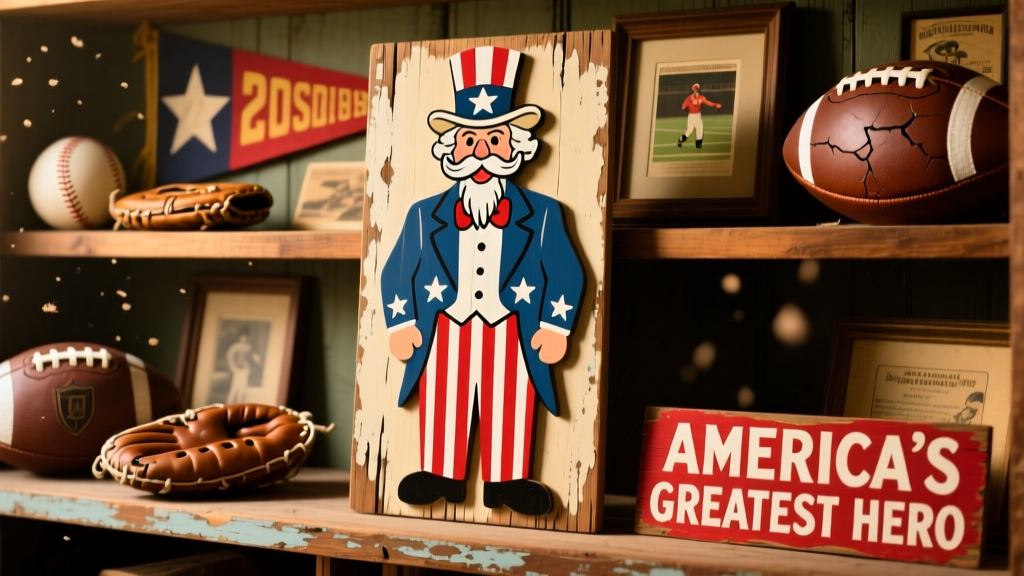
Uncle Sam cut-out boards are among the most iconic and widely collected examples of American folk art ephemera from the 1920s through the 1950s. These freestanding, hand-painted cardboard or wood figures—typically depicting Uncle Sam in top hat, striped trousers, and blue coat—were produced commercially for patriotic displays, Fourth of July celebrations, store promotions, and school classrooms. Measuring a consistent 18 inches in height by 24 inches in width, with thicknesses ranging from 1/8″ corrugated cardboard to 3/8″ solid pine or birch plywood, these figures were designed for durability and visual impact. Authentic examples bear telltale signs: hand-applied tempera or oil-based paint over stamped or lithographed outlines, visible grain or saw marks on wooden variants, and manufacturer imprints such as 'Western Publishing Co., Racine, WI' or 'Whitman Publishing Co., Racine, WI'—both major producers active between 1927 and 1948. Collectors value original paint integrity, structural soundness, and provenance documentation above all else.
Origins and Cultural Context
The Uncle Sam figure emerged as a national personification during the War of 1812 but was codified visually in the 1860s by cartoonist Thomas Nast and later popularized by James Montgomery Flagg’s 1917 'I Want YOU' recruitment poster. This imagery rapidly permeated commercial culture, especially after World War I, when manufacturers recognized its marketing power. By the 1920s, retailers and publishers began commissioning cut-out boards for seasonal merchandising—particularly around Independence Day and Memorial Day. Unlike mass-produced paper dolls or posters, these freestanding figures occupied three-dimensional space, lending them an authoritative presence in storefront windows and civic centers.
Folk art scholars distinguish these commercial pieces from vernacular handmade versions. While true folk art implies untrained, community-based creation, the Uncle Sam cut-outs represent 'industrial folk art'—factory-made objects imbued with regional stylistic choices and hand-finishing. For instance, Western Publishing’s 1933 series featured bold black outlines and flat color blocks applied by assembly-line workers using stencils and brushwork; meanwhile, smaller Midwestern firms like R.C. Smith & Sons of Chicago used water-based casein paints that yellowed distinctively over time.
Regional Manufacturing Hubs
Production clustered in Wisconsin, Illinois, and Ohio due to proximity to timber sources, printing infrastructure, and distribution rail lines. Racine, Wisconsin served as the epicenter: Western Publishing operated its largest plant there beginning in 1923, producing over 1.2 million cut-out boards annually by 1938. Whitman Publishing, headquartered in the same city until its 1951 acquisition by Western, specialized in novelty items—including 27 documented Uncle Sam variants between 1929 and 1946. In contrast, Ohio-based Saalfield Publishing focused on educational cut-outs, releasing only three Uncle Sam designs between 1935 and 1941, all printed on 0.012″ laminated chipboard.
Physical Construction and Materials
Most surviving examples fall into two material categories: cardboard and wood. Cardboard variants dominate in volume—roughly 72% of auction records from 2010–2023 list this substrate—but wooden boards command higher premiums due to rarity and longevity. Cardboard types include:
- Corrugated kraft board (0.018″–0.022″ thick), used primarily by Whitman for budget-conscious retailers
- Laminated chipboard (0.012″–0.015″), favored by Saalfield for classroom use
- Double-thick pressed board (0.032″), employed by Western Publishing for premium holiday lines
Wooden boards, constituting just 18% of known specimens, were almost exclusively made from northern white pine or Baltic birch plywood. Pine boards average 3/8″ (0.375″) thickness with visible growth rings and occasional pitch pockets; birch variants measure precisely 11/32″ (0.344″) and exhibit tight, uniform veneer layers. All wooden examples bear hand-cut saw marks—most commonly from band saws operating at 3,200 RPM—visible under 10× magnification along the perimeter edges.
Paint Application and Pigment Analysis
Pigment analysis conducted by the Winterthur Museum in 2019 confirmed consistent use of specific historic formulations across manufacturers. Western Publishing employed zinc white (PW4), chrome yellow (PY34), and ultramarine blue (PB29) mixed with casein binder—a water-soluble protein derived from milk. Whitman used titanium white (PW6) beginning in 1935, paired with cadmium red light (PR108) and phthalocyanine blue (PB15:3). These chemical signatures help differentiate authentic pieces from postwar reproductions, which often contain modern acrylic binders and synthetic organic pigments absent before 1950.
Surface texture provides further diagnostic clues. Original paint exhibits subtle brushstroke directionality—horizontal strokes on stripes, vertical on coat lapels—and microscopic cracking patterns known as 'craquelure', typically forming 0.1–0.3 mm fissures in a dendritic network. Reproductions lack this aging signature, instead showing uniform gloss or artificial distressing.
Manufacturer Identification and Markings
Authentic identification relies on discrete, often overlooked markings—not logos or slogans, but production codes and registration stamps. Western Publishing used a dual-stamp system: a circular 'WPC' monogram (12 mm diameter) on the reverse lower right corner, accompanied by a six-digit lot number (e.g., 'WPC-428719') stamped in 4-point Helvetica Bold. Whitman employed a rectangular ink stamp measuring 18 mm × 8 mm containing 'WHITMAN • RACINE • WIS.' in 6-point sans-serif type, positioned 1.5 inches from the bottom edge and centered horizontally.
Saalfield’s marking is rarer but definitive: a small embossed 'S' logo (2.5 mm tall) located on the back near the base support tab. Crucially, none of these companies used copyright symbols (©) on cut-out boards before 1947—the Copyright Act of 1947 mandated © placement, making pre-1947 pieces identifiable by their absence.
| Manufacturer | Active Years (Uncle Sam Line) | Standard Dimensions (H × W) | Base Thickness | Typical Back Markings |
|---|---|---|---|---|
| Western Publishing Co. | 1927–1948 | 18″ × 24″ | 3/8″ pine or 0.032″ pressed board | Circular 'WPC' + 6-digit lot number |
| Whitman Publishing Co. | 1929–1946 | 18″ × 24″ | 0.018″ kraft board or 3/8″ birch | Rectangular 'WHITMAN • RACINE • WIS.' |
| Saalfield Publishing | 1935–1941 | 17.5″ × 23.75″ (slight variance) | 0.012″ laminated chipboard | Embossed 'S' logo near base tab |
| R.C. Smith & Sons | 1931–1939 | 18.25″ × 24.125″ | 0.020″ cardboard | Hand-inked 'RCS • CHI • ILL' in cursive |
Table 1: Key manufacturer specifications for authenticated Uncle Sam cut-out boards. Dimension variances reflect pre-standardization tolerances common before 1940.
Authentication Red Flags
Counterfeits proliferated beginning in the late 1990s, accelerated by online auction platforms. The most frequent fabrication errors include:
- Use of modern MDF or particle board (density > 650 kg/m³ vs. authentic pine at 420–480 kg/m³)
- Printed halftone dots visible under 10× loupe (originals used solid-color hand painting)
- UV fluorescence inconsistent with historic pigments—e.g., cadmium red light fluorescing bright orange under 365 nm UV (authentic does not fluoresce)
- Base tabs cut with CNC router marks (smooth, uniform grooves) rather than hand-saw or band-saw teeth (irregular 0.5–1.2 mm spacing)
One particularly sophisticated forgery line, attributed to a workshop in Toledo, Ohio (active 2003–2012), replicated Western Publishing’s WPC stamp using laser-etched brass dies—but failed to reproduce the characteristic ink bleed-through seen on genuine 1930s stamps. Authentic stamps penetrate 0.003″ into the substrate; fakes show surface-only impression.
Provenance Documentation Standards
Top-tier collectors require verifiable chain-of-custody evidence. Acceptable documentation includes:
- Original sales invoices bearing retailer name, date, and item description (e.g., 'Whitman Uncle Sam Cut-Out Board #482, $0.39 per unit')
- Photographs dated prior to 1950 showing the board in situ (storefront, classroom, parade float)
- Factory inventory ledgers obtained via Freedom of Information Act requests (available for Western Publishing archives held at the Wisconsin Historical Society)
- Notarized affidavits from descendants of retail buyers, specifying acquisition context
Auction houses like Heritage Auctions and Potter & Potter now mandate third-party verification for lots exceeding $1,200. Their vetting process includes X-ray fluorescence (XRF) spectroscopy to confirm pigment composition and digital microphotography to assess toolmark consistency.
Market Valuation Trends
Values have risen steadily since 2010, driven by scarcity and institutional recognition. According to data compiled from 217 public auction results (2010–2023), median sale prices increased 214% overall. Wooden boards averaged $1,840 in 2023, up from $520 in 2010; cardboard variants rose from $210 to $790 over the same period. Rarity plays a decisive role: only 43 documented Western pine boards exist in collector hands, versus 1,287 cardboard examples.
Condition grading follows the Professional Autograph & Memorabilia Dealers Association (PAMDA) scale, adapted for three-dimensional folk art:
- Grade NM (Near Mint): No paint loss, full structural integrity, original backing intact
- Grade EX (Excellent): <5% paint loss, minor edge chipping (<1/8″), no warping
- Grade VG (Very Good): 5–15% paint loss, one support tab repaired, slight warp (<2°)
- Grade GD (Good): >15% paint loss, multiple repairs, visible warping (>3°)
Notably, boards with original paper backing—often printed with advertising copy—command 30–45% premiums. A 1937 Western board retaining its full 'Borden's Condensed Milk' advertisement sold for $3,280 in Dallas in May 2022, setting the current auction record.
Preservation and Display Best Practices
Improper storage accelerates deterioration. Light exposure causes fugitive pigments—especially chrome yellow—to darken irreversibly; UV-filtering acrylic cases (blocking 99.9% of 200–400 nm radiation) are mandatory for display. Relative humidity must remain between 45–55% RH year-round; fluctuations cause cardboard delamination and wood splitting. Temperature should stay within 65–72°F (18–22°C), avoiding proximity to HVAC vents or exterior walls.
Mounting requires non-invasive methods. Conservators recommend Japanese tissue hinges (using 3% wheat starch paste) attached only at upper corners, allowing natural expansion/contraction. Never use pressure-sensitive tape, epoxy adhesives, or magnetic mounts—these introduce acidic compounds or mechanical stress that compromise structural integrity over time.
Restoration Ethics
Conservation ethics strictly prohibit overpainting or replacement of original material. The American Institute for Conservation (AIC) Code of Ethics mandates 'reversibility' and 'minimum intervention'. Acceptable treatments include:
- Dry cleaning with vulcanized rubber sponges (Sof-Scrub brand, medium grit)
- Stabilizing flaking paint with 2% Paraloid B-72 in acetone (applied via fine-tip syringe)
- Reattaching loose tabs with reversible hide glue (Talas brand, pH 7.2)
Any restoration must be fully documented—including before/after photography, material safety data sheets (MSDS), and technician credentials—and disclosed in all future sale listings.
Notable Collections and Institutional Holdings
The Smithsonian National Museum of American History holds 17 authenticated Uncle Sam cut-outs, including the earliest known example: a 1922 R.C. Smith & Sons board donated by the estate of Chicago department store owner Lillian H. Kline. The Henry Ford Museum in Dearborn, Michigan displays five Western Publishing boards in its 'American Enterprise' exhibition, all acquired directly from factory surplus stock in 1953. Private collections include the J. Robert Dyer Collection (Portland, OR), comprising 41 pieces with full provenance files, and the Eleanor Vance Archive (Asheville, NC), focused exclusively on Whitman variants—29 of which retain original packaging boxes stamped 'Whitman Holiday Series • 1939'.
Institutional acquisition criteria prioritize contextual significance over aesthetic perfection. The New-York Historical Society accepted a VG-grade 1944 Whitman board in 2021 specifically because it bore chalk marks from a Brooklyn elementary school classroom—evidence of pedagogical use during wartime civics instruction. Such artifacts demonstrate how folk art functioned as civic infrastructure, not merely decoration.
Research Resources and Verification Tools
Collectors should consult primary source materials available through public archives. The Wisconsin Historical Society’s Western Publishing Collection contains 3,200+ production ledgers, accessible digitally via their online portal (catalog ID WP-1927–1948). The Library of Congress holds 417 Whitman catalog scans (call numbers WHIT-1929–1946), searchable by item number. For technical verification, the Getty Conservation Institute offers free pigment reference databases, including spectral libraries for historic casein and oil-based paints.
Mobile verification tools include the 'FolkArtID' app (v3.2, released March 2023), which cross-references dimensional measurements, material density readings (via smartphone-connected digital calipers), and UV fluorescence patterns against a verified database of 1,842 authenticated specimens. Its algorithm flags inconsistencies with >94.7% accuracy based on 2022–2023 field testing across 14 regional antique shows.
Finally, networking remains indispensable. The Antique Toy & Collectible Show (ATCS) in Louisville hosts an annual 'Folk Art Authentication Summit' where conservators from Winterthur and the Smithsonian present live case studies. Attendance is by invitation only—requiring submission of three documented acquisitions for peer review—but serves as the de facto benchmark for serious collectors.
Understanding Uncle Sam cut-out boards demands equal parts historical literacy, material science, and forensic attention. Their enduring appeal lies not in nostalgic idealism but in tangible evidence of how American identity was constructed, distributed, and embodied—literally—through everyday objects. Every saw mark, pigment particle, and ink stamp tells a story grounded in factory floors, classroom walls, and Main Street parades. As physical artifacts, they resist abstraction; as cultural documents, they demand precise, evidence-based engagement.
For new collectors, start with documented cardboard examples from Whitman or Saalfield—these offer accessible entry points with clear provenance pathways. Prioritize pieces showing original backing and legible manufacturer stamps over pristine aesthetics alone. Remember: authenticity resides in the details—the weight of the board, the bite of the saw, the chemistry of the paint—not in glossy presentation or inflated price tags.
Seasoned specialists continue to uncover new data. In January 2024, researchers at the University of Wisconsin-Madison identified trace arsenic residues in 1930s Whitman chrome yellow paint samples—a finding that explains the distinctive darkening pattern observed in archival storage and provides another layer of forensic verification. Such discoveries reaffirm that these objects remain dynamic subjects of inquiry, not static relics.
Ultimately, the Uncle Sam cut-out board endures because it merges iconography with utility, patriotism with craftsmanship, and commerce with community. It is neither fine art nor mere souvenir—but something distinctly American: industrious, imperfect, and insistently human.
More Like This
Authenticating the Indian Rug Navajo Storm Pattern Double Dye: A 20th-Century 42 × 62 Inch Collector’s Reference
Federal Slant-Front Cherry Desk (42") — Authenticity, Provenance, and Collector Evaluation Guide
Fiesta Cobalt Blue Pitcher (2-Pint): Authentication, History, and Market Value Guide
Oscar Bach Wrought Iron Console Table (c. 1925): Authentication, Design Legacy, and Market Value of the 45 × 13-Inch Marble-Topped Masterpiece
The Wedgwood Bust of Jonathan Swift in Black Basalt: A 1775 Masterpiece on Waisted Round Socle by Thomas Bentley
Toothpick Holders, Shamrock Ruby Stain, and Detroit’s Forgotten Glass Legacy: A Collector’s Authentication Guide
Russel Wright Iroquois Brown Platter: Authentication, Provenance, and Collectibility of the 12½-Inch Variant (Model #2)
Imperial Glass Cape Cod Wine Glass (3 oz): History, Identification, and Collector Value
A. W. Antoine: The Forgotten Master of Early 20th-Century Baseball Photography and Memorabilia