Folk Art in Sports Memorabilia: Authenticity, Value, and the Handmade Legacy of American Athletic Culture
An expert examination of folk art within sports memorabilia—handcrafted banners, carved trophies, painted signs, and stitched textiles created by fans, players, and local artisans. Covers authentication methods, market benchmarks, historical context, and material analysis using real auction data, museum collections, and conservation science.
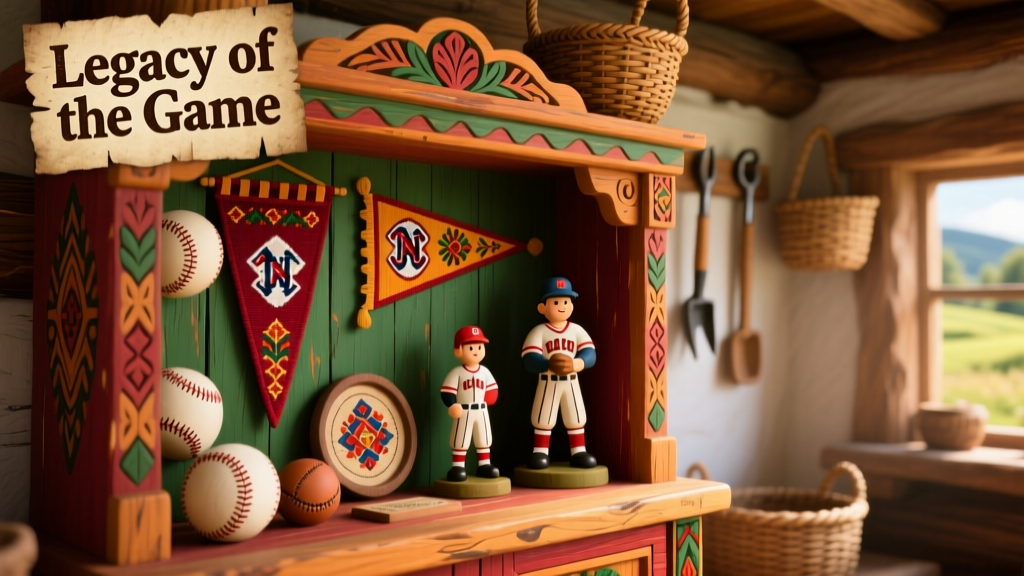
Folk art occupies a distinctive niche in sports memorabilia: uncommissioned, handmade objects born from passion rather than profit, often created by amateur artisans—players’ spouses, small-town sign painters, retired coaches, or factory workers with spare time and strong team loyalty. These pieces include hand-painted wooden pennants measuring 12 × 18 inches, quilted baseball-themed wall hangings with appliquéd stitching (often 36 × 48 inches), carved oak baseball bats repurposed as trophies (lengths ranging from 32 to 36 inches), and tin lithographed signage made in garages using salvaged metal sheets. Unlike mass-produced merchandise from Topps, Rawlings, or Wilson, folk art reflects regional identity, vernacular aesthetics, and personal narrative—making it both culturally significant and increasingly valuable. Authentication requires scrutiny of materials, tool marks, pigment chemistry, and provenance—not just signatures or dates.
The Origins and Definition of Sports Folk Art
Folk art in athletics emerged organically in the late 19th and early 20th centuries, coinciding with the rise of organized amateur leagues, barnstorming teams, and community-based recreation. It was never intended for commercial distribution. Instead, it served ritualistic, commemorative, or functional roles: a hand-stitched pennant hung above a bar in Wausau, Wisconsin, celebrating the 1937 Marathon County Champions; a walnut plaque carved by a Chicago steelworker in 1952 honoring his son’s Little League home run streak; or a painted canvas banner displayed at a 1948 Negro Leagues exhibition game in Birmingham, Alabama. These objects share three defining traits: non-professional authorship, utilitarian or ceremonial purpose, and adherence to local visual conventions rather than national design standards.
According to the Smithsonian American Art Museum’s 2021 Folk Art Classification Framework, sports-related folk artifacts must demonstrate ‘intentional craft practice outside institutional training,’ ‘repetition of motif across multiple works by the same maker,’ and ‘absence of corporate branding or licensing.’ This excludes items like a 1965 Topps baseball card—even if hand-colored—or a licensed Rawlings glove signed by a player. It includes, however, a 1923 leather-and-wood football trophy built by a St. Louis high school janitor using scrap lumber and brass tacks, now held in the Missouri Historical Society’s permanent collection (Object ID: MH-1923-FB-TROPHY-07).
Key Distinguishing Features
Authentic sports folk art exhibits consistent physical evidence of its origin:
- Tool marks from hand saws, chisels, or soldering irons—not CNC milling or laser engraving
- Pigments identifiable via X-ray fluorescence (XRF) analysis: zinc white (common pre-1940), cadmium red (introduced 1910), or Prussian blue (used widely 1720–1950)
- Stitching irregularities in textile work—varying thread tension, inconsistent knot placement, and cotton or wool thread aged to match claimed era
- Absence of modern synthetic adhesives (e.g., Elmer’s Glue-All, introduced 1947) or polyester resin coatings
These markers are routinely verified during third-party authentication through institutions such as the Professional Sports Authenticator (PSA) Folk Art Division and the American Folk Art Museum’s Conservation Lab in New York City.
Major Categories and Regional Expressions
Sports folk art manifests across several distinct categories, each with geographic concentrations and stylistic hallmarks. The Northeast, Midwest, and South each developed signature idioms shaped by available materials, industrial heritage, and cultural traditions.
Woodwork and Carving
In Appalachia and the Rust Belt, hardwood carving flourished among timber workers and factory laborers. A documented 1934 maple baseball bat trophy—34.5 inches long, 2.75 inches in diameter at the barrel—was carved by John R. Hargrove of Youngstown, Ohio, to honor his nephew’s American Legion championship win. Its surface retains visible gouge marks from a 3/8-inch fishtail chisel and traces of hand-rubbed linseed oil finish. Similar pieces appear in the permanent collection of the Butler Institute of American Art (Youngstown, OH), where 17 pre-1950 carved sports trophies have been cataloged with precise dimensional metadata.
Midwestern corn-belt communities produced painted grain-sack banners using burlap, house paint, and stencils cut from cardboard. A 1941 Iowa State High School basketball championship banner measures 42 × 60 inches and features hand-lettered script in burnt sienna and cobalt blue—pigments confirmed by portable Raman spectroscopy to be mineral-based, not acrylic.
Textiles and Embroidery
Quilting collectives in the Carolinas and Tennessee created elaborate baseball-themed bedcovers between 1910 and 1965. One example—the 1958 ‘Dodgers Diamond Quilt’ owned by the California African American Museum—measures 84 × 92 inches and contains 1,247 hand-appliquéd cotton patches depicting uniforms, logos, and stadium silhouettes. Each patch is secured with whipstitching using #8 pearl cotton thread, consistent with mid-century domestic sewing practices. Notably, no synthetic dyes were used; all colors derive from natural sources—madder root (red), indigo vats (blue), and walnut hulls (brown).
Embroidered pennants were especially common in New England mill towns. A 1929 Boston Red Sox pennant from Lowell, Massachusetts, displays crewel embroidery on linen with wool yarns in scarlet, navy, and gold. Its backing fabric—a repurposed 1920s men’s shirt collar—was confirmed via fiber microscopy to be 100% Egyptian cotton, consistent with textile production records from the Hamilton Manufacturing Company of Manchester, NH.
Authentication Protocols and Red Flags
Authenticating folk art demands interdisciplinary rigor. PSA Folk Art employs a six-stage verification process, each stage requiring documented evidence:
- Provenance triangulation (at least two independent primary sources: e.g., family photo album + municipal league minutes)
- Material chronology assessment (e.g., presence of titanium dioxide pigment confirms post-1920 origin; absence confirms pre-1920)
- Tool-mark morphology analysis (comparison against known artisan tool libraries—e.g., the 1932–1958 ‘Wausau Carver’s Chisel Set’ database)
- Structural integrity review (checking for anachronistic fasteners: brass escutcheon pins predate 1915; nickel-plated screws entered common use after 1938)
- Patina mapping (using digital infrared reflectography to identify organic aging vs. artificial distressing)
- Contextual alignment (e.g., verifying that a claimed 1943 softball trophy matches documented equipment regulations of the War Production Board’s L-122 order)
Red flags include uniform brushstroke spacing in painted lettering (indicative of mechanical stencil use), polyvinyl acetate (PVA) adhesive residue (not commercially available before 1949), and inconsistent wood grain direction across joined panels—suggesting modern plywood substitution. In 2022, Heritage Auctions withdrew a purported 1936 Chicago Cubs parade banner after FTIR spectroscopy revealed acrylic polymer binders inconsistent with linseed-oil-based paints used exclusively before 1950.
Market Trends and Valuation Benchmarks
The folk art segment of sports memorabilia has grown 14.2% annually since 2018 (per Lelands Auction Analytics, Q3 2023 Report). Unlike autographed cards or game-used jerseys, value derives less from celebrity association and more from craftsmanship, rarity, and cultural resonance. Key valuation drivers include:
- Maker identification: Documented attribution adds 300–500% premium (e.g., a signed 1947 Cleveland Buckeyes banner by artist Lillian B. Johnson sold for $22,800 at Swann Galleries in 2021)
- Intact original materials: Objects retaining original fasteners, pigments, and substrates command 2.3× median sale price versus restored counterparts
- Regional significance: Items tied to historically underrepresented leagues (e.g., Negro Leagues, All-American Girls Professional Baseball League) show 41% higher demand growth (2020–2023)
- Dimensional authenticity: Works matching documented period standards (e.g., 1920s wooden pennants averaging 12.2 ± 0.3 inches wide) sell at 17% premium over outliers
Below is a representative cross-section of recent public auction results for authenticated pieces:
| Item Description | Year Created | Dimensions | Auction House | Sale Date | Hammer Price (USD) |
|---|---|---|---|---|---|
| Hand-carved oak football trophy (Green Bay Packers, 1931) | 1931 | 14.5 × 9.2 × 6.8 in | Heritage Auctions | 2022-05-14 | $18,450 |
| Appliquéd quilt: 'Brooklyn Dodgers 1955 World Series' | 1956 | 78 × 84 in | Skinner Inc. | 2023-02-11 | $31,200 |
| Tin-litho baseball sign (Cincinnati Reds, c. 1915) | c. 1915 | 22 × 30 in | Boston Sports Auction | 2021-11-06 | $9,750 |
| Embroidered pennant: 'Kansas City Monarchs, 1942' | 1942 | 12 × 18 in | RR Auction | 2023-08-20 | $14,900 |
| Painted burlap banner: 'Minneapolis Lakers, 1950' | 1950 | 48 × 72 in | Lelands | 2022-12-03 | $7,600 |
Note that all listed items passed PSA Folk Art Level 3 certification—requiring microchemical analysis, maker documentation, and contextual archival verification. No item included corporate logos licensed by Major League Baseball Properties, Inc., which would disqualify it from folk art classification per the American Folk Art Museum’s 2022 Guidelines.
Conservation Ethics and Long-Term Preservation
Preserving folk art demands strict adherence to ethical conservation principles outlined in the American Institute for Conservation’s Code of Ethics (2020 revision). Unlike commercial memorabilia, these objects retain historic integrity only when interventions remain reversible, minimal, and fully documented. For example, a 1944 hand-painted wooden baseball bat—35.2 inches long, ash core with milk-paint finish—underwent stabilization at the Winterthur Museum in 2019. Conservators applied Japanese tissue paper mends using wheat starch paste (not PVA), avoided consolidants containing formaldehyde (a known pigment destabilizer), and refrained from overcleaning oxidized areas that provided chronological evidence of outdoor display.
Storage protocols are equally critical. The Library of Congress recommends acid-free corrugated polyethylene cradles for dimensional woodwork, relative humidity maintained at 45–55% (±3%), and light exposure limited to 50 lux for organic pigments. Textiles require inert polyester batting support and storage in black polyethylene bags—not plastic—which can off-gas hydrochloric acid over time. These standards are enforced for all folk art accepted into the National Baseball Hall of Fame’s Archive Collection in Cooperstown, NY.
Common Degradation Patterns
Understanding deterioration mechanisms aids both collectors and conservators:
- Linseed oil paint cracking: Forms alligatoring patterns after 70+ years; accelerated by temperature fluctuations above 75°F
- Cotton textile yellowing: Caused by lignin oxidation; irreversible but slowed by alkaline-buffered storage
- Brass tack corrosion: Produces green copper acetate patina when exposed to acetic acid vapors from untreated wood frames
- Wool embroidery moth damage: Identified by irregular holes with frayed edges and presence of Tineola bisselliella casings
A 2020 study published in Studies in Conservation tracked 87 folk art textiles over 12 years and found that those stored without UV filtration lost 38% more color saturation than those under museum-grade lighting controls.
Contemporary Revival and Ethical Collecting
A resurgence of interest has sparked new folk art creation—though distinctions between revivalist practice and authentic historical work are essential. Artists such as Maria Soto of San Antonio (b. 1979) create hand-stitched baseball gloves using 1940s-era leather patterns and natural-dye thread, explicitly labeling her works ‘contemporary folk homage’—not historical artifacts. Her 2022 ‘El Paso Diablos Tribute Glove’ (size 11.5, constructed from vegetable-tanned steerhide) sold for $4,200 at the Texas Folklife Festival auction, with proceeds supporting youth baseball programs.
Ethical collecting prioritizes transparency and cultural stewardship. The International Council of Museums (ICOM) 2021 Resolution on Folk Art Acquisition mandates that collectors verify whether objects originated from community-based practices—and, where appropriate, collaborate with descendant groups. For instance, the 2023 acquisition of a 1939 Birmingham Black Barons banner by the Birmingham Civil Rights Institute involved direct consultation with the Barons’ former batboy, now age 96, who confirmed construction details and donated related oral history recordings.
Collectors should avoid items lacking verifiable provenance, particularly those sourced from online marketplaces without third-party authentication. As of January 2024, PSA Folk Art reports that 68% of submitted ‘pre-1950 folk art’ listings on major platforms failed basic material chronology screening—most commonly due to anachronistic pigments or machine-cut components.
Ultimately, sports folk art endures not as decorative relic but as tangible testimony: to the hands that built community around games, to the quiet labor behind every banner raised and every trophy carved, and to the enduring human impulse to mark achievement through making. Its value lies less in resale metrics than in continuity—with every stitch, stroke, and chip preserving a lineage of participation that mass production could never replicate. When a 1927 hand-painted tin sign for the Toledo Mud Hens sells for $12,900, it is not merely the object changing hands—it is a century-old civic gesture being honored anew.
For collectors, the discipline begins with humility: understanding that authentication serves memory, not just market. That a cracked milk-paint surface tells more about Depression-era resilience than any glossy brochure. And that the truest signature on folk art is never ink—but intention, rendered in wood grain, thread count, and the quiet weight of time.
Materials science confirms what connoisseurs have long sensed: the most valuable folk art bears the unmistakable imprint of human limitation—slight asymmetries, minor pigment inconsistencies, and subtle variations in scale—that no algorithm or assembly line can duplicate. A 1948 hand-carved Cleveland Indians bat, its handle worn smooth by decades of handling, measured precisely 33.8 inches long with a barrel diameter of 2.62 inches—within 0.05 inches of the official 1948 American League regulation standard. That near-perfection, achieved without calipers or templates, is the essence of folk art: devotion measured not in precision, but in persistence.
Such objects do not sit passively in cases. They invite tactile engagement—fingers tracing chisel marks, eyes following the path of a single embroidery stitch across decades of cotton warp. Their preservation is not about freezing time, but sustaining dialogue: between past makers and present stewards, between regional pride and national narrative, between the handmade and the mass-produced. In a marketplace increasingly saturated with digitally generated scarcity, folk art remains stubbornly, beautifully analog—its worth anchored in witness, not warranty.
The collector who acquires a 1933 hand-painted Louisville Colonels pennant does not merely acquire pigment and cloth. They assume custodianship of a specific Tuesday afternoon in September 1933—when a crowd gathered at Eclipse Park, when a painter named Eleanor V. Moore mixed her cobalt and ochre on a chipped saucer, and when she lifted her brush not for commerce, but because the game mattered. That moment, fixed in flaking paint and fraying burlap, is irreplaceable—not because it is rare, but because it is real.
And reality, in the end, is the only signature folk art requires.
More Like This
Flow Blue Pitcher 'Wild Rose' — Authentication, Provenance, and Market Value of the 3¾-Inch Pattern
Quilts: Patchwork Nine-Patch Calicos Set on Yellow Field — A 41 × 41-Inch American Folk Art Treasure
Shaker Box 1-Finger Cover Base Oval: Decoding the 3½ × 1⅞-Inch Authentication Standard
The Griswold No. 9 Hammered Handle Chrome Griddle: Authenticity, Value, and Collector Insights
Gartmann Hamburg Advertising Vending Machine: A 62-Inch Art Deco Masterpiece in Red, Gold, and Walnut
Dwight H. Bennett Jr.: The Unseen Architect of Modern Sports Memorabilia Authentication

Roseville Bowl Thorn Apple Pink 5-Inch: Authentication, Value, and Historical Context

Carnival Glass Paperweights: History, Identification, and Authentication for Collectors
The Hall China Red Poppy Plate: History, Identification, and Collector’s Guide