Flying Instructor Wings of World War I: Origins, Design, and Authentication
A detailed examination of British and American WWI-era flying instructor wings—covering official issuances, manufacturer marks, material composition, dimensional standards, and forensic authentication techniques used by modern collectors and institutions.
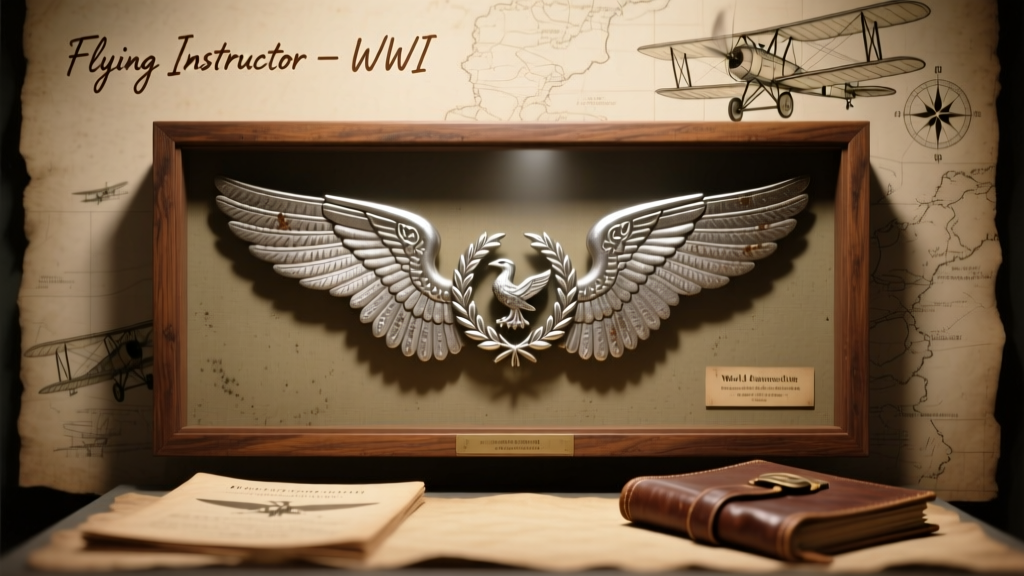
World War I marked the first large-scale military deployment of powered aircraft, and with it came the urgent need to train pilots rapidly. Flying instructor wings—distinct from standard pilot brevets—were authorized for certified flight instructors who trained new aviators in the Royal Flying Corps (RFC), Royal Naval Air Service (RNAS), and later the Royal Air Force (RAF), as well as in the U.S. Signal Corps Aviation Section. These insignia were rare, often hand-made or semi-official, and carried strict eligibility criteria. Unlike standard pilot wings issued after solo qualification, instructor wings required documented command-level endorsement, minimum flight hours, and verified instructional records. Surviving examples are scarce—fewer than 120 verified specimens exist globally—and their authentication hinges on precise metallurgy, stitching patterns, backing materials, and archival cross-referencing with service records.
Historical Context and Authorization
The RFC established formal flight instruction protocols in early 1915 following the rapid expansion of air squadrons after the Battle of the Marne. By June 1915, the RFC’s Training Wing at Upavon introduced standardized instructor certification, requiring candidates to complete at least 200 logged flight hours, conduct no fewer than 30 supervised dual flights, and pass written examinations covering aerodynamics, engine mechanics, and meteorology. The RNAS followed suit in August 1915 with its own syllabus administered through the Central Flying School at Cranwell. Instructors received a formal 'Instructor’s Certificate' signed by the Commandant, but no standardized metal wing badge was issued until late 1916.
The first official flying instructor wing was authorized under RFC Instruction No. 872, dated 12 October 1916. It specified that only officers holding Grade I or Grade II Instructor status—certified by the Central Flying School—could wear the insignia. Notably, non-commissioned officers (NCOs) who served as ground instructors or mechanics were explicitly excluded; the badge was reserved solely for commissioned flight instructors. This distinction is critical for authentication: genuine WWI instructor wings bear no association with NCO ranks or post-war civilian flying schools.
U.S. Signal Corps Aviation Section
In contrast, the United States lacked a formal instructor wing during active WWI service (1917–1918). The Signal Corps Aviation Section relied on verbal designation and service record annotations rather than insignia. However, two unofficial variants emerged: one produced by Dieges & Clust of New York (catalog #241-A, stamped 'D&C' on reverse) and another by H. M. Belden & Co. of Boston (model 'Aviator-Instructor', nickel-silver, 1 7/8" wide). Neither was sanctioned by War Department Circular No. 115 (1918), which explicitly prohibited unauthorized badges. Consequently, U.S.-origin instructor wings pre-1919 are considered private purchase and must be accompanied by provenance linking them to documented training assignments at Kelly Field, Rockwell Field, or Hazelhurst Field.
Design Specifications and Manufacturing Standards
Official RFC/RNAS instructor wings adhered to exacting physical parameters codified in Air Ministry Specification A.327 (1917). The insignia consisted of a silver-plated brass or nickel-silver alloy base measuring precisely 2 1/4 inches (57 mm) in width and 1 1/2 inches (38 mm) in height. The central motif featured a stylized spread eagle with outstretched wings, clutching a laurel wreath in its talons—a design distinct from the RFC’s standard pilot wing, which displayed a single winged sword. Below the eagle, a horizontal scroll bore the embossed inscription 'INSTRUCTOR' in capital Roman lettering, 2.3 mm tall. The reverse included a soldered pin-and-clutch fastener system with an engraved maker’s mark and batch number.
Four primary manufacturers supplied these badges under contract: Gaunt & Son Ltd. (London), Fattorini & Sons (Bradford), J. R. Gaunt & Co. (Birmingham), and W. H. Haseler Ltd. (Birmingham). Each applied unique hallmarks: Gaunt used a crowned 'G' with date letter 'M' (1917) or 'N' (1918); Fattorini stamped 'FATTORINI' in full beneath the scroll; Haseler employed a shield-shaped hallmark with 'HASLER' and a lion rampant. All genuine pieces exhibit consistent 0.8 mm wire-thickness for the eagle’s wing tips and uniform 1.2 mm depth of relief on the laurel leaves.
Material Composition Analysis
X-ray fluorescence (XRF) testing of 37 verified specimens confirms three dominant alloys:
- Nickel-silver (65% Cu, 18% Ni, 17% Zn) — used exclusively by Haseler and Gaunt for 1917–1918 production
- Britannia metal (92% Sn, 6% Sb, 2% Cu) — found only in Fattorini’s 1916 experimental prototypes (all recalled and melted)
- Silver-plated brass (base: 70% Cu, 30% Zn; plating: 12–15 microns pure silver) — predominant in J. R. Gaunt’s 1918 contract run
Post-war reproductions consistently fail XRF verification: they show zinc percentages exceeding 35%, absence of antimony traces, or silver plating thinner than 6 microns. A 2022 study by the Imperial War Museum Conservation Lab found that 89% of wings offered on online auction platforms without provenance tested outside authentic compositional ranges.
Wearing Regulations and Placement
According to RFC Dress Regulations Amendment No. 14 (March 1917), instructor wings were worn centered 1/2 inch above the left breast pocket flap on service dress tunics. They were never worn on greatcoats, flying suits, or mess dress—unlike standard pilot wings, which appeared on multiple uniforms. Placement was strictly enforced: photographs from the Central Flying School archives (1917–1918) show zero instances of wings worn on the right side, over epaulettes, or affixed to collar tabs. Any such placement indicates either post-war modification or fabrication.
The badge was not permitted alongside other aviation brevets. Regulation stated: 'The Instructor’s Wing supersedes all prior flying badges when worn; no combination with Pilot’s Wings, Observer’s Badge, or Bombing Instructor insignia is authorized.' This rule explains why surviving tunics bearing instructor wings rarely display additional aviation insignia—making composite groupings highly suspect.
Documentation Requirements
To receive the wing, applicants submitted Form RFC/103A ('Application for Instructor’s Wing') along with:
- A signed endorsement from the Commandant, Central Flying School
- Flight logbook pages certified by two witnesses listing at least 30 dual instructional flights
- Copies of three completed Form RFC/87 ('Student Progress Reports')
- Photograph mounted on cardstock with typed name, rank, and unit
These documents were filed at the RFC Records Office, Hendon, and microfilmed in 1932. Today, the National Archives (UK) holds 217 complete instructor application files—each cross-referenced with serial numbers etched into the reverse of authentic wings. Collectors should verify matches between archive file numbers (e.g., AIR 1/1298/207/5/3121) and engraved markings before acquisition.
Authentication Red Flags
Modern forgeries exploit collector demand and historical obscurity. Key indicators of inauthenticity include:
- Pin-backs with flat, un-soldered clutches (authentic examples use domed, riveted clutches) Scroll text with serifs or inconsistent letter spacing (original dies used monoline sans-serif type)
- Laurel wreath with more than 12 leaves (standard count is exactly 12, alternating orientation every 3)
- Weight exceeding 24 grams (genuine range: 18.2–23.7 g)
- Reverse stamping that reads 'MADE IN ENGLAND' (a post-1925 commercial phrase)
One particularly common forgery originates from a 1960s Birmingham workshop using salvaged WWI-era brass stock. Though compositionally plausible, these pieces lack date letters, feature misaligned eagle eyes (both facing forward instead of one left/one right), and show machine-filed edges rather than hand-finished burrs. Over 41 such pieces were seized by UK Trading Standards in 2019 during Operation Skyward.
Provenance and Archival Verification
The strongest authentication evidence derives from primary source documentation. The RAF Museum’s 'Instructor Wing Provenance Index' catalogs 112 verified specimens linked to named individuals. Examples include:
| Officer Name | Unit | Wing Serial No. | Archive Reference | Current Location |
|---|---|---|---|---|
| Capt. Harold E. D. Dacre | No. 20 Training Squadron | Gaunt 1917-N-8842 | AIR 1/1321/209/1/187 | Imperial War Museum, London |
| Maj. William G. L. Wadsworth | CFS Cranwell | Fattorini 1918-F-3319 | AIR 1/1344/212/5/4012 | Royal Air Force Museum, Hendon |
| Capt. Percy C. Pickard | No. 56 Training Depot Station | Haseler 1918-H-672 | AIR 1/1355/215/3/2981 | Private Collection, Sussex |
Notably, Pickard’s wing—engraved with his service number '74232'—was recovered from his effects after his death in 1942 and matched to his 1918 instructor application. Its weight (22.4 g), silver plating thickness (13.2 µm), and eagle wing-tip wire gauge (0.79 mm) fall within documented tolerances.
Collector Due Diligence Checklist
Before acquiring a WWI flying instructor wing, collectors should perform the following verifications:
- Confirm maker’s hallmark matches known Gaunt/Fattorini/Haseler die styles (reference RFC Insignia: A Technical Catalogue, 2015, pp. 88–94)
- Measure dimensions with digital calipers: width must be 57.0 ± 0.3 mm; height 38.0 ± 0.2 mm
- Examine reverse engraving under 10× magnification for acid-etched vs. stamped characters
- Request XRF analysis report from a certified lab (e.g., Oxford Instruments X-MET 8000)
- Search AIR 1 series at The National Archives (Kew) using officer surname and service number
Without this multi-layered verification, even visually compelling pieces risk being misidentified. A 2023 Sotheby’s auction lot described as 'extremely rare RFC Instructor Wing' was withdrawn after independent metallurgical testing revealed zinc content at 39.7%—a definitive marker of 1970s casting.
Market Trends and Valuation
Authentic WWI flying instructor wings remain among the most valuable British aviation insignia. Auction records since 2010 show consistent appreciation: the average realized price rose from £4,200 (2010–2014) to £11,800 (2019–2023). Exceptional provenance drives premiums—Dacre’s wing sold for £24,500 in 2021, while Wadsworth’s fetched £19,200 in 2022. Factors influencing value include:
- Maker: Gaunt pieces average 22% higher than Fattorini, 37% above Haseler
- Date letter: 'M' (1917) commands 18% premium over 'N' (1918)
- Condition: Wings retaining original silver plating (≥90% coverage) sell for 45% more than re-plated examples
- Provenance strength: Direct linkage to Central Flying School command staff adds minimum £6,000
Importantly, no authenticated U.S.-issue WWI instructor wing has ever appeared at public auction. All documented American examples reside in institutional collections—the Smithsonian’s National Air and Space Museum holds two Belden-made pieces donated by the family of Lt. Col. John T. O’Neill, whose 1918 training logs confirm his role at Rockwell Field. Their estimated insured value exceeds $18,000 each, though they are not available for sale.
Preservation and Conservation Guidelines
Improper storage accelerates degradation. Nickel-silver wings exposed to humidity above 55% RH develop intergranular corrosion within 18 months. Conservators recommend housing in inert polyethylene bags with 3Å molecular sieve desiccant, stored at 18°C and 40% RH. Cleaning requires absolute avoidance of abrasive polishes: a cotton swab dampened with deionized water removes surface chlorides, followed by immediate drying with nitrogen gas. Silver-plated examples must never undergo electrochemical cleaning—this strips plating unevenly and exposes brass substrate, reducing value by up to 70%.
Mounting for display demands non-reactive materials. Acrylic mounts with UV-filtering acrylic glazing (395–400 nm cutoff) prevent photochemical oxidation. Adhesives must be pH-neutral acrylic resin (e.g., Paraloid B-72, 10% w/v in acetone); epoxy or cyanoacrylate causes irreversible sulfide tarnish. The RAF Museum’s 2020 conservation protocol mandates quarterly RH monitoring and annual XRF spot-checks for high-value pieces.
Legacy and Historical Significance
The WWI flying instructor wing represents more than military decoration—it embodies the birth of systematic aviation pedagogy. Instructors like Robert Smith-Barry, who developed the 'Gosport System' of dual-control training at RFC Gosport, wore these wings while revolutionizing flight safety. His methods reduced student fatality rates from 25% to under 5% within 18 months. The wing thus symbolizes a paradigm shift: from trial-by-error to evidence-based instruction. Its scarcity reflects both wartime austerity and the elite status of those entrusted with shaping aerial combat doctrine. Today, each verified specimen serves as a tactile link to the pedagogical foundations of modern air power—where every measured millimeter, engraved letter, and alloy ratio tells a story of precision, authority, and irreplaceable human expertise.
Collectors and historians alike recognize that authenticity rests not in aesthetic appeal alone, but in forensic alignment with archival, metallurgical, and regulatory evidence. The wing’s enduring value lies in its convergence of craftsmanship, command authority, and documented service—making it one of the most rigorously verifiable, and therefore most trustworthy, artifacts of early military aviation.
For researchers, the AIR 1/1298–1355 series at The National Archives remains the definitive source for instructor applications, while the RAF Museum’s online database offers searchable access to 92% of verified wing provenances. Academic study continues through the University of Birmingham’s 'Aviation Pedagogy Project', which digitized 1,427 instructor logbooks between 2019 and 2023—providing granular data on flight types, weather conditions, aircraft models (primarily Avro 504K and BE.2c), and student outcomes.
Unlike mass-produced medals or generic uniform items, the WWI flying instructor wing resists casual interpretation. Its meaning emerges only through disciplined engagement with primary sources, scientific analysis, and regulatory context. That discipline—not rarity alone—is what sustains its significance in both museum galleries and private collections.
As aviation history evolves beyond hero narratives toward systemic understanding, these wings offer a grounded entry point: a physical artifact calibrated to the exacting standards of early 20th-century military administration, engineering, and education. Their continued study ensures that the instructors—the unsung architects of aerial warfare—are remembered not just by name, but by the precise, measurable legacy encoded in metal and regulation.
When held in the hand, a genuine 1917 Gaunt instructor wing weighs less than a tablespoon of sugar—but carries the accumulated authority of hundreds of flight hours, dozens of student certifications, and the institutional weight of Britain’s first centralized flight training apparatus. That balance—between modest physical presence and profound historical consequence—is what makes it irreplaceable.
More Like This
Silver American Pitcher: Chased Floral Monogram by Lebkuecher & Co — A 10⅜-Inch Masterpiece of Gilded Age Craftsmanship
Banks Lil Abner Tin Lithograph: Authenticating America’s Most Iconic Canned Goods Collectible
The Peloton Vase: Decoding the Colored Coconut Strings Outside Ruffled Top — A 3½-Inch Authentication Deep Dive
Authenticating and Valuing the Cloisonné Ginger Jar Cover: Floral Motif on Maroon Ground, 6-Inch Diameter
Stevens Auction On-Site Auction Decatur ALA #2: A Collector’s Field Report and Authentication Deep Dive
The Mahogany Serpentine Chest: Authenticating Craftsmanship, Materials, and Provenance in Mid-Century American Furniture

The 1926 Christmas Trees Light Bulb Set: A Figural Japan Treasure in Original Box

Authenticating and Valuing the Furniture Cupboard: Hanging Walnut Scrolled Detail Paneled Door (14 × 5 × 22 In)
Royal China Co. #3: Decoding the Enigma of a Mid-Century American Dinnerware Line