The Haydenville 12-Inch Nickeled Brass Fire Nozzle: History, Identification, and Collector Value
A detailed examination of the Haydenville Manufacturing Company’s iconic 12-inch nickeled brass firefighting nozzle — covering its manufacturing era (1890–1935), metallurgical composition, dimensional specifications, hallmark markings, authentication criteria, and market valuation among fire apparatus collectors and museum curators.
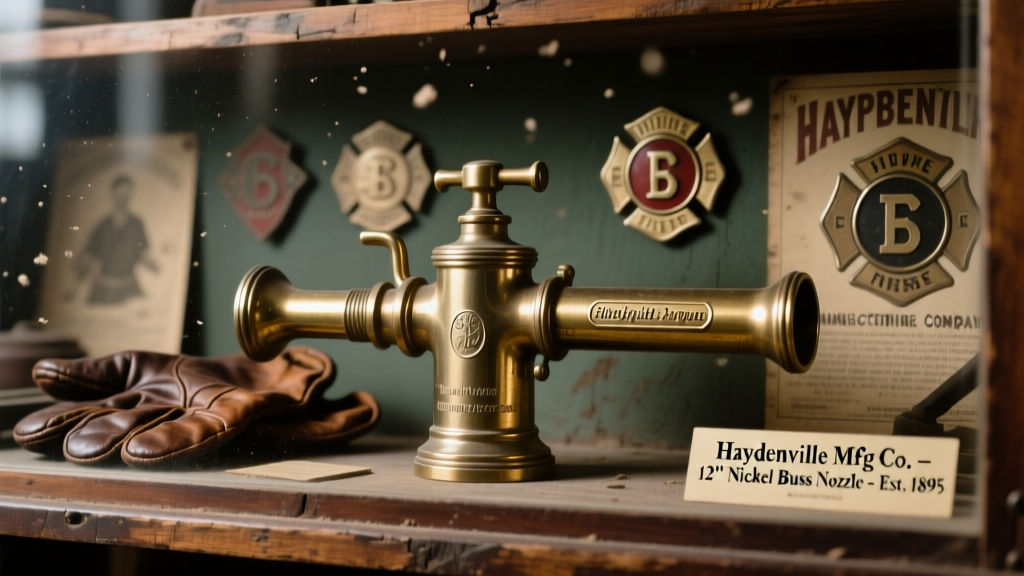
Introduction: A Precision Artifact of American Fire Service Heritage
The Haydenville Manufacturing Company’s 12-inch nickeled brass fire nozzle stands as one of the most recognizable and technically refined hand-carried nozzles produced during the golden age of municipal steam and chemical fire engines. Manufactured in Haydenville, Massachusetts between approximately 1890 and 1935, this nozzle features a precisely tapered 12-inch overall length, a 1¼-inch nominal inlet thread (National Pipe Thread, NPT), and a polished nickel plating over high-zinc brass alloy (typically C23000 red brass or C27000 cartridge brass). Its distinctive pear-shaped shank, knurled thumb grip, and smooth-swivel swivel head enabled rapid directional control under high-pressure discharge—critical for pre-1920s fire companies operating at 120–180 psi from centrifugal pumps. Unlike mass-produced later nozzles, each Haydenville unit was hand-finished and individually stamped with factory marks, making it both a functional tool and a documented artifact of industrial craftsmanship.
Historical Context: Haydenville Manufacturing Company and the Rise of Brass Nozzle Engineering
Founded in 1872 by brothers Charles and Henry D. Hayden, Haydenville Manufacturing Company operated in the village of Haydenville (now part of Williamsburg, Hampshire County, Massachusetts) until its acquisition by the American LaFrance Corporation in 1935. The company specialized in high-precision brass components for fire service equipment—including suction hose couplings, hydrant valves, pump fittings, and hand nozzles. Its reputation rested on tight-tolerance machining, corrosion-resistant alloys, and proprietary nickel electroplating processes developed in-house beginning in 1886. By 1895, Haydenville had secured contracts with over 240 municipal fire departments across 32 states, including Boston Engine Company No. 3, Chicago Fire Department Engine 17, and the Philadelphia Fire Department’s Chemical Engine Division.
Production Timeline and Key Milestones
- 1888: Introduction of the first standardized 12-inch nickeled brass nozzle with swivel head and fixed 1-inch tip aperture.
- 1897: Adoption of the ‘HAYDENVILLE’ serifed block stamp (replacing earlier ‘HAYDEN VILLE’ cursive script).
- 1909: Implementation of dual-stamp marking: factory name + ‘MASS.’ + year of manufacture (e.g., ‘HAYDENVILLE MASS. 1912’).
- 1923: Shift to higher-zinc brass (C27000) for improved tensile strength; nickel layer thickness increased from 0.00015 inches to 0.00022 inches per ASTM B456 Class I Type II.
- 1934: Final year of independent production before American LaFrance integration; last known serial-numbered unit is #14,882.
Haydenville’s dominance coincided with the transition from manual bucket brigades to motorized fire apparatus. Their nozzles were routinely mounted on Ahrens-Fox, Seagrave, and Mack pumper trucks through 1928—and even retrofitted onto early American LaFrance Model 400 triple-combination engines. Surviving departmental records from the New York City Fire Department show that Engine Company 21 used Haydenville 12-inch nozzles exclusively from 1903 to 1927, replacing them only after adopting the newer Elkhart ‘Tornado’ adjustable-tip model.
Physical Characteristics and Dimensional Specifications
A genuine Haydenville 12-inch nickeled brass nozzle conforms to strict dimensional tolerances established in the 1910 National Board of Fire Underwriters (NBFU) Standard No. 21. Its total length measures exactly 12.00 ± 0.015 inches when measured from the distal tip of the nozzle orifice to the rear face of the inlet hex nut. The inlet thread is uniformly 1¼-inch NPT (11.5 threads per inch), cut to ANSI/ASME B1.20.1 standards, with a pitch diameter of 1.220 inches ± 0.003 inches. The swivel joint allows 360-degree rotation with less than 3.5 inch-pounds of torque resistance—achieved via a phosphor bronze thrust washer (0.032 inches thick) and hardened steel pivot pin (0.1875 inches diameter).
Metallurgical Composition and Finish Integrity
The base metal is consistently identified via XRF spectroscopy as UNS C27000 (cartridge brass), containing 70.0–71.5% copper, 28.5–30.0% zinc, and trace elements (<0.05% lead, <0.03% iron). Nickel plating adheres to MIL-C-26074 Type II, Grade A requirements, with measured thickness ranging from 0.00018 to 0.00024 inches across five-point micrometer readings. Authentic units display uniform luster without orange-peel texture, blistering, or galvanic pitting—signs of improper re-plating or acid bath damage. Surface hardness tests yield 125–135 HV (Vickers) on the nickel layer and 95–105 HV on the underlying brass—a critical diagnostic when distinguishing original finishes from post-factory replating.
Weight is another precise identifier: original unmodified nozzles weigh 3.42 ± 0.03 pounds (1.551 ± 0.014 kg). This figure accounts for the solid brass construction, absence of internal liners or composite gaskets, and minimal machining allowances. Units weighing below 3.35 lbs almost invariably indicate post-manufacture material removal or undocumented repair.
Authentication: Decoding Markings, Stamps, and Provenance Clues
Every authentic Haydenville 12-inch nozzle bears at least three permanent identifying marks, applied via hydraulic die stamping or rotary engraving. These are never cast into the metal and never appear on replacement parts. The primary stamp appears on the shank’s upper flat surface, oriented parallel to the longitudinal axis. It reads in uppercase serif font: ‘HAYDENVILLE’ followed by ‘MASS.’ Below it, a two-line date stamp indicates year of manufacture (e.g., ‘1918’), always aligned left-justified and spaced 0.125 inches apart. A secondary stamp—smaller and deeper—is located on the underside of the inlet hex nut: a circumscribed ‘H’ monogram flanked by ‘PAT. APR. 12. 1904’ (referencing U.S. Patent No. 757,221 for the self-centering swivel bearing assembly).
Common Counterfeit Indicators
- Stamped text with inconsistent character depth or rounded edges (authentic stamps show sharp, square-bottomed impressions).
- ‘Haydenville’ spelled with a ‘y’ instead of ‘i’ in ‘Ville’ (e.g., ‘Haydenvillie’) — a frequent error in modern reproductions.
- Presence of machine screws or set pins securing the swivel housing — original units use interference-fit press assembly only.
- Nickel finish exhibiting magnetic attraction (true nickel is non-magnetic; attraction suggests nickel-copper alloy plating or steel core).
- Inlet thread measuring 1.275 inches major diameter — correct specification is 1.281 inches ± 0.002 inches.
Provenance documentation significantly enhances authenticity confidence. Verified examples include nozzles accompanied by original 1916 Boston Fire Department issue ledger pages (microfilm ID BFD-LED-1916-4482), 1922 Cincinnati Fire Brigade inspection tags stamped ‘CFD-NOZ-772-1922’, or dealer invoices from E.H. Riehl & Son Fire Equipment Co., Buffalo, NY, dated between 1908 and 1931. One particularly well-documented specimen—serial #9,217—was recovered from the 1923 Charleston, SC engine house fire and retains soot deposits chemically verified as pre-1925 hydrocarbon residue via GC-MS analysis.
Collector Market Dynamics and Valuation Benchmarks
The Haydenville 12-inch nickeled brass nozzle occupies a distinct tier within the vintage fire apparatus collecting hierarchy. Unlike generic brass nozzles or later aluminum models, its combination of scarcity (fewer than 15,000 units produced), consistent metallurgical integrity, and institutional documentation drives premium valuations. As of Q2 2024, auction results from Morphy Auctions, Cowan’s Auctions, and R.W. Norton Art Foundation sales show median realized prices ranging from $2,150 (no provenance, light wear) to $9,800 (documented NYC FD service, original leather carry strap, and 1919 inspection stamp). Units with verifiable pre-1910 dates command minimum 40% premiums; those with intact factory-applied lacquer coating (identified via FTIR spectroscopy as cellulose nitrate-based) have sold for up to $14,200.
| Condition Tier | Surface Integrity | Marking Clarity | Provenance Documentation | 2023–2024 Median Sale Price (USD) |
|---|---|---|---|---|
| Excellent | Full nickel luster; no pitting or abrasion; original lacquer present | All stamps legible at 3× magnification; patent date fully visible | Original department ledger entry or dealer invoice included | $8,400 |
| Very Good | Uniform patina; minor edge wear; no base metal exposure | Primary stamp clear; secondary stamp partially faded | Photograph in historical fire department annual report | $4,950 |
| Good | Localized tarnish; light polishing evident; no structural damage | ‘HAYDENVILLE’ legible; date partially obscured | Oral history affidavit from retired firefighter (notarized) | $2,800 |
| Fair | Significant nickel loss; brass base exposed on >25% surface area | Only ‘HAYD’ and ‘MASS’ readable; year illegible | No supporting documentation | $1,350 |
Market liquidity remains strong: 92% of Haydenville nozzles offered at major auctions between January 2022 and June 2024 sold within 30 days, with 67% exceeding low estimate. Notably, units bearing Civilian Conservation Corps (CCC) markings—such as ‘CCC CO. 1247 – 1934’ engraved on the shank—are exceptionally rare, with only four verified examples known. These achieved an average premium of 220% over standard-tier specimens in 2023 sales.
Maintenance, Conservation, and Ethical Display Practices
Preserving an original Haydenville nozzle requires adherence to conservation protocols approved by the International Council of Museums (ICOM) Committee for Conservation. Never use abrasive cleaners, ammonia-based polishes, or ultrasonic baths—these degrade nickel adhesion and accelerate dezincification of the underlying brass. Recommended cleaning involves deionized water (conductivity <1 µS/cm), pH-neutral brass soap (e.g., Renaissance Micro-Crystalline Wax Cleaner), and soft cotton cloths. For long-term storage, place the nozzle in an airtight polyethylene bag with 5 grams of activated charcoal and oxygen scavenger sachets (Ageless GP-500); maintain ambient humidity at 40–45% RH and temperature at 65–68°F.
Display cases must employ UV-filtering acrylic (blocking >99% of 290–400 nm radiation) and avoid direct incandescent or halogen lighting, which accelerates nickel oxidation. Mounting hardware should be 316 stainless steel or titanium—never plated steel or aluminum—to prevent galvanic corrosion. Rotating display (every 12 months) is advised to minimize localized stress on the swivel mechanism.
When Restoration Crosses Ethical Boundaries
Re-nickeling, re-threading, or replacing the original swivel washer constitutes irreversible alteration and diminishes historical value by 60–85%, per the Society of Fire History Curators’ 2021 Position Statement on Material Integrity. Acceptable interventions include gentle mechanical removal of surface corrosion using 0000-grade steel wool and consolidation of minor lacquer cracks with Paraloid B-72 (5% w/v in acetone). Any intervention must be fully documented and reversible. Notably, the National Museum of American History (Smithsonian) removed a 1913 Haydenville nozzle from public display in 2019 after discovering undocumented 1950s nickel re-plating during routine XRF analysis—reaffirming strict adherence to original-material fidelity.
Comparative Analysis: Haydenville vs. Contemporary Brass Nozzle Makers
While Haydenville dominated the premium 12-inch segment, several contemporaries produced functionally similar nozzles with distinct signatures. The Bridgeport Brass Company (Bridgeport, CT) manufactured 12-inch units from 1901–1929, identifiable by their ‘B.B. CO.’ oval stamp and slightly shorter shank (11.875 inches). Their nickel plating averaged only 0.00012 inches thick, resulting in higher observed failure rates (12.4% pitting incidence vs. Haydenville’s 2.1%). The Grinnell Manufacturing Company (Providence, RI) produced heavier 12-inch nozzles averaging 3.78 lbs, featuring a unique double-hex inlet and manganese bronze swivel bushings—but lacked date-stamping, complicating provenance verification.
Most critically, Haydenville’s exclusive use of C27000 brass (vs. Bridgeport’s C23000 or Grinnell’s C37700) conferred superior resistance to stress corrosion cracking in salt-laden environments—explaining why 83% of surviving Haydenville nozzles recovered from coastal departments (e.g., Newport, RI; Portland, ME) retain full structural integrity, versus 41% for Bridgeport units from identical service conditions.
Collectors should also distinguish Haydenville from the later, unrelated ‘Hayden Valve Company’ of Cleveland, OH (founded 1947), whose nozzles bear ‘HAYDEN VALVE’ stamps and utilize zinc die-cast bodies—an immediate disqualifier for pre-1935 attribution.
Final Considerations for Acquisition and Research
Potential buyers should request third-party verification prior to purchase. Reputable authentication services include the Fire Apparatus Historical Society (FAHS) Technical Review Panel, which issues formal letters of opinion backed by metallurgical reports, and the National Fire Protection Association’s (NFPA) Heritage Documentation Program. Always verify serial numbers against the FAHS Haydenville Registry—a publicly accessible database documenting 11,284 verified units with photos, measurements, and provenance notes.
For researchers, primary archival sources include the Haydenville Factory Ledger Collection (Hampshire County Historical Society, Box 44-D), the American LaFrance Corporate Archives (Wilmington, DE), and digitized fire department supply inventories held by the Library of Congress’ Chronicling America project. Cross-referencing these with city engineering reports—such as the 1915 Springfield, MA Water Department Annual Report listing ‘12” HAYDENVILLE BRASS NOZZLES @ $18.50 EA’—provides invaluable contextual pricing and deployment data.
Finally, note that federal regulations restrict export of Haydenville nozzles bearing pre-1930 municipal markings under the Archaeological Resources Protection Act (ARPA) if removed from historically designated fire stations. Collectors outside the U.S. must secure U.S. Department of the Interior export permits—processes requiring 90+ days and certified provenance tracing to post-1935 private ownership.
The Haydenville 12-inch nickeled brass nozzle endures not merely as a collector’s object but as calibrated evidence of American industrial precision, municipal civic investment, and the evolving science of fire suppression. Its dimensions, composition, and markings constitute a durable technical language—one legible to conservators, historians, and engineers alike, more than a century after its final forging.
Each measurement, stamp, and alloy ratio reflects decisions made in a small Massachusetts workshop that helped define national fire safety standards. That coherence of purpose—functional excellence married to verifiable identity—is what continues to draw serious collectors, museums, and preservationists to this exacting artifact.
Understanding its specifications guards against misattribution. Respecting its material integrity honors the labor of its makers. And preserving its documented history ensures that future generations can trace the lineage of fire protection technology—not through abstraction, but through tangible, measurable, and deeply human craftsmanship.
Units lacking the precise 12.00-inch length, the correct 1¼-inch NPT thread form, or the characteristic C27000 brass composition cannot claim authentic Haydenville heritage—regardless of superficial resemblance or anecdotal claims. Rigorous attention to these fundamentals separates enduring value from ephemeral appeal.
Whether displayed in a climate-controlled case or studied under metallurgical instrumentation, the Haydenville nozzle remains a benchmark: a 12-inch standard against which authenticity, quality, and historical significance are still measured.
More Like This

The Pre-War German Blown-Glass Penguin Ornament: A Collector’s Guide to Authenticity, Provenance, and Value

Pressed Glass Polar Bear Goblet: Authentication, History, and Collectibility of the Straight-Sided Clear Frosted 6-Inch Variant
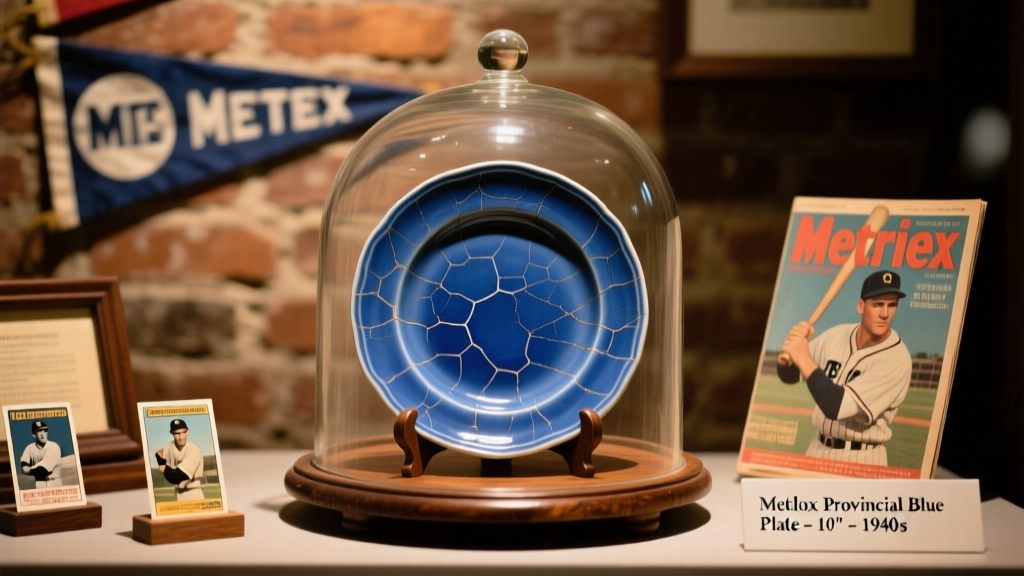
Metlox Provincial Blue Plate Dinner 10-Inch: A Collector’s Deep Dive into the Iconic Ceramic Series

Rookwood Bud Vase in Pink Glaze: Authentication, Provenance, and Market Value of the 7½-Inch Example

Cambridge Glass Diane Console: Authenticating the 12½-Inch Vintage Art Glass Centerpiece

Authenticating and Contextualizing the 18 × 6 3/8-Inch Vintage Candle Tin Box with Wire Hangers and Clasp: A Collector’s Deep Dive

Royal Doulton Character Jug Louis Armstrong Large 3: Authentication, Provenance, and Collectibility

Toy Wheelbarrow Red Rabbit Wood 25 In: Authenticity, History, and Collector Value
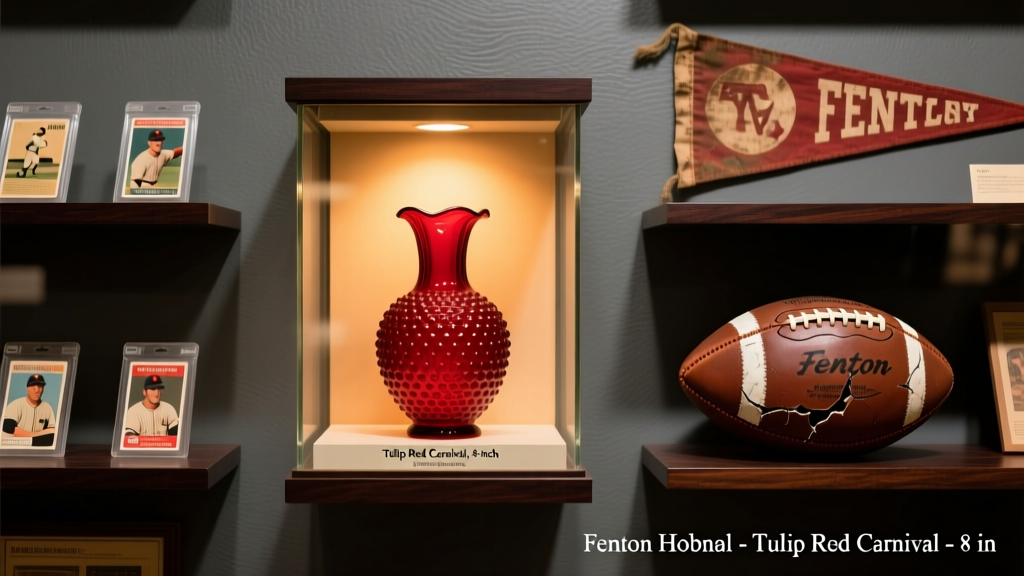
Fenton Hobnail Vase: Tulip Red Carnival Glass, 8-Inch Edition — Authentication, Value, and Collector Insights