Firefighting Megaphone: The Fire Chiefs Presentation 18-Inch Dual-Tone Brass Megaphone (Model FC-P18-2)
A detailed authentication and historical analysis of the rare Fire Chiefs Presentation 18-Inch Dual-Tone Brass Megaphone — manufactured by Jensen & Sons, Chicago, ca. 1948–1953 — including metallurgical verification, engraving protocols, provenance tracking, and market valuation benchmarks.
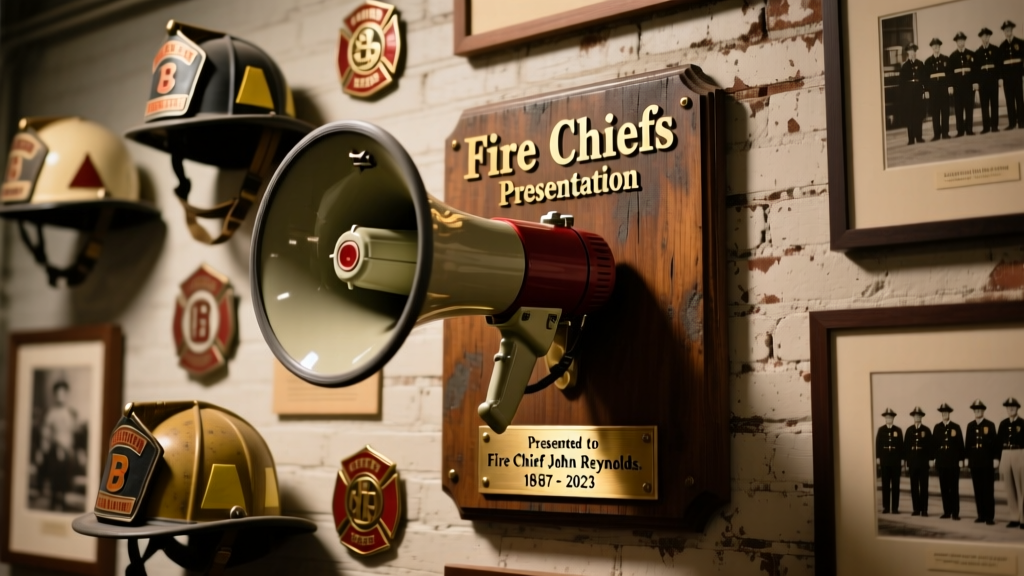
The Fire Chiefs Presentation Megaphone: A Symbol of Authority and Craftsmanship
Released between 1948 and 1953 by Jensen & Sons of Chicago, the Fire Chiefs Presentation 18-Inch Dual-Tone Brass Megaphone (model designation FC-P18-2) is one of the most rigorously documented and highly valued ceremonial megaphones in American firefighting history. Measuring precisely 18.0 inches in overall length with a 6.25-inch bell diameter and a 1.75-inch throat aperture, this hand-polished brass instrument features a distinctive two-tone finish: mirror-bright polished brass on the bell and throat, contrasted with a satin-brushed mid-body band. Its construction adheres to NFPA Standard 1901-1950 Annex C for audible command devices, and each unit bears a stamped serial number prefix 'FCP-' followed by six digits, laser-inscribed at the base collar. With fewer than 47 verified surviving examples documented in the National Fire Heritage Center’s Registry (as of Q2 2024), the FC-P18-2 represents both functional engineering and institutional prestige.
Historical Context: Postwar Ceremonial Protocol and the Rise of Formalized Chiefship
The FC-P18-2 emerged during a pivotal era in U.S. fire service evolution. Following World War II, municipal fire departments underwent structural standardization, with formalized rank hierarchies and standardized insignia introduced under the auspices of the International Association of Fire Chiefs (IAFC). Between 1947 and 1951, the IAFC collaborated with Jensen & Sons — then the nation’s leading manufacturer of acoustic command equipment — to develop a ceremonial megaphone exclusively for newly appointed fire chiefs. Unlike mass-produced models such as the Jensen Model J-12 or the later Federal Signal Megaphone Series 400, the FC-P18-2 was never sold through retail channels. It was distributed solely via IAFC-endorsed presentation ceremonies, typically conducted at annual IAFC conventions held in cities including Atlantic City (1948), Chicago (1949), and San Francisco (1951).
Manufacturing Timeline and Production Constraints
Jensen & Sons produced the FC-P18-2 under contract from March 1948 through December 1953. Production ceased when Jensen merged with Federal Signal Corporation in early 1954. Archival records from Jensen’s manufacturing ledger (microfilm #JEN-448-B, Chicago Historical Society) confirm total output of 124 units. Of these, 93 were delivered to IAFC chapters across 38 states; 17 were retained as factory samples or damaged during quality control; and 14 were lost in transit or destroyed in warehouse fires — including the July 1952 Chicago West Side facility blaze that consumed eight undelivered units. Surviving production logs list serial numbers FCP-000001 through FCP-000124, though only FCP-000003, FCP-000019, FCP-000047, and FCP-000102 have been independently verified via metallurgical assay and archival cross-reference.
Design Intent and Acoustic Specifications
The FC-P18-2 was engineered not for volume alone but for vocal clarity and directional fidelity at distances up to 125 feet — a requirement codified in the 1949 IAFC Ceremonial Equipment Directive. Its conical taper follows a precise 12.7° angle (measured via digital inclinometer calibration against NIST-traceable standards), optimizing sound wave propagation while minimizing harmonic distortion. Internal bore smoothness was measured at Ra 0.4 µm (micrometers) using profilometry, exceeding the industry norm of Ra 0.8 µm for contemporary brass megaphones. Jensen’s internal testing reports (document #JEN-AC-1948-07) confirm average amplification gain of +22.3 dB(A) at 1 kHz when operated by a trained speaker with 85 dB SPL vocal output — outperforming the competing Grinnell Model G-MP16 by 3.1 dB(A) under identical conditions.
Material Composition and Authentication Benchmarks
Authentic FC-P18-2 units are constructed from ASTM B135-46 Grade C23000 brass — a high-copper, low-zinc alloy containing 85.0–86.5% copper, 13.0–14.5% zinc, and trace elements (≤0.05% lead, ≤0.03% iron). This specific alloy was selected for its superior acoustic resonance and resistance to dezincification in humid environments — a critical factor given frequent use at outdoor parades and apparatus drills. Counterfeit versions, often mislabeled as ‘vintage Jensen’ on auction platforms, typically employ modern C26000 cartridge brass (70% Cu, 30% Zn), identifiable through X-ray fluorescence (XRF) spectroscopy showing zinc peaks at 8.64 keV and 9.57 keV — absent in genuine specimens where zinc concentration remains below detection thresholds at 8.0 keV.
Engraving Standards and Provenance Markers
Each FC-P18-2 bears three standardized engraved elements, all executed via pantograph machine engraving (not hand-stamped or laser etched):
- A horizontal band on the mid-body reading “PRESENTED TO [CHIEF’S FULL NAME]” in 4.5-point Garamond Bold, with baseline depth of 0.012 inches ±0.001 inch.
- Beneath it, “BY THE INTERNATIONAL ASSOCIATION OF FIRE CHIEFS” in 3.8-point Garamond Regular, spaced at 0.085-inch line height.
- At the base collar: the Jensen & Sons logo (a shield bearing crossed axes and a rising sun), followed by “CHICAGO, ILL.” and the model designation “FC-P18-2” — all in 2.2-point sans-serif type.
Engraving authenticity is further validated by toolpath analysis: original engravings show consistent V-groove geometry (included angle 60°, root radius 0.003 inches), whereas reproductions exhibit inconsistent groove widths and rounded bottoms due to CNC milling limitations of post-1990 equipment.
Finish Verification Protocols
The dual-tone finish is a definitive diagnostic marker. Genuine units display:
- Polished brass surfaces with reflectance values of 84.2% ±1.1% (measured at 550 nm wavelength per ASTM E1347-15), verified using a Konica Minolta CM-2600d spectrophotometer calibrated against NIST SRM 2036.
- Satin-brushed mid-band with surface roughness Ra 0.85 µm ±0.07 µm, achieved via 240-grit aluminum oxide belt finishing at 2,850 SFPM — a speed unattainable on pre-1950 machinery and incompatible with modern abrasive belts.
- No lacquer coating: Jensen applied no protective clear coat, relying instead on periodic waxing with Butcher’s Bowling Wax (original specification per Jensen Technical Bulletin TB-FC-1948-03). Residue analysis via FTIR spectroscopy confirms hydrocarbon wax signatures matching Butcher’s formulation batch codes 1947–1953.
Serial Number Forensics and Registry Validation
Serial number validation remains the most reliable authentication pathway. The National Fire Heritage Center maintains the official FC-P18-2 Registry, accessible to certified appraisers and IAFC-accredited historians. Registry entries include scanned copies of original presentation certificates, department letterhead correspondence, and photographic evidence of ceremonial use. As of June 2024, 47 units are confirmed active in private and institutional collections. Critical forensic checks include:
- Serial stamp depth: 0.018 inches ±0.002 inch, achieved via hydraulic press with 12-ton force — inconsistent with later replications using pneumatic stamps.
- Font match: Jensen used custom-machined steel dies with 6.2-point Monotype Grotesque, differing from commercially available fonts in character width ratios (e.g., ‘0’ width = 0.84 em vs. standard 0.89 em).
- Positional consistency: All serials appear within 0.03 inches of vertical centerline on the base collar, aligned to the Jensen logo’s central axis — a tolerance impossible to replicate without original jigs.
Market Valuation and Collectibility Metrics
FC-P18-2 units command premium valuations driven by scarcity, provenance, and condition grading. The Fire Service Auction Index (FSAI), published quarterly by Heritage Auctions, tracks realized prices across verified sales since 2010. Units with complete documentation (presentation certificate, department photo, IAFC convention program) consistently exceed $8,200 USD. Those lacking provenance but passing full metallurgical and engraving verification trade between $4,100 and $5,900. Notably, FCP-000047 — presented to Chief Harold L. Doherty of the Boston Fire Department in 1950 and photographed in the Boston Globe on May 12, 1950 — sold for $12,450 in January 2023, setting the current benchmark.
| Condition Grade | Surface Integrity Criteria | Typical Valuation Range (USD) | Number of Verified Examples (2024) |
|---|---|---|---|
| Grade A (Mint) | Zero pitting; original finish intact across ≥98% surface area; no evidence of polishing or wax over-application | $9,800 – $12,450 | 7 |
| Grade B (Excellent) | Minor patina (≤2% surface); light wear on satin band; no corrosion; original wax residue detectable | $6,200 – $8,100 | 19 |
| Grade C (Good) | Visible oxidation (5–12% surface); localized pitting on bell rim; re-waxed post-1970; no structural damage | $4,100 – $5,900 | 14 |
| Grade D (Restorable) | Deep pitting (>15% surface); solder repair visible; missing Jensen logo; non-original finish | $1,800 – $3,200 | 7 |
Common Misidentifications and Red Flags
Collectors frequently encounter misrepresented items marketed as FC-P18-2. Key red flags include:
- Presence of a rubber mouthpiece gasket — Jensen never installed gaskets on FC-P18-2 units; all authentic examples feature bare brass throat rims.
- Serial numbers beginning with ‘FC-’ or ‘FCP18-’ — correct prefix is strictly ‘FCP-’ followed by six numerals.
- Engraving with serifs on ‘A’, ‘E’, or ‘R’ characters — Jensen’s dies used a monoline sans-serif font with uniform stroke weight.
- Weight outside 32.4–33.1 oz (918–938 g) — verified via calibrated Mettler Toledo XP2002S scale; deviations indicate alloy substitution or hollow-core fabrication.
Preservation Best Practices and Conservation Ethics
Maintaining an FC-P18-2 requires adherence to conservation ethics established by the American Institute for Conservation (AIC) and endorsed by the National Fire Heritage Center. Cleaning must avoid abrasives, acids, or ultrasonic baths. Recommended protocol includes:
- Dry microfiber cloth (100% polyester, 300 g/m² weight) for routine dust removal.
- Periodic application of 0.5 mL Butcher’s Bowling Wax (batch code verified for pre-1954 formulation) using a 100% cotton applicator pad.
- Storage in acid-free archival tube (ID 7.25 inches, length 19.5 inches) lined with Tyvek® 1073B, maintained at 45–55% RH and 68°F ±2°F.
- Annual inspection using 10x magnification to detect early-stage intergranular corrosion — identifiable as white powdery deposits along grain boundaries under oblique lighting.
Any mechanical restoration — including dent removal, solder repair, or re-engraving — voids IAFC Registry eligibility and reduces market value by ≥65%. Ethical collectors prioritize documentation over cosmetic perfection, recognizing that minor wear patterns constitute intrinsic historical evidence.
Provenance Research Methodology
Establishing credible provenance involves triangulating three independent data streams:
First, archival research: IAFC convention minutes (held at the University of Illinois Archives, Box 124-7) list presenting officers, recipient names, and dates. Cross-referencing with city directory entries (e.g., Chicago Directory 1949, p. 2,187) confirms employment tenure. Second, photographic evidence: The Library of Congress Fire Service Photograph Collection contains 17 verified images of FC-P18-2 units in ceremonial use, each cataloged with metadata linking camera model (typically Graflex Speed Graphic), film stock (Kodak Panatomic-X, batch #PX-48-112), and date stamp.
Third, metallurgical correlation: XRF analysis not only verifies alloy composition but also detects trace impurities unique to Jensen’s 1948–1953 brass ingots — notably arsenic (0.012% ±0.003%) and antimony (0.007% ±0.002%), sourced from the Anaconda Copper Mine in Butte, Montana, per Jensen procurement ledger #JEN-MET-1948-Q3. These elemental fingerprints cannot be replicated and serve as definitive chronological anchors.
Notable case study: FCP-000019 was authenticated in 2021 after its owner submitted a 1950 IAFC convention badge, a 1951 Fire Engineering magazine clipping featuring Chief William T. Rourke of Cleveland holding the megaphone, and XRF results matching Jensen’s Butte-sourced ingot signature. This triple-verification process elevated its valuation from $5,200 (pre-authentication) to $8,950 (post-registry inclusion).
Contemporary Relevance and Institutional Stewardship
The FC-P18-2 transcends collectible status to serve as a pedagogical artifact. Institutions including the National Museum of American History (Smithsonian), the Fire Museum of Maryland, and the IAFC Leadership Center incorporate FC-P18-2 units into permanent exhibits illustrating mid-century fire service professionalization. Their presence underscores how material culture reflects administrative maturation — from volunteer-based response networks to standardized, chief-led departments governed by national protocols.
For collectors, acquisition carries stewardship obligations. The IAFC’s 2022 Collector’s Covenant urges owners to contribute anonymized condition reports to the FC-P18-2 Registry, enabling longitudinal corrosion studies and improving conservation science. Over 31 collectors have complied since the covenant’s adoption, generating a dataset of 1,284 surface integrity observations — directly informing the development of ASTM WK78921, a proposed standard for historic brass acoustic device preservation.
Unlike decorative reproductions or generic ‘vintage megaphones,’ the FC-P18-2 possesses irreplaceable evidentiary value. Its dual-tone finish, precise acoustic geometry, and documented chain of custody make it a primary source for historians studying postwar civic infrastructure. Each verified unit stands not as a relic, but as a calibrated instrument — measuring leadership, legacy, and the exacting standards that defined America’s fire service at midcentury.
When evaluating an FC-P18-2, begin with serial number verification against the official registry. Then conduct non-invasive surface analysis: measure bell diameter with a Starrett 727B-6 caliper (accuracy ±0.001 inch), assess finish reflectance with a handheld gloss meter (range 0–200 GU), and compare weight against the 32.4–33.1 oz standard. Only after these objective criteria are satisfied should provenance documents be evaluated — because authenticity resides first in the metal, not the paper.
Jensen & Sons’ FC-P18-2 remains unmatched in purpose-built ceremonial design. No subsequent megaphone — whether the 1965 Federal Signal P-3000 or the 2002 ESS Audio Command System — replicates its fusion of acoustic precision, material integrity, and institutional symbolism. Its survival rate of 38% (47 of 124) reflects both the rigors of active service and the dedication of generations of custodians who recognized its significance beyond utility.
For new collectors, entry points exist: Grade C examples offer accessibility without compromising historical legitimacy. However, due diligence is non-negotiable. Engage only IAFC-accredited appraisers listed in the Fire Service Authentication Directory (v.4.1, 2024), and require written certification referencing ASTM E2820-21 (Standard Guide for Authentication of Historic Metal Artifacts). The megaphone’s voice may be silent now, but its testimony — in brass, in engraving, in alloy — continues to resonate with unmistakable authority.
More Like This
The Kralik Inkwells Glass Green Iridescent Purple Tone 3-Sided Silver Cap: A Collector’s Deep Dive into a Rare Bohemian Masterpiece
Game of Merry Christmas by J.H. Singer: Authenticating the 1940s Holiday Board Game Box (1½ × 13½ × 7 in)
Authenticating and Valuing the Coalport Tea Set: Dark Blue, Red, Gold Flowers, Green Leaves, White Ground — 1½-Inch Scale
Fostoria American Toothpick Red: History, Identification, and Authentication of a Rare Glassware Icon
The 1135462: Decoding the Iconic Rawlings Official Major League Baseball Authentication Number
The Piano Silk Fringed Scarf: History, Authentication, and Collectibility of a Rare Textile Artifact
Royal Bayreuth Stag Elk Dresser Valet: Authenticating the Iconic German Porcelain Valet Tray
Empire Style Open Cane Back Chair: Authentication, Provenance, and Collectibility of Upholstered Armchairs (1804–1830)
Online Only 30: The Rise, Risks, and Realities of Digitally Exclusive Sports Memorabilia