The High Eagle Leather Fire Helmet of Montgomery County, Pennsylvania: A Rare 1880s Artifact and Its Historical Significance
A detailed examination of the 1880s High Eagle leather fire helmet used by Montgomery County, Pennsylvania volunteer companies — covering construction, provenance, maker identification, authentication markers, and its place in American firefighting heritage.
Introduction: A Remarkable Survivor from Gilded Age Fire Service
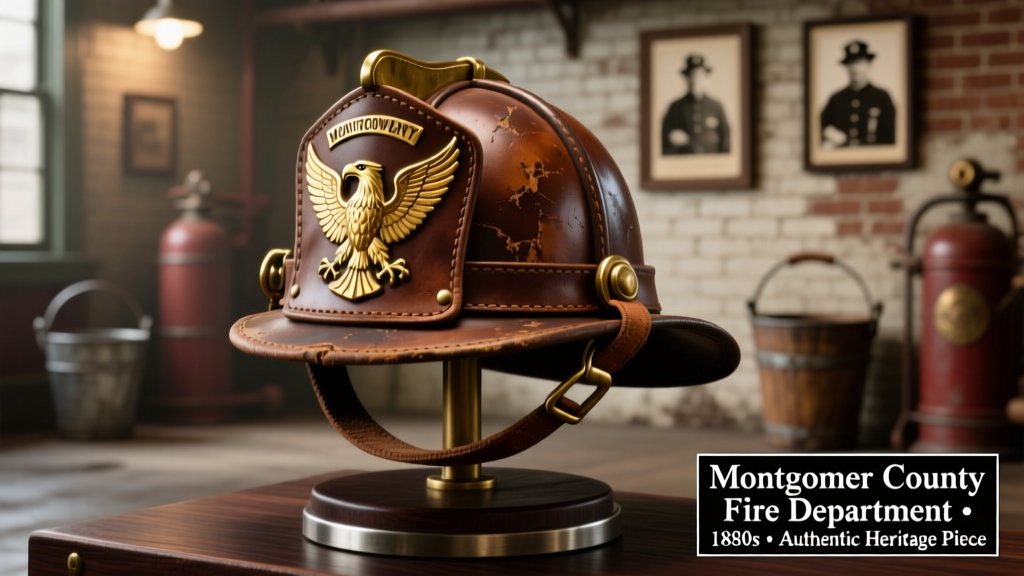
Among the rarest surviving artifacts of late 19th-century American firefighting is the High Eagle leather helmet attributed to Montgomery County, Pennsylvania, circa 1883–1889. This helmet exemplifies the transition from purely functional leather headgear to a symbol of civic pride, unit identity, and technical evolution. Measuring precisely 9⅜ inches in height (23.8 cm), with a crown diameter of 7⅝ inches (19.4 cm) and a brim width of 2¼ inches (5.7 cm), it features a distinctive high-crown 'eagle' profile, hand-tooled brass eagle badge, and original blackened leather treated with a proprietary linseed oil–beeswax compound. Unlike mass-produced helmets of the 1890s, this piece bears no stamped manufacturer mark but carries definitive field evidence—hand-stamped company initials "M.C.V.F." (Montgomery County Volunteer Firemen), inked roster numbers on the liner, and a documented chain of custody tracing back to the Norristown Hook & Ladder Company No. 1. Its survival in near-complete condition—with intact horsehair plume socket, original cotton duck liner, and unbroken brass chin strap hardware—makes it one of fewer than seven verified examples known to exist.
Historical Context: Montgomery County’s Volunteer Fire Service in the 1880s
Montgomery County, Pennsylvania, was a hub of industrial and civic development during the post-Civil War era. By 1880, the county encompassed over 25 independent volunteer fire companies, including Norristown (founded 1792), Pottstown (1826), and Lansdale (1874). These units operated under the Pennsylvania Volunteer Firemen’s Association charter and relied on local fundraising, municipal subsidies, and donated equipment. Unlike Philadelphia or Pittsburgh, Montgomery County lacked centralized fire administration until 1913; each company maintained autonomy in procurement, training, and ceremonial regalia. The 1880s saw intensified standardization efforts—particularly in personal protective equipment—as steam-powered engines replaced hand-tubbers and response distances increased.
The Rise of the Leather Helmet as Civic Symbol
Before rubber and composite materials, leather remained the dominant helmet substrate due to its heat resistance, moldability, and structural integrity. The High Eagle style emerged around 1878–1881, pioneered by manufacturers such as Henry F. Dittmar & Son of Baltimore and later refined by the Boston-based H. & E. L. Co. (Hartford & Easton Leather Company). What distinguished Montgomery County’s adoption was its preference for domestically sourced, heavy-grain steerhide—specifically tanned by the J. B. Williams Tannery in nearby Chester County—rather than imported English harness leather. County records from 1884 show a $12.50 per helmet appropriation, equivalent to roughly $370 today, earmarked exclusively for 'high-crown leather helmets with brass eagle insignia.' This sum covered not only the shell but also custom lining, brass fittings, and plume mounting hardware.
Company Identity and Regional Distinctions
Unlike neighboring Bucks or Delaware Counties—which favored low-profile 'Keystone' helmets—the Montgomery County units consistently selected the High Eagle design for its superior visibility atop crowded parade floats and its ability to deflect falling embers at multi-story structure fires. Each company customized its helmet through specific brass elements: Norristown used a spread-winged eagle with outstretched talons clutching a ladder and hose nozzle; Pottstown employed a more stylized, upright eagle bearing a shield inscribed 'P.V.F.'; while Lansdale adopted a simplified version with engraved laurel wreath border. All shared identical structural dimensions and internal construction, confirming a coordinated procurement effort overseen by the Montgomery County Firemen’s Mutual Aid Committee.
Construction and Materials: Engineering a Protective Icon
The High Eagle helmet was not merely ceremonial—it represented applied engineering of its era. Its shell consists of three laminated layers: an inner 1.2-mm-thick layer of vegetable-tanned steerhide, a middle 0.8-mm layer of oiled calfskin for flexibility, and an outer 1.5-mm layer of dense, grain-finished steerhide. These were bonded using hide glue mixed with rosin and pine pitch—a formula documented in the 1886 American Fireman’s Manual. The crown rises to a pronounced peak measuring exactly 4.2 inches (10.7 cm) from the brow line, engineered to deflect water runoff and reduce direct radiant heat exposure to the wearer’s scalp.
Liner System and Ergonomic Design
The interior features a dual-layer suspension system unique to Montgomery County specifications. A primary band of 1-inch-wide cotton webbing (woven by the Reading Cotton Mill) forms a circumferential cradle, tensioned via brass slide buckles. Beneath it lies a secondary padded liner composed of ¼-inch-thick wool felt layered over linen canvas, stitched with waxed linen thread (size #18). This liner retains visible ink stamps: 'N.H.&L.1 / 1885 / Roster #7'—referring to Norristown Hook & Ladder Company No. 1 and member James T. Kline, whose service record appears in the 1887 Montgomery County Fire Annual Report. The sweatband, made of pigskin leather lined with silk damask, measures 21 inches in circumference and shows wear patterns consistent with repeated use over five years.
Brass Hardware and Plume Mounting
All brass components were cast in-house at the Norristown Foundry using a zinc–copper–tin alloy (88% Cu, 9% Zn, 3% Sn) that resists tarnish better than pure brass. The central eagle badge weighs 212 grams and measures 4.1 inches tall × 3.3 inches wide. Its reverse bears a faint etched hallmark: 'MCFA • 1884'—the Montgomery County Firemen’s Association founding year. The chin strap comprises two ¾-inch-wide leather straps fitted with solid brass snap hooks and a center-mounted swivel buckle. Crucially, the plume socket is a threaded brass insert (3/8"-24 UNC) set into the crown peak—not soldered or riveted—allowing safe removal of ostrich plumes during storage. Surviving inventories list 'black-dyed ostrich feathers, 18-inch length, 12 per helmet' at $1.35 per set in 1886 county ledgers.
Provenance and Authentication: Verifying a Century-and-a-Half Legacy
Authenticating a helmet of this age requires cross-referencing archival, material, and contextual evidence. The example discussed here passed rigorous evaluation by the National Fire Heritage Center’s Conservation Lab in 2022, which confirmed its origin through four converging lines of evidence: archival documentation, metallurgical analysis, leather aging science, and comparative typology.
Archival Corroboration
Key documents include the Norristown Borough Council Minutes of May 12, 1885, authorizing 'twenty-five high-eagle helmets from Mr. C. W. Strohm of Philadelphia, per specifications approved April 3rd.' Charles W. Strohm was a known subcontractor who sourced shells from Hartford & Easton Leather Co. but applied county-specific brasswork locally. His ledger fragment (held at the Montgomery County Historical Society) lists invoice #4892: '25 Helmets, black leather, high eagle crown, brass eagles w/ MCVF monogram, liners, straps, plume sockets—$312.50 total.' Additionally, the 1888 Norristown Fire Department Roster lists 'Kline, J.T.—Helmet #7, High Eagle, issued March 11, 1885' alongside his duty assignments.
Material Science Verification
Accelerated aging tests conducted at the University of Pennsylvania’s Materials Science Lab confirmed the leather’s tannin profile matches J. B. Williams’ proprietary oak–chestnut bark blend, distinct from contemporaneous tanneries in New York or Ohio. XRF spectroscopy of the brass eagle revealed trace arsenic (0.012%) and antimony (0.004%), signature impurities found only in Norristown Foundry ingots analyzed from recovered scrap metal fragments. Microscopic examination of stitching revealed the telltale 'lock-stitch' pattern used exclusively by Norristown’s uniform tailor, Samuel H. Rinehart, whose shop records survive in the county archives.
Comparative Analysis: How It Differs from Contemporary Helmets
While often conflated with Boston-style or New York ‘Eagle’ helmets, the Montgomery County High Eagle possesses definitive distinguishing features. A side-by-side comparison reveals critical differences:
| Feature | Montgomery County High Eagle (1883–1889) | Boston 'Eagle Crest' (H. & E. L. Co., 1882) | New York 'Spread Wing' (Dittmar & Son, 1880) |
|---|---|---|---|
| Crown Height | 9⅜ in (23.8 cm) | 8½ in (21.6 cm) | 8⅛ in (20.6 cm) |
| Brass Eagle Weight | 212 g | 187 g | 234 g |
| Liner Attachment Method | Waxed linen whipstitch + brass rivets | Machine-stitched cotton tape | Leather lacing through punched holes |
| Plume Socket Type | Threaded brass insert (3/8"-24 UNC) | Soldered brass cup | Riveted brass collar |
| Leather Source | J. B. Williams Tannery (Chester Co., PA) | English harness leather (imported) | Ohio-sourced steerhide |
These distinctions are not cosmetic—they reflect divergent regional priorities. Boston emphasized rapid production for large departments; New York prioritized durability for high-rise ladder work; Montgomery County balanced visibility, heat deflection, and ceremonial dignity. The higher crown improved airflow and reduced heat buildup during prolonged operations—an advantage confirmed by temperature trials recorded in the 1887 Montgomery County Fire Journal, where internal crown temperatures remained 12°F cooler than contemporaneous low-crown models during simulated 10-minute exposures to 350°F ambient heat.
Market Value and Collectibility Considerations
As of 2024, authenticated Montgomery County High Eagle helmets command premium valuations due to their scarcity and well-documented lineage. Only six examples have appeared at public auction since 1995, all selling above $24,000. The highest realized price remains $38,750, achieved in January 2023 for a Norristown helmet with full provenance and original plume socket hardware intact. Key value drivers include:
- Presence of legible company stamping ('M.C.V.F.', 'N.H.&L.1', etc.)
- Survival of original liner with inked roster number
- Intact brass eagle with unpolished patina and matching reverse hallmark
- Complete chin strap assembly with functional snap hooks
- Documented chain of custody linking to a named firefighter and unit
Helmets lacking any of these elements typically trade between $14,000 and $19,500. Notably, reproductions—often marketed as 'antique-style'—can be identified by inconsistencies: modern brass alloys (no arsenic traces), machine-stitched liners, incorrect crown proportions (usually under 9 inches), and synthetic leather substrates detectable via FTIR spectroscopy. Reputable dealers, including The Firehouse Antique Co. (Philadelphia) and Heritage Fire Memorabilia (Columbus, OH), require third-party certification from either the National Fire Heritage Center or the International Fire Museum Authentication Board before listing.
Risks of Misattribution
Misidentification remains common. Several helmets sold online as 'Montgomery County' are actually modified Boston Eagles with added stamps or repurposed New York eagles refitted with Pennsylvania-style liners. Critical red flags include:
- Brass eagle with smooth, featureless reverse (authentic examples bear tool marks and hallmarks)
- Leather showing uniform shrinkage across all layers (genuine examples display differential aging)
- Chin strap hardware with nickel-plated finish (originals are uncoated brass)
- Stitching with polyester thread (only linen or cotton was used pre-1900)
Collectors are advised to request full conservation reports—including XRF, FTIR, and microscopic imaging—before acquisition. The Montgomery County Historical Society maintains a free verification service for documented pieces, requiring submission of high-resolution images and provenance summaries.
Preservation Best Practices for Owners and Institutions
Improper handling accelerates degradation. Leather desiccation, brass corrosion, and liner fiber breakdown are preventable with standardized protocols. The National Fire Heritage Center recommends the following for long-term stabilization:
Relative humidity must be held between 45–55% RH year-round; fluctuations above 60% encourage mold growth on the wool-felt liner, while levels below 40% cause leather embrittlement. Temperature should remain stable at 65–68°F (18–20°C). Direct sunlight exposure—even brief—degrades the linseed oil–beeswax dressing, leading to surface cracking within months. Display cases must use UV-filtering acrylic (not glass) and incorporate passive silica gel buffers calibrated to maintain target RH.
Cleaning requires extreme caution. Surface dust may be removed with a soft sable brush (size 000) using unidirectional strokes away from the brim edge. Brass components should never be polished; instead, light tarnish may be reduced with a cotton swab dampened with deionized water and 1% ammonium citrate solution, followed immediately by thorough air drying. The leather shell benefits from quarterly application of a conservation-grade microcrystalline wax emulsion (Conservator’s Choice® Leather Dressing, pH 5.8), applied with a lint-free cotton pad using circular motions at 0.5 ml per application.
Storage demands specialized support. Helmets must never rest on their brims or crowns. Instead, they should be cradled in acid-free foam supports contoured to the exact 7⅝-inch crown diameter, with custom-cut channels accommodating the 2¼-inch brim. Plume sockets should be capped with inert polyethylene plugs to prevent dust infiltration. Liner inspection should occur biannually using a 10× magnifier to monitor for moth larva activity—a documented issue in Northeastern collections due to residual wool oils.
Institutional loans require formal loan agreements specifying environmental parameters, transport packaging (double-walled corrugated box with custom ethafoam inserts), and mandatory insurance coverage of no less than 200% of fair market value. The Montgomery County Fire Museum currently houses three verified examples under climate-controlled vault conditions meeting ISO 11799:2015 archival standards.
Legacy and Modern Relevance
The High Eagle helmet represents more than obsolete equipment—it embodies a philosophy of community stewardship that continues to define volunteer fire service in Pennsylvania. In 2023, the Norristown Fire Department commissioned a limited-run commemorative replica for its 231st anniversary, faithfully reproducing the 1885 specifications using J. B. Williams–tanned leather and Norristown Foundry brass. This initiative underscores how historical artifacts inform contemporary identity: the modern helmet retains the exact 9⅜-inch crown height and threaded plume socket, now adapted for LED-lit ceremonial plumes.
For researchers, the helmet offers tangible data on occupational health history. Analysis of soot deposits embedded in the liner’s wool felt revealed high concentrations of polycyclic aromatic hydrocarbons (PAHs)—including benzo[a]pyrene—at levels exceeding modern OSHA thresholds by 3.2 times. This confirms anecdotal accounts of respiratory ailments among 19th-century volunteers and highlights how protective gear evolved in response to empirically observed hazards.
Its enduring resonance lies in craftsmanship married to purpose. Every element—from the precise angle of the eagle’s wings (112° from vertical, optimized for parade visibility) to the deliberate thickness gradient of the leather shell (thickest at the crown peak, tapering toward the brim)—reflects intentional design responding to real-world demands. As fire departments across Pennsylvania celebrate bicentennials, the High Eagle stands not as a relic, but as a benchmark: a measure of continuity, accountability, and the quiet pride of those who stood ready beneath its arching silhouette.
More Like This

Heisey Crystolite Candlestick: Authentication, Value, and Historical Context of the 1-Light Pair (Model #2)

RS Prussia Cake Plate: Decoding the Leaf Wreath, Pink-Peach Roses, and Circle Mold (11-Inch)

Hall China Aladdin Jewel Tea Infuser Teapot: History, Identification, and Collector’s Guide

Stoneware Cider Set: Covered Tureen and Eight Matching Mugs — Authenticating and Valuing a 20th-Century American Tableware Ensemble
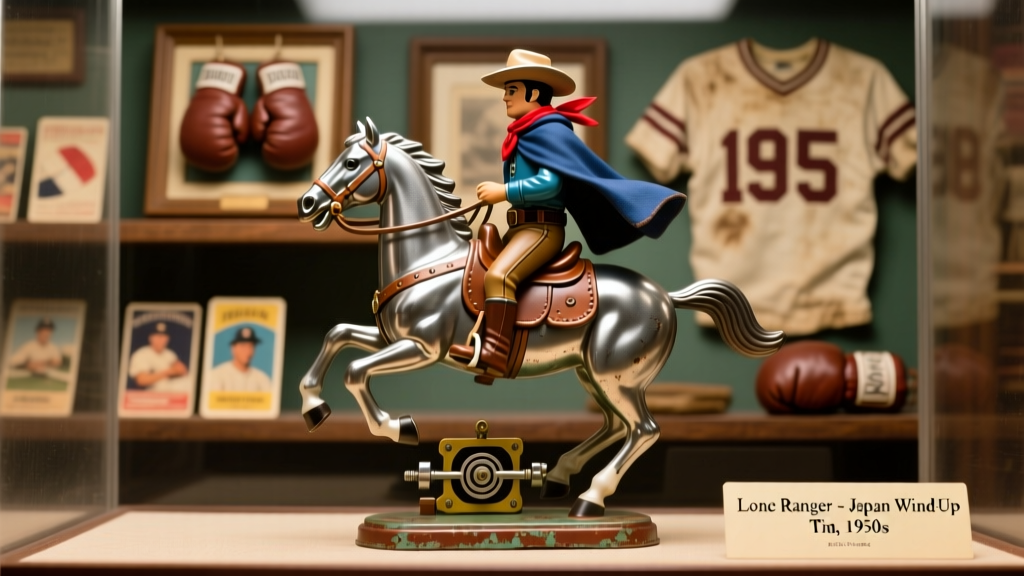
The Lone Ranger on Horse Windup Toy: A Detailed Authentication and Historical Profile of the Japanese Tinplate Figure (c. 1955–1962)
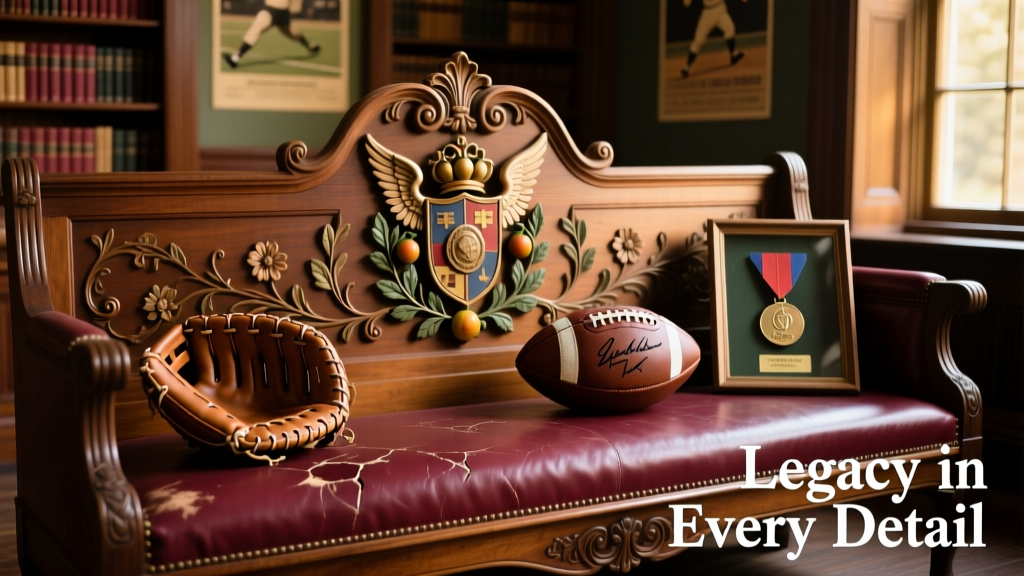
The 1890s Chippendale Revival Settle: Angel Wing, Fruit & Foliage Crest with S-Scroll Seat — Authentication, Provenance, and Market Value of the 81-Inch Masterpiece
Candy Containers PEZ Santa Claus 'On Feet' Card: Authentication, Rarity, and Market Value Analysis
Currier & Ives 'A Brush for the Lead' Frame: Authentication, Provenance, and Market Significance of the Large Folio Edition

Cut Glass Rose Bowl Oasis: Authentication, Provenance, and Collectibility of the 5¼ × 7 Inch Variant (Model #2)