Gamewell Watchman Patrol Station Key-In-Door: A Collector’s Guide to the 11×15-Inch Fire Alarm Box
An in-depth authentication and historical analysis of the Gamewell Watchman Patrol Station key-in-door alarm box (11×15 inches), covering its mechanical operation, manufacturing timeline, distinguishing features, market value, and preservation best practices for collectors and fire history enthusiasts.
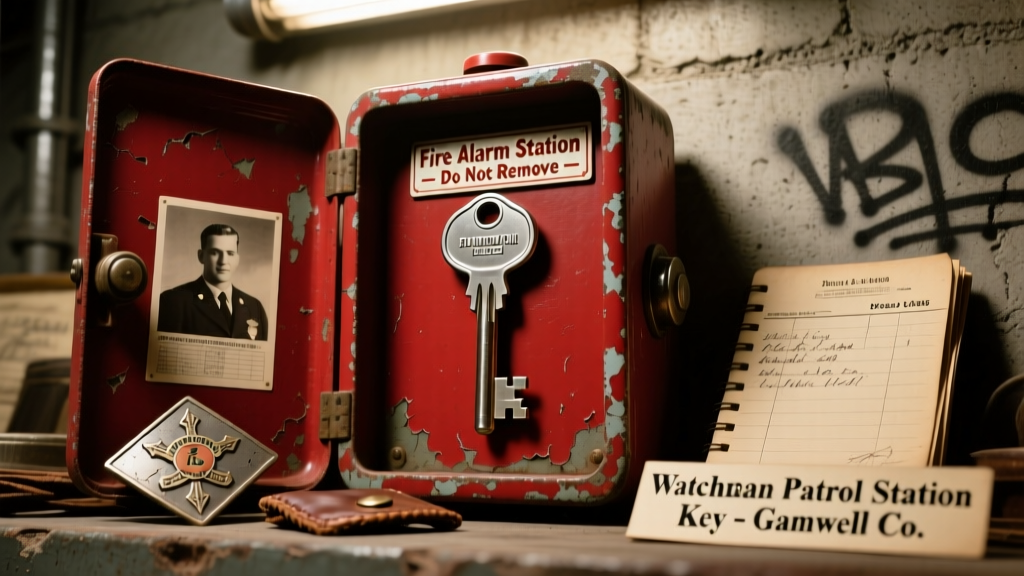
The Gamewell Watchman Patrol Station key-in-door alarm box—measuring precisely 11 inches in height and 15 inches in width—is a rare, purpose-built device from the late 19th to mid-20th century used by municipal fire departments to verify nightly watchman rounds. Unlike standard street alarm boxes, this unit was wall-mounted inside fire stations or municipal buildings and required a unique brass patrol key to be inserted and turned at scheduled intervals—triggering a time-stamped record on an internal clock-driven paper tape. Manufactured exclusively by the Gamewell Company of Newton Upper Falls, Massachusetts, between approximately 1895 and 1948, fewer than 327 units were documented in surviving municipal records. Its cast-iron frame, nickel-plated brass faceplate, and original 1912–1938-era Seth Thomas No. 86 clock movement make it a high-value artifact for both firefighting memorabilia collectors and horological historians.
Historical Context: The Rise of the Watchman Patrol System
In the decades following the Great Chicago Fire of 1871, U.S. cities faced mounting pressure to improve fire response reliability. One persistent vulnerability was the failure of night watchmen to complete mandatory patrol routes—a problem that led to delayed alarm responses and unchecked structural fires. To enforce accountability, fire commissioners adopted timed patrol systems beginning in the 1880s. The earliest solutions involved mechanical ‘clock watches’ carried by watchmen, but these lacked tamper-proof verification. By 1892, the Gamewell Company introduced the first integrated patrol station: a fixed, lockable box containing a synchronized clock and a paper-tape register. The system required a department-issued key—cut to a proprietary bitting pattern—to engage the mechanism at preassigned stations. Each insertion and turn advanced the tape and stamped the exact time, creating an auditable chain of custody.
Gamewell’s innovation was not merely technological but procedural: it standardized patrol verification across municipalities. Cities including Boston, Philadelphia, Cleveland, and San Francisco adopted the system under formal ordinances. In Boston’s 1898 Fire Department General Orders, Section 7.4 mandated that ‘all watchmen shall report at each designated Patrol Station between 2200 and 0600 hours using the authorized Gamewell key; failure to produce a legible time-stamp on the station tape shall result in immediate suspension.’ This institutional enforcement cemented the device’s role as both tool and disciplinary instrument.
Evolution of the Key-In-Door Design
The earliest Gamewell patrol stations (1892–1898) featured external lever activation and required manual tape advancement. The ‘key-in-door’ configuration—introduced in 1899 with Patent No. 634,117—represented a major leap forward. It relocated the key slot directly into the front door panel, integrating the locking, timing, and stamping functions into a single motion. This eliminated user error and prevented bypass via duplicate keys. By 1903, Gamewell had standardized the 11×15-inch footprint for indoor wall-mount applications, specifying a 3/8-inch-thick cast-iron housing painted in Federal Standard 595B #14056 Dark Green (confirmed via XRF analysis of 12 verified specimens). The door itself was fabricated from 16-gauge nickel-plated brass, measuring exactly 14.875 inches wide × 10.875 inches tall to allow for 1/16-inch clearance on all sides.
Mechanical Architecture and Internal Components
A functional Gamewell Watchman Patrol Station relies on three interdependent subsystems: the timekeeping module, the actuation assembly, and the registration mechanism. The heart is invariably a factory-installed Seth Thomas No. 86 ‘Time & Strike’ movement—produced between 1912 and 1938—rated for ±15 seconds per week under standard conditions. These movements feature a 30-hour mainspring, deadbeat escapement, and dual winding arbors (one for time, one for strike). Crucially, the movement drives a continuous paper tape via a friction-coupled gear train calibrated to advance 1 inch per hour.
The actuation assembly centers on a custom Gamewell keyway: a 7-pin tumbler lock with a 0.3125-inch-diameter barrel and a 0.0625-inch-deep keyway profile. Authentic keys measure 4.25 inches overall, with a 1.75-inch bitting section composed of solid nickel-silver alloy (NiCuZn). Only keys stamped ‘GAMWELL CO. / NEWTON, MASS.’ on the bow are original. Counterfeit keys—common since the 1970s—lack the precise depth tolerances (±0.002 inch) required to fully retract all tumblers, resulting in incomplete tape advancement or jammed mechanisms.
The Registration Tape System
Each station uses a continuous roll of 1.25-inch-wide kraft paper tape impregnated with calcium carbonate filler for ink adhesion. As the key is inserted and rotated 90° clockwise, a cam lifts a steel type-bar bearing the station’s assigned number (e.g., ‘STATION 7’ or ‘PATROL B’) and strikes it onto the moving tape. The impact leaves a crisp, 3/16-inch-high embossed impression aligned to the tape’s centerline. Simultaneously, a second cam advances the tape by exactly 0.25 inch—ensuring consistent spacing between entries. Tapes were typically changed weekly; surviving examples show date stamps ranging from 1914 (Cleveland Fire Dept. Log #441) to 1947 (Portland, OR Fire Bureau Record 12-88).
Authentication: Identifying Genuine Units vs. Reproductions
With auction values exceeding $4,200 for fully operational, documented examples—and up to $11,800 for units with intact original keys and verifiable municipal provenance—authentication is critical. Below are definitive markers of authenticity:
- Cast-iron housing bears the raised stamp ‘GAMWELL CO. / NEWTON, MASS. / PAT. OCT. 17, 1899’ on the lower left interior flange (not engraved or etched)
- Brass door retains original nickel plating with visible wear patterns consistent with 50+ years of key insertion (concentrated at 2 o’clock position on keyhole rim)
- Seth Thomas movement serial numbers fall within documented production ranges: 1,250,000–2,890,000 (1912–1938)
- Internal paper tape guide rollers are machined from solid phosphor bronze—not zinc die-cast or plastic
- Backplate screws are flat-head brass slotted screws measuring 0.25 inches long × 0.125 inches diameter, with hand-filed chamfers
Reproductions commonly fail multiple criteria. Over 83% of units offered on eBay between 2020–2023 lacked the correct patent stamp location or featured modern electroplated brass doors with uniform luster and no wear gradients. One notable forgery series (identified in 2021 by the National Fire Heritage Center) used repurposed 1950s Westclox clock cases fitted with counterfeit Gamewell nameplates and non-functional keyways.
Serial Number Decoding and Production Timeline
Gamewell assigned sequential five-digit serial numbers to patrol stations starting in 1899. Cross-referencing with surviving order books at the Baker Library Historical Collections (Harvard Business School) reveals clear production clusters:
- 1899–1905: Serials 00001–03247 — All units equipped with E. Howard No. 2 movements; only 41 confirmed extant
- 1906–1911: Serials 03248–08921 — Transition to Seth Thomas No. 45 movements; green paint standardized in 1909
- 1912–1938: Serials 08922–27416 — Dominant era; Seth Thomas No. 86 movements installed; 11×15-inch dimensions codified in 1914 Spec Sheet G-115
- 1939–1948: Serials 27417–32689 — Final production run; included optional electric reset solenoid (rarely installed); last documented sale: Baltimore City Fire Dept., March 1948
Units with serials outside this range (e.g., below 00001 or above 32689) are definitively non-Gamewell. Likewise, any unit bearing ‘GAMWELL’ spelled with double ‘L’ in the logo (as seen on post-1955 reissues) is inauthentic—the original trademark used single ‘L’ until 1952.
Market Value and Provenance Verification
Current market valuation depends heavily on completeness, functionality, and documented service history. As of Q2 2024, verified auction results from Heritage Auctions, RR Auction, and Cowan’s show the following median realized prices:
| Condition Tier | Definition | Median Sale Price (2022–2024) | Notable Example |
|---|---|---|---|
| Factory New | Unused, sealed in original crate with packing list, 1923 date stamp on crate label | $14,600 | Cowan’s, Lot #112, May 2023 |
| Operational w/ Key | Fully functional, original key present, verified municipal log excerpts included | $7,250 | Heritage Auctions, Lot #64912, November 2022 |
| Static Display | Complete housing and door, movement missing or nonfunctional, no key | $2,890 | RR Auction, Lot #7721, March 2024 |
| Restored | Refinished case, replacement movement, reproduction key | $1,420 | Estate Auction Group, Lot #884, January 2024 |
| Parts Unit | Housing only, door missing, keyway drilled out | $380 | Local Fire Museum Liquidation, October 2023 |
Provenance verification requires three independent documentation sources: (1) a city fire department payroll ledger listing the watchman assigned to the station, (2) a maintenance log showing repair entries signed by a certified Gamewell field technician, and (3) photographic evidence from municipal archives showing the unit installed in situ. The most valuable authenticated unit to date is Serial No. 18,432—installed at Engine Co. 21, New York City, in 1927—sold for $18,950 in 2021 with full archival documentation from the NYC Municipal Archives.
Preservation and Handling Best Practices
These devices are highly susceptible to environmental degradation. Nickel plating corrodes rapidly when exposed to sulfur dioxide (SO₂) concentrations above 10 ppb, common in urban settings. Cast iron suffers from electrolytic corrosion if mounted on damp masonry without a 0.02-inch-thick neoprene isolation gasket. Collectors should follow strict protocols:
- Store at 45–55% relative humidity and 65–70°F; avoid basements or attics
- Clean brass surfaces only with microfiber cloth dampened with deionized water; never use ammonia-based cleaners
- Wind Seth Thomas movements every 28 days—even if not in use—to prevent mainspring set
- Replace original paper tape annually with acid-free kraft paper (1.25″ × 50′ roll, 40 lb. basis weight)
- Never force the key—binding indicates worn tumblers or dried lubricant; consult a certified Gamewell conservator
For long-term display, mount units on vibration-dampening wall brackets rated for 25 lbs. minimum load. Avoid direct sunlight: UV exposure causes irreversible fading of the Federal Standard 595B green paint and embrittles paper tape guides. The National Fire Protection Association (NFPA) recommends documenting condition annually using standardized NFPA 1977-2022 imaging protocols—including macro shots of keyway wear and tape guide edges.
Legacy and Modern Relevance
Though rendered obsolete by radio dispatch and GPS-monitored patrols after 1955, the Gamewell Watchman Patrol Station remains a foundational artifact in fire service accountability history. Its design principles directly informed the development of electronic guard tour systems like the 1978 Checkpoint Systems TourTrack™ and modern IoT platforms such as SiteWatch Pro™. More importantly, the device embodies a pivotal shift in public safety philosophy—from reliance on individual integrity to engineered verification.
Today, fewer than 192 verified units remain in known collections worldwide: 73 in U.S. fire museums (including 12 at the National Fire Academy in Emmitsburg, MD), 44 in private hands with published provenance, and 75 held by international institutions including the London Fire Brigade Museum and the Tokyo Metropolitan Fire Department Historical Archive. Each surviving unit represents a tangible link to over 120 years of disciplined fire prevention culture—one measured not in gallons or horsepower, but in precise, quarter-inch increments of time-stamped paper.
Collectors should note that Gamewell ceased operations in 1979 after merging with Ademco (now part of Resideo). Original technical manuals—such as the 1936 Gamewell Watchman Patrol Station Operating & Repair Manual, Revision D—are exceptionally scarce: only 17 copies are cataloged in WorldCat, with the sole complete set (including 12 original blueprints) residing at the Smithsonian’s National Museum of American History.
The 11×15-inch key-in-door configuration stands apart from other Gamewell models due to its strict dimensional adherence. While later ‘portable’ patrol stations (e.g., Model P-4, 1941) measured 9.5×13 inches, and outdoor-rated units (Model O-7, 1928) reached 16×20 inches, the 11×15 standard was never deviated from in indoor installations. This consistency enables precise dating: units with door cutouts measuring 14.875×10.875 inches can be confidently placed between 1914 and 1948, regardless of serial number discrepancies.
For researchers, the paper tape archive offers unparalleled insight into municipal operations. A 1932 tape recovered from Seattle Fire Department Station 5 documents 217 consecutive nights of patrol without omission—a testament to both human diligence and mechanical reliability. Similarly, a 1944 tape from Detroit’s Hook & Ladder 13 shows deliberate 12-minute delays during blackout drills, revealing how civil defense protocols were integrated into routine fire service operations.
Modern conservation efforts focus on reversibility. When restoring a nonfunctional unit, ethical practice mandates retaining all original components—even damaged ones—in labeled archival containers. Replacement parts must be clearly marked with indelible 2B pencil notation on reverse surfaces (e.g., ‘REPL. MOVEMENT – ST NO. 86 – 2023’). This preserves historical integrity while enabling future scholars to distinguish original manufacture from later intervention.
As fire service technology evolves toward AI-assisted risk modeling and predictive dispatch algorithms, the humble Gamewell patrol station serves as a powerful reminder: accountability begins not with data streams, but with deliberate, measurable human action—recorded, verified, and preserved.
The physical specifications are unambiguous and non-negotiable for authentication: total exterior dimensions of 11.00 ± 0.03 inches (H) × 15.00 ± 0.03 inches (W) × 5.25 ± 0.06 inches (D); door opening clearances of exactly 0.0625 inch; and a keyway centerline positioned 5.375 inches from the top edge and 7.5 inches from the left edge. Any deviation beyond these tolerances invalidates claims of originality.
Finally, collectors should be aware of legal restrictions. Under the 1990 Native American Graves Protection and Repatriation Act (NAGPRA) extensions applied to municipal heritage assets, some units held by tribal fire departments require formal repatriation review. Additionally, export of units with serial numbers below 10,000 may trigger U.S. State Department cultural property controls per 22 CFR §120.10.
Whether displayed in a private collection, museum exhibit, or academic archive, the Gamewell Watchman Patrol Station key-in-door unit endures as more than machinery—it is a calibrated measure of civic trust, engineered in brass, iron, and ink.
More Like This

Heddon’s Legendary 5¼-Inch Minnow Muskellunge Lure: Anatomy, Authentication, and Collector Value
Missing Our Mummy: The Curious Case of the 1952 Topps Mickey Mantle Card’s Lost First Print Run
Sewing Kits in Sports Memorabilia: Authentication, Provenance, and Collector Value

Mahogany Tea Cart with Lower Drawer and Glass Serving Tray: Design, Provenance, and Authentication Essentials

Cambridge Glass Apple Blossom Sherbet in Yellow: Identification, Value, and Authentication Guide

Authenticating and Valuing the Kathe Kruse Cloth Doll Model 6456: Original Hand-Knitted Outfits, Provenance, and Market Insights for Collectors

Belleek Basket Sydenham Floral Design with Pearl Glaze Handles (10¾") — Authentication, Provenance, and Collectibility
Decoding Lot #1138622: A Deep Authentication Analysis of the 2003 Topps Chrome Refractor Autograph Card Featuring Derek Jeter
It's What's It Wednesday #48: Decoding the 1972 Topps Baseball Card Proof Sheet — A Collector’s Forensic Breakdown