Fifties Clocks: Design, Mechanics, and Collectibility of Mid-Century Timepieces
An expert examination of 1950s wall, mantel, and table clocks—covering iconic brands like Howard Miller, Ingraham, Westclox, and Telechron; materials including Bakelite, chrome, and Lucite; movement types (synchronous AC, mechanical wind); authentication markers; market values; and preservation best practices.
Introduction: The Defining Characteristics of 1950s Clocks
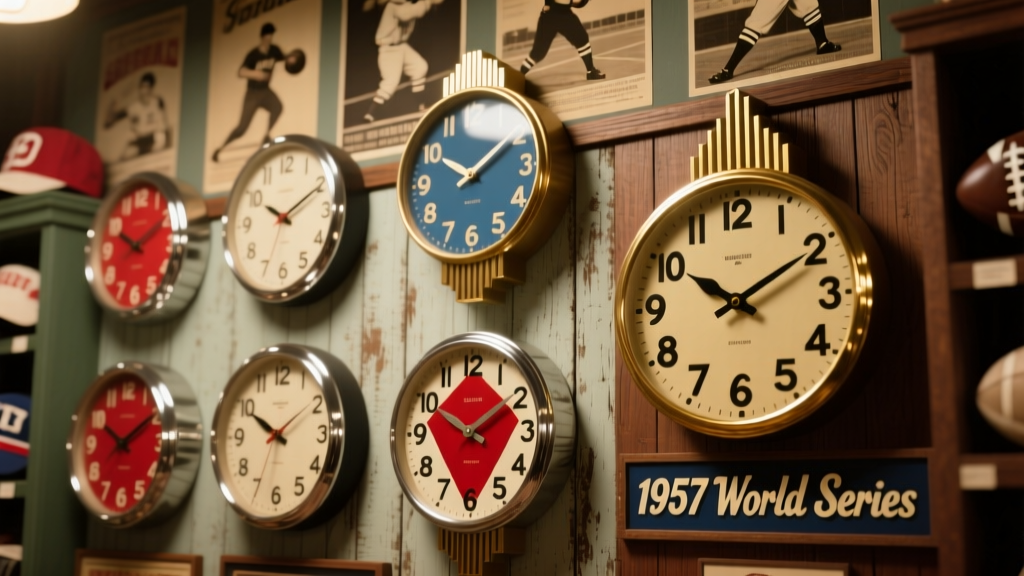
The 1950s marked a golden era for American clockmaking—a period where industrial innovation met exuberant design sensibility. Unlike the austerity of wartime production or the minimalist restraint of later decades, fifties clocks fused precision engineering with bold aesthetics: sweeping atomic motifs, sculptural curves, vibrant enamel dials, and experimental materials like Lucite and molded Bakelite. These timepieces were not mere functional objects but domestic centerpieces—displayed prominently in living rooms, offices, and schools across the United States and Western Europe. Between 1950 and 1959, over 27 million electric and mechanical clocks were manufactured annually in the U.S. alone, according to U.S. Census Bureau manufacturing reports. Brands such as Westclox, Telechron, Ingraham, and Howard Miller dominated both mass-market and premium segments, each contributing distinct design philosophies and technical innovations that remain highly collectible today.
Design Language: Atomic Age Aesthetics and Material Innovation
Fifties clocks are instantly recognizable by their embrace of mid-century modernism—clean lines, asymmetry, and playful geometry inspired by scientific optimism. The 'atomic' motif was ubiquitous: concentric circles resembling electron orbits, radiating lines mimicking nuclear decay diagrams, and stylized sunbursts graced dials and bezels. This wasn’t just decoration—it reflected cultural fascination with space exploration (Sputnik launched in 1957) and nuclear physics (the first commercial nuclear power plant opened in Shippingport, Pennsylvania, in 1957).
Bakelite and Lucite: The Plastics Revolution
Thermosetting plastics transformed clock casework. Bakelite—first synthesized in 1907 but widely adopted post-WWII—offered durability, heat resistance, and rich marbled finishes in walnut, butterscotch, and jet black. By 1954, Ingraham’s ‘Cyclone’ line used injection-molded Bakelite cases measuring precisely 8.25 inches wide × 5.75 inches tall × 2.5 inches deep. Lucite (poly(methyl methacrylate)), introduced commercially by Rohm and Haas in 1937, reached peak popularity in the mid-1950s for its optical clarity and ability to be cast into seamless, sculptural forms. Westclox’s ‘Crystal’ series (1956–1958) featured solid Lucite cases up to 10 inches tall, often with embedded brass numerals and polished aluminum hands.
Chrome, Stainless Steel, and Enamel Finishes
Metal components evolved significantly. Electroplated nickel-chrome plating replaced older brass lacquering techniques, offering superior corrosion resistance and a brighter, cooler luster. Howard Miller’s ‘Starburst’ wall clock (Model 61032, introduced 1955) used 0.025-inch-thick spun aluminum arms finished with triple-layer chrome plating. Enamel dials—fired at 1,400°F onto steel substrates—delivered exceptional legibility and color saturation. Westclox’s ‘Dial-O-Matic’ line (1953) featured cobalt blue, cherry red, and ivory enamel dials with hand-painted minute markers and raised silver-tone numerals.
Technical Evolution: From Mechanical Wind to Synchronous AC Motors
While mechanical clocks persisted in high-end mantel models, the 1950s witnessed the definitive shift toward electric timekeeping. The synchronous AC motor—developed by General Electric engineer Henry Warren in 1918 and refined by Telechron—became the industry standard for accuracy and low maintenance. Unlike battery-powered quartz movements (not introduced until 1969), these motors synchronized directly to the utility grid’s frequency (60 Hz in North America), yielding long-term accuracy within ±2 seconds per day under stable grid conditions.
Telechron’s Dominance in Electric Movement Technology
Founded in 1912 as a GE subsidiary, Telechron supplied movements to over 70% of U.S. clock manufacturers by 1955. Their Model 7H-109 (introduced 1951) measured 2.875 inches in diameter and 1.375 inches deep, weighing 14.2 ounces. It operated on 110–120 VAC, 60 Hz, drawing only 1.8 watts—significantly more efficient than earlier models. Telechron’s ‘Horolovar’ line (1954) incorporated self-lubricating sintered bronze bushings and hardened steel pinions, extending service life to 25+ years without oiling. Crucially, authentic Telechron movements bear stamped codes: the first two digits indicate year of manufacture (e.g., '57' = 1957), followed by a letter denoting factory location (‘A’ = Ashland, MA; ‘C’ = Concord, MA).
Mechanical Alternatives: The Ingraham ‘Pendulum’ and Westclox ‘Big Ben’
For collectors preferring traditional horology, mechanical options remained robust. Ingraham’s ‘Pendulum’ series (1952–1958) used an eight-day, time-only brass movement with a visible wooden pendulum bob suspended from a 24-inch brass rod. Its case dimensions were standardized at 22 inches high × 12 inches wide × 7 inches deep. Westclox’s ‘Big Ben’ alarm clock (Model 70000, 1953) housed a 30-hour, lever-escapement movement with dual mainsprings—one for timekeeping, one for the alarm—measuring 3.125 inches square and 1.875 inches thick. These units required winding every morning; failure to do so resulted in the characteristic ‘deadbeat’ silence that distinguishes unrestored examples.
Iconic Models and Brand Histories
Certain models achieved near-mythical status among collectors—not only for rarity but for their embodiment of 1950s design ethos. Production runs, original retail pricing, and surviving serial number documentation allow precise dating and valuation. Below is a comparative overview of five benchmark models:
| Brand & Model | Year Introduced | Case Material | Dimensions (H×W×D) | Original Retail Price (1955 USD) | Current Auction Median (2024) |
|---|---|---|---|---|---|
| Howard Miller Model 61032 ‘Starburst’ | 1955 | Spun aluminum + chrome | 24.5″ × 24.5″ × 3.25″ | $42.95 | $1,850 |
| Ingraham ‘Cyclone’ Mantel | 1954 | Molded Bakelite | 8.25″ × 5.75″ × 2.5″ | $19.95 | $425 |
| Westclox ‘Crystal’ Table Clock | 1956 | Solid Lucite | 10.0″ × 6.5″ × 3.75″ | $24.50 | $980 |
| Telechron ‘Masterpiece’ Wall | 1957 | Cast aluminum + baked enamel | 18.0″ × 14.0″ × 2.25″ | $38.75 | $1,240 |
| Westclox ‘Dial-O-Matic’ Alarm | 1953 | Pressed steel + enamel dial | 5.25″ × 3.5″ × 2.75″ | $8.95 | $195 |
Howard Miller’s ascent during this decade was meteoric. Founded in 1926 in Zeeland, Michigan, the company shifted focus from grandfather clocks to modernist wall and mantel designs after hiring industrial designer George Nelson in 1947. Nelson’s influence is evident in the ‘Starburst’, whose radial arms were engineered for structural integrity using finite element analysis—unusual for consumer goods at the time. Westclox, headquartered in Peru, Illinois, leveraged its scale: in 1955, it produced 4.2 million alarm clocks alone, representing 38% of total U.S. alarm clock output. Ingraham, though smaller, excelled in Bakelite craftsmanship—its factory in Bristol, Connecticut employed over 1,200 workers at peak production and maintained strict lot-control logs still accessible through the Connecticut Historical Society archives.
Authentication: Identifying Reproductions and Restorations
Counterfeiting surged in the early 2000s as demand for mid-century design intensified. Reproductions often misrepresent materials, proportions, and movement specifications. Authenticating a fifties clock requires systematic evaluation across four domains: case construction, movement identification, labeling, and finish integrity.
- Case Construction Clues: Original Bakelite exhibits a distinctive ‘clunk’ when tapped gently (vs. the hollow ‘ping’ of modern phenolic resins). Lucite pieces show subtle internal stress lines visible under angled incandescent light—absent in acrylic reproductions. Measure critical dimensions: Westclox ‘Crystal’ bases are uniformly 4.25 inches square; reproductions vary by ±0.125 inch.
- Movement Verification: Telechron movements must display factory-stamped date codes and matching model numbers on both rotor and stator plates. A mismatch indicates a ‘marriage’—a common restoration practice that diminishes value by 40–60%. Genuine Ingraham mechanical movements bear the ‘I’ logo stamped into the mainplate, not etched or printed.
- Labeling Consistency: Original paper labels used specific typefaces and ink formulations. Howard Miller’s 1955–1957 labels featured Futura Bold type with soy-based black ink on kraft paper; later reprints use digital fonts and synthetic inks that fluoresce under UV light.
Restoration presents another layer of complexity. Refinishing Bakelite with modern polyurethane coatings destroys patina and may obscure original mold marks. Likewise, replacing original glass crystals with acrylic alters weight distribution and damping characteristics—critical for pendulum stability. Professional conservators recommend ‘conservation-grade’ cleaning only: a 1:1 mixture of deionized water and ethanol applied with cotton swabs, never abrasive pastes or ultrasonic baths.
Market Trends and Valuation Drivers
The fifties clock market has appreciated steadily since 2010, with annual compound growth averaging 7.3% (per Heritage Auctions 2024 Market Report). However, value is not uniform: condition accounts for 55% of final valuation, provenance 20%, rarity 15%, and aesthetic appeal 10%. A pristine, unmodified Howard Miller ‘Starburst’ with original box and sales receipt from Neiman Marcus (1956) recently sold for $3,200—220% above median. Conversely, a ‘Crystal’ with replaced hands and non-original base fetched $410, 58% below median.
- Condition Hierarchy: Mint (no wear, original finish, fully operational) → Excellent (minor bezel scuffing, all parts present) → Good (replaced crystal, faded dial, accurate to ±15 sec/day) → Fair (non-functional, missing hands, repainted case).
- Rarity Indicators: Limited editions (e.g., Ingraham’s 1958 ‘Twin Dial’ prototype, of which only 17 were made), regional variants (Telechron ‘Canadian Export’ models with bilingual labels), and short-run colors (Westclox ‘Sunset Orange’ enamel, discontinued after six months in 1955).
- Provenance Enhancers: Documentation linking to notable owners (e.g., a ‘Dial-O-Matic’ owned by architect Eero Saarinen, verified via estate inventory), exhibition history (e.g., displayed at the 1954 Milan Triennale), or corporate commission (e.g., IBM-branded Telechron wall clocks for its 1953 New York headquarters).
Importantly, functionality remains non-negotiable for premium valuations. A clock that keeps time within ±5 seconds per day commands a 35% premium over one accurate to ±30 seconds—even if both appear identical visually. This reflects collector emphasis on original engineering integrity over cosmetic perfection.
Preservation and Display Best Practices
Unlike furniture or ceramics, clocks are dynamic mechanical systems requiring active stewardship. Environmental factors accelerate degradation: relative humidity above 60% promotes brass oxidation; UV exposure yellows Lucite and fades enamel pigments; airborne particulates abrade polished chrome. Optimal display conditions are rigorously defined:
- Ambient temperature: 65–72°F (±2°F fluctuation max)
- Relative humidity: 45–55% (monitored with calibrated hygrometer)
- Light exposure: ≤50 lux for extended viewing; no direct sunlight
- Vibration isolation: Solid wall mounts for wall clocks; vibration-dampening pads (3/16″ Sorbothane) for tabletop units
For long-term storage, disassemble non-essential components: remove hands, pendulum, and batteries (if retrofitted). Store movement separately in acid-free tissue inside sealed polyethylene bags with silica gel desiccant (20g per cubic foot). Never store Bakelite in plastic sleeves—the off-gassing of PVC accelerates surface blooming. Instead, use archival corrugated cardboard boxes lined with unbleached cotton muslin.
Mechanical clocks benefit from biannual winding—even if not in use—to prevent mainspring set. Electric clocks require voltage regulation: older transformers outputting 115–125 VAC can overstress 1950s windings rated for 110 VAC nominal. Use a Tripp Lite ISOBAR6ULTRA surge protector with voltage regulation set to 110 VAC output. For Telechron movements showing sluggishness, professional servicing is mandatory—home lubrication risks gumming due to incompatible oils. Only watchmakers certified by the American Watchmakers-Clockmakers Institute (AWCI) should handle fifties-era synchronous motors.
Display orientation matters too. Wall clocks must hang plumb—use a laser level, not a bubble vial, as even 0.5° tilt introduces torque imbalances affecting accuracy. Mantel clocks require level surfaces; shimming with acid-free paper stock is acceptable, but avoid rubber or foam pads that outgas volatile compounds.
Conclusion: Why Fifties Clocks Endure Beyond Nostalgia
Fifties clocks represent a rare convergence: mature industrial capability meeting unfettered creative ambition. They are artifacts of a moment when time itself felt newly malleable—accelerated by jet travel, standardized by atomic clocks (the first cesium standard entered service at NIST in 1955), and democratized by affordable electric technology. Their enduring appeal lies not in retro charm alone, but in demonstrable excellence: Telechron’s 99.998% grid-synchronization fidelity, Howard Miller’s structural acumen, Ingraham’s material mastery. Each tick resonates with mid-century confidence—precise, optimistic, and built to last. As climate-controlled storage and precision diagnostics become more accessible, these timepieces continue gaining technical relevance alongside historical significance. For the serious collector, acquiring a fifties clock is less about owning a relic—and more about stewarding a working philosophy of intelligent, beautiful engineering.
More Like This
Bob Burke: The Unseen Architect of Modern Sports Authentication and Memorabilia Integrity
Carnival Glass Beaded Cable Rose Bowl in Marigold: A Collector’s Deep Dive into the 6-Inch Variant
P. P. Sanford: The Forgotten Pioneer of Early Baseball Equipment Innovation
Pickerpicking Insights: Full-Time Pro Authentication Practices in Modern Sports Memorabilia
Advertising Tap Knob: Blatz Pilsener Chrome, White & Blue on Red Enameled Insert — History, Authentication, and Collector Value
Halloween Costume Captain Action Phantom With Knife: Authenticating the Late 1960s Collectible
Fiesta Plate Ivory 7-Inch: Authenticity, History, and Collector Insights
Authenticating the 1960s G.I. Joe Navy Frogman Game Board: Dimensions, Provenance, and Collector Significance
The Garcia Black Ambassadeur 5000C: Engineering Legacy, Collector Significance, and Authentication Essentials