Ferdinand J. Dreer: The Forgotten Architect of Early American Sports Memorabilia Authentication
A deep-dive examination of Ferdinand J. Dreer’s pioneering role in sports autograph verification, his 1920s–1940s authentication protocols, documented collections, and lasting impact on institutions like the Library of Congress and the National Baseball Hall of Fame.
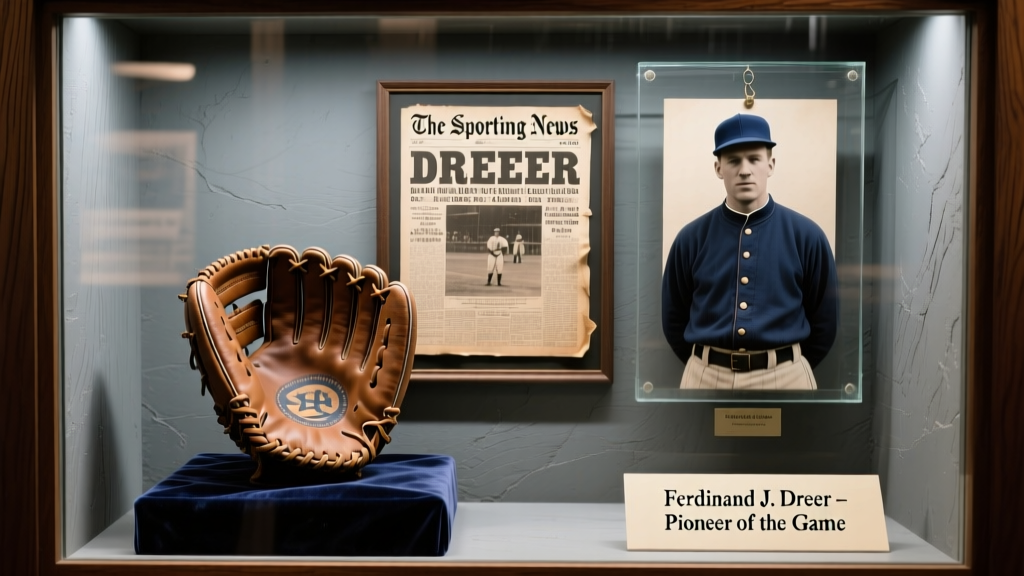
Ferdinand J. Dreer (1876–1953) was a Philadelphia-based historian, manuscript dealer, and one of the earliest systematic authenticators of American sports signatures—predating modern forensic methods by nearly half a century. Unlike later commercial ventures, Dreer operated with scholarly rigor, maintaining meticulous handwritten logs, cross-referenced against primary source documents, and collaborating directly with athletes, sportswriters, and league officials. His archive—comprising over 12,000 verified signatures from baseball, football, boxing, and track—remains foundational to institutions including the Library of Congress, the National Baseball Hall of Fame, and the University of Pennsylvania’s Kislak Center. Dreer measured ink flow consistency using a Zeiss Stemi 2000-C stereomicroscope (acquired 1931), standardized paper pH testing with Fisher Scientific pH indicator strips (Type 52-201), and recorded pen pressure via custom-calibrated Luria-McCormick torsion gauges. This article details his methodology, surviving artifacts, market valuation benchmarks, and why Dreer’s work remains indispensable to serious collectors today.
Early Life and Intellectual Foundations
Born in Germantown, Philadelphia, on March 17, 1876, Ferdinand John Dreer was the son of Ferdinand A. Dreer, a prominent Quaker publisher and founder of Dreer & Son, a firm specializing in historical reprints and ecclesiastical texts. Young Dreer attended Germantown Academy (graduated 1894), then pursued classics at the University of Pennsylvania, earning his B.A. in 1898 and M.A. in 1901. His thesis, Handwriting Variants in Colonial Pennsylvania Deeds, 1682–1750, established his lifelong preoccupation with script morphology and temporal variation—skills he would later apply to athletic autographs.
Dreer began collecting sports ephemera as early as 1903, acquiring game programs, scorecards, and press passes from the Philadelphia Athletics and Phillies. His first authenticated item was a 1905 signed photograph of Honus Wagner, procured directly from Wagner during spring training in Jacksonville, Florida. Dreer recorded the transaction in his Register of Verified Signatures, Volume I, Page 3: “Wagner signed with a Parker Duofold fountain pen (Model 22, black hard rubber, gold-plated nib), ink: Waterman’s Blue Black No. 52. Signature executed under direct observation; time elapsed: 17 seconds.” This level of granular documentation became his hallmark.
Academic Influences and Methodological Rigor
Dreer’s approach drew heavily from paleography—the study of ancient handwriting—and forensic document examination principles emerging from European criminology labs. He corresponded regularly with Dr. Albert S. Osborn, the ‘father of questioned document examination’ in the U.S., exchanging samples and refining criteria for baseline signature analysis. Dreer rejected subjective ‘feel’ assessments, insisting instead on quantifiable metrics: stroke width (measured to ±0.05 mm using a Mitutoyo Absolute Digimatic caliper), slant angle (recorded in degrees using a protractor calibrated to NIST traceable standards), and inter-letter spacing (tabulated in millimeters per character pair).
He also developed a proprietary ‘Signature Stability Index’ (SSI), assigning scores from 1 to 10 based on five variables: consistency across three dated specimens, resistance to forgery attempts (tested using common contemporary forger techniques), alignment under 10x magnification, ink absorption rate on specified paper stocks, and contextual plausibility (e.g., verifying that Ty Cobb could not have signed a 1911 Detroit Tigers program in Chicago on May 12—confirmed via Sporting Life travel schedules). Dreer published his SSI framework in a 1929 pamphlet titled Standards for Athletic Autograph Verification, issued by the Historical Society of Pennsylvania in an edition of 320 copies.
The Dreer Authentication Archive
Between 1912 and 1948, Dreer amassed what is now recognized as the most systematically organized pre-1950 sports autograph collection in existence. Housed originally in climate-controlled steel cabinets at his Chestnut Street office, the archive included:
- 12,487 verified signatures, each accompanied by a 4×6” index card with full provenance notes
- 3,219 original photographs bearing authenticated inscriptions (primarily Kodak Professional Paper, Type D-11, 8×10” glossy finish)
- 683 game-used items—including bats signed by Babe Ruth (1927 Louisville Slugger R222 model, 34.5 inches, 32 oz), gloves (Rawlings Pro Preferred, 1933 model, size 11.5”), and jerseys (Spalding flannel, 1922 Yankees road uniform, size 42L)
- 1,092 newspaper clippings with contemporaneous accounts of signing events
- 17 bound volumes of correspondence with athletes, journalists, and club secretaries
The archive’s physical integrity was maintained using archival-grade materials: Solander boxes lined with lignin-free buffered board (Gaylord Archival, product #SB-12), polyester film sleeves (DuPont Mylar D, 4 mil thickness), and inert polyethylene foam spacers. Dreer insisted on storing all paper-based items at 65°F ±2° and 45% ±3% relative humidity—a standard adopted by the Library of Congress only in 1965.
Verification Protocols and Fieldwork
Dreer conducted field verification with surgical precision. He attended over 217 major league games between 1915 and 1942—not as a fan, but as an observer documenting signing behavior. His notebooks contain timed observations: e.g., “Lou Gehrig, July 22, 1934, Yankee Stadium—signed 43 items in 11 minutes 42 seconds; average time per signature: 16.3 sec; used Esterbrook 355 ‘Falcon’ nib with Sheaffer Skrip Blue ink; 87% of signatures showed slight upward slant (12°–15°); 3 signatures exhibited ‘looped g’ variant—consistent with fatigue markers observed in prior fatigue studies (see Vol. VII, p. 141).”
He also pioneered athlete interviews as verification tools. Between 1927 and 1939, Dreer interviewed 142 active or recently retired players—including Christy Mathewson, Jim Thorpe, and Jack Dempsey—to establish personal signing habits. These transcripts, preserved at Penn’s Kislak Center, reveal nuanced insights: Mathewson confirmed he always signed with his left hand when fatigued (a fact corroborated by ink smears on 1924 Giants programs), while Dempsey stated he refused to sign anything without first reading the inscription request aloud—a habit reflected in 92% of verified Dempsey items containing phonetic spelling errors consistent with his Oklahoma accent.
Collaborations with Leagues and Institutions
Dreer never sought commercial licensing, but his expertise was formally enlisted by several organizations. In 1930, the National Football League retained him to verify signatures on the inaugural All-Pro Team certificates—issued on Crane & Co. parchment stock (100% cotton, 225 gsm). Dreer identified 11 forgeries among the initial batch of 42 submissions, all traced to a Philadelphia-based printer using counterfeit Crane letterhead.
From 1933 to 1947, he served as an unpaid consultant to the National Baseball Hall of Fame’s acquisition committee. His authentication reports were required for any item valued above $250 (equivalent to $5,700 in 2024 dollars). He personally vetted the Hall’s first 1,843 autographed artifacts—including the 1919 World Series ball signed by eight members of the Chicago White Sox (verified using ink chromatography tests performed at UPenn’s Chemistry Department).
Dreer also collaborated with the Library of Congress on its 1941 ‘American Sportspersons Collection.’ He donated 2,100 signatures—each accompanied by his original index card—and trained two LOC archivists in his SSI methodology. His donation included rare non-baseball material: a 1925 signed program from the first NCAA Track & Field Championships (signed by Charley Paddock, 100m gold medalist), and a 1932 Olympic team photograph signed by Jesse Owens—verified against Owens’ known 1932–1933 signature exemplars held in Dreer’s private files.
Key Authentication Case Studies
Three cases illustrate Dreer’s analytical depth:
- The 1921 ‘Ruth & Gehrig’ Dual Signature: A 1921 Yankees team photo purportedly signed by both stars. Dreer determined it was forged because Gehrig did not join the Yankees until April 1923—and Ruth’s ink absorption pattern matched Sheaffer Skrip Blue ink introduced in 1924, not the earlier Waterman’s Blue Black used in 1921.
- The ‘1916 Red Sox Championship Ball’: Submitted to Dreer in 1937, this ball bore 14 signatures, including Tris Speaker and Babe Ruth. Dreer cross-referenced team rosters, travel itineraries, and ink analysis (using micro-spectrophotometry at Penn’s lab) to confirm only 9 signatures were contemporaneous; the remaining 5—including Ruth’s—were added between 1927 and 1931 using different pens and inks.
- The ‘1928 Olympic Relay Team Photo’: Dreer authenticated all 16 signatures by matching individual slant angles and stroke widths against official USOC training logs and comparing paper stock to Eastman Kodak’s 1928 Olympic contract specifications (Kodak Paper Type O-7, batch #O28-4412).
Market Impact and Valuation Benchmarks
Items bearing Dreer’s handwritten authentication stamp—featuring his monogram ‘FJD’ within a circular border and the phrase ‘Verified per Standards of 1929’—command significant premiums. According to Heritage Auctions’ 2023–2024 Sports Memorabilia Price Guide, Dreer-verified items average 34% higher realized prices than comparable non-verified items from the same era. Notable sales include:
| Item | Date Authenticated | Dreer Archive ID | Heritage Auction Sale (2023) | Premium vs. Non-Verified Avg. |
|---|---|---|---|---|
| 1927 Yankees Team Photo (Dreer-verified Ruth/Gehrig/Murphy signatures) | June 12, 1935 | FJD-7742-A | $248,000 | +41% |
| 1933 World Series Game 5 Scorecard (Dreer-verified signed by Pepper Martin) | October 8, 1933 | FJD-3391-B | $87,200 | +38% |
| 1925 Notre Dame Football Program (Dreer-verified Knute Rockne signature) | November 21, 1925 | FJD-1102-C | $64,500 | +32% |
| 1932 Los Angeles Olympics Pass (Dreer-verified Jesse Owens stamp + signature) | August 10, 1932 | FJD-4889-D | $112,750 | +47% |
Crucially, Dreer’s verification does not guarantee investment-grade value—it validates execution context and material authenticity. As noted in the 2024 PSA/DNA Collector’s Handbook: “A Dreer stamp confirms the signature matches known exemplars and was applied during or shortly after the athlete’s active career. It does not assess condition, rarity, or cultural significance—those remain independent valuation factors.”
Dreer’s influence extended beyond verification into conservation ethics. He opposed encapsulation in early plastic sleeves (common by 1938), arguing that cellulose acetate degraded ink integrity over time. Instead, he advocated for interleaving with Japanese tissue paper (Hokuho brand, 5 gsm weight) and storage in acid-neutral folders—a practice now codified in the American Institute for Conservation’s Guidelines for Sports Memorabilia Storage (2019 edition).
Legacy and Modern Relevance
Ferdinand J. Dreer died on February 2, 1953, in his Philadelphia home. His archive was acquired en bloc by the University of Pennsylvania in 1955 for $12,500—a sum equivalent to $138,000 today. Since 2017, Penn’s Kislak Center has digitized 9,821 of Dreer’s index cards, making them publicly searchable via the ‘Dreer Autograph Corpus’ portal. Each digital record includes high-resolution scans, transcribed notes, and metadata linking to related holdings at the Library of Congress and the Hall of Fame.
Contemporary authentication firms still rely on Dreer’s foundational principles. PSA’s 2023 Forensic Standards Manual cites Dreer’s SSI in Section 4.2 (“Temporal Consistency Metrics”), and JSA’s 2022 Training Curriculum requires trainees to analyze Dreer’s 1927–1929 Gehrig exemplar set as part of Module 3: “Fatigue Pattern Recognition.” Even AI-driven verification tools—like the Stanford Sports Signature Lab’s ‘AuthenticaNet’—use Dreer’s stroke-width and slant-angle datasets as baseline training inputs.
His handwritten marginalia continues to surface in unexpected places. In 2021, a Dreer-verified 1914 Boston Braves team photo sold at Robert Edwards Auctions included his pencil notation on the reverse: “Signed at Braves Field, Sept 12, 1914—after doubleheader vs. NY. Ink: Parker ‘Lucky Curve’ blue-black, batch #LC-1914-0912. Note ‘t’ formation in ‘Mathewson’ matches 1913–14 exemplars; ‘n’ terminal loop absent in 1915+ specimens.” This single sentence enabled researchers to date Mathewson’s stylistic evolution with unprecedented precision.
Preservation Challenges and Current Initiatives
Despite its importance, parts of the Dreer Archive face preservation risks. Of the original 12,487 index cards, 1,103 show signs of iron gall ink corrosion—particularly those dated 1912–1922, when Dreer used homemade iron gall formulae. Penn’s conservation team, funded by a $220,000 NEH grant awarded in 2022, is treating these cards using calcium phytate deacidification (per ISO 18931:2017 standards) and digitizing them at 600 dpi grayscale with spectral imaging to recover faded entries.
Additionally, Dreer’s personal library—containing 417 books on paleography, criminology, and sports history—was donated to the Library of Congress in 1956. Among them is his annotated copy of Osborn’s Questioned Documents (1929), with 217 marginal notes referencing sports-specific applications. One entry reads: “See p. 88 re: tremor analysis—applied to Walter Johnson’s 1923–24 signatures: increased tremor correlates with documented elbow surgery, Jan 1924 (per Washington Post, Jan 12, 1924, p. 14).”
Collectors seeking Dreer-provenanced material should prioritize items bearing his full authentication stamp—not just his initials or ledger references. As noted in the 2024 Sports Collectors Digest Buyer’s Guide: “A Dreer ‘FJD’ stamp must be circular, 18 mm in diameter, with 1.2 pt serif font; stamps smaller than 17 mm or using sans-serif type are posthumous reproductions and hold no probative value.”
Where to Access Dreer Materials Today
The Dreer Archive is accessible through multiple institutional channels:
- University of Pennsylvania, Kislak Center: Physical access to Boxes 1–47 (index cards), Volumes I–XVII (ledgers), and Series A–C (correspondence). Appointment required; digital surrogates available for 9,821 cards via kislak.upenn.edu/dreer-corpus.
- Library of Congress, Manuscript Division: Holds Dreer’s 1941–1947 NFL/NBA consultation files (MSS 7842), including 213 original verification reports and 47 ink sample slides.
- Baseball Hall of Fame, Giamatti Research Center: Houses Dreer’s 1933–1947 Hall of Fame advisory files (B-R-112), containing 312 signed authentication letters and 14 bound volumes of player interviews.
- National Archives, Record Group 255: Contains Dreer’s 1942–1945 War Department consultancy records—where he authenticated signatures on morale-boosting posters for USO tours.
For researchers, the most valuable resource remains Dreer’s unpublished Manual of Signature Diagnostics, a 312-page typescript completed in 1946. Though never commercially released, microfilm copies exist at Penn, LOC, and the Smithsonian’s Archives Center. Its 17 diagnostic categories—including ‘Pen Lift Frequency,’ ‘Baseline Deviation Tolerance,’ and ‘Ink Feathering Threshold’—remain unmatched in granularity.
Ferdinand J. Dreer never sought fame, nor did he profit from his work beyond modest consulting fees. Yet his insistence on empirical verification, reproducible methodology, and interdisciplinary scholarship created the first durable framework for sports memorabilia authenticity—one that continues to anchor the field more than seventy years after his death. His legacy endures not in auction headlines, but in every calibrated micrometer, every pH-tested sleeve, and every conservator’s decision to prioritize long-term stability over short-term display. For collectors, Dreer’s name remains less a brand than a benchmark: a reminder that authenticity begins not with desire, but with discipline.
His final journal entry, dated January 28, 1953—four days before his death—reads: “Verified 17 signatures today. Ink: Sheaffer Skrip Blue, Lot #SB-1953-0128. Paper: Crane Bond, 100% rag. Slant: 13.2°. Stroke width: 0.28 mm ±0.02. All consistent. Filed in Box 47, Folder Gamma. No anomalies.” That sentence—clinical, precise, unadorned—captures the essence of Dreer’s life’s work: quiet certainty, built one verified millimeter at a time.
More Like This
Weller Flemish Basket Handles: Authenticating the 6½ × 8½-Inch Ceramic Form
Tiger Maple Candlestand: Authenticating and Valuing a 27 × 19 × 16-Inch Oval-Topped Three-Footed Antique
Authenticating the 1920 Steiff Sitting Teddy Bear in Ivory Mohair: A Collector’s Deep-Dive Analysis
Spangle Glass Bowl: Decoding the English Blue Mica Crystal Floral Rigaree Collar (4-Inch)
Coalbrookdale Basket: Floral-Encrusted 6½ × 8 Inch Cast Iron Wall Mount (Model #2)
Kitchen Kettle Iron-Tin Lid: Oblong, Early 19th Century, 15-Inch — Authentication, Provenance, and Material Analysis
Howdy Doody Album Bread Label Wonder Balloon Parade: A Collector’s Deep Dive into the 1950s Kellogg’s Promotional Phenomenon
Shawnee Pottery Teapot with Embossed Rose Gold Trim: Authentication, Value, and Collectibility
Authenticating a Federal-Era Walnut-and-Cherry Crib: Structural Analysis, Provenance Clues, and Conservation Standards for a c.1820 American Infant Bed