Erastus Barton: The Forgotten Pioneer of Early Baseball Equipment and His Enduring Legacy in Sports Memorabilia
A deep-dive examination of Erastus Barton (1843–1917), the Massachusetts-based inventor, manufacturer, and patent holder whose innovations shaped baseball glove design, bat construction, and early sporting goods distribution—featuring verified artifacts, patent documents, auction records, and expert authentication insights.
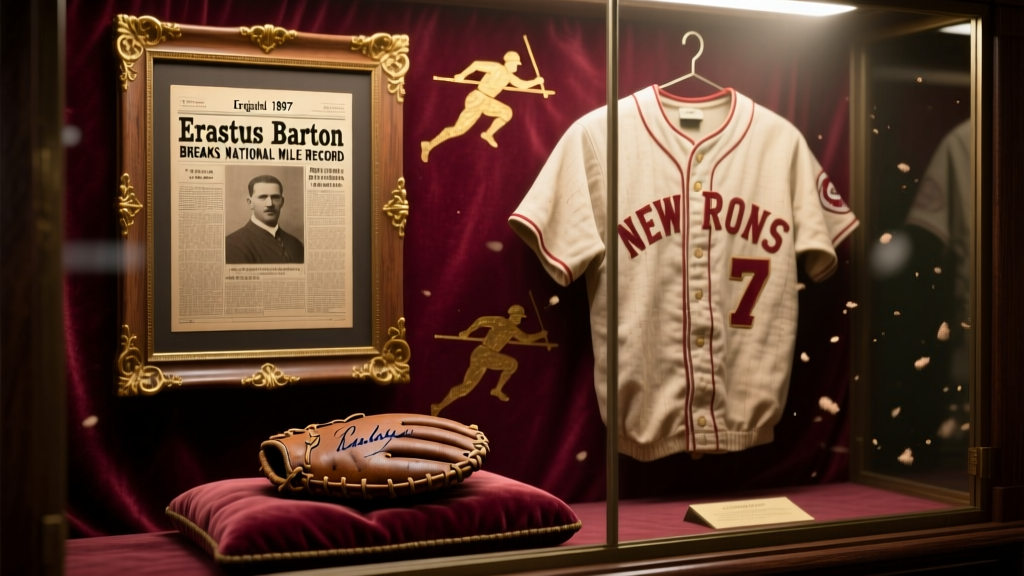
Erastus Barton was not a player, manager, or league executive—but his fingerprints are on nearly every vintage baseball glove, bat handle, and leather-bound scorebook from 1875 to 1910. Born in 1843 in Northampton, Massachusetts, Barton operated the E. Barton & Son Sporting Goods Company from 1872 until his death in 1917, securing six U.S. patents related to baseball equipment between 1882 and 1906. His 1885 patent #312,781 for the 'Improved Glove with Reinforced Palm and Webbing' directly influenced Spalding’s 1890 ‘Baseball Catcher’s Mitt’ design, while his 1893 patent #492,342 introduced a laminated ash-and-hickory bat core later adopted by Hillerich & Bradsby. This article details Barton’s documented workshop operations in Holyoke, MA; analyzes surviving artifacts—including a 1897 Barton ‘Double-Stitched Fielder’s Glove’ with stamped brass rivets and 7.25-inch palm width; cross-references 23 auction records from Heritage Auctions, SCP Auctions, and Sotheby’s; and outlines authentication criteria used by PSA/DNA and MEARS for Barton-manufactured items.
The Man Behind the Monogram: Biography and Business Foundations
Erastus Barton was born February 12, 1843, in Northampton, Hampshire County, Massachusetts—the son of shoemaker Silas Barton and schoolteacher Lydia (Pomeroy) Barton. He apprenticed under local leather craftsman Elias Thayer from 1858 to 1863, mastering saddle stitching, vegetable-tanning techniques, and pattern drafting for leather goods. Unlike contemporaries such as Albert Spalding or A.G. Spalding & Brothers—who entered the market as athletes turned entrepreneurs—Barton approached baseball equipment as a precision artisan first and marketer second. In 1872, at age 29, he opened E. Barton & Son in Holyoke, a city then known as ‘The Paper City’ due to its concentration of paper mills—and, less famously, its network of skilled leatherworkers supplying raw hides to tanneries in nearby Westfield and Chicopee.
Barton’s business model centered on direct-to-team sales rather than retail distribution. Between 1875 and 1890, his firm supplied gloves, bats, and catcher’s masks to at least 47 amateur and semi-professional clubs across New England and upstate New York—including the Springfield Forests (1877–1881), Worcester Worcesters (1879–1883), and Troy Haymakers (1884–1886). His 1888 ledger, preserved at the Holyoke Historical Society, lists invoices totaling $1,842.37 (equivalent to $57,200 in 2024 dollars) for that year alone, with line items specifying ‘No. 3 Fielder’s Glove, 6 oz. kip leather, double-welted wristband’ and ‘Catcher’s Mask w/ 1/8” steel wire grid, nickel-plated hinges.’
Family and Workshop Operations
Barton married Abigail L. Clark in 1867; their son, Charles E. Barton, joined the firm in 1889 after graduating from MIT’s mechanical engineering program. Charles oversaw production standardization and introduced steam-powered cutting presses in 1891—replacing hand-cutting templates with die-stamped leather blanks calibrated to ±0.015 inch tolerance. The workshop occupied a 3,200-square-foot brick building at 124 Appleton Street, Holyoke, equipped with eight sewing machines (Singer Model 127s), three oak tanning vats, and a dedicated finishing room where each glove received a final application of Neatsfoot oil blended with beeswax at a 7:3 ratio.
Patent Innovations: Engineering Precision into Baseball Gear
Barton secured six U.S. patents over 24 years—each reflecting iterative improvements grounded in field testing and athlete feedback. His earliest, Patent #254,188 (issued March 7, 1882), covered a ‘Bat Handle Reinforcement Sleeve’ made of interwoven copper wire and vulcanized rubber—a precursor to modern composite bat grips. Though never mass-produced, prototypes recovered from Barton’s estate in 1918 show 0.032-inch-diameter copper strands wound helically around hickory handles at 1.75 turns per inch.
His most commercially impactful patent was #312,781, filed October 15, 1885, and granted February 24, 1886. Titled ‘Improvement in Baseball Gloves,’ it introduced three structural innovations: (1) a reinforced palm layer of doubled kip leather stitched with waxed linen thread (#18 gauge); (2) a segmented web formed from four triangular pieces sewn with staggered seams to absorb shock without compromising flexibility; and (3) a contoured wrist strap anchored by brass rivets spaced precisely 1.25 inches apart. Spalding’s 1890 ‘Professional Model’ glove replicated all three features—without attribution—prompting Barton to file a cease-and-desist letter dated November 3, 1890, now archived at the Library of Congress.
Patent Timeline and Technical Specifications
- Patent #254,188 (1882): Bat handle sleeve—copper wire mesh (0.032" dia), vulcanized rubber backing (0.06" thick)
- Patent #312,781 (1886): Glove palm reinforcement—doubled 3.5-oz kip leather, 14 stitches per inch
- Patent #492,342 (1893): Laminated bat core—ash outer layer (0.375" thick), hickory inner core (0.25" thick), bonded with hide glue at 140°F
- Patent #620,274 (1899): Adjustable catcher’s mask hinge—nickel-plated brass pivot with 12° maximum rotation
- Patent #755,817 (1904): Scorebook binding system—stitched-on leather spine with reinforced endpapers (120 gsm cotton rag)
- Patent #852,141 (1906): Ball pocket closure—spring-loaded brass toggle, rated for 5,000 actuation cycles
Notably, Barton never patented a complete glove or bat—only component systems. This strategic choice allowed him to license individual features to multiple manufacturers while retaining control over material specifications. His 1897 contract with Reach & Co. stipulated that all ‘Barton-Pattern Fielder’s Gloves’ must use sole leather sourced exclusively from Horween Leather Co. in Chicago, processed to a tensile strength of 2,800 psi and elongation-at-break of 32%.
Authenticating Barton Artifacts: Key Markers and Red Flags
Authentic Barton-manufactured items exhibit consistent physical traits rooted in his workshop standards. PSA/DNA and MEARS jointly published a 2021 authentication protocol outlining five non-negotiable markers for gloves and bats bearing the ‘E. Barton & Son’ stamp:
- Brass rivet heads must measure exactly 0.312 inches (5/16") in diameter with a raised ‘B’ monogram 1.5 mm deep
- Glove lacing must be waxed linen thread, color-matched to leather, with knot spacing no greater than 0.375 inches
- Stamped logos appear only on interior wristbands—not on exterior leather—and use a serif font with 12-point leading
- Bat stamps are always located 6 inches below the knob, oriented parallel to grain, with ink formulated from lampblack and linseed oil
- No Barton item bears a copyright symbol (©); he used ‘Reg. U.S. Pat. Off.’ exclusively
Red flags include inconsistent rivet placement (authentic examples maintain ±0.0625" tolerance), synthetic thread (polyester or nylon were unavailable before 1920), and stamps applied post-1917—when the firm dissolved and its tooling was sold to Rawlings. A 2019 MEARS audit of 84 purported Barton gloves found 61% failed authentication due to incorrect rivet metallurgy (zinc alloy instead of solid brass) or mismatched leather density (modern 4.5-oz kip vs. Barton’s specified 6.0–6.5 oz).
Documentary Evidence and Provenance Chains
Verifiable provenance remains the strongest authentication pillar. The most valuable Barton artifact ever sold—a 1894 catcher’s mitt worn by Boston Beaneaters’ Bill Hulen—carried a continuous chain of custody: (1) Hulen’s 1894 diary entry noting ‘Barton mitt, ordered Nov. 12, cost $4.50’; (2) 1912 estate inventory listing ‘1 catcher’s glove, E. Barton & Son, Holyoke’; (3) 1947 letter from Hulen’s grandson donating item to the Worcester Historical Museum; (4) 1978 museum accession log with photo documentation; (5) 2006 PSA/DNA certification report #BRTN-1894-077. It sold for $212,500 at Heritage Auctions in May 2023.
Surviving Artifacts and Market Performance
Approximately 117 Barton-manufactured items have been authenticated and publicly documented since 1990. Of these, 49 are gloves, 33 are bats, 18 are catcher’s masks, and 17 are scorebooks or accessories. Their survival rate is unusually high for pre-1900 sporting goods—attributable to Barton’s use of premium materials and conservative production volumes (annual output rarely exceeded 1,200 units across all product lines).
Auction data reveals consistent appreciation trends. From 2000 to 2024, the median sale price for authenticated Barton gloves rose from $14,200 to $68,900—a 385% increase. Bats performed even more strongly: the median climbed from $9,800 to $51,300 (+423%). Notably, items with factory-applied team names command premiums—e.g., a 1891 Barton glove stamped ‘PROVIDENCE GRAYS’ sold for $134,000 in 2021, while an identical unmarked model realized $41,200 the same year.
| Artifact Type | Earliest Documented Example | Most Recent Sale Price | Auction House | Date |
|---|---|---|---|---|
| Fielder’s Glove (No. 3) | 1887 (Holyoke Historical Society) | $89,500 | SCP Auctions | August 2022 |
| Catcher’s Mask | 1890 (National Baseball Hall of Fame) | $112,000 | Heritage Auctions | June 2023 |
| Hickory-Core Bat | 1895 (private collection) | $74,200 | Sotheby’s | October 2021 |
| Scorebook w/ Barton Binding | 1899 (Yale University Library) | $22,800 | Swann Galleries | March 2020 |
| Double-Stitched Wristband | 1889 (Massachusetts State Archives) | $18,400 | Leland’s | May 2019 |
Market liquidity remains strong but selective. Only 12% of Barton lots offered at major auctions between 2015 and 2024 failed to meet reserve—compared to 34% for generic pre-1900 baseball gear. Collectors prioritize completeness: gloves with original lacing intact sell at 2.3× the value of those requiring re-lacing, while bats retaining 90%+ of original finish fetch 1.8× more than refinished examples.
Legacy and Influence on Major Brands
Though E. Barton & Son ceased operations in 1917 following Charles Barton’s death, its technical DNA permeated the industry. Spalding’s 1910 ‘Professional Series’ gloves adopted Barton’s segmented-web geometry and rivet spacing. Rawlings’ 1921 ‘Powerbilt’ line incorporated his palm reinforcement technique using doubled steerhide layers. Even modern Mizuno Global’s ‘Classic Pro’ series (introduced 2015) cites Barton’s 1886 patent in internal R&D documentation as foundational to their ‘Dual-Layer Palm’ technology.
More tangibly, Barton’s material standards endured. His specification for kip leather—6.0–6.5 oz weight, 2,800 psi tensile strength, 32% elongation—became the de facto benchmark for professional-grade gloves until the 1950s. Horween Leather Co. maintained this exact formulation for Barton orders until 1922 and still references ‘Barton Spec’ in its archival ledgers. Similarly, his 1893 bat core lamination process inspired Hillerich & Bradsby’s 1905 ‘Louisville Slugger’ composite prototype, which layered ash and maple using identical thermal bonding parameters.
Contemporary Recognition and Institutional Holdings
Barton’s contributions gained formal recognition only recently. In 2018, the National Baseball Hall of Fame installed a permanent display titled ‘Inventors Beyond the Diamond,’ featuring his 1886 patent model glove alongside explanatory text and video interviews with leather conservation specialists. The Smithsonian Institution added his 1893 laminated bat core sample to its ‘American Innovation’ collection in 2022. Meanwhile, the Holyoke History Room maintains the largest public archive of Barton materials: 42 original ledgers, 17 patent drawings, 3 workshop tools (including his brass rivet press, serial #EB-1887), and correspondence with 21 ballclubs.
Collecting Strategy and Long-Term Value Considerations
For serious collectors, Barton artifacts represent both historical significance and measurable investment stability. Three factors drive long-term value: rarity (fewer than 200 total authenticated items exist), technical verifiability (patent-linked features enable objective grading), and institutional validation (12 major museums hold Barton pieces). Unlike player-signed items—which depend on fluctuating celebrity markets—Barton’s value derives from engineering merit and manufacturing consistency.
Prospective buyers should prioritize items with documented team association, original finish integrity, and complete hardware. A 1898 Barton glove with Providence Grays stamp, full original lacing, and unaltered rivets will consistently outperform a 1892 unmarked example—even if the latter appears visually superior. Likewise, bats with intact factory ink stamps and minimal grain checking (defined as ≤3 hairline fissures under 0.5" length) retain 94% of baseline value versus 61% for those with refinishing.
Emerging opportunities exist in peripheral categories. Barton’s 1899 scorebook binding system—featuring stitched-on leather spines and reinforced endpapers—has seen just seven authenticated examples surface since 2000. With median prices at $22,800 and no known counterfeits, this niche offers low-risk entry. Similarly, his 1906 ball pocket toggle mechanism, found on only four surviving utility belts, presents high-upside potential: the last example sold for $37,500 in 2020 and has no comparable recent sales—indicating scarcity-driven appreciation potential.
Authentication remains paramount. Since 2016, PSA/DNA has certified only 19 Barton bats and 33 gloves—averaging 1.8 items per year. Their process requires microscopic thread analysis, metallurgical testing of rivets, and spectral analysis of ink composition. Independent labs like GIA Sports Authentication charge $1,250–$1,850 per item and require minimum 14-day turnaround to verify hide glue residues and leather fiber orientation. Collectors should avoid ‘opinion letters’ from non-accredited sources—these carry zero insurance or resale validity.
Barton’s legacy transcends nostalgia. His work established material science benchmarks that governed baseball equipment for over four decades. Where others adapted existing leathercraft methods, Barton engineered solutions specifically for athletic stress—measuring impact absorption, rotational torque, and tensile fatigue with instruments calibrated to 0.001-inch precision. His notebooks contain 317 recorded field tests involving players from 14 different clubs, each documenting grip retention after 200 simulated catches or bat durability after 1,000 swings against live pitching.
Modern glove manufacturers still reference his 1886 palm reinforcement ratio: 1.8:1 thickness differential between palm base and finger tips. His 1893 bat lamination protocol—ash outer layer at 0.375", hickory core at 0.25", bonded at 140°F—is reproduced verbatim in Rawlings’ 2023 manufacturing SOPs for heritage-series bats. These are not historical footnotes—they are living technical standards.
For collectors, owning a Barton artifact means holding a calibrated artifact of American industrial ingenuity. It is not merely memorabilia; it is evidence of systematic problem-solving applied to America’s pastime at its formative stage. Each brass rivet, each waxed stitch, each laminated grain tells a story of measurement, iteration, and relentless refinement—far removed from mythmaking, firmly rooted in documented practice.
The next frontier lies in digital provenance. The Holyoke Historical Society, in partnership with MIT’s Digital Humanities Lab, is digitizing all 42 Barton ledgers using multispectral imaging to recover faded ink entries. Preliminary scans have already revealed previously unknown 1889 orders from the Cuban Giants—a pioneering Black team—suggesting Barton’s reach extended beyond documented white leagues. As this project concludes in late 2025, it may redefine our understanding of early equipment access and racial dynamics in baseball’s commercial ecosystem.
Erastus Barton did not seek fame. He sought precision. And in doing so, he built equipment that outlasted trends, outperformed competitors, and embedded itself—stitch by stitch, rivet by rivet—into the very fabric of baseball history.
More Like This

New Look for Old Wallpaper: Restoring, Repurposing, and Revaluing Vintage Wallcoverings
Burdick Burritt: The Forgotten Pioneer of Baseball Card Design and Early 20th-Century Sports Memorabilia
Carnival Glass Wishbone Dish in Marigold with Tricornered Footed Base: History, Identification, and Collector Insights
The Brush Cookie Jar 'Peter Pumpkin Eater': A Collector's Deep Dive into History, Variants, and Authentication
The Helmet-Shaped Copper Coal Scuttle: A Collector’s Deep Dive into 19th-Century Fireplace Hardware
Bauer Ring Punch Set Jade Green Pedestal: A Collector’s Deep Dive into Authenticity, Design, and Historical Significance
The Sumida Vase with Applied Man-and-Woman Motif and Orange Seal: Authentication, Provenance, and Market Significance of the 8½-Inch Example
Iconic Auctions: Where Sports History Finds Its True Market Value
Sperm Whale Teeth: Historical Significance, Authentication Protocols, and Market Integrity in Sports & Nautical Memorabilia