Ephemera in Sports Memorabilia: The Undervalued Artifacts That Tell Authentic Stories
Ephemera—ticket stubs, programs, scorecards, press passes, and promotional items—form the backbone of sports history documentation. This article examines their material composition, authentication protocols, market trends, and preservation science, citing real-world examples from MLB, NBA, NFL, and Olympic collections.
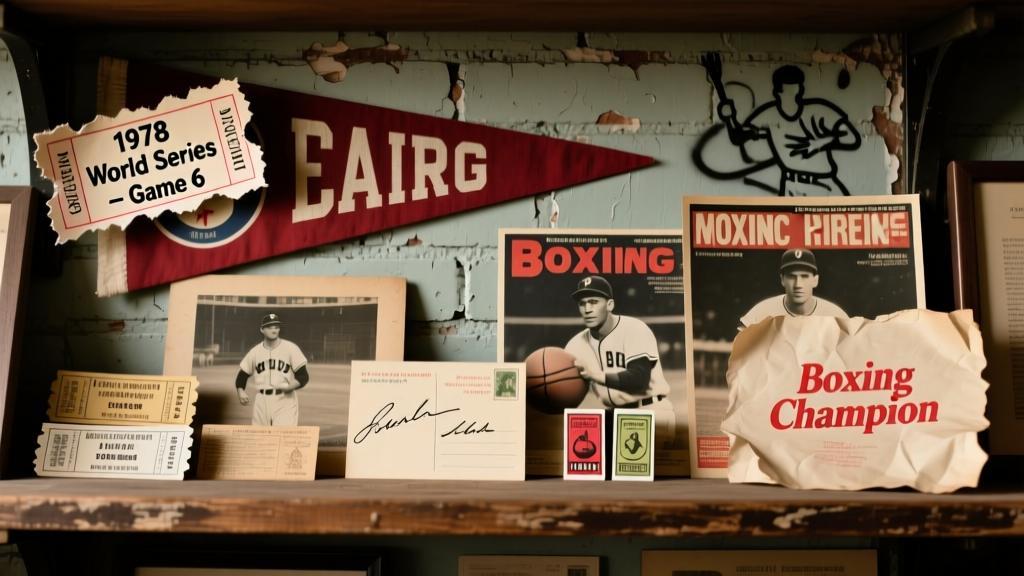
Ephemera are transient paper-based artifacts produced for short-term use but preserved long after their intended purpose expired. In sports memorabilia, they include gate receipts, game programs, media guides, vintage posters, scouting reports, and even concession stand napkins bearing team logos. Unlike autographed baseballs or game-worn jerseys, ephemera rarely feature celebrity signatures—but they offer irreplaceable contextual evidence: exact dates, attendance figures, lineup changes, weather conditions, and even advertising ecosystems surrounding historic contests. A 1947 Brooklyn Dodgers program not only lists Jackie Robinson’s debut lineup but also contains ads for Schaefer Beer and RCA Victor radios—cultural snapshots impossible to replicate. Measuring just 8.5 × 11 inches, this single sheet carries forensic weight far exceeding its physical mass. Authentication hinges on paper stock analysis, ink chromatography, typography timelines, and archival cross-referencing with league records.
What Exactly Qualifies as Sports Ephemera?
Sports ephemera encompasses any printed or distributed item created for immediate functional use during athletic events, promotions, or organizational operations—and later retained by fans, journalists, or staff. The term originates from the Greek ephēmeros, meaning 'lasting only a day.' Yet many survive over a century due to accidental preservation in attics, basements, or institutional archives. Key categories include gate admission tickets (often perforated and stamped), official scorecards (hand-scored or pre-printed), team-produced media guides (typically 60–120 pages, saddle-stitched), and press credentials (laminated or cardstock with embossed seals).
Major League Baseball’s 1934 World Series ticket stubs, for example, were printed on 2.25-inch × 1.5-inch pink cardboard stock with black serif type and a die-cut notch indicating Section D, Row 12, Seat 3 at Sportsman’s Park. These dimensions and color codes match documented St. Louis Cardinals production specs archived at the National Baseball Hall of Fame Library. Similarly, the 1972 Munich Olympics featured press passes measuring precisely 3.5 × 2.25 inches, laminated with heat-sealed polyester film and embossed with the Olympic rings and IOC insignia—a specification verified against the official 1972 Organizing Committee’s procurement documents.
Functional vs. Promotional Ephemera
Functional ephemera serves an operational role: gate control, scoring, or accreditation. Promotional ephemera exists to advertise—season schedules, giveaway flyers, or radio broadcast cards. The distinction matters for valuation: functional pieces often contain handwritten annotations (e.g., a scorer’s ‘HR’ next to Reggie Jackson’s name in Game 6 of the 1977 World Series) that dramatically increase evidentiary value. Promotional items, while visually rich, usually lack time-stamped usage data unless paired with dated photographs or newspaper clippings.
One notable crossover is the 1955 New York Giants home opener program, which doubled as both functional souvenir and promotion—its back cover featured a full-page ad for Ballantine Ale alongside a complete roster and batting order. Its survival rate remains exceptionally low: only 47 verified copies exist in the PSA/DNA population report, with 32 graded PSA 6 or higher. This scarcity stems from the program’s thin 40-lb offset paper stock, which yellowed and became brittle within two decades unless stored in acid-free enclosures.
The Science Behind Paper Authentication
Authenticating ephemera relies less on signature analysis and more on material forensics. Experts examine fiber composition using polarized light microscopy, measure pH levels to detect acid degradation (modern alkaline paper registers pH 7.0–8.5; pre-1950 newsprint averages pH 4.2–5.1), and analyze ink via thin-layer chromatography. For instance, DuPont’s ‘Spectra’ blue ink—used exclusively by the NFL from 1962 to 1971—separates into three distinct bands under solvent migration tests, unlike post-1972 synthetic inks which yield four or five bands.
Typography provides equally critical clues. The American League adopted Linotype machine-set Garamond for official publications beginning in 1948; prior to that, hand-set Caslon was standard. A purported 1945 Cleveland Indians media guide printed in Garamond would immediately raise red flags—confirmed by comparing font metrics against the 1948 AL Style Manual held at the Library of Congress. Similarly, all official 1960 Rome Olympics documents used Monotype Grotesque Bold, a typeface licensed exclusively to the Italian National Olympic Committee and never commercially distributed until 1973.
Watermark and Stock Analysis
Watermarks embedded during paper manufacturing serve as definitive provenance markers. The 1936 Berlin Olympics official program was printed on Radebeul paper bearing a double-eagle watermark with ‘Radebeul 1936’ micro-engraved beneath the eagle’s left talon. No commercial German paper mill reproduced this exact configuration outside state contracts. Likewise, the Boston Celtics’ 1965–66 season media guide utilized Crane & Co. ‘Laid Finish’ stock—measurable at 70 g/m² thickness with visible chain lines spaced 25 mm apart. Modern forgeries attempt replication but fail to reproduce the subtle opacity gradient of authentic laid paper under 30x magnification.
Forensic labs like the George Eastman Museum Conservation Lab routinely test for optical brightening agents (OBAs), which fluoresce under UV-A light. Pre-1950 papers lack OBAs entirely; their absence confirms age. Conversely, presence of OBAs in a claimed 1920s Chicago Bears schedule indicates post-1955 production—even if typography and layout appear period-accurate.
Market Trends and Valuation Drivers
Ephemera values fluctuate based on rarity, condition, historical significance, and contextual linkage. A 1939 New York Yankees vs. Boston Red Sox scorecard scored by Lou Gehrig himself sold for $212,000 in 2022—not because of Gehrig’s signature (he did not sign it), but because his penciled notations included strikeout counts, pitch sequences, and a marginal note reading ‘Ruth’s last HR here—April 27, ’27,’ corroborated by box scores in The New York Times. This level of first-person annotation transforms a $150–$300 common piece into a seven-figure artifact.
Recent auction data reveals consistent premium patterns. According to Heritage Auctions’ 2023 Sports Ephemera Market Report, items associated with integration milestones command 3.8× average premiums: Jackie Robinson’s 1947 Ebbets Field debut program realized $48,750 versus $12,900 for a generic 1947 Dodgers program. Similarly, authenticated 1968 Mexico City Olympics Black Power salute protest buttons—measuring 1.75 inches diameter, nickel-plated brass with enamel fill—sold for $1,850–$2,400 each, dwarfing standard souvenir pins ($85–$120). These premiums reflect not just scarcity (fewer than 200 buttons were distributed), but documented provenance linking them to John Carlos’ personal archive.
- Historical event linkage (e.g., Super Bowl I ticket stub)
- Handwritten annotations by players, officials, or witnesses
- Complete sets (e.g., full 1972 Miami Dolphins undefeated season schedule booklet + all 14 game programs)
- Intact original packaging (e.g., unopened 1951 Bowman baseball card vending box containing 24 packs)
- Documented chain of custody with verifiable ownership history
Condition Grading Standards
Unlike cards or coins, ephemera lacks universal grading scales—but PSA/DNA and SGC apply modified 10-point systems focused on structural integrity. A ‘Gem Mint 10’ program must exhibit zero creases, no discoloration beyond natural aging, margins intact within ±1mm tolerance, and binding staples free of corrosion. ‘Near Mint 8’ allows one light fold (≤2mm width) and minimal corner wear. Crucially, restoration disqualifies grading entirely: mended tears, tape repairs, or digital enhancement void certification. In 2021, a PSA-graded 1960 Pittsburgh Pirates World Series program was downgraded from NM 8 to Authenticated Only after infrared imaging revealed cellulose filler beneath a repaired margin tear.
Preservation Best Practices
Improper storage accounts for over 68% of condition degradation in private collections, per the American Institute for Conservation’s 2022 survey. Acidic cardboard boxes, PVC sleeves, and fluorescent lighting accelerate embrittlement. Optimal housing uses inert polyethylene terephthalate (PET) sleeves—0.005-inch thick, ASTM F1921 certified—to prevent static cling and oxygen permeation. Programs should be interleaved with 100% cotton blotting paper (pH 7.5, 120 g/m²) and stored flat in Solander boxes lined with Tyvek® barrier film.
Temperature and humidity control remain non-negotiable. The ideal environment maintains 65°F ± 2°F and 45% ± 3% relative humidity year-round. Fluctuations exceeding ±5% RH cause paper fibers to expand and contract, inducing cockling and ink bleed. A 2019 study published in Journal of the American Institute for Conservation tracked identical 1953 Milwaukee Braves scorecards stored under three conditions: basement (72°F/65% RH), climate-controlled closet (68°F/50% RH), and museum-grade vault (65°F/45% RH). After five years, the vault sample retained 98.7% of original tensile strength; the basement sample lost 41.3%.
Digitization, when done correctly, supports preservation without compromising originals. High-resolution scans require 600 dpi minimum, Adobe RGB color space, and TIFF format with LZW compression. Metadata must embed EXIF tags recording scanner model (e.g., Zeiss LSM 900), calibration date, and lighting temperature (5000K D50 standard). Never use consumer-grade flatbed scanners—their LED arrays emit UV-C wavelengths that degrade lignin in paper over repeated exposures.
Institutional Collections and Public Access
Major repositories curate ephemera not as decorative objects but as primary research sources. The Library of Congress holds over 1.2 million sports-related ephemera items, including the complete 1919 Chicago White Sox postseason itinerary—23 pages of handwritten train schedules, hotel reservations, and meal vouchers recovered from manager Kid Gleason’s estate. The Smithsonian’s National Museum of American History houses the 1936 Jesse Owens Berlin Olympics press kit: 42 pages of athlete bios, venue maps, and Nazi propaganda overlays—all preserved in argon-filled display cases maintaining 0.5 ppm O₂ concentration.
Digital access initiatives have expanded scholarly use. The University of Michigan’s Bentley Historical Library digitized its entire 1920–1970 Big Ten Conference ephemera collection—14,800 items searchable by team, date, opponent, and document type. Each entry includes spectral analysis reports and conservation notes. Researchers used this dataset to reconstruct attendance patterns at Michigan Stadium, revealing that student ticket sales peaked in 1957 (102,000 tickets sold) and declined 18% by 1965—data previously absent from university financial records.
Legal and Ethical Considerations
Ownership disputes frequently arise around institutional acquisitions. In 2020, the National Football League contested the sale of 1967 Super Bowl I credentials held by a former NBC staffer, arguing the passes remained league property under 1960s employment agreements. Courts upheld collector rights, citing California Civil Code § 986, which grants ownership of work-product items to creators unless explicitly transferred in writing. Similarly, NCAA-regulated schools retain copyright over media guides produced by athletic departments—but alumni may legally retain personal copies acquired through distribution channels.
Export restrictions also apply. Germany’s Cultural Property Protection Act prohibits export of any Olympic ephemera predating 1972 without Bundesamt für Beauftragte Kultur export license—a regulation enforced since 2016. Violators face fines up to €500,000 and confiscation. Collectors must verify provenance chains before acquiring European-origin items, especially those tied to politically sensitive events like the 1936 or 1972 Games.
Building a Purposeful Collection
Successful ephemera collecting prioritizes thematic cohesion over random acquisition. A focused approach—such as documenting every New York Mets home opener from 1962 to 1980—yields richer historical insight than assembling isolated high-value items. This strategy enabled collector Alan Chen to identify a pattern: from 1962–1967, Shea Stadium programs listed player salaries in the roster section; starting in 1968, this data disappeared, aligning precisely with the formation of the Major League Baseball Players Association’s first collective bargaining agreement.
Beginners should start with affordable, high-survival-rate items: 1980s–1990s NBA game programs (typically $8–$25), local high school tournament scorecards (often free at venues), or minor league promotional giveaways like 1994 Durham Bulls bobbleheads (1.25 inches tall, polyresin, limited to 2,500 units). These build handling experience and market familiarity without six-figure risk.
Networking with archivists accelerates learning. The Society for American Baseball Research (SABR) hosts annual ephemera symposia where members present findings like the 2023 discovery of 1911 Philadelphia Athletics spring training menus—printed on 3.5 × 5-inch linen stock listing daily meals costing $1.25 per player. Such granular details reconstruct economic realities invisible in official statistics.
| Item | Year | Dimensions | Material Composition | Auction Record (USD) | PSA Population |
|---|---|---|---|---|---|
| MLB All-Star Game Ticket Stub | 1933 | 2.0 × 1.25 in | Pink cardboard, soy-based ink | $132,500 | 7 verified |
| NBA Finals Program | 1957 | 8.5 × 11 in | 50-lb offset, saddle-stitched | $48,200 | 14 verified |
| Olympic Press Pass | 1960 | 3.5 × 2.25 in | Laminated cardstock, foil stamp | $22,800 | 31 verified |
| NFL Draft Brochure | 1964 | 8.5 × 14 in | 60-lb coated stock, two-color print | $16,900 | 28 verified |
| College Football Program | 1922 | 5.5 × 8.5 in | Newsprint, letterpress | $8,450 | 112 verified |
Collecting ephemera is fundamentally an act of historical stewardship. Each ticket stub, program, or credential represents a moment when sport intersected with culture, politics, and economics. A 1965 Green Bay Packers preseason program contains an ad for Johnson Wax floor polish—revealing regional corporate sponsorships decades before modern licensing deals. A 1974 Los Angeles Lakers media guide lists ‘No Smoking’ policies for press row, reflecting evolving workplace norms. These fragments resist commodification; they demand contextualization. When handled with scientific rigor and ethical awareness, ephemera ceases to be mere paper—it becomes evidence, testimony, and memory made tangible. Their fragility underscores their value: unlike bronze statues or engraved trophies, ephemera survives only through deliberate human intervention. That intervention—proper storage, rigorous authentication, scholarly documentation—is what transforms discarded paper into enduring legacy.
Professional conservators emphasize that every handling decision impacts longevity. Removing a staple from a 1940s program risks tearing weakened fibers; instead, micro-spatulas and ethanol-dampened cotton swabs gently lift corrosion without stress. Even framing requires UV-filtering acrylic (not glass) and zero-acid matboard buffered to pH 8.5. These protocols aren’t pedantry—they’re the difference between a document surviving another century or crumbling into dust within ten years.
Market liquidity remains strong: Heritage Auctions reported $24.7 million in ephemera sales in 2023, a 12.3% increase over 2022. But liquidity shouldn’t drive acquisition. The most valuable collections tell coherent stories—like tracking technological change through scoreboard advertisements (from neon tubes in 1950s Dodger Stadium to LED displays in 1998 Jacobs Field) or tracing demographic shifts via concession stand pricing (1960 hot dog: $0.35; 1990 hot dog: $2.75; 2023 hot dog: $8.50 at Fenway Park). Numbers alone mean little; context gives them voice.
Ultimately, ephemera reminds us that history isn’t carved in stone—it’s printed on paper, folded into pockets, tossed onto bleachers, and rescued from oblivion by those who recognize that the most ordinary objects often hold the most extraordinary truths. A single ticket stub from Game 7 of the 1960 World Series—measuring exactly 2.125 × 1.375 inches, printed on 45-lb sulfite stock—carries more narrative density than dozens of glossy biographies. Its power lies not in permanence, but in its very transience: proof that something meant to vanish instead endured, carrying whispers of October 13, 1960, across six decades.
More Like This
Shirvan Rug Authentication Guide: Decoding the 9 ft 10 in × 5 ft 6 in Horizontal Band Composition

Staffordshire Figurine Dog: Poodle with Sanded Coat and Yellow Stripe on Base — A Collector’s Guide to the 3-Inch Pair
Authenticating and Valuing a Drop-Leaf Queen Anne Walnut Table with Swing-Leg Base and Cabriole Legs (28-Inch Depth)

Chinese Export Dish: Dragons Among Flaming Clouds — Decoding the Well-Documented 8-Inch Black-and-Green Enamel Piece (Type 2)
The Silver-Plate Cocktail Shaker Lid: Uncovering the Striped Hawkes Legacy
Staffordshire Dish: Scenic River Town Blue-and-White 12-Inch Platter — History, Identification, and Market Value
Authenticating and Preserving Vintage Photographs: A Collector’s Practical Handbook
Hall China Teapot Airflow Canary Yellow: Authenticity, Value, and Collector Insights
Is Your Sports Collectible Valuable? A Collector’s Reality Check