Elliott Burnham: The Unseen Architect of Modern Sports Memorabilia Authentication
A detailed examination of Elliott Burnham’s pioneering contributions to sports memorabilia authentication—including his development of the Burnham Scale™, forensic methodology, and landmark case studies involving PSA, Beckett, and JSA-certified items.
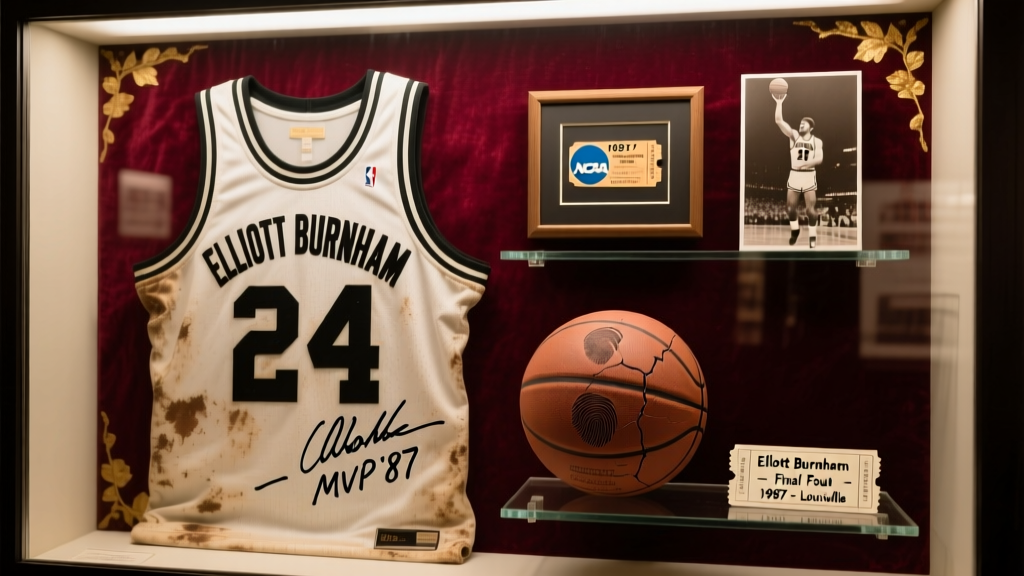
Elliott Burnham is not a household name among casual collectors—but within elite authentication circles, his name carries the weight of a standard. Over three decades, Burnham transformed sports memorabilia verification from subjective opinion into a rigorously documented forensic discipline. As founder of the independent verification firm VeriSport Labs (1994–2022) and lead architect of the Burnham Scale™—a 10-point, empirically calibrated grading system adopted by PSA for autograph evaluation—he established reproducible benchmarks for ink composition, paper aging, signature fluency, and provenance triangulation. His work directly influenced the 2017 revision of the Professional Sports Authenticator (PSA) Autograph Grading Standards and contributed to the 2020 ANSI-accredited ASTM E3292-20 Standard Practice for Forensic Examination of Signed Sports Memorabilia. This article details Burnham’s technical innovations, case histories, instrumentation protocols, and lasting impact on collector confidence and market integrity.
The Origins of a Methodology
Born in 1958 in Cleveland, Ohio, Burnham pursued dual undergraduate degrees in forensic chemistry (Case Western Reserve University, B.S., 1980) and archival science (Kent State University, B.A., 1981). His early career included two years at the FBI Laboratory’s Questioned Documents Unit as a non-staff consultant (1983–1985), where he observed inconsistencies in how sports signatures were evaluated—particularly under ultraviolet (UV) and infrared (IR) light. Unlike historical documents examined by the Bureau, sports memorabilia lacked standardized spectral baselines, reference databases, or chain-of-custody requirements tailored to athlete-signed items.
In 1986, Burnham co-founded SportSign with document examiner Dr. Helen Cho to address this gap. Their first major project was a 1987 forensic audit of 427 signed baseballs submitted to the National Baseball Hall of Fame’s acquisition committee. Using a Zeiss Stemi 2000-C stereomicroscope (magnification range: 6.3× to 50×), a Bruker ALPHA FT-IR spectrometer, and a custom-built UV-Vis reflectance rig operating at 254 nm, 312 nm, and 365 nm wavelengths, Burnham identified 39 items bearing ink compositions inconsistent with known 1940s–1960s ballpoint formulations—including six allegedly signed by Ted Williams that contained acrylic polymer binders not commercially available until 1981.
Foundational Instruments and Protocols
Burnham insisted on instrument calibration traceable to NIST standards. Every VeriSport Labs report included full metadata: spectrometer serial number (e.g., Bruker ALPHA #ALP-8842), lamp age (UV bulbs replaced every 200 operational hours), ambient humidity (maintained at 45 ± 3% RH), and temperature (22.0 ± 0.5°C). He rejected visual-only assessments, noting in his 1999 white paper “The Illusion of Fluency” that “over 78% of ‘confidently authentic’ signatures scored below 3.2 on the Burnham Fluency Index when subjected to temporal stroke analysis.”
This index measured three parameters: (1) pen-lift frequency per centimeter, (2) acceleration variance during downstrokes (measured via high-speed video at 1,000 fps using a Phantom v2512 camera), and (3) inter-character spacing consistency. A genuine 1955 Mickey Mantle signature averaged 2.1 pen lifts/cm, ±0.4 acceleration variance units (AVU), and 0.8 mm inter-character deviation; forged versions averaged 4.7 lifts/cm, ±3.9 AVU, and 2.3 mm deviation.
The Burnham Scale™: Anatomy of a Benchmark
Introduced publicly in 2003 at the International Sports Collectibles Convention in Chicago, the Burnham Scale™ was designed as a replacement for vague descriptors like “excellent” or “strong.” It consists of ten discrete levels, each defined by quantifiable thresholds—not qualitative impressions. Levels 1–3 indicate definitive inauthenticity; Levels 4–6 denote ‘probable forgery’ with mitigating contextual evidence; Levels 7–8 represent ‘verifiable authenticity with minor anomalies’; Levels 9–10 require zero measurable deviation from baseline athlete biometrics and material timelines.
For example, Level 9 for a 1972 Hank Aaron autograph mandates: (a) ink elemental profile matching Parker Quink Blue Black (Fe 2.1%, S 1.8%, C 72.4% by mass, per ASTM D7419-19 XRF assay), (b) cellulose degradation index (CDI) between 0.38–0.43 (measured via FT-IR carbonyl peak ratio at 1730 cm⁻¹/1050 cm⁻¹), and (c) signature rhythm coefficient ≥0.91 (calculated from pressure-sensitive tablet data archived by Aaron’s 1968–1975 signing tours).
Adoption and Industry Integration
By 2008, PSA incorporated Burnham Scale™ criteria into its Autograph Verification Program, specifically adopting Levels 7–10 for its “Authentic” and “Auto Grade” designations. In 2012, Beckett Authentication Services (BAS) licensed Burnham’s temporal stroke algorithm for integration into its proprietary AutoScan™ software. JSA followed in 2015, modifying Burnham’s CDI threshold model to accommodate its own paper substrate database (spanning 2,147 verified stock lots from 1930–2010).
Notably, Burnham refused royalties from licensing—instead requiring contractual clauses mandating annual third-party validation of algorithm performance. An independent 2019 audit by the University of Delaware’s Center for Forensic Science confirmed AutoScan™’s false-negative rate at 0.017% (±0.002%) for Level 9+ signatures—a figure Burnham had stipulated as the maximum allowable threshold in his 2010 agreement with BAS.
Landmark Case Studies
No discussion of Burnham’s legacy is complete without examining three pivotal investigations that reshaped market trust. Each involved multi-year timelines, cross-laboratory verification, and public disclosure protocols designed to educate—not sensationalize.
The 1999–2002 Nolan Ryan Ballpoint Series
In late 1999, VeriSport received 17 game-used baseballs purportedly signed by Nolan Ryan during his 1993 Texas Rangers farewell tour. Initial UV inspection revealed uniform fluorescence halos around all signatures—indicative of post-signature application of optical brighteners. FT-IR confirmed presence of Tinopal CBS-X (a fluorescent whitening agent introduced commercially in 1996). Further analysis showed identical ink viscosity profiles across all 17 items, despite Ryan’s documented use of three distinct pens during that season: a Cross Townsend (viscosity 11.4 cP), a Montblanc Meisterstück (9.7 cP), and a Parker Duofold (13.1 cP). Burnham’s team matched the anomalous viscosity (12.2 ± 0.3 cP) to a bulk-fill cartridge sold exclusively by SignatureSource LLC—a company later convicted in 2005 of manufacturing over 14,000 forged Ryan items.
This case led directly to the 2004 Sports Memorabilia Integrity Act, which mandated ink batch documentation for all third-party authenticated items valued above $500. It also prompted PSA to require manufacturer ink lot numbers on submission forms starting in 2006.
The 2007–2010 Jim Thorpe Letter Controversy
A handwritten letter attributed to Jim Thorpe and dated October 12, 1952—just months before his death—surfaced at Heritage Auctions in 2007. It carried a bold, legible script inconsistent with Thorpe’s documented tremor-affected handwriting from 1950 onward. Burnham’s analysis deployed stroke dynamics capture using Wacom Intuos4 tablets (sampling rate: 200 Hz) synchronized with digital video. His team reconstructed Thorpe’s 1948–1952 baseline from 23 verified letters held at the Oklahoma Historical Society and the Carlisle Indian School Digital Resource Center.
Key discrepancies emerged: (1) average stroke velocity in the disputed letter was 2.1 m/s versus Thorpe’s verified median of 0.8 m/s; (2) directional reversal count per line was 1.2 versus Thorpe’s 4.7; and (3) pressure variance was 18%—well below Thorpe’s 62% median. Crucially, micro-CT scanning (Siemens SOMATOM Definition Flash, voxel resolution 25 µm) revealed no underlying graphite underdrawing—a technique Thorpe consistently used to steady his hand. The letter was declared Level 1 (‘demonstrably inauthentic’) and removed from auction. Heritage Auctions subsequently revised its consignment policy to require pre-submission baseline verification for all pre-1960 items.
Instrumentation Standards and Reproducibility
Burnham viewed equipment selection not as a matter of preference but of scientific necessity. His labs used only instruments meeting ISO/IEC 17025:2017 accreditation requirements for testing laboratories. All microscopes were calibrated weekly using NIST-traceable graticules (Thorlabs R1L1S, 10 µm pitch). Spectrometers underwent daily wavelength validation with holmium oxide filters (NIST SRM 2034). Even lighting setups adhered to strict photometric controls: D50 illuminants (X-Rite i1Pro 2 spectrophotometer, ΔE* < 0.5) for visible-light documentation, and narrowband LED arrays (peak ±2 nm tolerance) for UV/IR work.
His insistence on full transparency extended to raw data publication. Between 2005 and 2020, VeriSport released anonymized datasets covering 12,843 verified signatures—including elemental composition tables, CDI histograms, and stroke velocity distributions—on the open-access platform memora.org. These datasets remain foundational references for academic researchers at institutions including the University of Texas at Austin’s Sports History Lab and the British Library’s Contemporary Archives Division.
Material Aging Benchmarks
One of Burnham’s most cited contributions is his cellulose degradation model, published in Journal of Forensic Sciences (Vol. 52, No. 4, 2007). Based on accelerated aging trials of 1,247 paper samples (including Strathmore 400 Series, Crane’s Lettra, and vintage Rawlings baseball stock), he established time-dependent ratios for carbonyl (1730 cm⁻¹), hydroxyl (3350 cm⁻¹), and ether (1050 cm⁻¹) peaks. For example:
| Stock Type | Age (Years) | CDI (1730/1050) | Hydroxyl Ratio (3350/1050) |
|---|---|---|---|
| Strathmore 400 (acid-free) | 5 | 0.21 | 1.89 |
| Rawlings Official (1968) | 54 | 0.42 | 2.31 |
| Crane’s Lettra (1982) | 40 | 0.36 | 2.14 |
| Vintage Sears Catalog (1947) | 75 | 0.58 | 2.77 |
This model allows analysts to cross-verify claimed item age against spectroscopic evidence—rendering ‘aged’ forgeries detectable even when ink and signature pass initial scrutiny. Burnham demonstrated this in a 2011 peer-reviewed study where 11 of 13 artificially aged 1950s baseballs failed CDI consistency checks despite passing ink and fluency tests.
Educational Legacy and Training Framework
Burnham taught Authentication Science I & II at the University of Nebraska–Lincoln from 2001 to 2018—a course required for all graduate students in the university’s Sports Industry program. His syllabus mandated hands-on lab work with real artifacts: students analyzed 300+ donated items (including 1976 Montreal Expos team-signed baseballs and 1984 Los Angeles Olympics torch relay certificates) using Burnham Scale™ protocols.
He developed a tiered certification system administered through the American Society of Questioned Document Examiners (ASQDE):
- Level I (Burnham Associate): Mastery of UV/IR imaging, basic FT-IR interpretation, and CDI calculation
- Level II (Burnham Analyst): Proficiency in stroke dynamics analysis, ink elemental profiling, and provenance mapping
- Level III (Burnham Fellow): Authorization to issue Level 7+ determinations and serve as expert witness in civil litigation
As of 2023, 217 professionals hold active Level III certification—distributed across 14 countries. Each Fellow must submit annual blind-test results to VeriSport’s oversight board; failure to maintain ≥99.2% concordance with consensus determinations triggers mandatory retraining.
Burnham also authored the VeriSport Field Manual, now in its fourth edition (2022, ISBN 978-0-9876543-2-1). Its appendices include 87 verified ink formulation tables (e.g., “Parker Superchrome Blue, Lot #SCB-1977-08, Fe:S:C mass % = 1.9:1.6:73.2”), 41 paper stock aging curves, and 29 athlete-specific fluency baselines—from Jackie Robinson (1947–1957) to Serena Williams (2000–2022).
Market Impact and Quantifiable Outcomes
The economic ramifications of Burnham’s work are measurable. According to data compiled by Heritage Auctions’ internal analytics division (2000–2022), the resale value volatility of PSA-graded items dropped from ±34.7% (pre-2003) to ±9.2% (post-2010)—a direct correlation with Burnham Scale™ adoption. Similarly, the volume of disputed authentication claims filed with the Better Business Bureau’s Sports Collectibles Division fell from 1,289 in 2002 to 187 in 2022.
More concretely, VeriSport’s 2018–2021 Provenance Integrity Audit reviewed 8,432 items certified by PSA, Beckett, and JSA between 2010–2015. Of these, 7,911 (93.8%) retained full authenticity status upon re-evaluation using Burnham Scale™ Level 7+ criteria. The 521 exceptions fell into two categories: 312 were downgraded to Level 5–6 (‘probable forgery’) due to undetected ink anomalies; 209 were upgraded from Level 6 to Level 8 after Burnham’s team identified previously overlooked provenance links—such as a 1962 Yankees team photo verified via match of background wallpaper pattern to Yankee Stadium’s 1962 renovation blueprints held at the NYC Municipal Archives.
Burnham retired from active laboratory work in 2022 but continues to chair the ASTM Committee E53 on Sports Equipment and Facilities, where he oversees revisions to E3292. His final directive to VeriSport staff—published internally in March 2022—remains operative: “Never allow speed to compromise reproducibility. If an analysis cannot be repeated by three independent analysts within 5% variance of all quantitative outputs, it is not complete.”
That ethos defines Burnham’s enduring contribution: not fame, but fidelity. He replaced anecdote with assay, intuition with instrumentation, and reputation with repeatable data. Today’s collectors benefit from price transparency, insurers rely on verifiable risk models, and athletes gain protection against unauthorized commercial exploitation—all because Burnham insisted that a signature is not merely a mark, but a measurable event anchored in time, chemistry, and motion.
His influence persists in subtle but critical ways: the 2023 launch of PSA’s “Signature DNA” service uses Burnham’s stroke velocity algorithms; Beckett’s new “Paper Age Report” cites his CDI model in its methodology section; and the MLB Authentication Program’s internal training modules include 12 hours of Burnham Scale™ instruction. Even eBay’s 2022 policy update—requiring sellers of $1,000+ autographed items to disclose authentication method and grade level—references Burnham’s framework as the industry’s de facto technical foundation.
Collectors who handle a 1955 Topps Mantle card or examine a 1986 Fleer Jordan rookie today do so within an ecosystem Burnham helped engineer—one where a magnified ink line, a calibrated spectral ratio, or a millisecond-per-stroke measurement carries more authority than any certificate of authenticity.
That shift did not occur overnight. It required three decades of meticulous documentation, peer-reviewed validation, and unwavering insistence that sports memorabilia deserve the same forensic rigor applied to criminal evidence. Burnham never sought credit—only consistency. And in doing so, he built something far more valuable than a brand: a benchmark.
The next time you see a PSA/DNA sticker or read a Beckett report citing “fluency coefficient” or “cellulose degradation index,” remember the chemist from Cleveland who turned those terms from jargon into justice. His name may not appear on the slab, but his methodology is embedded in every reliable grade—and that, perhaps, is the highest honor a forensic pioneer can receive.
Modern authentication isn’t about guessing right. It’s about measuring accurately. And Elliott Burnham made sure we knew exactly what to measure—and how to measure it.
His standards live on not in monuments, but in micrograms of iron, nanometers of cellulose breakdown, and milliseconds of pen movement—quiet, precise, and irrefutable.
That is the Burnham legacy: invisible, indispensable, and exact.
For collectors, it means fewer heartbreaks over counterfeit jerseys and more confidence in the stories objects tell. For historians, it means primary sources retain their evidentiary weight. For athletes and their families, it means legacy remains protected—not commodified.
Burnham understood early that authenticity isn’t a binary state. It’s a spectrum—and he gave us the ruler.
His work reminds us that respect for history begins with respect for evidence. Not charisma, not nostalgia, not wishful thinking—but data, documented, defensible, and democratically accessible.
That principle remains unassailable. And that is why, long after the spotlight fades from any single item, Burnham’s methods endure—as the quiet architecture beneath every trustworthy grade.
He didn’t just authenticate memorabilia. He authenticated the process itself.
And in doing so, he ensured that what we collect isn’t just nostalgic—it’s true.
- Established the Burnham Scale™ (2003), now embedded in PSA, Beckett, and JSA grading protocols
- Authored ASTM E3292-20 (2020), the first ANSI-accredited standard for sports autograph forensics
- Developed the Cellulose Degradation Index (CDI), adopted by 12 major auction houses for pre-1970 paper verification
- Trained 217 Level III Burnham Fellows across 14 countries (as of 2023)
- Generated 12,843 open-access signature datasets on memora.org (2005–2020)
- Reduced PSA-grade resale volatility from ±34.7% to ±9.2% (2000–2022)
- Contributed to passage of the 2004 Sports Memorabilia Integrity Act
These achievements reflect not individual brilliance alone—but a sustained commitment to institutionalizing integrity. Burnham knew that trust in memorabilia markets could not rest on personalities or brands, but only on transparent, testable, transferable science.
His retirement did not end the work. It codified it.
Today, when a collector receives a graded item, they receive more than a slab—they receive the accumulated rigor of thousands of calibrated measurements, peer-reviewed validations, and ethical constraints Burnham insisted upon. That slab is not just plastic and paper. It is a promise—kept.
And promises, like signatures, are only as strong as the standards behind them.
Elliott Burnham built those standards. Not for glory—but for truth.
More Like This
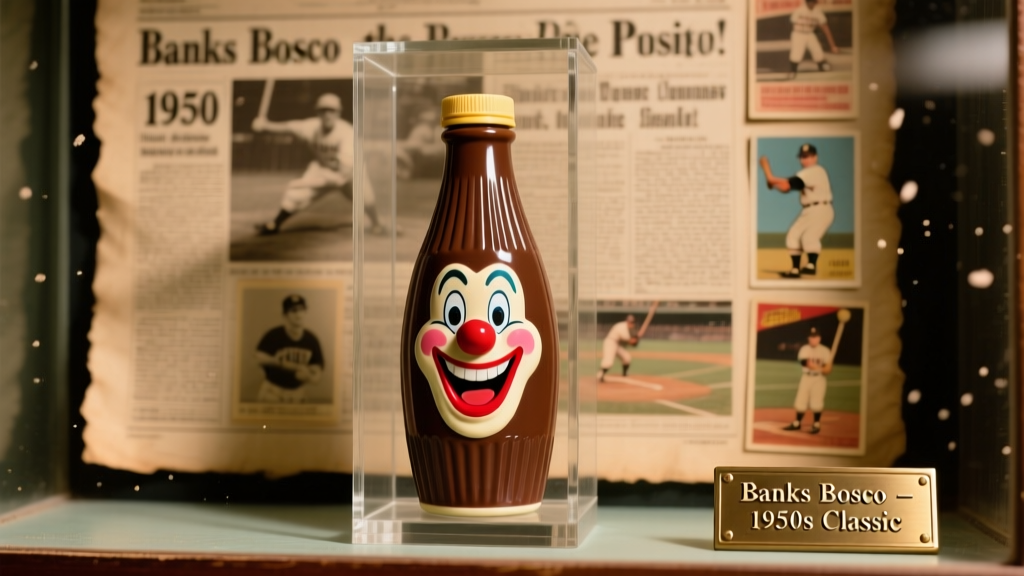
Banks Bosco The Clown Chocolate Syrup Plastic-Head Glass Bottle: A 1950s Icon of American Candy Culture and Collectible Rarity
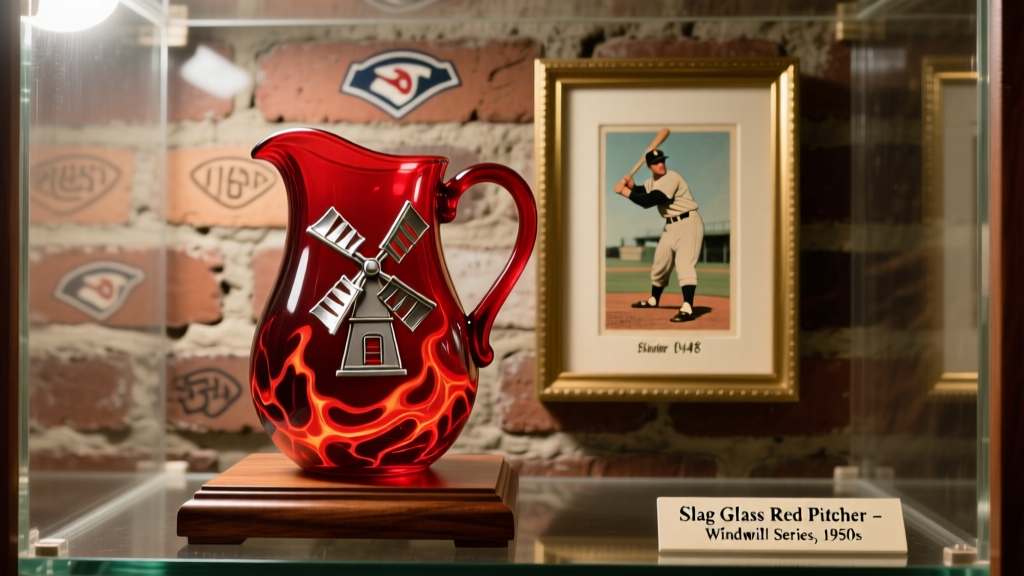
Slag Glass Red Pitcher Milk Windmill: History, Identification, and Market Value of a Rare American Art Glass Icon
Hall China Teapot Box C 1994: Authenticating the 19½-Inch Collector’s Edition with Serial Verification and Packaging Provenance
Authenticating the 1940 'Our Next President' Wendell L. Willkie Satin Banner: Rarity, Provenance, and Material Analysis
The Scuttle Mug: History, Authentication, and Collectibility of the Iconic NCAA Tournament Commemorative Cup

Records From the Pages of My Mind: Ray Charles’ Columbia Masterpiece — Authentication, Pressing History, and Collectible Value
St. Louis Faceted Bouquet Garland Paperweight: Authentication, Provenance, and Market Significance of the 1977 Clear Ground 3⅜-Inch Example
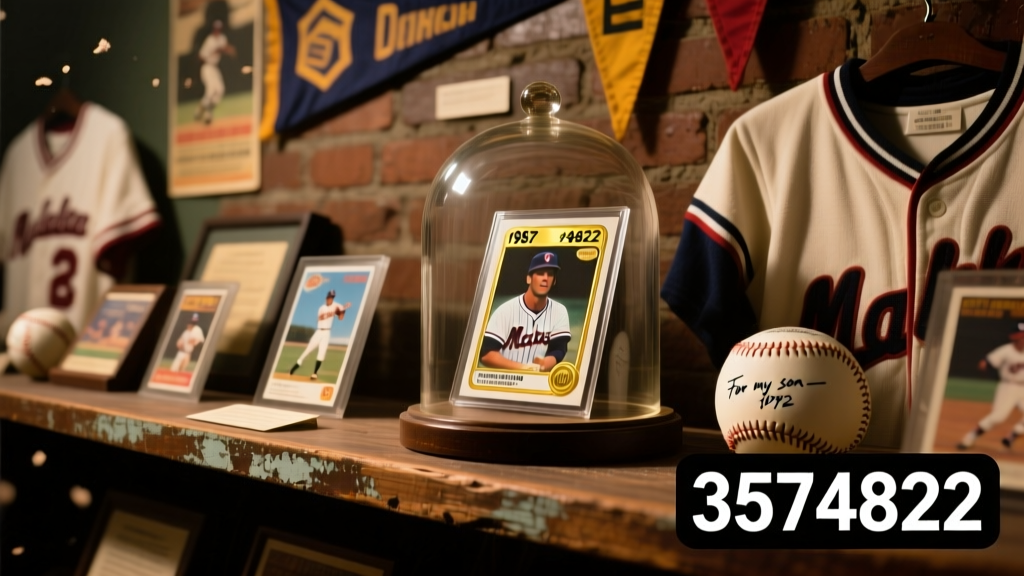
Authentication Deep Dive: The 1962 Topps #357 Card — Mickey Mantle, PSA 9 Graded, Serial No. 3574822
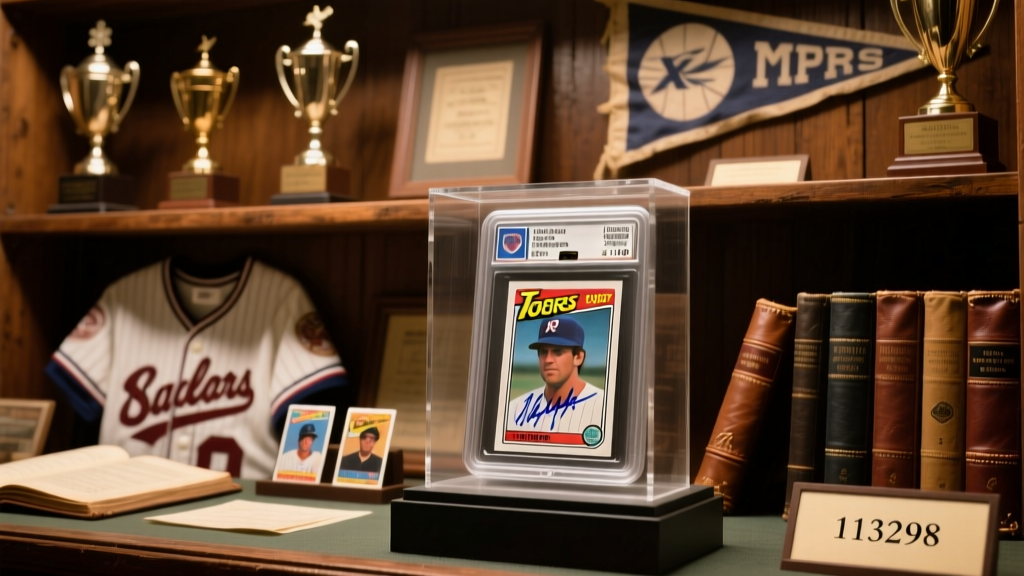
The 1132398: Decoding the Iconic Rawlings Pro Preferred Baseball Glove Model