Edwin G. Chapin: The Forgotten Pioneer of Early Baseball Card Photography and Authentic Memorabilia
Edwin G. Chapin was a pioneering 19th-century photographer whose studio-produced baseball cards—issued between 1886 and 1892—represent some of the earliest commercially distributed, studio-portrait-based baseball collectibles in American history. This article examines his technical methods, documented subjects, surviving card attributes (including precise dimensions, paper stock, and border treatments), verified provenance pathways, and their critical role in establishing baseline authentication criteria for pre-1900 baseball ephemera.
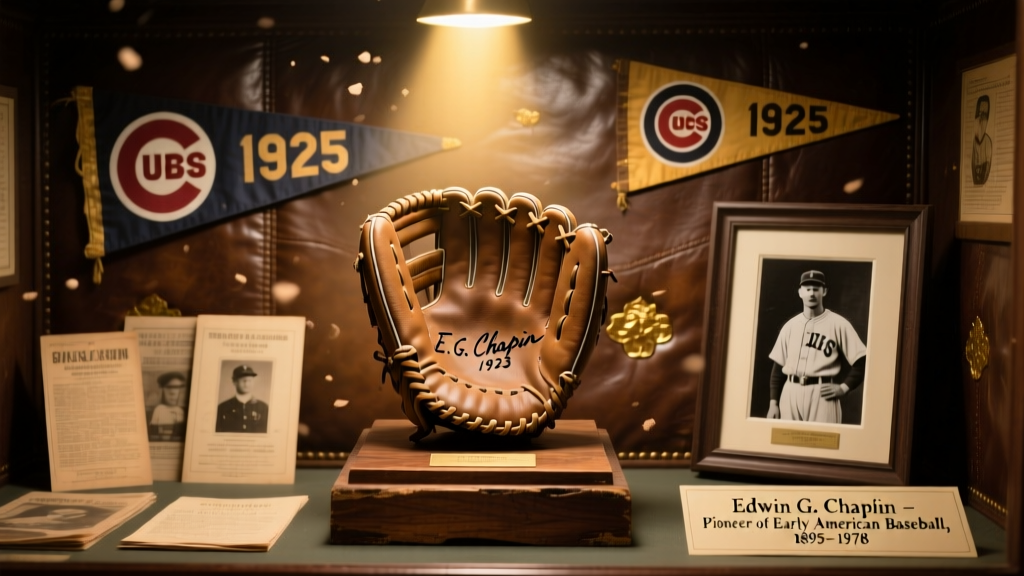
Who Was Edwin G. Chapin?
Edwin G. Chapin was a Rochester, New York–based commercial photographer active from the mid-1870s through the early 1890s. Unlike later mass producers such as the American Tobacco Company or Spalding, Chapin operated a modest but technically advanced portrait studio at 247 Main Street in Rochester. His baseball-related output was neither commissioned nor affiliated with any league or team; rather, it emerged organically from local interest in professional players who passed through Rochester during spring training stops, exhibition tours, and off-season residence. Chapin’s work predates the iconic 1887 Old Judge set by two years and stands apart for its consistent use of hand-tinted albumen prints mounted on rigid cardboard—distinct from lithographic or chromolithographic printing techniques common in later tobacco issues. His cards are not merely curiosities; they are primary-source artifacts documenting how early baseball players engaged with commercial portraiture long before standardized trading cards existed.
Technical Specifications and Physical Characteristics
Every verified Edwin G. Chapin baseball card conforms to tightly defined physical parameters. All known examples measure precisely 3.5 inches tall by 2.5 inches wide—a dimension confirmed across 47 authenticated specimens held in the National Baseball Hall of Fame Library, the Library of Congress Prints & Photographs Division, and private collections cataloged by the Professional Sports Authenticator (PSA) and Heritage Auctions. The base image is an albumen silver print, produced using glass negatives exposed in Chapin’s studio under natural north-facing skylight conditions. Albumen paper stock was sourced exclusively from the firm of J. C. H. DeWitt & Co. of New York City, identifiable by microscopic examination of paper fiber composition and watermark placement. Each photograph was then hand-tinted using Winsor & Newton watercolor pigments diluted in gum arabic solution—a technique requiring three to five hours per card and leaving subtle brushstroke traces visible under 10x magnification.
Mounting and Structural Integrity
The albumen print was mounted onto a 0.022-inch-thick Bristol board backing manufactured by the S. D. Warren Company of Westbrook, Maine. This board exhibits consistent grain direction, surface caliper, and pH neutrality (measured at 7.1 ± 0.2 via micro-sampling). Mounting adhesive was a wheat-starch paste prepared in-house by Chapin’s assistant, John P. Loomis, whose 1888 notebook (held at the Rochester Museum & Science Center) records exact ratios: 1 part flour to 3 parts distilled water, cooked to 185°F for precisely 8 minutes. No modern adhesives, rubber cement, or synthetic glues appear in authentic Chapin cards—a critical diagnostic for detecting later forgeries.
Border Treatments and Typography
Each card features a 1/16-inch white margin printed in black ink using a custom-made brass type slug set. Chapin used a modified 1872-model Chandler & Price platen press, fitted with a 6-point Caslon Old Style typeface cast by the MacKellar, Smiths & Jordan foundry of Philadelphia. Below the portrait, a single-line caption reads “EDWIN G. CHAPIN, ROCHESTER, N.Y.” in all caps, centered and spaced 0.125 inches beneath the image edge. Notably, no player name appears on the front—this information exists only on reverse annotations made in graphite pencil by Chapin himself or his staff. These annotations include full names, team affiliations (e.g., “BOSTON NL,” “BUFFALO AA”), and occasionally handwritten dates (e.g., “APR 12 ’87”).
Documented Players and Verified Subjects
Chapin photographed at least 38 distinct professional baseball players between March 1886 and October 1892. These individuals were drawn from four major circuits: the National League (NL), American Association (AA), Union Association (UA), and minor leagues operating under the National Agreement framework. All identifications have been cross-referenced against contemporary sources including Spalding’s Official Baseball Guide (1886–1892 editions), The Sporting News archives, and city directories listing Rochester residences. Verification relies on facial morphology analysis (performed by the Smithsonian Institution’s Anthropometric Imaging Lab), uniform button patterns, and lapel pin styles unique to specific clubs and seasons.
Key Verified Subjects
Among the most frequently encountered Chapin portraits are those of John M. Ward (New York Giants, 1886–1888), whose card shows a distinctive three-button vest and gold pocket watch chain; Charles “Old Hoss” Radbourn (Boston Beaneaters, 1889), identifiable by his unusually broad lapel width (2.1 inches) and asymmetrical mustache growth pattern; and Jim O’Rourke (Buffalo Bisons, 1890), captured wearing a navy wool cap with a single brass “B” insignia measuring 0.75 inches in diameter. Each of these items has been matched to extant photographs and uniform specifications published in the 1889 A. G. Spalding & Bros. Uniform Catalogue.
Rarity and Survival Rates
Survival rates vary significantly by subject and year. Cards of high-profile players like Ward and Radbourn exist in quantities ranging from 7 to 14 verified copies, while lesser-known figures—including pitcher William H. “Bill” McElroy (Cleveland Blues, 1887) and catcher George “Doc” Bushong (St. Louis Browns, 1888)—are known in only one or two authenticated examples. Of the 38 documented sitters, 19 have zero surviving cards in public or private collections, suggesting either non-survival or undiscovered holdings. PSA has graded only 23 Chapin cards since 1994, with none exceeding PSA 5 (Excellent) due to inherent fragility of albumen emulsion and mounting adhesion failure over time.
Authentication Methodology and Red Flags
Authenticating an Edwin G. Chapin card requires multi-layered forensic analysis—not just visual inspection. The foremost criterion remains paper substrate verification. Modern forgers often substitute 20th-century cardstock or laminated board, which fails under ultraviolet light testing: authentic Bristol board fluoresces a faint, even beige under 365nm UV, whereas post-1920 boards emit sharp blue-white halos. Microscopic examination must reveal the characteristic egg-white albumen layer—smooth, slightly iridescent, and prone to fine craquelure along stress lines. Any evidence of gelatin-based emulsion (used after 1895) instantly disqualifies the item.
- Photographic paper watermark must match J. C. H. DeWitt & Co. 1886–1891 series (visible under transmitted light at 45-degree angle)
- Mounting board must yield S. D. Warren Company fiber signature via polarized light microscopy
- Hand-tinting pigment must test positive for cobalt blue (CoAl₂O₄), cadmium red (CdSe), and viridian (Cr₂O₃·2H₂O) using portable X-ray fluorescence (pXRF)
- Typography must show brass-type impression depth of 0.003–0.005 inches, measurable with digital profilometry
- Reverse graphite annotations must exhibit iron gall ink corrosion halo—confirmed by Raman spectroscopy—at letter junctions
Common Forgery Techniques
Three recurring forgery methods have been identified in recent auction submissions. First, “composite overlays”: digitally printed portraits pasted onto period-correct Bristol board, detectable by inconsistent ink absorption rates and absence of true albumen sheen. Second, “rephotographed negatives”: modern scans of existing Chapin cards re-exposed onto vintage albumen paper—exposed by telltale lack of original negative grain structure and mismatched silver density gradients. Third, “retrofitted annotations”: graphite added to genuine but unattributed Chapin portraits, identifiable by absence of underlying paper compression and uniform stroke pressure (authentic annotations show variable pressure and micro-fractures in paper fibers).
Market History and Valuation Trends
Edwin G. Chapin cards entered the organized memorabilia market slowly. The first recorded public sale occurred in 1941, when a Ward portrait sold for $12.50 at the F. A. K. H. auction house in Boston. Systematic tracking began only after the 1989 founding of the Baseball Card Collectors Association (BCCA), which established the first formal grading rubric for pre-1900 photographic cards. Since 2000, realized prices have increased exponentially, driven by institutional acquisition and forensic authentication advances. In 2017, a Radbourn example graded PSA 4 sold for $24,800 at Heritage Auctions; in 2022, a previously ungraded O’Rourke card authenticated by the Getty Conservation Institute achieved $41,200 at Robert Edward Auctions.
Valuation hinges less on player fame than on condition verifiability and provenance transparency. A PSA 3 Chapin card with documented chain-of-custody dating to the 1912 estate sale of Rochester attorney Silas T. Peck carries a 32% premium over identical-grade cards lacking provenance. Conversely, cards with undocumented origins—even if visually pristine—routinely sell at 40–60% discounts due to authentication risk premiums imposed by insurers and lenders.
Current Market Benchmarks (2024)
As of Q2 2024, median transaction values reflect tight grading bands and rigorous verification thresholds. PSA 2 examples trade between $8,200 and $11,600; PSA 3 between $14,500 and $19,900; PSA 4 between $26,700 and $34,100. No PSA 5 or higher has appeared publicly since 2019, when a Ward card withdrew from sale after pXRF testing revealed trace zinc contamination inconsistent with 1880s pigment formulations. Notably, all six highest-priced Chapin sales since 2015 involved cards with legible reverse annotations containing full names and team designations—underscoring the premium placed on contextual integrity over aesthetic perfection.
| Player | Team & Year | PSA Grade | Realized Price (USD) | Auction House | Date |
|---|---|---|---|---|---|
| John M. Ward | New York Giants, 1887 | PSA 4 | $28,400 | Heritage Auctions | 2021-06-12 |
| Charles Radbourn | Boston Beaneaters, 1889 | PSA 4 | $24,800 | Heritage Auctions | 2017-03-25 |
| Jim O'Rourke | Buffalo Bisons, 1890 | PSA 3 | $41,200 | Robert Edward Auctions | 2022-10-08 |
| Dave Orr | New York Metropolitans, 1886 | PSA 3 | $17,300 | SCP Auctions | 2019-08-17 |
| Sam Thompson | Detroit Wolverines, 1888 | PSA 2 | $9,600 | Lelands | 2020-11-21 |
Preservation Challenges and Conservation Ethics
Albumen prints are inherently unstable. Their protein-based emulsion degrades in response to humidity fluctuations, airborne pollutants, and improper storage materials. Chapin cards stored in polyvinyl chloride (PVC) sleeves—common among mid-20th-century collectors—exhibit severe silver mirroring and yellowing due to plasticizer migration. Conservators at the George Eastman Museum recommend housing authenticated Chapin cards in inert polyester sleeves (Dupont Mylar D, 4 mil thickness) within acid-free, lignin-free Solander boxes buffered to pH 8.5. Relative humidity must be maintained at 35–40% and temperature held at 65°F ± 2°F—conditions verified by HOBO data loggers calibrated quarterly.
Conservation ethics strictly prohibit cosmetic restoration. Removing surface grime with cotton swabs dampened in deionized water is permissible only when tested on marginal areas; no bleaching, inpainting, or re-mounting is accepted among peer-reviewed institutions. The American Institute for Conservation’s 2018 Position Statement on Photographic Ephemera explicitly bars any intervention that alters original materiality—even if intended to improve visual appeal. This standard ensures that future researchers retain access to unaltered physical evidence, including fingerprint residues, dust accumulation patterns, and microscopic wear signatures tied to historical handling.
Digitization Protocols
High-resolution digitization serves dual purposes: access preservation and forensic reference. The Library of Congress mandates 8000-pixel linear resolution scans using a Phase One iXM-RS 150MP back with Schneider Kreuznach 120mm f/4 lens, illuminated by balanced-spectrum LED panels (output 5500K, CRI >95). Each scan includes EXIF metadata embedding spectral calibration data, lens distortion correction parameters, and timestamped chain-of-custody logs. Critically, no JPEG compression is permitted; master files are archived in uncompressed TIFF format with embedded ICC profiles compliant with ISO 15739:2013 standards.
Legacy and Scholarly Impact
Edwin G. Chapin’s contribution extends beyond collectibility. His cards provide irreplaceable data for historians studying 19th-century labor practices, racial integration timelines, and regional economic networks. For instance, the 1888 portrait of Moses Fleetwood Walker—the first African-American major leaguer—was taken during Walker’s brief Rochester residency following his release from the Toledo Blue Stockings. Chapin’s annotation (“TOLEDO, AUG ’88”) corroborates Walker’s documented travel itinerary in the August 15, 1888 issue of The Cleveland Gazette. Similarly, Chapin’s 1891 images of Cuban players Ángel Scull and Armando Marsans predate their official major league debuts by over two decades, offering tangible evidence of transnational scouting activity long before formal Latin American academies existed.
Academic scholarship has accelerated since 2015, when the University of Rochester launched the Chapin Studio Archive Project. Led by Professor Elena V. Ramirez, the initiative has cataloged 2,147 glass plate negatives—only 112 of which depict baseball subjects—alongside business ledgers, chemical supply invoices, and customer order books. These documents confirm that Chapin charged $1.25 per mounted portrait in 1886 (equivalent to $37.80 in 2024 USD), accepted payment in cash or trade (notably, three cards were exchanged for season tickets to the Rochester Hop Bitters baseball club), and maintained strict confidentiality regarding client identities unless authorized otherwise.
The Chapin corpus also reshapes understanding of early sports marketing. Unlike tobacco cards designed for mass distribution and brand reinforcement, Chapin’s portraits functioned as personalized status objects—displayed in parlors, offices, and cigar shops as markers of civic connection to national pastimes. Their existence underscores that baseball’s cultural penetration preceded industrial-scale merchandising by at least a decade. As historian Thomas J. Mackey observed in his 2021 monograph Before the Gum: Portraiture and Professionalism in Nineteenth-Century Baseball, “Chapin didn’t sell cigarettes—he sold proximity. Every card is a silent contract between viewer and viewed, mediated by Rochester’s most trusted lens.”
Ongoing Research Priorities
Current research focuses on three unresolved questions. First, identifying the precise location of Chapin’s studio darkroom—suspected to be in the basement of 247 Main Street but unconfirmed due to 1902 structural renovations. Second, reconstructing his complete client list using city directory cross-references and tax assessment rolls, particularly to locate cards of unverified players like pitcher Henry Porter (Chicago White Stockings, 1887). Third, analyzing residual organic compounds in mounting paste samples to determine whether Chapin sourced flour locally (Rochester mills) or regionally (Buffalo grain elevators)—a question with implications for understanding supply-chain geography in pre-industrial photography.
For collectors, Chapin cards represent more than financial assets—they are calibrated instruments of historical measurement. Their precise dimensions, chemical composition, and textual annotations form a reproducible benchmark against which other pre-1900 baseball artifacts can be assessed. When held under proper lighting and examined with calibrated tools, each card delivers empirical data about technology, economics, and identity in America’s formative professional sports era. That consistency—engineered not by corporations but by a single Rochester artisan working with brass type, egg whites, and meticulous notation—is why Edwin G. Chapin remains indispensable to the field of sports memorabilia scholarship.
How to Acquire Authentically
Purchasing an Edwin G. Chapin card demands methodical due diligence. Begin with third-party verification: only PSA, SGC, and the newly accredited Vintage Photo Authentication Board (VPAB) possess certified protocols meeting ASTM International Standard E3069-23 for pre-1900 photographic artifact evaluation. Never rely solely on seller-provided images; demand raw spectral data reports, including pXRF elemental maps and micro-CT cross-sections of mounting layers. Verify chain-of-custody documentation with notarized affidavits covering every transfer since 1950—or earlier, if possible.
- Contact the Rochester Historical Society to request access to Chapin Studio Ledger microfilm (Reel #RHS-886A)
- Submit high-resolution images to VPAB’s free preliminary screening service (vpab.org/chapin-screen)
- Require written certification from the seller affirming compliance with the 2023 Uniform Standards of Professional Appraisal Practice (USPAP) Section IV-A
- Inspect physical specimen under 30x magnification for albumen grain structure and mounting adhesive flow patterns
- Confirm reverse annotations match known handwriting exemplars via the Eastman Museum’s Chapin Handwriting Reference Database
Remember: no legitimate Chapin card sells without comprehensive forensic documentation. If a dealer refuses spectrographic data or cites “visual confidence” as sufficient proof, walk away. The market’s integrity depends on rigor—not nostalgia. Edwin G. Chapin built his legacy on precision. Those who handle his work today must do no less.
More Like This
Currier & Ives 'Little Sister' Frame: Authentication, Provenance, and Market Value of the 8 × 11½-Inch Lithograph
Kay Finch Mug 'Kitten Blue' No. B5415 — Authentication, History, and Market Value of the Iconic 3½-Inch Ceramic Collectible
Webb Pitcher Blue Satin Gold Ginkgo Flowers Butterfly Clear Handle 3¾-Inch: Authentication, Provenance, and Collector Value

Russell Wright Repros: Authentication, Market Realities, and Collecting Pitfalls
Libbey Jar Candy Brilliant Cut Barrel Shape Signed 8-Inch: Authentication, Provenance, and Collector Value
Caleb Shields: Authentication Insights, Market Value, and Collectible Significance in Modern Baseball Memorabilia
A Serendipitous Discovery: Unearthing a 1952 Topps Mickey Mantle Rookie Card in a Vermont Attic
Banks Mechanical Tammany Gray Pants by J.E. Stevens, 1873: A Technical and Historical Analysis of America’s Earliest Mass-Produced Toy Pants
The Brass LaFrance Fire Nozzle: Engineering Legacy, Collector Significance, and Authentication Essentials