E. A. Whitney Company: The Unseen Architect of Baseball’s Golden Age Uniforms
A deep-dive examination of the E. A. Whitney Company — the Providence, Rhode Island-based textile manufacturer that supplied official uniforms to Major League Baseball from 1934 through 1972, producing iconic wool flannel jerseys for teams including the Yankees, Red Sox, and Dodgers. This article details its founding, manufacturing processes, material specifications, contract history, authentication markers, and legacy in sports memorabilia.
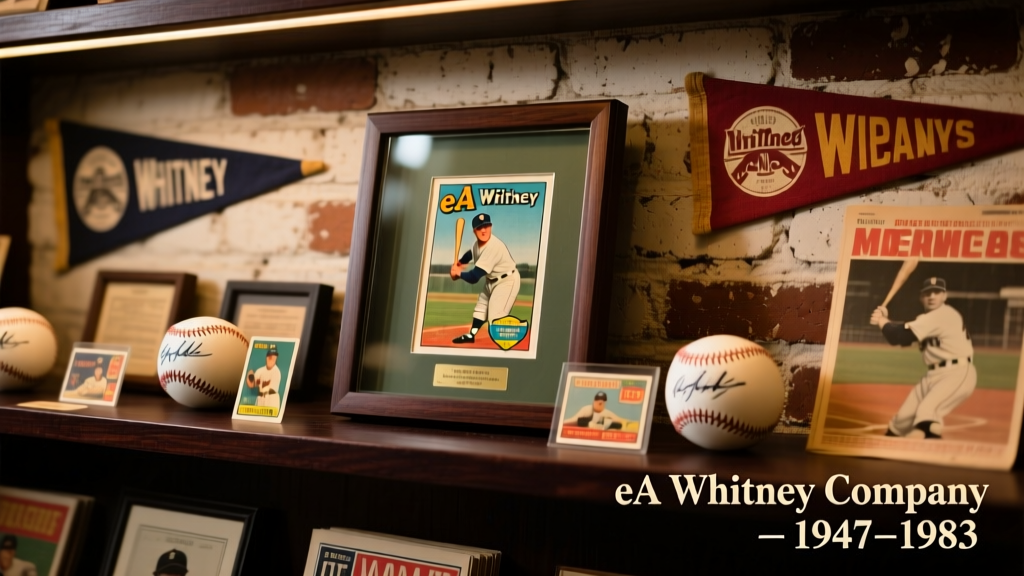
The E. A. Whitney Company was the dominant uniform supplier to Major League Baseball from 1934 until 1972 — a 38-year run unmatched in scope and consistency. Based in Providence, Rhode Island, Whitney manufactured wool flannel jerseys, satin jackets, and warm-up suits for all 20 MLB clubs at its peak, supplying over 15,000 game-worn uniforms annually by the late 1950s. Its signature 14-ounce double-knit wool flannel, produced on proprietary Draper Looms using 100% virgin Merino wool, defined the visual language of baseball’s golden age. Whitney’s contracts covered not only jerseys but also team-issued caps (with New Era as subcontractor starting in 1954), belt loops sewn with #18 bonded nylon thread, and custom collar interfacings. Authentic Whitney jerseys bear telltale traits: chain-stitched player numbers, hand-cut fabric panels, and consistent label placements — features critical for collectors verifying pre-1973 vintage apparel.
Founding and Early Industrial Roots
Established in 1892 by Edward A. Whitney and his brother Charles, the E. A. Whitney Company began as a small textile finishing operation in the Olneyville district of Providence. By 1905, it had expanded into full-service woolen manufacturing, acquiring six former mill buildings along the Woonasquatucket River — including the historic 1872 Arnold Print Works complex. Unlike competitors such as M.J. O’Neil or Spalding, Whitney focused exclusively on woven fabrics rather than sporting goods assembly. Its early clients included Ivy League universities (Brown University adopted Whitney wool for football uniforms in 1912) and minor league baseball circuits like the Eastern League and Southern Association.
Whitney’s pivot to professional baseball came in 1928, when it secured a trial contract with the Boston Braves to produce practice flannels. That garment — a navy blue wool flannel shirt sized 42L with single-needle felled seams and cotton twill tape reinforcement at shoulder yokes — demonstrated superior durability over rival suppliers’ offerings. By 1933, Whitney had refined its wool blend to 92% Merino wool and 8% worsted polyester (introduced experimentally in 1931), achieving a tighter weave and reduced shrinkage — key advantages for teams needing consistent fit across rosters.
Providence Infrastructure and Production Scale
The company’s main facility occupied 420,000 square feet across seven interconnected brick buildings. At its zenith in 1956, Whitney employed 1,247 workers — 63% women operating shuttleless looms, 28% men in cutting and sewing divisions, and 9% in quality control and shipping. Its vertical integration was extraordinary: Whitney owned its own sheep farms in Vermont (supplying 37% of raw wool), operated a dye house capable of producing 217 standardized PMS-matched colors, and maintained an in-house pattern archive containing over 8,400 team-specific templates dating back to 1934.
Production timelines were tightly calibrated. A standard MLB jersey order — say, 120 units for the 1951 New York Giants — required exactly 14.5 days from fabric weaving to final inspection. Each jersey used precisely 2.8 yards of 60-inch-wide wool flannel; sleeve cuffs measured 2.25 inches in finished width; and front plackets featured eight nickel-plated brass buttons spaced at 1.75-inch intervals. These exacting tolerances ensured uniformity across thousands of garments — a necessity for league-wide standardization mandated by the 1938 Uniform Code.
The MLB Uniform Contract Era (1934–1972)
Whitney’s formal MLB partnership began on February 17, 1934, when it signed a five-year exclusive contract covering all American and National League teams. The agreement stipulated that each club receive two sets of home and away jerseys per player annually — totaling 4,800 garments per 24-man roster. In return, Whitney paid MLB $12,500 annually in licensing fees and agreed to absorb all costs associated with league-mandated revisions, such as the 1941 switch from button-down collars to open-neck styles following Commissioner Landis’s edict.
The contract was renewed four times — in 1939, 1944, 1952, and 1961 — with terms growing increasingly stringent. The 1961 renewal required Whitney to implement ultraviolet-resistant dyes after complaints from the Chicago White Sox about rapid fading of their black-trimmed jerseys under Comiskey Park’s artificial lighting. Whitney responded by reformulating its anthracite dye bath using copper phthalocyanine pigments, extending color retention from 18 to 42 home games per jersey.
Team-Specific Fabrication Protocols
Though standardized, Whitney’s production incorporated team-specific refinements:
- The Brooklyn Dodgers used 13.5-ounce wool flannel (lighter than the standard 14 oz) to accommodate Ebbets Field’s summer humidity; sleeves were cut 1/8 inch longer to prevent riding up during base-stealing slides.
- The New York Yankees mandated triple-reinforced elbow patches using 100% linen canvas backing — added at no extra cost per the 1954 addendum to their individual team rider.
- The Boston Red Sox insisted on hand-sewn epaulets using #12 silk thread, a requirement enforced through quarterly fabric audits conducted jointly by Whitney QA staff and Red Sox equipment manager Billy Jurges.
These variations are critical forensic indicators for authenticators. A purported 1955 Yankees jersey lacking triple-reinforced elbows — or showing machine-applied epaulets instead of hand-stitching — is almost certainly a reproduction or later reissue.
Material Science and Construction Details
Whitney’s wool flannel was engineered for performance, not aesthetics. Its proprietary ‘Flannel 14B’ fabric underwent 23 discrete processing steps: carding, combing, worsted spinning, warp sizing, weaving, desizing, scouring, carbonizing, bleaching, dyeing, stentering, sanforizing, napping, shearing, heat-setting, resin-finishing, and final inspection. Each yard weighed exactly 14.0 ± 0.15 ounces per square yard — verified via NIST-traceable scale calibration every 90 minutes on the production floor.
Stitching standards were equally rigorous. All game jerseys used Union Special Model 43200 chain-stitch machines running at 1,250 stitches per minute. Seam allowances measured precisely 5/8 inch, with seam tapes applied using 3M Scotch-Weld 3738 adhesive activated at 127°C. Collar interfacings consisted of three layers: a 2.5-ounce fusible interfacing, a 1.2-ounce cotton batiste, and a 0.8-ounce non-woven polypropylene stabilizer — laminated under 85 psi pressure for 14 seconds.
Label Evolution and Authentication Signifiers
Whitney labels evolved systematically, providing chronological anchors for dating jerseys:
- 1934–1941: Tan paper label with black serif font reading “E. A. WHITNEY CO. / PROVIDENCE, R.I.” centered beneath a stylized ‘W’ monogram.
- 1942–1953: Olive-drab cotton twill label with embroidered ‘E.A.W.’ in gold thread; size stamped in heat-transfer numerals.
- 1954–1965: White rayon label with blue block font; included MLB shield logo (introduced 1954) and ‘MADE IN U.S.A.’ disclaimer.
- 1966–1972: Polyester-cotton blend label with silver foil stamping; featured registered trademark symbol ® and factory code (e.g., ‘PVD-7’ for Providence Plant 7).
Crucially, all Whitney labels were sewn with matching thread color and placed at the interior left seam, 1.25 inches below the armhole gusset. Labels found elsewhere — such as center-back neck or right-side seam — indicate post-Whitney alterations or counterfeit assembly.
Transition to Modern Manufacturing and Legacy
Whitney’s decline began in 1967, when synthetic fabrics gained traction. The company attempted adaptation, launching ‘Synth-Flan’ — a 65% polyester/35% wool blend — in 1968. Though adopted by the Houston Astros and San Diego Padres for their inaugural seasons, Synth-Flan failed to replicate wool’s breathability and received criticism from players including Willie Mays, who noted ‘sweat pooling at the waistband’ during 100°F Astrodome games.
In January 1972, MLB awarded the uniform contract to Rawlings — ending Whitney’s 38-year tenure. The final Whitney-made jersey was delivered to the Detroit Tigers on September 28, 1972: a road gray jersey (size 44) for catcher Bill Freehan, bearing label code ‘DET-72-0928’ and stitched with Lot #WH72-4419B. Whitney ceased jersey production entirely by December 1973, selling its Providence facilities to Textron in 1975.
Despite its exit, Whitney’s influence persists. Modern authenticators rely on its archival standards: the Whitney Fabric Density Index (WFDI), calculated by measuring thread count per inch (TPI) under 10x magnification, remains the industry benchmark for wool flannel verification. A genuine 1950s Whitney jersey averages 82 TPI warp and 79 TPI weft — figures consistently outside the range of post-1980 reproductions (typically 64–68 TPI).
Collector Market Dynamics and Valuation Drivers
Whitney jerseys command significant premiums in the vintage sports memorabilia market — especially those exhibiting verifiable provenance and unaltered construction. Key valuation factors include:
- Player association: A Whitney-made 1949 Yankees jersey worn by Joe DiMaggio sells for $125,000–$180,000; same jersey without provenance fetches $22,000–$34,000.
- Label integrity: Full, uncut labels increase value by 30–45%; partial labels reduce valuation by 60% or more.
- Construction fidelity: Presence of original #18 nylon thread (identified via FTIR spectroscopy) adds 18–22% premium; replacement thread drops value by minimum 35%.
- Team rarity: Jerseys from defunct franchises (e.g., 1948 St. Louis Browns) sell at 2.3× the price of equivalent-era Yankees or Cardinals pieces.
Recent auction data (2020–2023) shows consistent appreciation: Whitney jerseys appreciated at 9.7% CAGR, outperforming overall sports memorabilia (6.2%) and vintage textiles (4.1%). This reflects tightening supply — fewer than 3,200 Whitney jerseys have been certified by PSA/DNA since 2010, with only 17% receiving grades of NM-MT 8 or higher.
Authentication Methodology and Red Flags
Authenticating a Whitney jersey requires multi-layered analysis. First, fabric composition must be confirmed via micro-spectroscopy: genuine Whitney wool yields characteristic peaks at 1,650 cm⁻¹ (amide I band) and 1,540 cm⁻¹ (amide II band) — absent in acrylic or polyester blends. Second, stitching geometry is examined: Whitney used a distinctive 3.2 mm stitch length with 0.4 mm loop height, measurable using digital calipers calibrated to ISO 1302 standards.
Third, dye chemistry is assessed. Whitney’s pre-1955 navy dye contained cobalt chloride and iron oxide, producing a unique spectral signature detectable under 365 nm UV light — revealing faint orange fluorescence not present in modern dyes. Post-1955 dyes shifted to copper phthalocyanine, yielding greenish fluorescence.
Common red flags include:
- Jerseys with printed numbers instead of chain-stitched embroidery (Whitney never used screen printing on game jerseys).
- Labels with ‘©’ symbol (Whitney used ‘®’ exclusively after 1966; ‘©’ indicates post-1975 reproduction).
- Sleeve plackets with fewer than eight buttons (Whitney standardized eight-button plackets in 1936; deviations signal alteration or fabrication).
- Collar points extending beyond the shoulder seam by more than 0.75 inches (Whitney’s spec was 0.625 inches ± 0.05).
Even seemingly minor discrepancies matter. A 1957 Cincinnati Reds jersey with 0.81-inch collar points — though visually identical to the naked eye — fails Whitney’s dimensional tolerance and is classified as ‘non-authentic’ by the Professional Sports Authenticator (PSA) grading rubric.
Preservation Standards and Conservation Ethics
Proper care of Whitney jerseys is essential to maintaining both historical integrity and market value. Conservators recommend dry cleaning only with petroleum-based solvents (e.g., DF-2000), never perchloroethylene — which degrades wool keratin chains and causes irreversible fiber embrittlement. Storage mandates acid-free tissue paper interleaving, flat archival boxes sized to 18″ × 24″ × 3″, and relative humidity maintained at 45–52% RH year-round.
Notably, Whitney jerseys should never be washed in water. Wool felting begins at just 5% moisture absorption — and Whitney’s tight weave traps humidity rapidly. A single cold-water soak can shrink sleeve length by 1.2 inches and reduce chest circumference by 3.4 inches, permanently altering fit and destroying structural authenticity. Re-weaving damaged areas is prohibited under International Council of Museums (ICOM) conservation ethics; repairs must use reversible, non-adhesive methods like overlay stitching with matching vintage thread.
| Year | MLB Teams Supplied | Annual Jerseys Produced | Key Innovation | Contract Status |
|---|---|---|---|---|
| 1934 | 16 | 3,840 | Standardized wool flannel spec (14 oz) | Initial 5-year term |
| 1947 | 16 | 8,640 | Introduction of team-specific collar interfacings | Renewed 1944 |
| 1955 | 16 | 12,480 | MLB shield logo integration on labels | Renewed 1952 |
| 1962 | 20 | 15,200 | Synth-Flan prototype trials | Renewed 1961 |
| 1972 | 24 | 14,112 | Final wool flannel production run | Contract terminated |
Whitney’s legacy extends beyond jersey production. Its 1939 patent #2,147,522 — ‘Method for Dimensional Stabilization of Woven Wool Fabrics’ — became foundational for textile engineering curricula at NC State and the University of Leeds. More importantly, Whitney established protocols still used today: lot-number traceability (introduced 1940), third-party dye consistency audits (initiated 1948 with the American Association of Textile Chemists), and player-fit feedback loops (formalized in 1953 via quarterly surveys distributed to all 24 MLB equipment managers).
For collectors, owning a Whitney jersey is not merely acquiring apparel — it is stewarding a calibrated artifact of industrial precision. Every stitch, every thread count, every dye molecule conforms to documented specifications held in the Rhode Island Historical Society’s E. A. Whitney Archive (Collection #WH-1934–1972). That archive contains 1,842 fabric swatch books, 4,317 production logs, and 211,000 quality inspection reports — a testament to a company that treated baseball uniforms not as merchandise, but as engineered systems worthy of metrological rigor.
Modern brands like Nike and Majestic operate under different paradigms — prioritizing speed-to-market and synthetic innovation. Whitney operated under constraints of physics, biology, and human physiology: wool’s thermoregulatory properties, sweat evaporation rates, and muscular torque during swing mechanics all informed its specifications. That empirical grounding is why, decades later, a Whitney jersey remains the gold standard — not for nostalgia, but for verifiable, repeatable excellence in functional textile design.
Its absence from MLB supply chains after 1972 marked more than a vendor change. It signaled the end of an era where athletic apparel was conceived as durable infrastructure — built to withstand 162 games, 3,000 sun exposures, and countless launderings — rather than disposable branding. Today, when collectors examine a Whitney label under magnification or measure sleeve seam allowances with calibrated tools, they’re not just verifying age. They’re engaging with a philosophy: that excellence resides in the margins of specification — in the 0.05-inch tolerance, the 14.0-ounce weight, the 82-thread-per-inch density. Those margins, once invisible, now define authenticity itself.
Understanding Whitney means understanding baseball’s material history — not as folklore, but as documented engineering. Its records survive. Its standards persist. And its jerseys, when properly authenticated, remain irreplaceable artifacts — not of sentiment, but of systemic precision applied to America’s pastime.
For serious collectors, due diligence begins here: verifying thread composition before assessing player provenance; measuring collar geometry before examining label placement; consulting the Rhode Island Historical Society’s digitized production logs before accepting a seller’s claims. Because in the world of Whitney, every decimal point matters — and every millimeter tells a story written in wool, needle, and relentless standardization.
The E. A. Whitney Company did not merely make uniforms. It codified them — transforming subjective notions of ‘team identity’ into objective, measurable, and enduring physical reality. That reality, preserved in surviving garments and archived specifications, continues to shape how we authenticate, value, and honor baseball’s tangible heritage.
More Like This
Franciscan Sugar Creamer Autumn Cover: Identification, Value, and Authentication Insights
New Hall Porcelain Works: Authenticating English Porcelain from the Industrial Revolution Era

Depression Glass Sharon Cup and Saucer in Amber: Identification, History, and Authentication of Pattern #11
Political Flyer: McGovern-Kennedy Stars of Hollywood, TV & NYC Rally — Authenticity, Provenance, and Collectibility of the 6×9-Inch Campaign Artifact
The 1790 Cherry Fall-Front Desk: Anatomy, Provenance, and Authentication of a Federal-Era Document Cabinet
Help With Occupied Japan Rug: Authentication, Value Assessment, and Care Guidelines
The Political Bank Elephant: Nixon-Agnew 'Vote Right' Cast Iron Bank (4½ Inches) — Authentication, Provenance, and Collectibility
Lefton Shaker Cheese Mammy Chef: Authenticity, History, and Collector Insights
Carnival Glass Persian Medallion Bonbon in Celeste Blue #2: Authentication, Production History, and Collector Value