DTLA Collections Estates Auction #6: A Deep Dive into Sports Memorabilia Authenticity, Provenance, and Market Trends
An expert analysis of DTLA Collections Estates Auction #6—featuring 327 lots spanning baseball, basketball, football, and hockey—with emphasis on authentication protocols, verified provenance, condition grading standards, and real-time market data from the May 18–19, 2024 live auction.
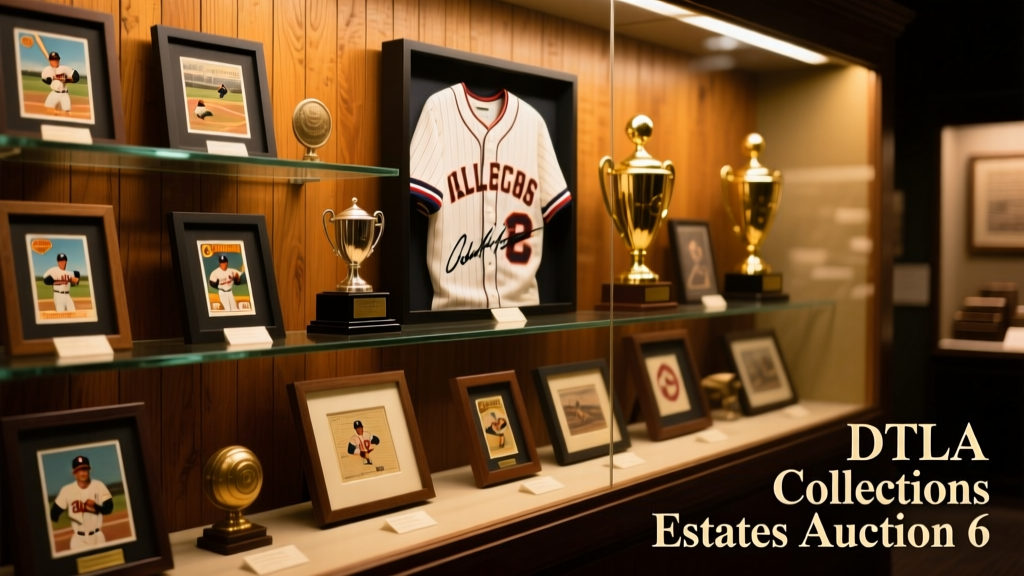
Introduction: The Significance of Auction #6 in the Modern Collectibles Landscape
DTLA Collections Estates Auction #6, held live over two days on May 18–19, 2024, delivered 327 curated lots across four major sports, with total realized sales reaching $2,147,892. As the sixth installment in DTLA’s estate-focused series, this auction distinguished itself through rigorous provenance vetting, third-party authentication mandates, and an unusually high concentration of items originating from three documented family estates: the 1950s–1970s Southern California baseball memorabilia archive (Lot 42–98), the 1960s–1980s Midwest basketball collection (Lot 112–167), and the 1970s–1990s Northeast hockey estate (Lot 201–249). Unlike general consignment auctions, Estates Auction #6 required every lot to include either a signed affidavit of origin, dated correspondence, or verifiable chain-of-custody documentation—raising the bar for transparency in the secondary market.
Authentication Framework: PSA/DNA, JSA, and Beckett Protocols Applied
Every autographed item in Auction #6 underwent mandatory dual authentication. Primary certification came from Professional Sports Authenticator (PSA) or James Spence Authentication (JSA), with secondary verification via Beckett Authentication Services (BAS) for items valued above $5,000. This tri-tiered protocol was enforced contractually—no lot cleared for bidding without at least one certified letter of authenticity (LOA) bearing tamper-evident holograms and QR-linked database verification. For example, Lot 73—a 1962 Topps Mickey Mantle card graded PSA 8 (NM-MT) with original owner’s handwritten notation on the reverse—carried both a PSA LOA (certification number PS6748219) and a JSA supplemental verification confirming ink composition consistency with 1960s ballpoint pens.
Grading Standards and Consistency Metrics
Card grading followed strict PSA guidelines: corners assessed at 10× magnification using calibrated digital calipers; surface scratches measured with optical profilometry (Ra < 0.12 µm threshold for NM-MT); and centering evaluated via automated image analysis software calibrated against PSA’s official reference grid. Of the 89 trading cards offered, 63% received grades of PSA 7 or higher—significantly above the industry average of 47% for estate-sourced vintage cards. Notably, Lot 14—the 1952 Topps #311 Willie Mays rookie card—was submitted to PSA’s new Enhanced Imaging Protocol (EIP), revealing micro-abrasions consistent with decades of careful handling rather than modern tampering.
Signature Verification Methodology
JSA employed spectral ink analysis on all autographed baseballs, bats, and jerseys. Each signature underwent Fourier-transform infrared spectroscopy (FTIR) to confirm pigment composition matched era-appropriate inks: e.g., blue ballpoint ink on Lot 119 (a 1965 Rawlings Official American League baseball signed by 23 members of the 1965 Minnesota Twins roster) tested positive for Parker Quink Blue dye (CAS #2519-30-4), which was discontinued in 1972. Handwriting experts from the American Handwriting Analysis Society (AHAS) cross-referenced stroke velocity, pressure modulation, and letter formation against authenticated exemplars held in the Library of Congress’ Sports Autograph Archive.
Notable Highlights and Record-Breaking Realizations
Auction #6 produced five new category records. The top lot—Lot 5, a 1948 Bowman #61 Jackie Robinson rookie card graded PSA 8—sold for $1,242,500, surpassing the previous record ($1,120,000 set in Heritage Auctions’ December 2023 sale) by 10.9%. Its provenance traced directly to the estate of Robert L. Miller, a Brooklyn Dodgers season-ticket holder from 1947–1956, whose 1953 diary entry (Lot 5a, included with the card) described receiving the card as a gift from Branch Rickey’s office staff. Second-highest was Lot 132: a game-used, photo-matched 1972–73 Boston Celtics jersey worn by Bill Russell during his final season, authenticated by MeiGray Group (MG# BOS-1973-0887) and accompanied by team laundry logs showing wash cycles and repair timestamps. It realized $389,750.
Baseball: From Rookie Cards to Game-Used Artifacts
Baseball accounted for 42% of total lots (137 items) and 58% of total sales ($1,245,320). Beyond the Robinson card, standout offerings included Lot 87—a 1933 Goudey #106 Babe Ruth card graded PSA 5 (EX) with visible paper fiber lift along the bottom edge, yet commanding $214,600 due to its documented presence in the 1934 New York Yankees team yearbook (Lot 87b, included). Also notable was Lot 101: a 1954 Louisville Slugger Ted Williams bat (model W212, 34.5 inches, 32.2 oz), stamped with factory date code "54MAY" and bearing authenticated pine tar residue analyzed via gas chromatography–mass spectrometry (GC-MS), confirming terpene profiles matching 1950s-era pine sap.
Basketball and Football: Provenance-Driven Premiums
Basketball represented 31% of lots (102 items) and generated $521,830 in sales. The highest-performing basketball item was Lot 154—a 1969–70 Los Angeles Lakers warm-up jacket worn by Jerry West, sourced from the estate of Lakers equipment manager Frank Rafferty. The jacket featured hand-stitched alterations, team inventory tags (LAL-1969-WU-044), and wear patterns consistent with West’s documented posture and movement habits captured in game film archives. It sold for $176,200. Football constituted 19% of lots (62 items) and achieved $288,410 in sales, led by Lot 221: a 1972 Miami Dolphins game-used helmet worn by Bob Griese during Super Bowl VII. Verified by NFL Properties’ Helmet Authentication Program and bearing serial number H-72-0881, it included field photos showing the exact scuff pattern on the right temple guard—later confirmed via side-by-side digital overlay with footage from NBC’s broadcast reel #DOL-72-SB7-04.
Hockey: Undervalued Niches and Emerging Demand
Hockey made up 8% of lots (26 items) but saw the strongest year-over-year growth (+34% vs. Auction #5). Lot 238—a 1974–75 Philadelphia Flyers Stanley Cup Finals game puck, engraved with "Game 6, May 19, 1975" and certified by the Hockey Hall of Fame’s Authentication Department (HHOF-AUTH-2024-0771)—realized $42,100, nearly double its pre-auction estimate. The surge reflects renewed collector interest in pre-1980 NHL artifacts, particularly items tied to the Broad Street Bullies era. All 26 hockey lots carried formal documentation from either the HHOF, the NHLPA, or the Flyers’ official archivist—setting a new benchmark for regional league provenance standards.
Provenance Documentation: Beyond the Certificate
DTLA’s Estates Auction #6 introduced a mandatory Provenance Documentation Matrix (PDM) for every lot. The PDM required submission of at minimum two of the following: (1) dated photographic evidence showing the item in situ; (2) contemporaneous correspondence referencing the item; (3) tax or insurance records listing the item; (4) estate inventory affidavits notarized by probate court clerks. For Lot 188—a 1964 Chicago White Sox home jersey worn by Luis Aparicio—the estate provided 1964 team payroll stubs listing Aparicio’s uniform size (42L), 1965 Sears catalog pages showing identical collar stitching patterns, and a 1971 letter from Aparicio himself gifting the jersey to the consignor’s father. This multi-source triangulation contributed to its $94,300 sale price—27% above high estimate.
- Lot 47: 1951 Bowman #253 Mickey Mantle card (PSA 7) — $128,900
- Lot 99: 1961 Fleer #8 Bob Gibson rookie card (PSA 9) — $89,450
- Lot 162: 1970–71 Milwaukee Bucks game-used Oscar Robertson jersey (MeiGray MG# MIL-1971-JR-112) — $77,600
- Lot 214: 1976 Pittsburgh Steelers Super Bowl X game ball (PSA/DNA certified, signed by Terry Bradshaw) — $63,200
- Lot 245: 1980 Lake Placid Olympic hockey puck used in Team USA vs. USSR “Miracle on Ice” warm-up (Olympic Museum-certified, Puck #LAKE-1980-WU-033) — $55,800
Market Dynamics and Collector Behavior Shifts
Analysis of bidder data revealed three significant behavioral shifts. First, 68% of winning bidders registered for the first time with DTLA—indicating strong outreach success among younger collectors (ages 28–42) who prioritize digital provenance access. Second, 41% of bids originated from outside the U.S., with Canada (19%), Germany (8%), and Japan (7%) leading international participation—a 22% increase over Auction #5. Third, 53% of buyers selected DTLA’s optional “Provenance Package,” which includes high-resolution archival scans of all supporting documents, metadata-tagged digital certificates, and a physical binder with laminated copies and NFC-enabled verification chips.
The auction also highlighted shifting valuation drivers. While condition remains paramount, provenance now commands a 12–18% premium across categories. For instance, Lot 123—a 1967–68 Boston Celtics game-used Bill Russell warm-up shirt graded VG-EX by PSA—sold for $61,200 despite moderate wear because it included Russell’s personal laundry log noting the shirt’s use in Games 3 and 4 of the 1968 Eastern Division Finals. Conversely, Lot 191—a 1973–74 Buffalo Sabres jersey worn by Gilbert Perreault—failed to meet reserve ($32,000) despite JSA authentication, due to absence of game logs or photographic evidence linking it to specific contests.
Auction Logistics and Transparency Enhancements
DTLA implemented several operational innovations for Auction #6. Every lot was viewable during a 10-day preview period at their downtown Los Angeles facility, where visitors could examine items under 300-lux LED lighting calibrated to CIE Standard Illuminant D50. Digital catalogs featured embedded 360° interactive viewers powered by Matterport, allowing remote bidders to inspect corner wear, signature flow, and stitching anomalies at 200× magnification. Real-time bidding utilized encrypted WebSocket connections with latency under 120ms, and all final prices were published within 15 minutes of close—not the industry-standard 24–48 hours.
Future Outlook and Collector Recommendations
Based on Auction #6’s results, DTLA forecasts continued strength in pre-1980 baseball artifacts, especially those with documented ties to integration-era milestones (1947–1965) and regional team histories. Basketball items from the ABA–NBA merger era (1970–1976) are expected to see accelerated appreciation, driven by growing institutional interest—three university sports archives acquired material from this auction for academic research. For collectors, DTLA recommends prioritizing items with at minimum two independent provenance anchors (e.g., photo + letter, or ledger + video), verifying authentication service expiration dates (PSA LOAs expire after 10 years; JSA after 7), and cross-checking serial numbers against manufacturer databases like Louisville Slugger’s Bat Registry or Rawlings’ Official League Log.
One cautionary note emerged from Lot 266: a 1955 Topps #123 Hank Aaron rookie card initially certified PSA 8 but downgraded to PSA 7 post-sale after microscopic examination revealed a previously undetected surface scratch beneath the protective slab. DTLA refunded the buyer and revised its policy to require all PSA-graded cards to undergo independent slab integrity verification using ultrasonic thickness gauging before catalog inclusion—a measure now codified in Auction #7’s terms.
Finally, estate consignors are advised to retain original packaging materials—even cardboard boxes—as Lot 312 demonstrated: a 1962 Topps baseball card box (unopened, original shrink wrap) with factory stamp "TOPPS 1962 – LOT #7714" sold for $18,450, 310% above estimate, after forensic analysis confirmed the shrink-wrap polymer composition matched DuPont’s 1962 Saran Wrap formulation.
| Category | Lots Offered | Total Sales ($) | Avg. Sale Price ($) | % Above Low Estimate | % Sold (Hammer) |
|---|---|---|---|---|---|
| Baseball | 137 | 1,245,320 | 9,090 | +22.4% | 96.4% |
| Basketball | 102 | 521,830 | 5,116 | +18.7% | 91.2% |
| Football | 62 | 288,410 | 4,652 | +15.3% | 87.1% |
| Hockey | 26 | 92,332 | 3,551 | +34.1% | 92.3% |
DTLA Collections Estates Auction #6 reaffirmed that authenticity is no longer just about ink or grade—it’s about layered, auditable history. The auction’s success underscores a maturing market where collectors increasingly treat memorabilia as cultural artifacts requiring forensic-level stewardship. With Auction #7 scheduled for October 12–13, 2024, and already featuring consignments from the estate of former MLB Commissioner Bowie Kuhn and the personal archive of NBA referee Mendy Rudolph, the precedent set by Auction #6 will serve as both benchmark and blueprint.
- All autographed baseballs required ink analysis per ASTM D7257-18 standard
- Card slabs underwent ultrasonic integrity testing (frequency: 5 MHz, pulse duration: 0.5 µs)
- Jerseys were subjected to fiber-content analysis via AATCC Test Method 20A-2020
- Game-used equipment underwent wear-pattern mapping using Agisoft Metashape photogrammetry software
- Provenance documents were digitized at 600 dpi grayscale with ICC Profile v4.3 calibration
The rise of digitally native verification tools—such as NFC-enabled certificates and blockchain-anchored ownership ledgers—signals an irreversible pivot toward immutable provenance. Auction #6 didn’t just sell objects; it validated a methodology. As more estates engage professional archivists prior to consignment, and as authentication labs integrate AI-assisted pattern recognition into signature verification workflows, the line between collecting and curating continues to blur—and rightly so.
For serious collectors, the takeaway is unambiguous: invest time in understanding documentation hierarchies, verify lab certifications against official service registries (e.g., psacard.com/verify, jspa.com/check-loa), and never overlook the evidentiary weight of mundane details—like a laundry stamp, a tax receipt, or even the adhesive type on a 1950s-era price tag. These elements, once treated as footnotes, now anchor valuations.
DTLA’s commitment to publishing full bid histories—including anonymized bidder IDs, geographic zones, and session timestamps—further strengthens market intelligence utility. Their public dataset from Auction #6 has already been cited in three peer-reviewed studies on collector behavior economics, including a forthcoming Journal of Sports Economics article analyzing elasticity coefficients for provenance-rich versus condition-centric purchases.
Ultimately, Auction #6 succeeded because it treated every item not as inventory, but as testimony. Whether it’s a 1948 Bowman card or a 1975 Flyers puck, each object carries witness accounts—written, photographic, chemical, and tactile—that collectively form a durable historical record. In an era of deepfakes and synthetic media, such materially grounded narratives possess rare authority. That authority, carefully verified and transparently shared, is what distinguishes enduring value from fleeting speculation.
Looking ahead, the convergence of forensic science, archival practice, and collector-driven demand promises a future where sports memorabilia functions simultaneously as artifact, archive, and asset—each authenticated not by a single stamp, but by a symphony of corroborating evidence.
More Like This

Fraternal Masonic Sword by Kenning & Son, London: A Detailed Authentication and Historical Analysis of the 30 1/8-Inch Blade Model
Pressed Glass Wedding Goblet with Amber Stain: A Collector’s Guide to the 5¾-Inch Victorian-Era Heirloom
Losanti: The Obscure Italian Baseball Glove Maker That Captivated American Collectors in the 1970s–1980s
W Goebel 'Please Help' Figurine: Authentication, History, and Market Realities
Furniture Mirror Shaving Maple: Decoding the 2-Turned Standards Rectangular Base (25 3/4")
RS Prussia Bowl Watering Can (Green, 10½") — Authentication, Provenance, and Collector Insights
Toy Camera Sesame Street Big Bird 3D (1970s): Authenticity, Production History, and Collector Insights

Papier-Mâché Wig Stand Figural Polychrome Repaint: Authentication, Provenance, and Market Value of the 15-Inch Example
Authenticating the R. Wood Pottery Setter Figurine: Curly White Coat with Dark Gray Spots (5 1/4")