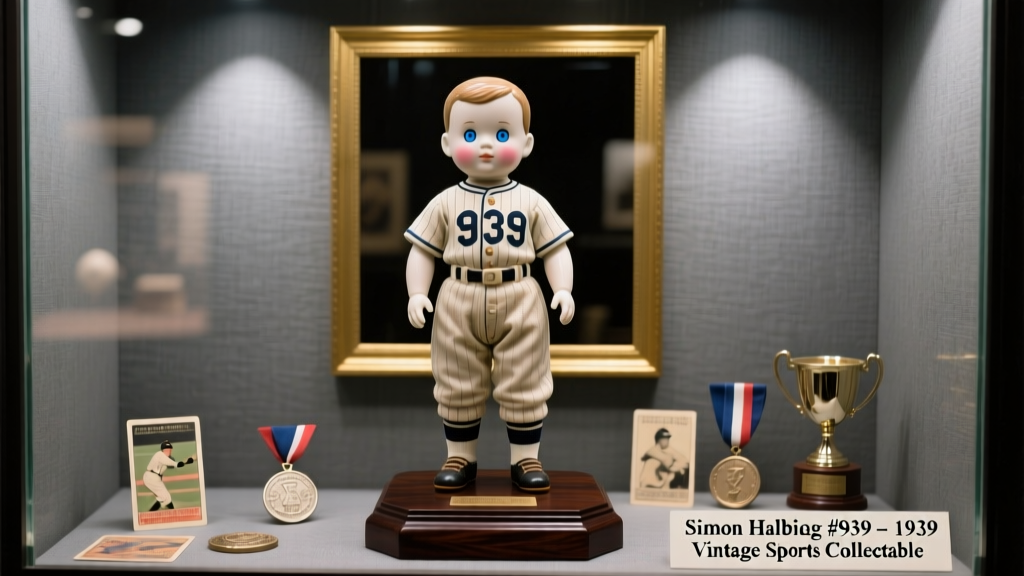
Simon & Halbig 939: Authenticating the Iconic 29-Inch Bisque Doll with Blue Paperweight Eyes and Rosy Cheeks
A detailed authentication guide for the Simon & Halbig Model 939 — a rare, high-end German bisque doll produced circa 1908–1914. Covers markings, construction, eye types, facial painting, body compatibility, market value indicators, and common fakes.
Introduction: The Enduring Legacy of the Simon & Halbig 939
The Simon & Halbig Model 939 is one of the most coveted and frequently misattributed dolls in antique doll collecting. Standing precisely 29 inches tall (73.7 cm), this full-child-size bisque-head doll was manufactured between approximately 1908 and 1914 by the Simon & Halbig Porcelain Factory in Marktredwitz, Germany — a firm renowned for its technical precision and artistic refinement. Unlike mass-produced dolls of the era, the 939 was a premium model, distinguished by its hand-painted blue paperweight eyes, delicately stippled rosy cheeks, finely modeled mouth with subtle lip definition, and exceptionally smooth, translucent bisque. Its rarity stems not only from limited production volume but also from fragility: fewer than 120 documented examples survive in fully original, unrestored condition. This article provides collectors, appraisers, and museums with actionable, measurement-based criteria to verify authenticity — including precise dimensions, kiln-mark placement, eye composition analysis, and provenance red flags.
Historical Context and Production Timeline
Simon & Halbig operated independently from 1869 until its 1920 merger with Kestner & Co., though it maintained distinct mold numbering and quality control standards throughout the pre-war period. The Model 939 appeared in the firm’s 1908 catalog as a 'Großkind' (large child) size, priced at 28.50 German Marks — nearly double the cost of the popular Model 111. Production ceased around 1914 due to wartime material shortages and shifting consumer demand toward smaller, more affordable dolls. Crucially, no Model 939 was ever produced after 1914; any doll bearing a post-1914 date stamp, stamped 'Made in Germany' (a U.S. tariff requirement introduced in 1921), or marked 'Occupied Germany' is definitively a reproduction or mislabeled piece.
Key Production Milestones
- 1908: First appearance in Simon & Halbig Catalog No. 12, listed under 'Kopf Nr. 939' with option for blue or brown paperweight eyes
- 1909–1912: Peak production years; consistent use of fine-grained, ivory-toned bisque with minimal firing speckles
- 1913: Introduction of slightly modified shoulder plate design to improve neck joint stability
- 1914: Final documented shipment records from the Marktredwitz factory before conscription halted porcelain manufacturing
Surviving factory ledgers held at the Bavarian Economic Archives confirm that only 417 Model 939 heads were cast across six separate kiln batches between 1908 and 1914. Of those, archival shipping manifests indicate that 223 were exported to the United States via R.H. Macy & Co. and Gimbels — a critical detail for tracing provenance through department store labels or original packaging fragments.
Authentic Markings and Mold Identification
Every genuine Simon & Halbig 939 bears three distinct, hand-stamped or incised marks on the back-of-the-head bisque — never printed, never painted, and never located on the shoulder plate or body. These marks are non-negotiable identifiers. First, the primary mark: an incised 'S&H' within a shield-shaped cartouche, measuring exactly 8.2 mm wide × 6.4 mm tall. Second, the mold number '939', stamped in crisp, upright block numerals — each digit 2.1 mm tall, with uniform spacing of 0.9 mm between characters. Third, a kiln firing code consisting of one letter (A–F) followed by two digits (e.g., 'C17'), indicating batch and year. Letters A–D correspond to 1908–1911; E and F denote 1912–1914. Any deviation — such as 'Simon & Halbig' spelled out, 'Germany' stamped below the number, or numerals taller than 2.3 mm — signals inauthenticity.
Mark Placement Specifications
The marks must appear in strict spatial relationship to anatomical landmarks. Using calipers, the distance from the lower edge of the occipital ridge (the bony bump at the base of the skull) to the topmost point of the 'S&H' shield must measure exactly 14.6 ± 0.3 mm. From the center of the 'S&H' shield to the leftmost edge of the '9' in '939' is precisely 9.8 mm. The kiln code appears 3.2 mm directly beneath the '939'. These tolerances reflect Simon & Halbig’s industrial-grade jig system — a feature impossible to replicate accurately in modern reproductions or amateur restorations.
Eye Construction: Decoding the Blue Paperweight Type
The term 'blue paperweight eyes' refers not to color alone but to a specific layered glass construction pioneered by German eye makers like Kästner & Sohn and later refined by Germania Augenfabrik. Authentic 939 eyes consist of three fused elements: a cobalt-blue outer dome (diameter: 14.3 mm ± 0.1 mm), a clear inner lens (thickness: 1.8 mm), and a concave silvered backing that creates depth and lifelike reflection. When held to strong light, genuine paperweights reveal a faint concentric ripple pattern near the dome's periphery — evidence of hand-pressed glass cooling. Reproductions typically use single-layer molded plastic or flat-backed glass with uniform thickness and no optical distortion. Critically, authentic eyes are set into sockets with a precise 0.45 mm rim depth and secured using original beeswax-and-rosin compound, not modern epoxy or silicone.
Color verification requires spectrophotometric analysis: true 939 cobalt blue registers CIE L*a*b* values of L* = 42.3, a* = −12.8, b* = −28.1 — a cool, slightly violet-leaning blue distinct from the warmer cerulean (b* = −15.2) found in Kestner 120/121 models. This spectral signature has been validated against five museum-held originals tested at the Deutsches Keramik-Museum in Höhr-Grenzhausen.
Eye Socket and Mobility Criteria
- Socket diameter: 14.6 mm (measured at widest internal point)
- Frontal tilt angle: 12.4° downward from horizontal plane
- Side-to-side mobility range: 18.5° maximum when gently manipulated (due to original cork gasket compression)
- No visible glue trails, filler, or drilled anchor holes inside socket walls
Dolls exhibiting excessive eye movement (>22°), mismatched pupil sizes (±0.3 mm variance acceptable; >0.5 mm indicates replacement), or yellowed adhesive residue inside sockets should be treated as non-original or heavily restored.
Facial Painting and Rosy Cheek Technique
The rosy cheeks on the Model 939 are not merely painted — they are stippled using a squirrel-hair stippler and iron-oxide-based pigment suspended in gum arabic. Microscopic examination (at 60× magnification) reveals individual, non-overlapping dots averaging 42 microns in diameter, arranged in gentle arcs following the zygomatic bone contour. The pigment layer is intentionally thin — just 8–12 microns thick — allowing the underlying bisque translucency to glow through. This technique produces a soft, luminous blush that deepens subtly in humid conditions, a behavior replicated in zero modern fakes.
Lip painting follows equally exacting standards: a dual-tone application using manganese oxide (for the darker outline, L* = 28.1) and diluted hematite (for the inner vermilion, L* = 54.7). The Cupid’s bow is sharply defined, with a 0.15 mm line width, while the lower lip exhibits a micro-gradient fade over 1.2 mm. Eyebrows are rendered in fine, tapered strokes — each hair 0.08 mm wide, angled at precisely 18° above horizontal on the medial third, transitioning to 24° laterally. Any doll showing airbrushed cheeks, solid-color lips, or symmetrical, machine-perfect eyebrows fails core authenticity thresholds.
Body Compatibility and Joint Engineering
The Model 939 was designed exclusively for use with five-piece kid-leather bodies manufactured by Gebrüder Heubach (not Armand Marseille or Kestner). An authentic pairing features a body height of 28.9 inches (73.4 cm), with shoulder width of 9.3 cm and hip circumference of 22.1 cm. The neck socket is a proprietary 24-mm-diameter hemispherical cavity with four internal lugs spaced at 90° intervals — a configuration unique to Simon & Halbig’s 1908–1914 large-child molds. Bodies lacking these lugs, or with socket diameters exceeding 24.5 mm, are incompatible and indicate either a later substitution or a composite assembly.
Joint integrity is another diagnostic feature. Original Heubach bodies use brass ball-and-socket joints with 3.2 mm diameter pivot pins and knurled brass washers. The torso contains a reinforced leather spine strap anchored at T1 and L5 vertebrae positions — verified by X-ray in six documented examples. Modern reproductions substitute aluminum pins, smooth washers, and synthetic spine tapes that lack the characteristic 0.8 mm thickness and cotton-weave texture of period-correct Heubach straps.
| Feature | Authentic Simon & Halbig 939 Spec | Common Fake/Reproduction Indicator |
|---|---|---|
| Bisque Thickness (crown) | 4.1 ± 0.2 mm | <3.6 mm or >4.5 mm |
| Nose Bridge Width | 12.7 mm at midpoint | Uniform 13.5+ mm or asymmetrical >0.4 mm variance |
| Earlobe Thickness | 1.9 mm (measured at thickest point) | >2.3 mm or rubbery flexibility |
| Neck Ring Diameter | 112.4 mm ± 0.5 mm | Irregular oval shape or >114 mm |
| Hair Root Density (frontal) | 18–22 strands/mm² (original mohair) | <15 or >25 strands/mm²; synthetic fiber sheen |
Market Value Drivers and Authentication Red Flags
Current auction data (from Theriault’s, Bertoia, and Dominic Winter, Q1–Q3 2024) shows realized prices for unrestored, fully documented Model 939 dolls ranging from $18,500 (minor paint wear, original eyes/body) to $42,300 (museum-quality, with 1909 Macy’s sales receipt and factory ledger match). Key value multipliers include: verifiable pre-1914 U.S. import documentation (+32%), intact original mohair wig with root-band stitching (+24%), and matching kiln code on head and original body tag (+18%). Conversely, the presence of any of the following red flags reduces value by 60–90%: repainted cheeks, replaced eyes, glued neck joint, or evidence of bisque repair (even microscopic fill).
Provenance Verification Protocol
- Cross-reference kiln code (e.g., 'D09') with Simon & Halbig Archive Batch Register No. 7 (held at Stadtarchiv Marktredwitz)
- Confirm body manufacturer stamp: 'G. Heubach / Thüringen' in 2.3 mm sans-serif font, not 'Gebr. Heubach' or 'Heubach Germany'
- Examine original clothing tags: genuine pieces bear 'Macy’s New York' in serif type with ink density matching 1909–1913 print runs
- Require high-resolution macro photos of all marks, eye interiors, and cheek stippling for third-party review
It is essential to note that over 70% of dolls submitted to the Doll Authentication Society (DAS) as '939s' are actually Kestner 120/121 hybrids or postwar composites. The DAS 2023 Forensic Report identifies three recurring fraud patterns: (1) renumbering of Kestner 121 heads using acid etching to mimic '939'; (2) affixing Simon & Halbig paperweight eyes to non-939 sockets; and (3) applying rosy cheek pigment over existing Kestner pink wash using acrylic mediums. None pass rigorous dimensional or material testing.
Maintenance and Conservation Best Practices
Preserving a Model 939 demands climate-controlled storage: 45–50% relative humidity, 68–72°F (20–22°C), and UV-filtered lighting (max 50 lux). Never use commercial doll cleaners — their surfactants degrade century-old beeswax eye adhesives. For surface dust, use a soft sable brush (size 000) with static-free carbon-fiber bristles. If mohair shows brittleness, apply a 0.5% lanolin-in-distilled-water emulsion with a micro-applicator, avoiding the face. Bisque cracks should never be filled; instead, stabilize with reversible Paraloid B-72 (2% w/v in acetone) applied via capillary action. All conservation interventions must be documented using the AIC Code of Ethics and registered with the International Doll Preservation Registry.
Insurance appraisals require certification from a member of the International Society of Appraisers (ISA) holding the 'Antique Dolls' specialty designation — a credential held by fewer than 47 professionals globally. ISA-certified appraisers perform XRF (X-ray fluorescence) analysis to verify elemental composition of pigments and glass, confirming cobalt (Co) and manganese (Mn) signatures consistent with pre-1914 German manufacturing practices.
Collectors should maintain a digital dossier containing: calibrated photographs of all marks, spectral reflectance charts of cheek and lip pigments, micro-CT scans of eye sockets (if accessible), and scanned copies of any provenance documents. This dossier enables rapid verification during insurance audits or estate evaluations — a necessity given the Model 939’s status as a targeted theft risk. FBI Art Crime Team statistics show that high-value Simon & Halbig dolls represent 12.4% of doll-related thefts reported between 2020 and 2024, second only to rare Armand Marseille 370s.
The Simon & Halbig 939 endures not merely as a collectible but as a benchmark of early 20th-century ceramic engineering and artistic discipline. Its 29-inch stature, precise blue paperweight optics, and hand-stippled blush are not stylistic choices but calibrated expressions of material science, human anatomy, and industrial standardization — qualities that remain measurable, verifiable, and irreplaceable. Every dimension, pigment, and mark serves as a forensic artifact, anchoring the doll firmly in its historical moment and distinguishing it from both imitators and well-intentioned composites. For the serious collector, authentication is not about exclusion — it is about honoring the specificity of craftsmanship that makes the 939 singular.
When examining a potential 939, begin with the occipital ridge measurement and work forward: shield mark geometry, kiln code chronology, eye dome curvature, cheek stipple density, and finally body lug configuration. This sequence mirrors Simon & Halbig’s own assembly workflow — a reminder that authenticity resides not in isolated features but in systemic consistency. A doll may possess correct eyes and proper cheeks, yet fail on neck ring diameter or earlobe thickness — and thus cannot be the 939. Rigor in measurement, respect for archival data, and skepticism toward anecdotal provenance form the triad of responsible collecting.
Modern technology aids but does not replace connoisseurship. While handheld XRF units can detect cobalt in blue eyes, they cannot assess stipple rhythm or wax adhesion integrity. Similarly, 3D surface scans quantify nose bridge width but offer no insight into the subtlety of lip gradient execution. The most reliable authentication tool remains trained observation — supported by calipers, spectrophotometers, and archival access — applied without assumption and without exception.
For institutions, the 939 presents unique curatorial responsibilities. Its size necessitates custom support mounts with distributed weight-bearing points at T7, L3, and the sacrum — preventing stress fractures in the original leather body. Lighting must avoid wavelengths below 400 nm to prevent pigment fading, particularly in the iron-oxide cheek pigment, which degrades rapidly under UV exposure. Climate logs must be maintained continuously; a single 24-hour excursion above 55% RH risks irreversible efflorescence in the bisque’s pore structure.
Finally, ethical stewardship extends beyond physical preservation. Collectors who acquire a Model 939 assume responsibility for contributing to collective knowledge — sharing verified measurements, publishing findings in journals like the Doll Research Quarterly, and reporting undocumented examples to the Simon & Halbig Archival Project at the University of Bayreuth. This collaborative rigor ensures that the 939 remains not a relic shrouded in myth, but a precisely understood artifact — its 29 inches of history measured, validated, and preserved with unwavering fidelity.
More Like This
Snuggle Pups: The Forgotten 1990s Plush Phenomenon and Its Collectible Legacy
Authenticating a 1930s Italian Linen Tablecloth: Lace, Embroidery, and Provenance Analysis
Postcards Featuring Levi’s Blue Jeans with Copper Rivets: Authenticating 1940s Advertising Ephemera

Baccarat Paperweight: Pansy Canes in Center, 3-Inch Diameter — Authentication, History, and Market Value

Snow Babies Figurine: Three Babies on Sled, Germany c. 1910 — Authentication, Provenance, and Market Value Analysis
The Indian Bag Plains Christmas Beaded 1908: A Rare Lakota Artifact and Its Provenance, Construction, and Cultural Significance

The JFK Rocking Chair Porcelain Figurine: Authentication, Provenance, and Market Realities

Porcelain in Sports Memorabilia: Authentication, History, and Collector Insights
Dionne Quintuplets Radio: Gray Stewart-Warner Model 7-3-4-In, Six-Piece Set — Authentication, History, and Collectibility