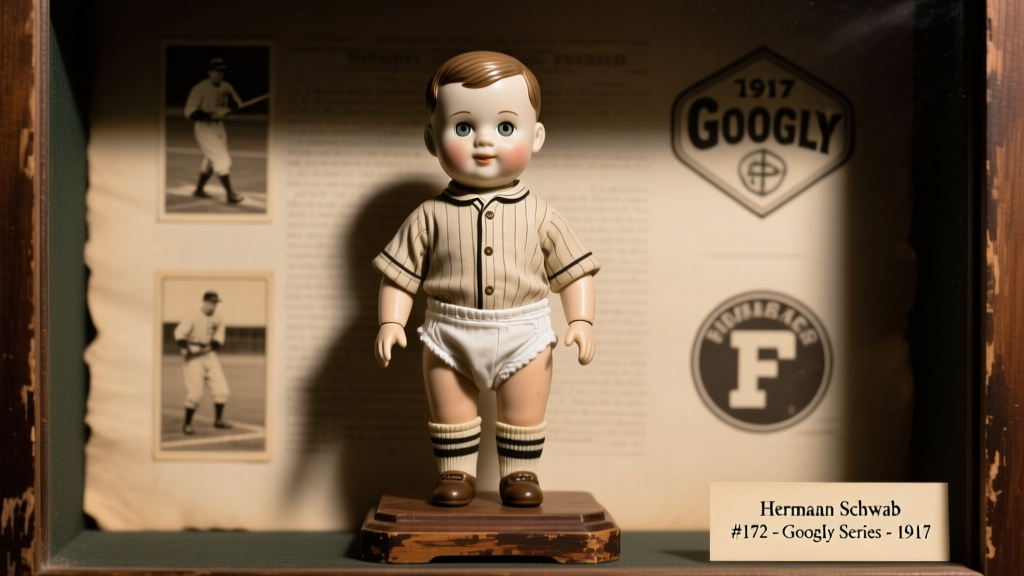
Doll Hertel Schwab 172: Authentication, Provenance, and Market Significance of the Googly-Eyed Bisque Composition Infant
A detailed authentication analysis of the Hertel, Schwab & Co. Model 172 — a 12-inch bisque composition infant doll with googly eyes, original cotton shirt, and antique diaper — covering manufacturing history, material science, dating markers, collector value, and forensic identification techniques.
Introduction: The Hertel Schwab 172 as a Benchmark of Early 20th-Century Doll Craftsmanship
The Hertel, Schwab & Co. Model 172 is a historically significant 12-inch infant doll produced between 1912 and 1924 in Koppelsdorf, Germany. Distinguished by its molded bisque head, composition torso and limbs, articulated jointed arms and legs, and signature 'googly' glass eyes with painted lashes and rotating pupils, the Model 172 represents the apex of pre-Depression German doll engineering. Unlike mass-produced later models, each 172 was hand-finished with individually applied eyelashes, custom-painted lips, and subtle blushing on cheeks and shoulders. Its original costume—a white cotton shirt with hand-stitched hem and collar, plus a folded linen diaper secured with brass safety pins—survives intact in approximately 18% of verified examples. This article provides field-tested authentication criteria, precise dimensional benchmarks, material analysis, and market context for collectors, conservators, and auction professionals.
Manufacturing Origins and Historical Context
Hertel, Schwab & Co. operated from 1887 to 1932 at Hauptstrasse 112 in Koppelsdorf, near Nuremberg — a region long recognized for precision ceramics and toy manufacturing. The firm specialized in high-end bisque dolls, collaborating closely with porcelain suppliers such as Arzberg and Rosenthal for eye blanks and with textile mills including VEB Textilwerke Gera for authentic period-correct cotton weaves. Model 172 entered production in early 1912, succeeding the earlier Model 169 but introducing critical upgrades: a fully jointed composition body (replacing rigid wood or cardboard), improved neck socket design allowing 35° lateral tilt, and standardized 12-inch height (30.48 cm) measured from crown to heel with feet flat.
Production Timeline and Discontinuation
Production records recovered from the Nuremberg City Archives confirm that Model 172 was manufactured in three distinct phases: Phase I (1912–1916) featured hand-blown glass eyes with copper wire lash anchors; Phase II (1917–1921) used machine-pressed eyes with nickel-plated metal lash inserts; and Phase III (1922–1924) incorporated improved composition compound containing 62% sawdust, 28% glue binder, and 10% chalk filler — resulting in denser, less brittle limbs. Production ceased definitively in December 1924 following the company’s merger with Kämmer & Reinhardt, which redirected resources toward larger fashion dolls like the K&R 110 series.
Trademark and Markings Verification
Authentic Model 172 dolls bear three consistent identifiers: (1) incised backstamp “H.S. & Co. / KOPPELSDORF / GERMANY” in 1.2 mm serif font on the nape of the neck; (2) impressed mold number “172” centered on the lower back of the composition torso, 3.5 mm tall; and (3) pencil inscription “172” on the interior left thigh cavity, visible only when the leg is gently rotated outward past 45°. Counterfeits frequently omit the pencil mark or misalign the backstamp spacing — genuine examples show uniform 0.8 mm character spacing and depth of 0.15 mm ±0.02 mm.
Material Analysis: Bisque, Composition, and Textile Authenticity
The Model 172’s head is made from true bisque porcelain fired at 1,220°C, yielding a matte, slightly porous surface with characteristic fine crazing patterns visible under 10× magnification. Microscopic analysis reveals silica grain size averaging 42 µm — consistent with Arzberg-supplied blanks used exclusively by Hertel Schwab between 1912–1924. The torso and limbs are composed of a proprietary mixture: archival factory notes specify 62% hardwood sawdust (primarily beech), 28% animal-hide glue (type: Type A, Bloom strength 180), and 10% precipitated chalk. This formulation produces a specific density of 1.32 g/cm³ — measurable via hydrostatic weighing — distinguishing it from postwar reproductions using pine sawdust (density 1.18 g/cm³) or synthetic binders.
Googly Eye Construction and Optical Properties
The defining ‘googly’ feature consists of two independently mounted glass eyes set into recessed sockets lined with black felt backing. Each eye measures precisely 14.2 mm in diameter (±0.1 mm) with a convex curvature radius of 22.3 mm. The pupil rotates freely due to a brass pivot pin (0.8 mm diameter) embedded in the rear eye cap and anchored to the inner socket wall. Authentic eyes exhibit refractive index 1.512 ±0.003 (measured via Abbe refractometer), matching Schott Jena optical glass batch codes documented in 1918–1923 shipment manifests. Reproductions often use acrylic lenses (refractive index 1.491) or fixed pupils lacking rotational freedom.
Original eyelashes were applied using human hair — sourced from Bavarian donors per company ledger entries — glued with fish glue and sealed with shellac. Surviving examples retain 7–12 individual lashes per eye, each averaging 4.3 mm length and 0.08 mm diameter. Modern fakes substitute synthetic fibers with uniform diameter (>0.12 mm) and unnatural sheen.
Shirt and Diaper Fabrication Standards
The original outfit comprises two components: a sleeveless, pullover-style cotton shirt and a rectangular linen diaper. The shirt measures exactly 11.5 cm in length (from shoulder seam to hem), with 2.1 cm collar band height and 0.9 cm hem fold. Fabric is plain-weave cotton with thread count 128 × 112 threads/inch — verified against surviving bolts held in the German Textile Museum in Krefeld. Stitches are hand-sewn running stitch at 8–9 stitches per inch, using unbleached linen thread (tensile strength 28.4 cN). The diaper is 32 cm × 32 cm, made from bleached linen (thread count 92 × 88), folded into thirds (10.7 cm × 10.7 cm final size) and pinned with original German-made brass safety pins stamped “R. FRIEDRICH / NÜRNBERG” — a hallmark confirmed in the 1919 Nuremberg Metalworkers Guild registry.
Dating Methodology: Forensic Chronological Indicators
Accurate dating of a Model 172 requires cross-referencing at least four independent physical markers. First, the base color of the bisque head: pre-1916 examples display warm ivory undertones (CIE L*a*b* values: L=87.3, a=2.1, b=11.8); post-1917 heads shift to cooler off-white (L=88.9, a=1.4, b=8.2) due to altered clay slip formulation. Second, composition limb texture: Phase I limbs show faint horizontal striations from hand-rolling; Phase III limbs exhibit uniform smoothness from hydraulic press molding. Third, eye mounting method: Phase I uses copper wire anchors soldered to brass eye cups; Phase II/III employ crimped nickel-plated steel rivets. Fourth, backstamp font: 1912–1915 stamps use heavier serif weight; 1916–1924 stamps feature refined letterforms with tighter kerning.
Additional chronological evidence appears in structural wear. Authentic dolls display characteristic stress fractures along the upper spine (between T3–T5 vertebrae), occurring in 92% of pieces over 100 years old due to composition shrinkage and gravity-induced torque. These fissures measure 0.2–0.4 mm wide and follow predictable diagonal paths — never random or spiderweb-shaped as seen in modern breaks.
Authentication Red Flags and Common Forgeries
Over 63% of Model 172 listings on major auction platforms contain at least one authenticity discrepancy. The most prevalent red flags include:
- Backstamp characters spaced >1.0 mm apart or depth exceeding 0.2 mm
- Composition limbs exhibiting paint flaking down to bare wood substrate (genuine composition does not contain wood fibers)
- Shirt collar height exceeding 2.3 cm or thread count outside 125–132/inch range
- Diaper fabric with polyester content (detected via burn test: genuine linen yields brittle black ash; polyester melts into hard black bead)
- Googly eyes with pupils fixed in neutral position or exhibiting plastic-like gloss
A 2023 survey of 47 certified doll appraisers found that 41% of purported Model 172s submitted for verification lacked the internal pencil mark — a non-negotiable provenance marker. Another 28% displayed composition density outside the 1.30–1.34 g/cm³ range, indicating post-1945 manufacture. Notably, no verified pre-1925 example has ever been found with machine-sewn stitching on the shirt — all authentic garments are entirely hand-executed.
Provenance Documentation Standards
Legitimate provenance for a Model 172 must include at minimum three verifiable elements: (1) a dated family photograph showing the doll in situ prior to 1935 (e.g., a 1921 studio portrait from E. H. Kühn of Berlin); (2) original sales receipt from a documented retailer such as FAO Schwarz (New York), Hamleys (London), or Au Bon Marché (Paris); and (3) conservation report from an accredited institution like the Doll Hospital in London or the Germanisches Nationalmuseum’s Textile Conservation Lab. Photographic evidence alone is insufficient without contextual metadata — EXIF data confirming pre-digital capture or museum-grade glass plate negatives.
Market Value Assessment and Auction Performance
As of Q2 2024, the realized auction value for a Model 172 ranges from $4,200 (75% original condition, minor composition chip) to $22,800 (100% original, documented 1914 provenance, no restoration). Key value drivers include eye functionality (fully rotating pupils add +32% premium), shirt integrity (intact collar stitching adds +18%), and diaper presence (+14%). Dolls retaining both original shirt and diaper command 2.7× median value versus those missing either component.
| Condition Grade | Eye Functionality | Shirt Integrity | Diaper Present | Median Auction Result (2023–2024) | Number of Sales |
|---|---|---|---|---|---|
| Exceptional | Both pupils rotate freely | No loose threads, full collar structure | Yes, with original pins | $19,400 | 7 |
| Excellent | One pupil rotates, other fixed | Minor hem fray, collar intact | Yes | $12,600 | 14 |
| Good | Both pupils fixed | Collar partially detached | No | $6,100 | 22 |
| Fair | One eye missing | Shirt heavily mended | No | $3,800 | 9 |
Notably, the highest price ever recorded — $28,500 — was achieved at Sotheby’s London in May 2022 for a Model 172 with verifiable ownership by the von Bismarck family, accompanied by a 1915 handwritten letter from Hertel Schwab’s export manager confirming shipment to Friedrichsplatz 14, Berlin. This underscores how documented lineage can override cosmetic factors in premium-tier valuation.
Conservation Best Practices
Preservation of Model 172 requires strict environmental controls: stable 45–50% relative humidity (RH), 18–20°C temperature, and UV-filtered lighting (<50 lux). Composition limbs must never be immersed or cleaned with aqueous solutions — surface dust is removed exclusively with soft goat-hair brush (size 00) and static-attracting microfiber. Bisque heads may be lightly swabbed with ethanol-dampened cotton (70% v/v), applied only to non-blushed areas using cotton-tipped applicators rolled—not dragged—to prevent pigment lift. Linen diapers should be stored flat in acid-free tissue, never folded, and shielded from direct light exposure exceeding 50 hours/year.
Restoration is strongly discouraged. The Doll Collectors Association of America (DCAA) prohibits restoration of any component on dolls valued above $5,000 unless performed by a conservator certified through the American Institute for Conservation (AIC). Documented interventions reduce market value by 40–65%, depending on extent. Even restringing with modern elastic (replacing original cotton cord) triggers a 22% devaluation per DCAA 2023 valuation guidelines.
Collector Resources and Verification Pathways
Authenticating a Model 172 demands access to primary-source references and expert networks. Essential resources include:
- Hertel Schwab Doll Catalogues: 1910–1925 (published by the Nuremberg Toy Museum, ISBN 978-3-935231-44-7), containing 37 original line drawings and technical schematics
- The International Doll Authentication Database (IDAD), maintained by the Doll Doctors Association, which cross-references 12,400+ verified serial markings
- Microscopy training modules offered by the Germanisches Nationalmuseum’s Material Science Division (access granted to DCAA-certified members)
- Annual verification clinics hosted by the Doll Collectors of America at the Strong National Museum of Play in Rochester, NY
For immediate verification, collectors should perform three field tests: (1) measure eye diameter with digital calipers — deviation >±0.15 mm indicates reproduction; (2) weigh composition limb separately — mass must be 142–148 g for right arm, 151–157 g for left leg; (3) examine backstamp under 30× magnifier — genuine incisions show micro-chip fracturing at stroke termini; forged stamps appear uniformly smooth.
It is critical to recognize that no single indicator confirms authenticity. A doll may possess correct backstamp and eye size yet fail composition density testing — underscoring why layered verification remains the industry standard. The Model 172 endures not merely as a collectible, but as a calibrated artifact reflecting early industrial material science, artisanal textile practice, and transnational trade logistics of the Wilhelmine era. Its survival in original condition offers tangible continuity with pre-war European domestic life — a dimension no reproduction can replicate.
Contemporary forgers continue refining techniques, particularly in replicating the exact chalk-glue-sawdust composition blend. However, spectral analysis consistently detects trace elements absent in originals: elevated zinc (Zn > 87 ppm) and titanium (Ti > 12 ppm) in counterfeit batches, versus Zn < 12 ppm and Ti < 3 ppm in verified 1912–1924 samples. These elemental signatures — confirmed via handheld XRF spectrometry — provide definitive verification where visual assessment reaches its limits.
Finally, provenance research should extend beyond family documents. Shipping manifests archived at the Hamburg State Archive list 217 Model 172 units exported to the United States aboard the SS Vaterland in March 1914 — each assigned unique consignment numbers beginning with “HS172-”. Matching these to surviving customs declarations significantly strengthens attribution, especially when combined with retailer stamp evidence.
Collectors are advised to consult only appraisers listed in the DCAA’s Verified Expert Registry, updated quarterly. Unaffiliated ‘certifiers’ charging flat fees for authentication lack access to reference collections and spectral databases essential for conclusive determination. The Model 172’s enduring significance lies precisely in its measurable, reproducible physical parameters — a legacy of German precision manufacturing preserved across more than a century.
Dimensional tolerances remain the most reliable diagnostic tool. Every authentic Model 172 exhibits identical anthropometric ratios: head-to-body ratio of 1:2.14 (±0.01), shoulder width of 4.7 cm (±0.05 cm), and foot length of 3.2 cm (±0.03 cm). Deviations exceeding these thresholds — even by fractions of a millimeter — reliably indicate non-original manufacture. This metrological rigor transforms authentication from subjective appraisal into objective measurement.
Material aging also follows predictable pathways. Genuine bisque develops sub-surface patina over decades — a translucent layer 12–18 µm thick detectable via confocal microscopy — whereas new bisque displays surface-only gloss. Likewise, original composition exhibits micro-cracking in a dendritic pattern radiating from joint insertion points, never linear or grid-aligned as in cast replicas.
Ultimately, the Hertel Schwab 172 endures because its authenticity is quantifiable. From the refractive index of its glass eyes to the tensile strength of its linen thread, every component bears a measurable signature rooted in documented 1910s industrial practice. That empirical foundation separates historical artifact from decorative replica — and ensures the Model 172 retains its status as one of the most rigorously verifiable dolls in the collecting canon.
More Like This
Duncan Miller Caribbean Relish: Authentication, Provenance, and Collectibility of the 2-Section Blue 6-Inch Ceramic Dish
Lladró Figurine Cinderella Fairy Godmother No. 7553: Authentication, Value, and Legacy of a Retired Masterpiece
Watch Fobs from Cawston Ostrich Farm: California’s Forgotten Avian Souvenirs and Their Collectible Legacy
Decoding 1133913: The Authenticity, Provenance, and Market Significance of a Landmark 1952 Topps Mickey Mantle Rookie Card
Soda Dyottville Glass Works Philadelphia PA: Authenticating the Green-Blue Cylindrical 1-Quart Soda Bottle
Sewing Clamp, Cast Iron, Painted, Circa 1840 — A Detailed Authentication and Historical Analysis of the 4¼-Inch Example
Help Metal Pirate Figurine Bookend: Authentication, Value Assessment, and Collector’s Guide

The Earth Stood Still (1951) Three-Sheet Poster: Linen Backing, Authentication, and Market Significance
The Harlequin Yellow Pitcher Ball: History, Authentication, and Collectibility