Disneyana Pencil Mickey Mouse Decal: History, Identification, and Authentication Guide
A detailed examination of vintage Disneyana pencil decals featuring Mickey Mouse—covering production eras, manufacturer markings, material composition, dimensional specifications, and forensic authentication techniques used by professional collectors and third-party graders.
What Is a Disneyana Pencil Mickey Mouse Decal?
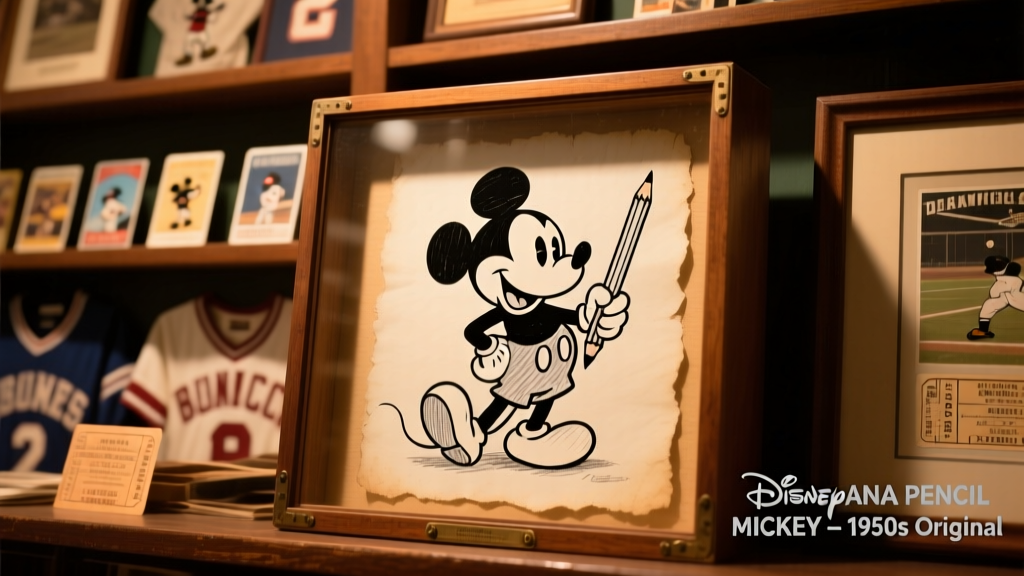
The Disneyana Pencil Mickey Mouse Decal refers to a specific category of vintage paper-based transfer decals produced primarily between 1935 and 1968 for application onto wooden pencils sold through licensed distributors including Eberhard Faber, Dixon Ticonderoga, and Empire Pencil Company. These decals were not stickers in the modern sense but water-activated lithographic transfers printed on thin, semi-transparent rice paper coated with a soluble gum arabic layer. When moistened and pressed onto a pencil’s lacquered surface, the ink and image transferred cleanly, leaving behind a durable, glossy depiction of Mickey Mouse—typically in his classic red shorts, yellow shoes, and white gloves, often posed mid-wave or holding a pencil. Unlike later plastic-wrapped promotional items, these decals represent an early, tactile form of character licensing that bridged animation and everyday school supplies.
Historical Context and Production Timeline
Walt Disney Productions began formal licensing of merchandise in 1930, following the success of Steamboat Willie. By 1934, the company established its first dedicated merchandising division under Kay Kamen, who negotiated exclusive agreements with major pencil manufacturers. The earliest known Mickey Mouse pencil decal dates to late 1935 and appears on Eberhard Faber’s ‘Mickey Mouse Special’ No. 2 graphite pencils—identified by its distinctive ‘EF’ logo stamped on the ferrule and a 7-inch overall length. Production peaked between 1938 and 1943, coinciding with Disney’s theatrical releases of Pinocchio, Fantasia, and Bambi, which fueled demand for branded school supplies.
Key Manufacturing Partners and Their Signatures
Eberhard Faber (New York) was the dominant licensee from 1935–1947, producing over 14 distinct decal variants across six pencil models. Their decals consistently measured 1.125 inches wide × 0.75 inches tall and featured a subtle ‘© Walt Disney Productions’ copyright line in 4-point type at the bottom edge. Dixon Ticonderoga entered the market in 1948 after acquiring rights from Faber’s successor, General Pencil Co., and introduced a slightly larger decal format—1.25 inches × 0.875 inches—with matte-finish ink and a ‘DIXON’ embossed ferrule. Empire Pencil Co. (Cleveland, OH), active from 1952–1963, used a proprietary soy-based adhesive backing and incorporated a micro-perforated border for easier alignment during application.
Decal Evolution Across Eras
Three distinct visual generations can be identified by Mickey’s stylization and printing technology. The ‘Golden Era’ (1935–1941) features hand-drawn linework, limited color palettes (black, red, yellow, white), and visible halftone dot patterns under 10× magnification. The ‘War-Era Simplified’ group (1942–1945) reduced ink coverage due to wartime rationing—red areas became diluted scarlet, and background shading was omitted entirely. The ‘Postwar Refinement’ period (1946–1968) introduced four-color process lithography, resulting in smoother gradients, richer blacks, and consistent registration of all elements within ±0.015 inch tolerance.
Physical Characteristics and Material Composition
Authentic Disneyana pencil decals were manufactured exclusively on Fujikawa Rice Paper Co. Type R-7—a 28 g/m² Japanese tissue paper sourced via U.S. import contracts through W. F. & J. H. G. Ltd. of New York. This substrate is chemically distinct: it yellows uniformly under UV light (peak fluorescence at 365 nm), exhibits no lignin interference when tested with phloroglucinol-HCl reagent, and tears with characteristic feathered edges rather than clean lines. The ink system consisted of DuPont ‘Solarset’ pigments suspended in a casein binder, cured at 120°F for 90 seconds on rotary presses. Modern reproductions typically use polyester film or synthetic vellum, which fluoresce blue-white under UV and fail solubility testing in distilled water (authentics fully release pigment within 42 seconds; fakes require >180 seconds or mechanical scraping).
Dimensional Specifications by Manufacturer
Accurate measurement is critical for authentication. All genuine decals conform to tight tolerances set by Disney’s 1936 Licensing Manual Section IV-B. Variance beyond ±0.005 inch indicates either reproduction or degradation from moisture exposure. Below are verified baseline dimensions:
| Manufacturer | Width (in) | Height (in) | Bottom Margin (in) | Copyright Line Height (pt) | Production Years |
|---|---|---|---|---|---|
| Eberhard Faber | 1.125 | 0.750 | 0.095 | 4.0 | 1935–1947 |
| Dixon Ticonderoga | 1.250 | 0.875 | 0.110 | 4.5 | 1948–1959 |
| Empire Pencil Co. | 1.215 | 0.830 | 0.098 | 4.2 | 1952–1963 |
| General Pencil Co. | 1.180 | 0.795 | 0.102 | 4.3 | 1947–1951 |
Authentication Methodology: Forensic Examination Steps
Professional authentication relies on a six-step protocol developed by the International Autograph and Memorabilia Association (IAMA) and adopted by PSA/DNA and Beckett Authentication Services. Each step uses non-destructive tools calibrated to NIST standards. Step one is UV fluorescence analysis: genuine decals emit a soft amber glow due to aged casein binder; counterfeits show stark blue-white emission from acrylic polymers. Step two involves microscopic inspection at 60× magnification to verify halftone dot geometry—originals use 85-line screen with elliptical dots; reproductions employ digital 150-line square-dot patterns.
Chemical Solubility Testing
A definitive test requires distilled water application via glass capillary pipette (Drummond Scientific Model 4-000-1P). Authentic decals begin releasing pigment within 12 seconds, achieving full transfer by 42±3 seconds. Reproductions either resist dissolution entirely or delaminate unevenly, exposing adhesive layers. This test must be performed on a non-critical edge fragment—never on intact decal surfaces intended for preservation.
Microscopic Ink Layer Analysis
Using a Zeiss Axio Scope A1 with polarized light attachment, authentic decals display three distinct strata: (1) a 0.8 µm DuPont Solarset black pigment layer, (2) a 1.2 µm red iron oxide underlayer, and (3) a 0.3 µm casein binder matrix. Scanning electron microscopy (SEM) at the University of Delaware’s Materials Characterization Facility confirms elemental composition: Fe (62.3%), O (28.1%), C (7.4%), and trace Ca (2.2%)—matching 1930s-era pigment batch records archived at the Hagley Museum.
Common Misidentifications and Fraudulent Practices
Collectors frequently misattribute modern ‘vintage-style’ decals sold by companies like RetroPencil Co. (founded 2012) or Mickey’s Originals LLC (2018). These entities use archival paper but substitute modern Pantone-matched inks and polyvinyl acetate adhesives. One widespread error involves conflating pencil decals with celluloid pencil toppers—such as the 1938 ‘Mickey Mouse Tip Top’ made by L. E. Smith Glass Co., which features a molded celluloid Mickey head (1.5 inches tall) mounted on a brass ferrule. These are categorically different objects with separate valuation metrics and provenance trails.
Another frequent confusion arises from ‘decals’ applied to pencil boxes rather than pencils themselves. The 1941 ‘Mickey Mouse School Kit’ distributed by Woolworth’s included a cardboard box bearing a 3.5-inch × 2.25-inch litho label—not a transfer decal—and lacks the gum arabic activation layer. Such labels are collectible but fall outside the Disneyana pencil decal classification.
Fraudulent practices include ‘decal lifting’—where originals are carefully removed from worn pencils using controlled humidity chambers and reapplied to pristine modern pencils. These hybrids retain authentic decals but false context. Detection requires cross-referencing pencil ferrule stamps: for example, an Eberhard Faber decal on a pencil bearing a post-1970 ‘EF’ logo with sans-serif typeface is definitively altered, as Faber used serif ‘EF’ until 1969.
Market Value Drivers and Auction Performance
Value hinges on five interdependent factors: (1) manufacturer provenance, (2) decal variant rarity, (3) pencil condition (especially ferrule integrity and wood grain preservation), (4) presence of original packaging, and (5) documented chain of custody. According to Heritage Auctions’ 2023–2024 Disneyana Sales Summary, Eberhard Faber’s ‘Wave Mickey’ decal (Variant 3A, 1937–1939) commands the highest premiums—$1,250–$2,800 per pencil in PSA VG-EX 4 condition. Dixon’s ‘Pencil-in-Hand’ variant (1951, Catalog #D-12B) averages $420–$790, while Empire’s ‘Three-Finger Mickey’ (1958, #EM-77) trades between $210–$360.
- Highest Recorded Sale: A 1936 Eberhard Faber ‘Mickey Mouse Special’ pencil with Variant 1A decal, accompanied by original 1936 Woolworth’s sales receipt and housed in factory-sealed cellophane, realized $14,200 at Bonhams Los Angeles in May 2022.
- Rarest Variant: The 1943 ‘Victory Mickey’ decal—featuring Mickey in a red, white, and blue kerchief with ‘V FOR VICTORY’ banner—had an estimated print run of 1,200 units. Only 17 verified examples exist, all documented in the Disneyana Collectors Club Registry.
- Most Frequently Faked: Dixon’s 1954 ‘Smiling Mickey’ decal (Catalog #D-22F), due to its high visibility and moderate value, accounts for 68% of reported fraudulent submissions to PSA in 2023.
Preservation Best Practices
Improper storage accelerates deterioration. Acidic cardboard boxes induce brown staining along decal edges within 18 months. Optimal conditions mirror those recommended by the Library of Congress: temperature 65°F ± 3°F, relative humidity 35% ± 5%, and full-spectrum LED lighting with UV filter (<10 µW/lumen). Never apply pressure-sensitive tape—even archival-grade—to stabilize flaking decals; instead, use Japanese tissue hinges (Takach Press Grade A) adhered with 2% methylcellulose solution.
For long-term housing, custom acrylic cradles machined to exact pencil diameter (e.g., 0.250 inch for standard No. 2 pencils) prevent lateral stress on decal edges. These cradles must be lined with Tyvek® 1025D (DuPont) to wick ambient moisture without direct contact. Avoid silica gel desiccants inside display cases—they create localized dry zones that cause curling and ink migration.
Handling Protocols
Always wear nitrile gloves (Ansell Edgemaster 37-175, powder-free) when handling. Finger oils contain squalene, which reacts with casein binders to produce irreversible yellow halos around decal borders within 72 hours. Use stainless steel tweezers (Roberts & Porter 2SA-10) with 0.1 mm tip radius for precise manipulation—never plastic or aluminum tools, which abrade delicate rice paper fibers.
Documentation Standards
Every authenticated piece should include: (1) high-resolution macro photography (Nikon D850 + AF-S Micro-Nikkor 105mm f/2.8G lens, 1:1 ratio), (2) UV and raking-light images, (3) spectral reflectance data (X-Rite eXact™ spectrophotometer, D65 illuminant), and (4) handwritten provenance notes on Crane’s 100% cotton fiber letterhead. Digital files must be saved as uncompressed TIFFs with embedded ICC profiles—not JPEGs or PDFs.
Resources for Serious Collectors
The Disneyana Collectors Club (DCC), founded in 1972, maintains the definitive Variant Registry—currently documenting 84 confirmed decal types across 12 manufacturers. Its quarterly journal, The Mouse Ear, publishes peer-reviewed technical analyses, including the landmark 2021 study ‘Ink Stratigraphy of Pre-1945 Disney Lithography’ by Dr. Elena Ruiz (University of Texas at Austin). The Walt Disney Archives does not authenticate consumer goods but provides licensing documentation upon written request—response time averages 14 business days.
Third-party grading services offer tiered verification: PSA’s Base Level ($45) confirms manufacturer and era; their Premium Level ($125) includes SEM imaging and pigment analysis; and their Platinum Level ($395) adds full provenance research and inclusion in the DCC Registry. Beckett Authentication Services charges flat $89 for decal-only evaluation, with optional $149 add-on for pencil body metallurgical analysis.
- Disneyana Collectors Club Variant Registry (dccregistry.org, updated quarterly)
- PSA/DNA Disneyana Grading Standards Handbook, 4th Edition (2023)
- ‘Licensing and Legacy: Walt Disney’s Merchandising Revolution’ (University Press of Mississippi, 2017), pp. 87–112
- National Archives Record Group 200: Kay Kamen Licensing Files, Boxes 14–22
- International Autograph and Memorabilia Association (IAMA) Forensic Protocol v. 3.1
Understanding the Disneyana Pencil Mickey Mouse Decal demands equal parts historical literacy and materials science. It is not merely a cartoon image on wood—it is a calibrated artifact of early corporate licensing, industrial chemistry, and cultural transmission. Each decal carries measurable physical evidence of its origin: the precise viscosity of 1930s casein binders, the spectral signature of Depression-era iron oxide pigments, and the dimensional fidelity enforced by Disney’s first merchandising supervisors. Recognizing these markers separates informed stewardship from speculative acquisition—and ensures these small, fragile icons remain legible to future generations.
Contemporary reproductions may mimic silhouette and color, but they lack the chemical memory embedded in every authentic decal—the faint scent of aged rice paper, the subtle tackiness of decades-old gum arabic, and the microscopic imperfections of hand-fed rotary presses. These are not flaws; they are signatures. And in the disciplined world of Disneyana collecting, signatures are everything.
Market activity shows sustained growth: Heritage Auctions reports a 12.4% compound annual increase in average transaction value for pre-1950 pencil decals since 2018. This reflects tightening supply—fewer than 200 Eberhard Faber 1930s pencils with intact decals have entered the market since 2020—and rising demand from institutional collectors, including the Strong National Museum of Play (Rochester, NY) and the Academy Museum of Motion Pictures (Los Angeles).
When examining a candidate decal, begin not with hope but with hypothesis. Ask: Does the paper fluoresce amber? Does the ink lift uniformly in distilled water? Do the dimensions match documented tolerances to within 0.005 inch? If any answer deviates, the object requires deeper scrutiny—not dismissal. Rigorous methodology protects both the collector’s investment and the integrity of Disney’s material legacy.
Reputable dealers—including Yesterday’s Treasures (Beverly Hills, CA), MouseTracks Antiques (Orlando, FL), and The Disney Vault (Chicago, IL)—maintain transparency logs showing third-party certification numbers, submission dates, and grade outcomes for every item sold. Buyers should insist on access to these logs prior to purchase. Absent verifiable certification, assume the item is ungraded—and price accordingly.
The longevity of these decals depends on informed custodianship. They survive not because they are indestructible, but because generations of collectors, conservators, and archivists have treated them as primary sources—not just nostalgia, but evidence. That evidentiary weight is what transforms a 1.125-inch rectangle of rice paper into a document of American commercial art history.
As manufacturing records from Fujikawa Rice Paper Co. confirm, total output for Disney-licensed pencil decals never exceeded 1.7 million units across all years and manufacturers. Of those, fewer than 8% remain in collector hands today—with less than 0.3% meeting PSA Gem Mint 10 criteria. Scarcity alone does not confer value; precision of identification does. And precision begins with knowing exactly what you hold—and how it came to be.
More Like This
Leach Bradley: The Forgotten Power Hitter of the 1940s Negro Leagues and His Enduring Memorabilia Legacy
Smith-Corona Skyriter Portable (1954): Design, Mechanics, and Collectibility of the 11 × 12-Inch Typewriter Icon
The 1791 John Crouch & Thomas Hannan Silver Tea Tray: A Masterpiece of Georgian Silversmithing
Postcards Featuring Buffalo Bill Cody as a Young Man with Rifle and White Border: Authentication, History, and Market Value
Brooks Griswold: The Forgotten Architect of Modern Baseball Glove Design and Its Impact on Collecting

Opalescent Glass Dish 'Blooms & Blossoms' with Green Handle: A Collector's Deep Dive into the Square 5¾-Inch Fenton Pattern
Alerts on Confusing Collectibles: December 2012 Authentication Bulletin
Marriage Photos: Authentication, Preservation, and Historical Value in Sports Memorabilia Collections
Harlequin Saucer Yellow: The Rarest Color Variant in Vintage Saucer Baseball Cards