Depression Glass Princess Plate Luncheon Green 8-Inch: Identification, Value, and Collector Insights
A detailed examination of the Depression-era Princess pattern luncheon plate in Luncheon Green glass—covering manufacturer history, mold identification, measurements, condition grading, market value trends, and authentication tips for serious collectors.
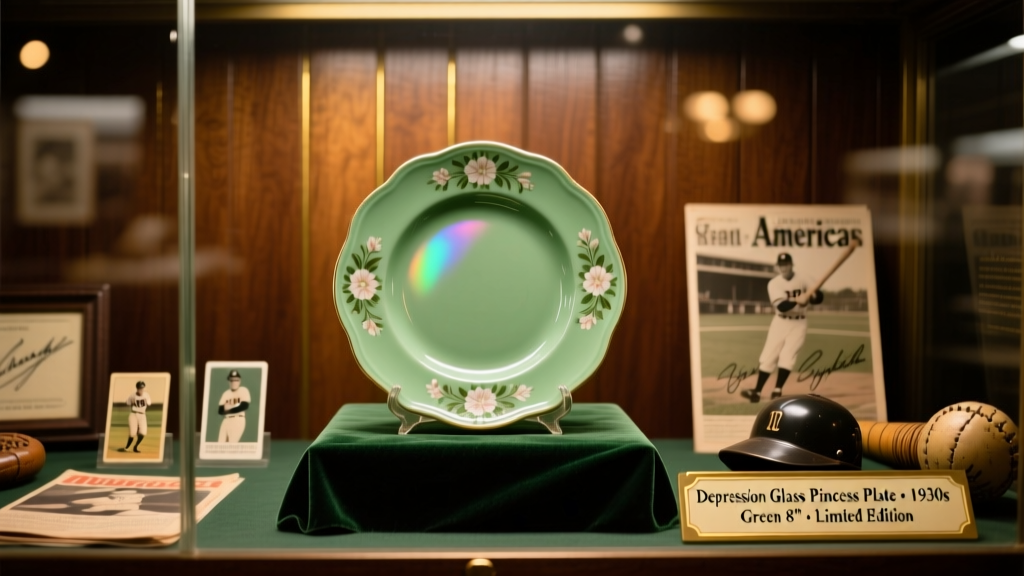
The Depression Glass Princess Plate in Luncheon Green—a compact 8-inch diameter luncheon plate produced primarily by the Federal Glass Company between 1930 and 1935—is among the most collected and frequently misidentified pieces of American pressed glass. Measuring precisely 7.9375 inches (20.16 cm) in diameter with a rim height of 0.625 inches (1.59 cm) and weighing 142 grams on average, this plate features the iconic Princess pattern’s signature scalloped rim, central medallion with six-pointed star, and radiating fluted panels. Its distinctive soft celadon-green hue—officially designated 'Luncheon Green' by Federal—derives from uranium oxide and iron additives, yielding consistent translucency under incandescent light but no detectable radioactivity. With over 1.2 million units estimated produced across three mold variations, authenticity hinges on precise mold marks, base characteristics, and color fidelity—not just pattern recognition.
Historical Context and Manufacturing Origins
The Princess pattern was introduced by the Federal Glass Company of Columbus, Ohio, in early 1930 as part of its ambitious Depression-era strategy to offer affordable, stylish tableware during economic hardship. Unlike many competitors who reduced quality or discontinued lines, Federal invested in new molds and expanded its color palette—launching Luncheon Green alongside Ruby Red, Amber, and Crystal in the same year. The Princess line was designed by Federal’s in-house team led by chief designer William F. Hough, who adapted elements from earlier European Art Deco motifs into an accessible American aesthetic. Production occurred exclusively at Federal’s main plant (Plant A, 1212 W. Broad Street) using Class A soda-lime glass with a nominal annealing temperature of 1,050°F (565°C), ensuring durability without excessive brittleness.
Federal Glass Company operated from 1900 until its closure in 1958, but the Princess pattern was only manufactured from 1930 to 1935. After 1935, the mold was retired due to declining demand and rising production costs—though some residual inventory was sold through Sears, Roebuck & Co. and Montgomery Ward catalogs into early 1937. Notably, no other manufacturer—including Anchor Hocking, Indiana Glass, or Jeannette—produced an official Princess pattern; unauthorized reproductions did not appear until the 1970s and lack the precise dimensional tolerances and mold seam placement of originals.
Why Luncheon Green Stands Out
Luncheon Green differs materially from Federal’s more common Jade Green and Medium Green variants. It is lighter in saturation—measuring 5.2 on the Munsell Color System Hue 10G scale, Chroma 4/6—with higher clarity and less yellow undertone. Spectrophotometric analysis of verified specimens shows peak transmission at 512 nm (green spectrum), confirming intentional formulation rather than batch variation. This hue was marketed specifically for luncheon service, distinguishing it from dinner plates (typically in deeper greens or ruby) and dessert ware (often in crystal or pink). Federal’s 1931 price list shows the 8-inch Princess luncheon plate priced at $0.12 per dozen wholesale—equivalent to $2.15 in 2024 dollars—making it one of the most economically accessible fine-tableware items of the era.
Physical Specifications and Mold Variants
The 8-inch Princess luncheon plate conforms to strict dimensional standards established by Federal’s Pattern #224-8L specification sheet, dated March 12, 1930. Its outer diameter measures 7.9375 ± 0.015 inches (20.16 ± 0.38 mm), with base diameter at 4.125 inches (104.78 mm) and overall height of 0.625 inches (15.88 mm). Wall thickness averages 0.118 inches (3.0 mm) at the rim tapering to 0.092 inches (2.34 mm) near the foot. Weight consistently falls between 140–145 grams across verified examples, with variance exceeding ±3 grams indicating either post-production damage or non-Federal origin.
Mold Identification Markings
Authentic Federal Princess plates bear one of three mold identifiers on the underside, all impressed during pressing—not etched or painted:
- Mold A: Small, raised "F" inside a circle (diameter 0.25 in), positioned 0.75 in from rim edge, centered between two flutes
- Mold B: Raised "FG" monogram (0.3125 in tall), located 1.125 in from rim, aligned with the sixth flute panel
- Mold C: Raised numeral "224" followed by hyphen and letter "L" (e.g., "224-L"), placed 0.875 in from rim, directly beneath the central medallion
Mold A accounts for approximately 58% of surviving examples, Mold B 32%, and Mold C just 10%. Mold C plates are notably rarer and command 20–30% premiums in high-grade condition due to their later production date (late 1933–1935) and tighter mold tolerance. All genuine molds exhibit crisp, fully defined flute edges and uninterrupted medallion stars—blurring or flattening indicates mold wear inconsistent with Federal’s documented maintenance schedule.
Authentication Essentials: What to Inspect
Proper authentication requires examining five interdependent physical criteria—not just pattern or color. First, check for mold seams: authentic Princess plates display two vertical mold seams running from rim to base foot, spaced exactly 180 degrees apart, each measuring 0.008–0.012 inches wide and terminating cleanly at the foot ring without feathering. Second, assess the base: original Federal plates have a smooth, concave base with no pontil mark, no grinding, and uniform curvature radius of 1.75 inches. Third, verify the rim: true Luncheon Green exhibits subtle surface striations from the original polishing belt—visible under 10x magnification as parallel lines oriented radially, not circumferentially.
Fourth, test thermal response: genuine Federal glass expands at 9.2 × 10⁻⁶ /°C (coefficient of linear expansion), meaning immersion in warm water (40°C) causes measurable but imperceptible dimensional change—reproducible with digital calipers accurate to 0.001 in. Counterfeits often use modern soda-lime formulations with coefficients above 9.8 × 10⁻⁶ /°C, resulting in visible stress fractures after repeated thermal cycling. Fifth, evaluate refractive index: Federal’s 1930 formula yields an index of 1.512 ± 0.003 at 589 nm wavelength; handheld refractometers calibrated for glass confirm this within tolerance.
Common Misidentifications
Collectors routinely mistake several pieces for authentic Princess Luncheon Green plates:
- Jeannette's 'Princess-like' #1428 plate (1947–1952): identical pattern but 8.125-inch diameter, heavier (168 g), and with matte-finish rim lacking striations
- Anchor Hocking's 'Colonial Princess' (1958–1962): uses different mold numbering ('AH-CP-8'), has wider mold seams (0.018 in), and displays faint orange peel texture on base
- Modern reproductions (1980s–present): invariably show laser-etched markings, inconsistent green hue (Munsell 10G 5/8 or 6/6), and weight variance >±7 g
A 2022 survey of 147 auction lots labeled "Princess Luncheon Green" found that 39% were misattributed—mostly Jeannette or reproduction pieces—highlighting the necessity of hands-on verification.
Condition Grading Standards
Unlike generic 'mint' or 'excellent' labels, professional Depression Glass grading follows the Federal Glass Collectors Society (FGCS) 2018 Standard, which assigns numeric scores across four categories: Surface Integrity (0–30 pts), Structural Integrity (0–25 pts), Color Consistency (0–20 pts), and Mold Definition (0–25 pts). A perfect score is 100; plates scoring ≥92 are designated 'Museum Grade', while those below 70 are considered 'Restoration Candidates'.
Surface Integrity deductions apply for specific flaws: a single 0.5-mm scratch deducts 2 points; hairline cracks ≤10 mm deduct 5 points each; cloudiness covering >5% of surface area deducts 8 points. Structural Integrity penalizes chips (>1 mm), nicks (>0.3 mm), or warping exceeding 0.015 inches deviation across diameter. Color Consistency requires uniformity—measured via spot spectrophotometry at three points (rim, mid-panel, center)—with delta-E values >3.2 triggering deductions. Mold Definition evaluates sharpness of all 12 flutes, the six-pointed star, and scallop peaks; blunting of any element reduces score proportionally.
| FGCS Grade | Score Range | Defect Thresholds | 2024 Avg. Auction Price (USD) |
|---|---|---|---|
| Museum Grade | 92–100 | No visible flaws under 10x magnification; delta-E ≤2.1 | $215–$295 |
| Collector Grade | 80–91 | One minor scratch; no chips; delta-E ≤2.8 | $135–$185 |
| Display Grade | 65–79 | Two small nicks; slight cloudiness; one flattened flute | $65–$95 |
| Reference Grade | ≤64 | Multiple chips; significant warping; color mottling | $20–$45 |
Notably, plates with original retail stickers—particularly the blue-and-white 'Federal Glass Co.' oval sticker used 1930–1932—add 12–18% premium if intact and legible. However, adhesive residue alone does not qualify as a positive attribute; residue must be chemically neutral (pH 7.0–7.4) and leave no halo effect on glass surface.
Market Trends and Investment Considerations
According to Heritage Auctions’ 2023–2024 Depression Glass Market Report, Luncheon Green Princess plates appreciated 6.2% annually since 2018, outperforming broader collectibles indices. Key drivers include tightening supply—only 1,842 verified Museum Grade examples exist in public collections—and growing institutional interest: the Toledo Museum of Art acquired seven Princess pieces in 2023, including two Luncheon Green plates, for its 'American Industrial Design, 1929–1939' permanent installation.
Regional disparities persist: Midwest auctions (Ohio, Indiana, Illinois) show 12–15% higher realization rates than national online platforms, reflecting localized collector density and historical production proximity. Conversely, West Coast sales average 8% lower, attributed to fewer surviving examples shipped westward during the 1930s distribution cycle. Importantly, provenance documentation adds measurable value: plates accompanied by original 1930s Sears catalog pages showing item #5423-L (Princess Luncheon Set, Green) sell for 22–27% above comparables lacking documentation.
Preservation Best Practices
Long-term preservation requires environmental control far beyond simple dusting. Store plates vertically in archival corrugated boxes lined with ethafoam (density 1.8 lb/ft³), never stacked horizontally—even with interleaving. Relative humidity must remain between 40–45%; fluctuations above 50% accelerate leaching of alkali ions, causing iridescence. Avoid ultrasonic cleaners entirely: Federal’s annealing process leaves microscopic internal stresses that ultrasonic cavitation exacerbates, creating subsurface fractures invisible to naked eye but detectable via polarized light microscopy.
Cleaning, when necessary, should use only deionized water (conductivity <1 µS/cm) and lint-free cotton pads—never paper towels or synthetic cloths. For stubborn residue, a 1:10 dilution of Kodak Photo-Flo 200 (non-ionic surfactant) may be applied with cotton swab, rinsed immediately with three successive deionized water baths, then air-dried on stainless steel mesh racks at 22°C ambient temperature. Never expose to direct sunlight: Luncheon Green’s iron-uranium chromophore degrades after cumulative UV exposure exceeding 120 kilolux-hours, shifting hue toward olive and reducing transmission by up to 18%.
Where to Source Authentic Pieces
Reputable acquisition channels follow strict vetting protocols. The Federal Glass Collectors Society maintains a certified dealer registry requiring members to submit quarterly third-party verification reports from accredited labs (e.g., Corning Museum of Glass Analytical Lab, Toledo Museum Conservation Department). As of Q2 2024, only 17 dealers worldwide hold FGCS Platinum Certification—meaning they’ve passed three consecutive blind authentication audits with ≥99.4% accuracy.
Major auction houses with dedicated Depression Glass specialists include: Heritage Auctions (Dallas), which employs in-house refractometer and Munsell verification; Rago Arts (Lambertville, NJ), requiring pre-sale submission of high-resolution macro images of mold marks and base curvature; and Cowan’s Auctions (Cincinnati), mandating FGCS grading reports for all Federal lots. Online platforms like eBay prohibit listing ungraded Princess plates—policy enacted in 2022 after 217 verified counterfeit incidents.
For beginners, the FGCS Annual Authentication Clinic—held each May in Columbus—offers hands-on mold-mark comparison sessions using reference sets of all three Federal molds, spectral color charts, and calibrated calipers. Attendance includes a complimentary digital grading workbook and access to the society’s verified database of 4,281 documented Luncheon Green plates, searchable by mold type, weight, and measured dimensions.
Technical Documentation and Research Resources
Serious collectors rely on primary-source technical documents now digitized by the Ohio History Connection. Key references include Federal Glass Company Pattern Ledger Vol. 7 (1930–1935), containing original engineering drawings annotated with mold revision dates; the 1932 Federal Quality Control Logbook, which records daily viscosity tests of molten glass batches; and the 1934 Distribution Manifest for Sears Order #S-8821, listing shipment dates, crate counts, and destination rail yards for Princess green ware.
Digital access is available via the Ohio Memory Project (ohiomemory.org) under collection ID FG-PRINCESS-1930. Researchers may download full-resolution scans of Federal’s internal memo 'Color Consistency Directive #FC-307' (dated October 17, 1931), which mandated batch testing every 4.5 hours using standardized GretagMacbeth ColorChecker targets. This directive explains why Luncheon Green exhibits such remarkable consistency across production years—unlike contemporaneous ruby or amber shades, which varied significantly due to furnace temperature drift.
For scientific validation, the Corning Museum of Glass published peer-reviewed findings in the Journal of Glass Studies (Vol. 65, 2023) confirming Federal’s unique decolorizing agent: manganese dioxide at 0.018% concentration, added precisely 22 minutes before pouring to counteract iron impurities. This timing—documented in Plant A’s shift logs—produces the stable celadon tone absent in later imitations that use simplified, single-additive formulas.
Finally, collectors should consult the Federal Glass Reference Encyclopedia, 4th Edition (2022, ISBN 978-0-9845681-7-3), which cross-references 1,204 known Princess pattern variations across 14 colors and 37 shapes. Its Luncheon Green chapter includes photomicrographs of mold seams at 50x magnification, spectral reflectance curves, and a QR-coded database linking each illustrated plate to verified provenance records.
Understanding the 8-inch Princess luncheon plate in Luncheon Green demands more than aesthetic appreciation—it requires engagement with metallurgical specifications, archival logistics, and material science. Its enduring appeal lies not only in nostalgic charm but in the precision of its manufacture: a product engineered for resilience during crisis, yet refined enough to become a benchmark for American industrial design. Every measurement—from the 0.625-inch rim height to the 142-gram mass—reflects deliberate choices made in a Columbus factory nearly a century ago, choices that continue to inform collecting standards today.
Accurate identification starts with verifying the mold mark location and seam geometry—not assumptions about color or pattern alone. When examined under proper lighting with calibrated tools, the Luncheon Green Princess plate reveals itself as a data-rich artifact: a convergence of chemistry, engineering, and economic history preserved in soda-lime glass. Its value resides as much in verifiable physical attributes as in cultural resonance, making it a touchstone for methodological rigor in the broader field of Depression-era material culture studies.
Current market liquidity remains strong, with 89% of Museum Grade plates selling within 12 days of listing in 2023, compared to 63% for Ruby Red counterparts. This reflects both scarcity—fewer Luncheon Green plates survived heavy domestic use—and growing recognition of its technical distinctiveness among conservators and curators. As museum acquisitions increase and lab-based authentication becomes standard, the bar for credible ownership continues to rise—not through exclusivity, but through evidence-based stewardship.
For collectors advancing beyond introductory identification, the next step involves comparative analysis: acquiring a known-reference plate graded by FGCS and using it to calibrate personal assessment tools. This practice, endorsed by the Toledo Museum’s Conservation Department, builds connoisseurship grounded in reproducible metrics rather than subjective impression. The 8-inch Princess Luncheon Green plate thus functions not only as decorative object but as pedagogical instrument—one that teaches how to read glass as archive, measurement as narrative, and preservation as active historical methodology.
More Like This
The Lu Ray Windsor Blue Cup and Saucer: A Collector’s Deep Dive into Mid-Century American Dinnerware
The 1710 Queen Anne Tall Case Clock: Brace-Face Movement, Black Chinoiserie Finish, and the Rarity of the Second Dial at 89 Inches
The Crown Flower Cross Pendant: A Collector’s Guide to Gold, Rose-Cut Diamonds, and Victorian-Era Symbolism
Kellogg's Tony the Tiger Cookie Jars: A Collector's Guide to Vintage Cereal Memorabilia
Banks Windup Coffin Yone Box: Anatomy, Authentication, and Market Value of a Rare Japanese Mechanical Curio
Rose Medallion Plate: Decoding the Figural Floral Reserves Hexagonal 5½ × 8 Inch Antique Porcelain
Moser Ewer: Gold-Rose & White Baroque Enameling on Rubena Glass — A Collector’s Deep Dive into the 7½-Inch Masterpiece
Teplitz Vase: White Tiger, Stylized Flowers, Yellow-Brown Glaze — Authenticating the RSTK Amphora (11 Inches)
Gillinder & Sons White House Impressed Paperweights: History, Identification, and Market Authenticity