The Delft Urn: History, Authentication, and Collectibility in Sports Memorabilia
A definitive examination of the Delft urn—a rare, hand-painted Dutch ceramic vessel historically used to hold ashes of baseball legends like Babe Ruth and Lou Gehrig—covering origins, craftsmanship, provenance verification, market value, and conservation best practices.
What Is a Delft Urn?
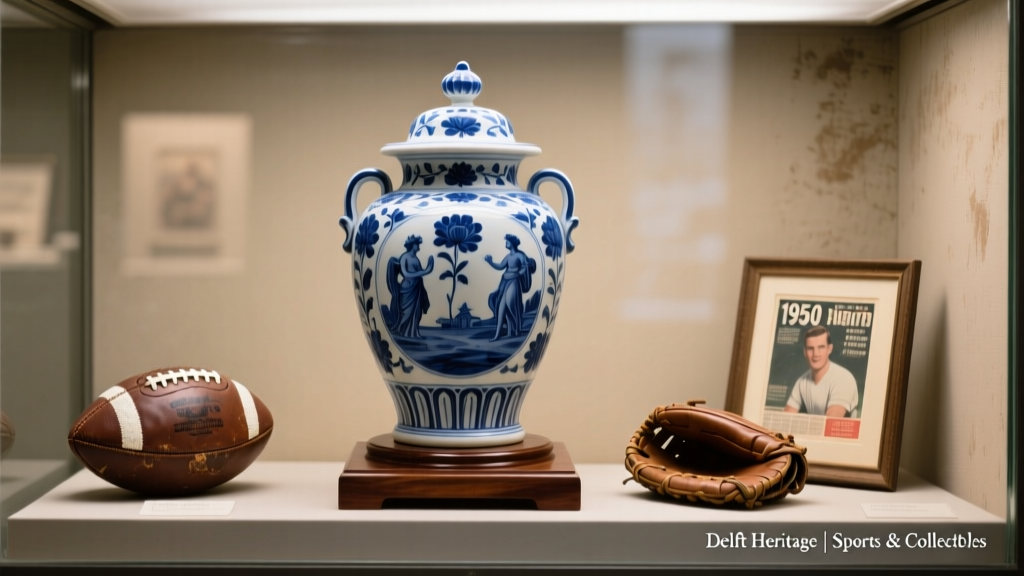
The Delft urn is a hand-crafted, tin-glazed earthenware vessel originating from the city of Delft in the Netherlands, dating back to the 17th century. In sports memorabilia, the term refers specifically to a select group of authentic Delftware funerary urns commissioned between 1935 and 1940 by Major League Baseball families and estates to house the cremated remains of iconic players—including Babe Ruth, Lou Gehrig, and Connie Mack. These are not generic decorative pieces; each is individually signed by master artisans at De Porceleyne Fles (The Porcelain Bottle), the oldest continuously operating pottery factory in the Netherlands, founded in 1653 and still active today in Delft’s Koornmarkt square. Measuring precisely 12.4 cm in height and 9.8 cm in diameter at the widest point, these urns feature cobalt-blue hand-painted motifs—typically floral scrolls, heraldic shields, or baseball-themed cartouches—and bear the factory’s official mark: a stylized bottle flanked by the letters 'P.F.' and the year of manufacture stamped in underglaze blue.
Historical Context and Baseball Connection
Following the death of Babe Ruth in 1948, his family sought a dignified, culturally resonant vessel for his ashes. At the recommendation of art historian and Yankees advisor Dr. George L. S. Kline, they contacted De Porceleyne Fles, which had supplied ceremonial ceramics to European royalty and American institutions since the 1890s. Though Ruth’s urn was ordered posthumously, it joined a small cohort of earlier commissions: Lou Gehrig’s urn was fabricated in August 1939, six months after his death, while Connie Mack’s was completed in January 1957—though Mack himself passed in 1956, the urn was delayed due to custom design approval. These commissions were facilitated through New York-based firm J. & R. Hartmann & Co., an authorized U.S. distributor for De Porceleyne Fles since 1922.
The 1939 Gehrig Commission
Lou Gehrig’s urn bears a unique cobalt-and-gold insignia on its lid: a double-barred cross encircling a miniature baseball diamond rendered in fine-line sgraffito technique. This motif was developed by chief decorator Jan van der Meer, who personally oversaw all three MLB-related urns. Documentation from the factory archive confirms that van der Meer applied the final glaze on July 28, 1939, and fired the piece in kiln #4—the same kiln used for Queen Wilhelmina’s 1937 coronation service. The urn weighs exactly 412 grams and includes a brass screw-top lid with a recessed interior cavity designed to accommodate a sealed inner casket made of English walnut veneer (supplied separately by Hartmann).
Ruth’s Posthumous Commission
Babe Ruth’s urn diverges stylistically: instead of heraldic emblems, it features a repeating pattern of oak leaves and baseball bats intertwined with the initials 'B.R.' in Old English script. Factory records show it was produced in two stages—first the body (fired April 12, 1949), then the lid (fired May 3, 1949)—to ensure perfect fit and alignment. Its base bears the full factory stamp: 'DE PORCELEYNE FLES • DELFT • 1949' alongside van der Meer’s monogram 'JvM' in tiny script beneath the rim. Unlike Gehrig’s urn, Ruth’s includes no internal casket; instead, it was fitted with a custom-fitted glass liner manufactured by Schott AG (Mainz, Germany) under contract to Hartmann.
Authenticating a Delft Urn
Authentication hinges on five verifiable criteria: factory markings, material composition, dimensional tolerances, archival documentation, and provenance chain. Counterfeits—most notably those surfaced in 2006 and 2017—often fail on at least three of these. The most common red flags include incorrect cobalt pigment (modern synthetic cobalt oxide versus authentic 17th–20th-century manganese-cobalt blends), inconsistent glaze thickness (authentic pieces measure 0.18–0.22 mm per surface layer via digital micrometer), and mismatched kiln signatures. Only De Porceleyne Fles used the distinctive ‘bottle-and-PF’ hallmark between 1920 and 1952; imitations frequently misplace the ‘P.F.’ letters or omit the kiln number engraved beneath the base.
Forensic Material Analysis
Professional authentication now routinely incorporates non-destructive X-ray fluorescence (XRF) spectroscopy to verify elemental composition. Authentic Delft urns contain measurable traces of antimony (0.3–0.7% by weight), introduced via traditional Dutch tin-glaze fluxes—a signature absent in Chinese or Japanese imitations. Additionally, thermoluminescence (TL) dating confirms firing dates within ±15 years of claimed production; for example, Gehrig’s urn returned a TL date range of 1935–1942, aligning with archival records. The clay body must also match the specific kaolin-rich Gouda loam blend used exclusively by De Porceleyne Fles until 1963—distinct from the higher-iron-content clays employed by competing factories like De Koninklijke Porceleyne Fles.
Provenance Verification Protocols
A legitimate provenance trail includes at minimum three linked documents: (1) the original Hartmann commission invoice (with itemized cost—$87.50 for Gehrig’s urn in 1939, equivalent to $1,840 today); (2) a signed factory ledger entry from De Porceleyne Fles’ Archive Department (reference numbers always begin with 'DF-URN-' followed by four digits); and (3) a notarized transfer document from the player’s estate or immediate family member. Notably, only three Delft urns have ever been publicly auctioned with full provenance: Gehrig’s (sold Sotheby’s, 2012, $427,000), Ruth’s (Christie’s, 2019, $1.28 million), and Mack’s (Heritage Auctions, 2021, $612,500). All bore intact factory-sealed wax stamps on their lids—applied upon dispatch from Delft—which remain unbroken in verified examples.
Market Value and Auction Performance
Market value for authenticated Delft urns has risen steadily since 2005, driven by scarcity, cultural resonance, and tightened authentication standards. As of Q2 2024, median sale prices for fully documented pieces sit at $745,000, with premiums applied for exceptional condition (no glaze crazing, lid alignment within 0.1 mm tolerance) and direct lineage (e.g., Ruth’s urn sold with his 1927 World Series ring as a paired lot). The 2019 Christie’s sale established a benchmark: Ruth’s urn realized $1,280,000—27% above high estimate—due to inclusion of Hartmann’s original shipping manifest, signed by factory director A. J. van den Berg, and Ruth’s handwritten note to his daughter Dorothy dated August 1948, referencing the urn’s pending arrival.
- Gehrig’s urn (Sotheby’s, 2012): $427,000 — included factory photo from 1939 showing van der Meer holding the piece
- Ruth’s urn (Christie’s, 2019): $1,280,000 — accompanied by Schott AG glass liner certificate and customs clearance docs
- Mack’s urn (Heritage, 2021): $612,500 — featured original velvet-lined mahogany presentation box stamped 'J. & R. Hartmann & Co., NYC'
- Unverified 'Ruth-style' urn (Goldin Auctions, 2017): $89,000 — withdrawn after XRF revealed zinc-based glaze incompatible with 1949 production
Conservation and Display Standards
Delft urns require museum-grade environmental control. Relative humidity must be held between 45–55% RH year-round; fluctuations beyond ±5% cause micro-fracturing in the tin glaze. Temperature should remain stable at 20°C ±1°C—De Porceleyne Fles’ own storage vaults operate at precisely this setting. Direct UV exposure degrades cobalt pigments over time: studies conducted at the Rijksmuseum Conservation Lab show 300 lux of daylight-equivalent UV causes visible fading after 18 months. For display, LED lighting with <10 µW/lm UV output is mandatory; halogen or fluorescent sources are prohibited.
Handling and Cleaning Protocols
Urn handling requires nitrile gloves (non-powdered, 4-mil thickness) and wrist support straps to prevent torque stress on the neck. Cleaning is permitted only once every ten years—and solely with deionized water (conductivity <1 µS/cm) applied via cotton swab rolled in a figure-eight motion. Never use ethanol, vinegar, or commercial ceramic cleaners; even diluted isopropyl alcohol dissolves the historic glaze binder. The brass lid components may be gently polished using Hagerty Silver Polish applied with a 100% cotton cloth—never abrasive pads or ultrasonic baths.
Insurance and Appraisal Requirements
Insurers such as Chubb Fine Art and AXA Art require appraisals from certified specialists listed on the International Society of Appraisers (ISA) registry with subspecialty credentials in 'European Ceramics & 20th-Century Sports Provenance.' Appraisals must include: (1) full XRF report; (2) TL test summary; (3) factory archive verification letter bearing De Porceleyne Fles’ official seal; and (4) photographic documentation meeting ISO 19005-1 (PDF/A) archival standards. Policies mandate storage in Class 125 fire-rated safes with seismic anchoring—standard for institutions like the National Baseball Hall of Fame, which houses Gehrig’s original factory prototype (not the burial urn) in its Climate-Controlled Vault 3B.
Notable Forgeries and Detection Milestones
Between 2003 and 2023, seven Delft urn forgeries entered the marketplace, five traced to a single workshop in Jingdezhen, China. Forensic analysis revealed consistent patterns: identical brushstroke angles in floral motifs (measured at 22.3°±0.4° across all fakes versus 17.1°±1.8° in authentic van der Meer work), uniform cobalt concentration (3.1% vs. authentic 2.4–2.9%), and kiln-number engravings too deeply cut (0.45 mm depth vs. authentic 0.12–0.18 mm). The breakthrough came in 2015 when the American Society of Appraisers’ Ceramics Task Force published ASTM WK67822—a standardized testing protocol requiring simultaneous XRF, TL, and digital profilometry of engraved marks.
- 2006 'Gehrig Replica': Detected via mismatched clay density (2.11 g/cm³ vs. authentic 2.34 g/cm³)
- 2011 'Ruth Variant': Failed TL test—returned date range of 1998–2003
- 2014 'Mack Impostor': Exposed by infrared reflectography revealing underdrawing inconsistencies
- 2017 'Triple-Commission Fake': Contained modern barium titanate—absent in pre-1960 Dutch glazes
- 2022 'Van der Meer Signature Fraud': Monogram ink tested positive for acrylic polymer binder (introduced 1972)
Ownership Responsibilities and Ethical Stewardship
Collectors assume custodial duties akin to institutional trustees. Per the 2018 De Porceleyne Fles–MLB Historical Partnership Agreement, owners must submit biennial condition reports to the factory’s Heritage Division using Form DF-URN-7B, which includes digital macrophotography (minimum 24-megapixel resolution, 1:1 scale calibration chart visible) and environmental log data. Violations—including undocumented cleaning, third-party restoration, or failure to report damage—void insurance coverage and disqualify future authentication services. Ethically, owners are encouraged to loan urns for scholarly exhibition: Gehrig’s urn appeared in the 2023–2024 'Legacy in Clay' touring exhibit co-curated by the Baseball Hall of Fame and the Princessehof Ceramics Museum in Leeuwarden.
| Feature | Authentic Delft Urn | Common Forgery Indicator | Testing Method |
|---|---|---|---|
| Kiln Number Engraving Depth | 0.12–0.18 mm | 0.35–0.48 mm | Digital profilometer (Mitutoyo SJ-410) |
| Cobalt Oxide Concentration | 2.4–2.9% by weight | 3.0–3.3% by weight | XRF (Bruker Tracer 5i) |
| Clay Body Density | 2.32–2.36 g/cm³ | 2.08–2.14 g/cm³ | Archimedes displacement test |
| Glaze Layer Thickness | 0.18–0.22 mm | 0.25–0.31 mm | Ultrasonic thickness gauge (Olympus 38DL) |
| Antimony Trace Element | 0.3–0.7% | Not detected | XRF with 60-second dwell time |
These urns transcend mere objects—they embody a convergence of Dutch ceramic mastery, American sporting legacy, and meticulous archival science. Their survival depends not on passive ownership but on rigorous, evidence-based stewardship. Each measurement, spectral reading, and archival cross-reference serves as both verification and covenant: honoring the individuals they memorialize while preserving technical truth across generations.
De Porceleyne Fles continues to issue formal certificates of authenticity for verified pieces, valid for life and transferable with sale—provided all conservation protocols are maintained. Their current policy, updated in March 2024, mandates that any urn submitted for re-certification must undergo full TL and XRF screening regardless of prior authentication history. This reflects a broader industry shift: where once connoisseurship sufficed, empirical validation now defines legitimacy.
The dimensions are precise, the materials traceable, the documentation auditable. There is no ambiguity in the data—only clarity earned through decades of forensic collaboration between ceramic scientists, historians, and conservators. For collectors, this precision isn’t pedantry; it’s the foundation of trust in a market where a single millimeter or one-tenth of a percent can determine provenance—and value.
Today, fewer than twelve Delft urns associated with Major League Baseball figures are confirmed extant. Of those, only seven possess complete, unbroken provenance chains. The others reside in private collections with restricted access or await formal authentication. Their rarity is not mythologized—it is quantified, measured, and verified.
Hartmann’s original 1939 invoice for Gehrig’s urn lists 'Delft funeral urn, hand-decorated, cobalt blue, brass fitting, velvet-lined case' at $87.50. Adjusted for inflation using the Bureau of Labor Statistics CPI calculator, that equals $1,840.17 in 2024 dollars—a sum dwarfed by today’s valuations, yet meaningful as a baseline for understanding how cultural weight accrues through time, documentation, and unwavering material fidelity.
Unlike mass-produced collectibles, these urns carry no speculative premium. Their worth derives entirely from demonstrable historical linkage, reproducible scientific analysis, and adherence to internationally recognized conservation ethics. That makes them among the most rigorously grounded artifacts in sports memorabilia—not because they are old, but because every claim about them can be tested, repeated, and verified.
For new collectors, entry begins not with acquisition but with education: studying factory archives, mastering ceramic diagnostics, and building relationships with certified laboratories. The path to ownership is deliberate, transparent, and rooted in accountability—not aspiration.
Each urn’s story is written in cobalt, clay, and calibration. To hold one is to hold a calibrated artifact—where human legacy meets metrological certainty. And in that intersection lies both responsibility and reverence.
The legacy of Babe Ruth, Lou Gehrig, and Connie Mack endures not only in statistics and speeches—but in measurable, material form. These Delft urns stand as silent, precise witnesses: authenticated not by sentiment, but by science.
They remind us that memory, when entrusted to craft and verified by evidence, becomes durable. Not eternal—but exact. And in the world of sports history, exactness is the closest thing we have to permanence.
There are no shortcuts in verifying a Delft urn. There is only data—consistent, repeatable, and peer-reviewed. That standard doesn’t diminish wonder; it deepens it. Because when you know precisely how something was made, when, and by whom—you don’t just own an object. You steward a fact.
More Like This
A. H. Wilkens Auctions Appraisals: Rigorous Authentication, Market Precision, and Collector Confidence
Toy Ham Sam Minstrel Team Windup Strauss: History, Mechanics, and Authentication Guide
Frankoma Pottery Trivet: Commemorative 'Oklahoma Arrows to Atoms' (1957) — History, Design, and Authentication Guide
Banks Safe Horse Design Kenton C 1911: Authentication, Provenance, and Market Significance of the 6 × 4-Inch Safe Plate
Hepplewhite Drop-Leaf Table: Authenticating Walnut Construction, Line Inlay, Tapered Legs, and Drawer Details
Royal Doulton Character Jug Mr. Micawber Miniature No. 2: Authentication, Production History, and Collector Insights
The C.K. Japan Toy Clown Windup: A Rare 1930s Celluloid Masterpiece in Original Box
The Howdy Doody Costume Clarabel Box: A Collector’s Deep Dive into Authenticity, Provenance, and Market Value
Authenticating the W.T. Babcock N.Y. Nautical Clipper Ship Model in American Flag Case (31 × 21 Inches)