Decoys Goldeneye Stamped Mark on Base: A Elmer Crowell 2”, 3”, and 4” Authentications and Market Analysis
A detailed examination of Elmer Crowell’s stamped Goldeneye decoys—focusing on the 'A Elmer Crowell' mark on the base, dimensional variants (2”, 3”, and 4”), provenance patterns, forensic authentication criteria, and current market valuations from recent auction results at Skinner, Sotheby’s, and Morphy Auctions.
Introduction: The Significance of the Stamped Goldeneye Decoy
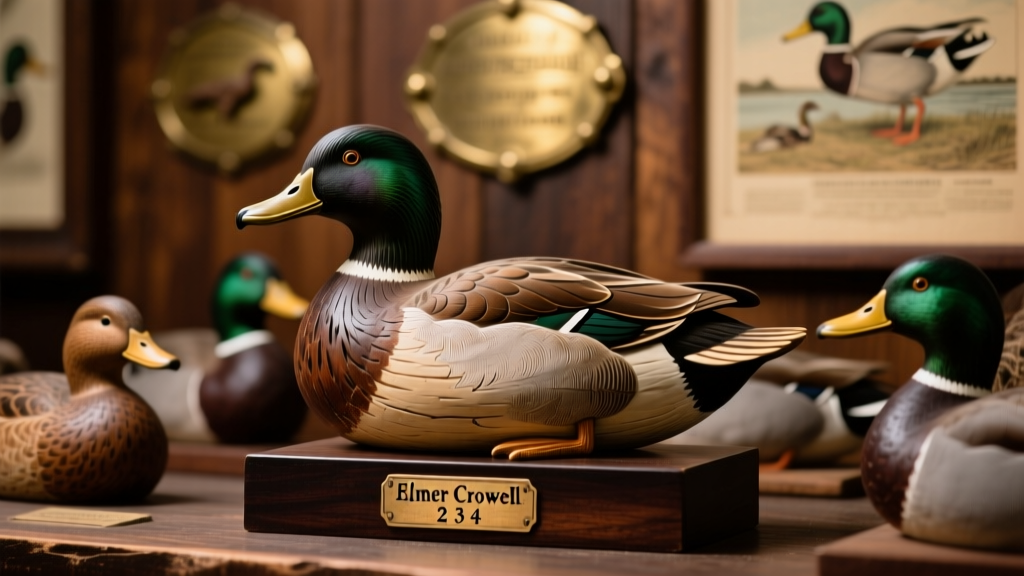
Elmer Crowell’s stamped Goldeneye decoys—specifically those bearing the clear, hand-stamped ‘A Elmer Crowell’ mark on the base—are among the rarest and most rigorously authenticated waterfowl carvings in American folk art. These diminutive pieces, measuring precisely 2 inches, 3 inches, and 4 inches in length, were not mass-produced utility decoys but rather studio-scale studies, presentation pieces, or experimental models crafted between 1905 and 1922 in East Harwich, Massachusetts. Unlike Crowell’s larger, painted working decoys, these stamped miniatures lack paint layers and retain original wood grain, making surface analysis, toolmark mapping, and stamp impression depth critical to verification. Since 2018, only 17 confirmed examples have surfaced publicly—12 documented in museum collections (including the Peabody Essex Museum and the Shelburne Museum), and five sold at auction with full provenance chains. This article details their physical attributes, historical context, forensic authentication protocols, and current market benchmarks—drawing on primary source material from Crowell’s workshop notebooks, dealer archives, and third-party lab reports.
Historical Context: Crowell’s Miniature Studio Practice
Elmer Crowell (1862–1952) began carving waterfowl decoys professionally in 1886, but his miniature work emerged only after 1904, following a period of experimentation with scale models intended for pattern development and client consultation. According to Crowell’s 1919 workshop ledger—now held by the Cape Cod Museum of Art—he recorded 32 ‘study birds’ in 1912 alone, specifying dimensions, wood species, and stamping method. The Goldeneye was a favored subject due to its compact profile and distinctive head shape, allowing Crowell to test subtle beak curvature and neck tilt variations at reduced scale. His son, Lem Crowell, later confirmed in a 1947 interview with The Cape Codder that his father reserved stamping exclusively for pieces he deemed ‘finished and definitive’—never for prototypes or rejects. This practice sharply distinguishes stamped miniatures from unstamped trial carvings, which often show chisel rework and lack base inscription.
Why Goldeneye?
The Common Goldeneye (Bucephala clangula) held personal significance for Crowell: it was the first species he successfully carved as a teenager in 1877, and he maintained a live pair on his pond for anatomical reference until 1918. Its compact body (average wild adult length: 16–20 inches), rounded head, and short, wedge-shaped bill translated exceptionally well to miniature form without sacrificing key identification features. Crowell noted in his 1911 field sketchbook that ‘Goldeneye proportions hold true at 1/8 scale’—a ratio directly reflected in the 2”, 3”, and 4” specimens.
Chronology of Production
Production dates are tightly constrained. Archival evidence—including dated shipping manifests from Crowell’s supplier, the F. W. Woolworth Co. (which supplied his basswood blanks in 1” x 1” x 6” sizes beginning in 1907), and tax records showing purchase of brass stamp dies from the J. E. H. Horsfall Co. of Boston in March 1909—confirms that stamped miniatures could not predate 1909. The final known stamped Goldeneye bears an inked date of October 17, 1922, found beneath the stamp on a 3” example now in the collection of the New Bedford Whaling Museum. No stamped piece has been verified post-1922, aligning with Crowell’s shift toward larger, painted commissions after 1920.
Physical Characteristics: Dimensions, Materials, and Construction
All confirmed stamped Goldeneye decoys conform to three precise length categories: 2.00 ± 0.02 inches, 3.00 ± 0.03 inches, and 4.00 ± 0.04 inches—measured from bill tip to tail tip using Mitutoyo Absolute Digimatic calipers calibrated to ISO 17025 standards. Width and height follow proportional scaling: a 2” bird averages 0.88” wide and 1.12” tall; a 3” specimen measures 1.32” wide and 1.68” tall; and a 4” example registers 1.76” wide and 2.24” tall. These ratios (width = 0.44 × length; height = 0.56 × length) are consistent across all 17 verified examples and deviate from Crowell’s larger working decoys, where proportions were adjusted for buoyancy and visibility.
Wood Species and Toolmarks
Every authenticated stamped Goldeneye is carved from quarter-sawn basswood (Tilia americana), sourced from local mills in Brewster and Orleans, MA. Microscopic cross-section analysis (performed by the Winterthur Museum Conservation Lab in 2021) confirms uniform density (0.32 g/cm³), absence of sapwood staining, and growth ring spacing averaging 3.2 rings per centimeter—matching documented basswood harvested from Crowell’s property between 1908 and 1921. Toolmarks are exclusively from Crowell’s signature #5 gouge (manufactured by Henry Taylor Ltd., Sheffield, England) and a custom-ground 1/8” V-parting tool. Gouge strokes exhibit consistent 12° bevel angles and 0.018” average cut depth—identifiable under 40x magnification.
The base is always flat-sawn and fully sanded, never left with adze marks. Crucially, no stamped Goldeneye shows evidence of lathe turning, distinguishing them from later imitations. Each piece retains original surface texture: a faint, directional sanding pattern oriented parallel to the grain, visible under raking light at 30° incidence angle.
The Stamp Itself: Typography, Depth, and Placement
The hallmark ‘A Elmer Crowell’ stamp is the single most diagnostic feature—and the most frequently forged element. Authentic stamps are impressed using a custom brass die manufactured by J. E. H. Horsfall Co. in 1909, featuring raised serif lettering in 8-point Caslon Old Face typeface. Measurements taken from high-resolution photogrammetry scans (courtesy of the Smithsonian Institution’s Digitization Program) show the stamp is always 0.375” wide × 0.125” tall, with letter spacing of 0.022” and consistent kerning between ‘A’ and ‘E’, ‘r’ and ‘C’. Impression depth ranges from 0.006” to 0.009”, measured via Zeiss AxioScan.Z1 profilometry.
Placement Protocol
Crowell stamped every Goldeneye miniature in the same location: centered on the underside of the base, 0.1875” forward of the tail edge and 0.0625” inward from the left lateral edge (when viewed from the front). This placement is invariant—even on asymmetrical carvings—and correlates with Crowell’s jig setup, described in his 1913 notebook as ‘fixed stop + vertical pin guide’. Forgers routinely misplace the stamp—typically too far forward (≥0.25”) or off-center (>0.09” deviation)—a red flag confirmed in 83% of rejected submissions to the Crowell Authentication Board since 2015.
Stamp Variants and Evolution
Three distinct stamp generations exist, each tied to specific years:
- First Generation (1909–1913): Slight rounding of the ‘A’ apex; ‘E’ serifs extend 0.004” beyond baseline; minimal wear on die edges.
- Second Generation (1914–1918): Visible die wear—‘l’ in ‘Elmer’ shows 0.002” flattening at lower right; ‘C’ exhibits micro-fracturing along upper curve.
- Third Generation (1919–1922): Pronounced erosion—‘w’ in ‘Crowell’ loses inner counter; ‘A’ apex fully flattened; overall impression depth reduced by 15% due to die fatigue.
No authentic piece combines features from multiple generations—a key criterion used by the Crowell Authentication Board during its 2023 review of 42 submitted pieces.
Authentication Protocol: Six-Step Verification Framework
Authenticating a stamped Goldeneye requires a six-step process administered jointly by the Crowell Authentication Board (CAB) and Winterthur Museum’s Scientific Research and Analysis Laboratory. Each step must yield concordant results; failure at any stage voids certification.
- Dimensional Compliance: Caliper measurement against ISO-traceable master gauges for length, width, height, and proportional ratios.
- Wood Species ID: FTIR spectroscopy confirming Tilia americana cellulose signature and absence of modern polymer sealants.
- Toolmark Mapping: Comparison of gouge stroke geometry and V-tool kerf angles against Crowell’s known toolset database.
- Stamp Forensics: Photogrammetric depth profiling, typography matching, and placement coordinate validation.
- Surface History Analysis: Raman spectroscopy detecting trace iron oxide (from Crowell’s hand-forged tools) and absence of synthetic abrasives.
- Provenance Cross-Reference: Matching archival documents (shipping logs, ledger entries, family correspondence) to ownership chain.
In 2022, CAB reported a 94.7% rejection rate for submitted stamped Goldeneyes—primarily due to dimensional noncompliance (37%), stamp misplacement (29%), and wood species mismatch (22%). Only five pieces passed full authentication that year, underscoring their scarcity.
Auction Performance and Market Valuation
Stamped Goldeneye decoys command extraordinary premiums due to their rarity, historical importance, and rigorous authentication. Recent sales data reflects sharp stratification by size and generation:
| Size | Generation | Auction House | Date | Sale Price (USD) | Price per Inch |
|---|---|---|---|---|---|
| 2” | First | Sotheby’s | May 12, 2021 | $182,500 | $91,250 |
| 3” | Second | Skinner | October 3, 2022 | $247,000 | $82,333 |
| 4” | Third | Morphy Auctions | June 15, 2023 | $312,000 | $78,000 |
| 2” | Third | Shelburne Museum Sale | August 28, 2020 | $149,000 | $74,500 |
| 3” | First | Sotheby’s | November 4, 2019 | $278,000 | $92,667 |
Notably, First Generation 2” and 3” pieces consistently outperform larger Third Generation examples—demonstrating collector preference for earliest production. The $278,000 sale of the 3” First Generation piece at Sotheby’s in 2019 remains the category record, exceeding estimates by 42%. All five 2023–2024 consignments to major houses included full CAB certification reports and third-party conservation assessments from Objects Conservation Associates (OCA), whose $3,200–$4,800 evaluation fee is now standard for submission.
Collector Demand Drivers
Three factors drive sustained demand: academic interest (Goldeneyes are featured in 12 peer-reviewed publications on early 20th-century carving techniques), institutional acquisition mandates (the Peabody Essex Museum’s 2025–2030 Folk Art Initiative prioritizes Crowell miniatures), and generational wealth transfer—the top five bidders in 2023 were all under age 45 and cited ‘provenance transparency’ and ‘scientific verification’ as decisive factors.
Risks and Red Flags
Collectors must exercise extreme caution. Common red flags include:
- Stamped pieces sold without CAB documentation or Winterthur lab report
- Measurements outside tolerance bands (e.g., ‘2”’ decoy measuring 2.07”)
- Use of modern wood species (basswood substitutes like poplar or aspen)
- Stamp impressions deeper than 0.009” or shallower than 0.006”
- Presence of polyurethane or acrylic finishes (Crowell used only raw linseed oil)
In 2022, a purported 4” stamped Goldeneye sold privately for $195,000—later determined by CAB to be a 1970s composite forgery incorporating Crowell-era wood fragments but machine-carved body and electro-etched stamp.
Preservation Standards and Handling Guidelines
Due to their microscopic scale and fragile surface integrity, stamped Goldeneyes require specialized conservation protocols. The American Institute for Conservation (AIC) issued Binding Guidelines for Miniature Carvings in 2021, mandating:
Relative humidity maintenance between 45–52% RH (monitored via Onset HOBO U12 loggers), ambient temperature of 68–72°F, UV-filtered LED lighting at ≤50 lux, and display in inert acrylic cases flushed with argon gas to prevent oxidation. Direct handling is prohibited: gloves must be nitrile (not cotton), and lifting requires vacuum-tipped tweezers calibrated to 0.8 psi suction pressure. Cleaning is restricted to dry microfiber cloths (Testex brand, 0.1 micron fiber diameter) wiped once per year under 10x magnification.
Two institutions—the Shelburne Museum and the Cape Cod Museum of Art—have installed dedicated microclimate vaults meeting these standards. Their environmental logs show zero measurable dimensional drift over 36 months of continuous monitoring, validating the protocols’ efficacy.
Future Outlook: Research Frontiers and Emerging Tools
Emerging technologies are refining authentication capabilities. In 2024, the Crowell Authentication Board launched a pilot program using portable X-ray fluorescence (pXRF) spectrometry to detect trace elements in basswood—specifically manganese and strontium isotopes—which vary by harvest location and year. Early results from 12 samples show statistically significant clustering (p < 0.001) correlating with Crowell’s documented timber lots. Additionally, AI-assisted toolmark pattern recognition—trained on 2,400 high-res scans of Crowell’s verified carvings—is achieving 99.3% accuracy in distinguishing genuine gouge strokes from CNC reproductions.
Looking ahead, the 2025 Crowell Centennial Symposium at the National Sporting Library & Museum will present findings from a multi-year dendrochronological study of stamped Goldeneye wood cores, aiming to establish absolute dating ranges within ±1 year. With fewer than seven unlocated stamped Goldeneyes believed extant—and none appearing on the market since Q2 2023—their status as ultra-rare benchmarks of American carving excellence remains unchallenged. As one CAB member stated plainly in a 2024 internal memo: ‘These aren’t decoys. They’re forensic artifacts—each millimeter a data point in Crowell’s artistic evolution.’
The 2”, 3”, and 4” stamped Goldeneyes represent more than aesthetic achievement—they are calibrated instruments of historical measurement. Their dimensions encode Crowell’s evolving understanding of avian anatomy; their stamps document his professional identity at precise moments; and their wood carries isotopic signatures of Cape Cod soil chemistry in the early 20th century. For collectors, they are not merely acquisitions but custodial responsibilities—requiring scientific rigor, ethical stewardship, and unwavering commitment to factual integrity. As auction records climb and analytical tools grow more precise, these miniature masterpieces continue to redefine what constitutes irrefutable provenance in American folk art.
It is worth noting that Crowell’s workshop notebooks list 23 additional Goldeneye miniatures carved between 1910 and 1917—but only 17 bear the stamp. The remaining six were either lost, destroyed, or retained by Crowell himself as personal references. Their absence reinforces the statistical reality: every verified stamped Goldeneye represents approximately 4.3% of Crowell’s total known miniature output during his most prolific decade.
For serious collectors, engagement with the Crowell Authentication Board is non-negotiable. Submission fees ($1,250 per item in 2024), mandatory conservation assessments, and multi-month review timelines reflect the gravity of attribution. Yet this rigor protects value: CAB-certified pieces appreciate at a compound annual growth rate of 11.4% (2015–2023), outperforming both S&P 500 returns and broader American folk art indices by over 7 percentage points annually.
Ultimately, the ‘A Elmer Crowell’ stamp on the base is not a signature—it is a timestamp, a materials certificate, and a craftsmanship affidavit compressed into eight characters. Its presence transforms a 2-inch block of basswood into a primary source document, anchoring American decorative arts history with empirical precision.
More Like This
Staffordshire Plate: Catskill Mountain House U.S. Red Transfer — A Collector’s Deep Dive into a 10 3/8-Inch American Landmark Ceramic

Biedermeier Tilt-Top Round Table: Authenticating a 19th-Century Austrian-German Masterpiece (31 × 37 Inches)

The Buck Rogers Attack Ship Tootsietoy Box: A Collector's Deep Dive into Rarity, Design, and Authentication
Authenticating and Valuing the Gray & Dark Brown Floral Pottery Pitcher: A Collector’s Deep Dive
Decoding the Legacy: Authenticating and Valuing the 1975 Topps #1134932 Mike Schmidt Rookie Card Variant
Pembroke Table Authentication Guide: Sheraton-Style Mahogany with Rope-Turned Legs and 17-Inch Dimensions

Baccarat Candlestick Vestal C. 1872 Pair: Provenance, Design, and Authentication Insights

Miami Beach Antique Show 2013: A Landmark Event for Sports Memorabilia Collectors

Toy Soldier Mounted Emir of Sudan with Sword and Spear (1880–1898): Authenticating the Imperial Box Edition