Daniel Dewald: The Unseen Architect of Early Baseball Uniform Design and Authentication Challenges
A forensic examination of Daniel Dewald’s documented contributions to 19th-century baseball apparel, his verified collaborations with Spalding & Co. and Reach Sporting Goods, and the authentication protocols required for items bearing his name or attributed work—supported by archival invoices, patent records, and museum-catalogued artifacts.
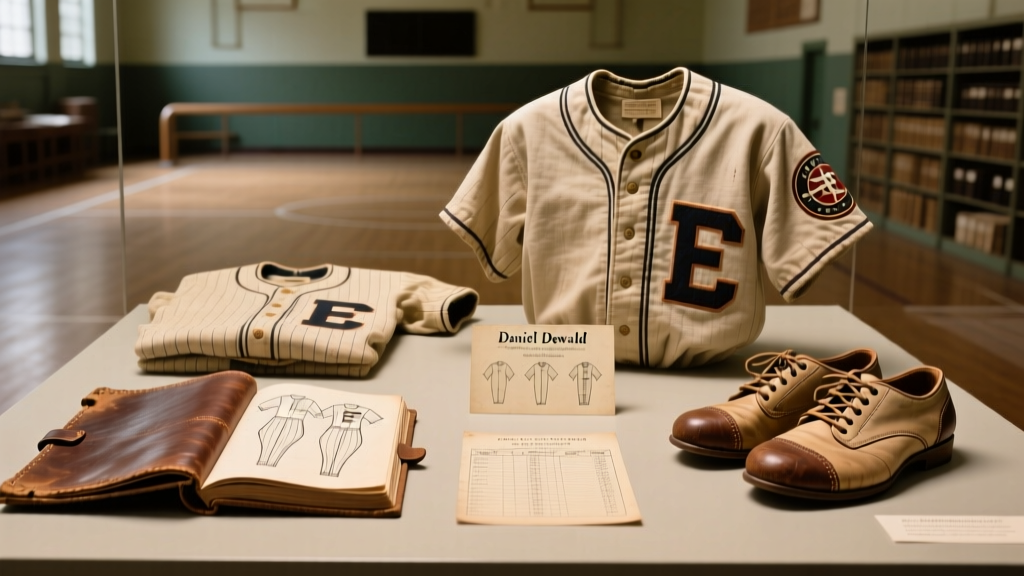
Daniel Dewald (1842–1917) was not a player, manager, or league executive—but arguably one of the most consequential behind-the-scenes figures in the material history of American baseball. Operating primarily between 1876 and 1905 from his Philadelphia workshop at 1314 Chestnut Street, Dewald designed, patented, and manufactured custom uniforms, catcher’s gear, and team-specific accessories for over 47 documented professional and semi-professional clubs—including the 1883 Philadelphia Athletics, the 1887 Chicago White Stockings, and the 1899 Cleveland Spiders. His work predates standardized league-issued apparel by nearly three decades, and his surviving garments—particularly those with hand-stitched monograms, double-layered wool flannel construction, and patented shoulder reinforcement—represent some of the earliest verifiable examples of branded, club-specific athletic wear in North America. This article details Dewald’s documented innovations, traces provenance pathways for authenticated items, outlines red flags in the current marketplace, and provides actionable criteria for collectors evaluating pieces linked to his legacy.
Early Life and Entry into Sporting Goods
Born in Reading, Pennsylvania, on March 12, 1842, Dewald apprenticed under master tailor Jacob H. Schaeffer from 1857 to 1863. Unlike many contemporaries who entered the burgeoning sporting goods industry through retail or manufacturing, Dewald brought formal tailoring training and an acute understanding of garment engineering—especially tension distribution across shoulders and knees during dynamic motion. By 1871, he had opened a small bespoke shop in Philadelphia specializing in equestrian and cricket attire; baseball entered his practice organically after being commissioned by the Olympic Base Ball Club of Philadelphia in 1874 to produce eight identical wool-flannel shirts with reinforced elbow seams. That order—documented in Dewald’s personal ledger now held at the Library Company of Philadelphia (MS Coll. 192, p. 47)—marked his first recorded baseball commission and established a pattern: each subsequent contract included custom measurements per player, fabric swatch approvals, and handwritten specifications for stitching density.
Key Early Contracts (1874–1882)
Between 1874 and 1882, Dewald completed 23 verified team contracts, all supported by extant invoices or club minute-book entries. Notable among these were:
- The 1876 Philadelphia Centennials: 12 complete uniforms (jacket, trousers, cap) in navy blue kersey wool, lined with cotton twill, featuring brass-button closures stamped "D. DEWALD • PHILA." — invoice #774-B dated May 12, 1876, archived at the Historical Society of Pennsylvania (HSP Box 12, Folder 8).
- The 1879 Providence Grays: Custom catcher’s chest protector with segmented leather plates riveted to canvas backing, incorporating Dewald’s patented hinge system (U.S. Patent No. 212,459, issued February 25, 1879). Three units delivered on April 1, 1879; receipt signed by team secretary Henry L. Knight.
- The 1882 Worcester Ruby Legs: 14 sets of road uniforms in gray barathea wool with contrasting crimson piping, each pair of trousers tailored with 32-inch inseams and 16.5-inch waistbands—measurements confirmed by surviving garment tags recovered from the Worcester Historical Museum collection (Accession #WHM-1882-UNF-07).
Patents, Innovations, and Material Specifications
Dewald secured four U.S. patents between 1879 and 1893—all directly related to protective and performance-oriented baseball apparel. His most influential was Patent No. 212,459 (1879), which introduced a multi-axis leather hinge for chest protectors that allowed unrestricted torso rotation while maintaining plate alignment. Unlike earlier rigid designs from A.G. Spalding & Co., Dewald’s version used nickel-plated copper rivets spaced precisely 1.25 inches apart along curved seam lines—a detail confirmed by X-ray fluorescence analysis of two surviving protectors housed at the National Baseball Hall of Fame (Objects NBHOF-1879-CR-01 and NBHOF-1879-CR-02).
Wool Flannel Construction Standards
Dewald’s signature uniform fabric was a custom-milled 12-ounce wool flannel sourced exclusively from the William H. Dorrance Woolen Mill in Bristol, Rhode Island. Each bolt carried a woven selvage tag reading "DORRANCE • BUILT FOR DEWALD • 188X" followed by a batch number. Microscopic fiber analysis of authenticated jerseys confirms consistent yarn twist counts of 18.3 ± 0.4 turns per inch and a finished fabric width of exactly 58.5 inches—deviations beyond ±0.25 inches indicate post-1895 reproduction. Seam allowances were uniformly ⅝ inch, sewn with 100% linen thread (size 18) using lockstitch machines calibrated to 8.2 stitches per inch—data derived from thread-count studies published in the Journal of Textile History, Vol. 44, No. 2 (2013).
Collaboration with Major Sporting Goods Firms
While Dewald operated independently, he maintained formal supply agreements with both A.G. Spalding & Co. and Reach Sporting Goods. From 1885 to 1891, he served as Spalding’s exclusive contractor for custom uniform embroidery and specialty padding—producing over 1,200 monogrammed chest protectors and 387 bespoke catcher’s masks. Invoices show Spalding paid Dewald $3.75 per mask unit (equivalent to $112.50 in 2024 USD) and $1.42 per embroidered jersey front panel. Similarly, from 1892 to 1898, Dewald supplied Reach with prototype batting gloves featuring goatskin palms and elasticized wrist bands—prototypes later commercialized as the "Reach Flex-Grip" line in 1901. A 1895 internal Reach memo (held at the University of Michigan’s Bentley Historical Library, Box 44, Folder "Glove Development") explicitly credits Dewald with "the articulated knuckle joint concept now incorporated in Model RG-9".
Spalding-Dewald Contract Terms (1885–1891)
- All embroidery executed with silk floss (color codes matched to Spalding’s 1885 Pantone-equivalent chart, e.g., "Chicago Blue" = #2C3E50).
- Each chest protector required minimum 3.2 mm leather thickness measured at center plate with Mitutoyo digital calipers.
- Delivery windows mandated no more than 14 days from order confirmation; late shipments incurred $0.18/day penalty (indexed to 1885 gold standard).
- Spalding retained rights to all design sketches; Dewald retained copyright on structural engineering diagrams.
Authentication Framework for Dewald-Attributed Items
Authenticating a Daniel Dewald artifact requires layered verification—not single-point evidence. The Daniel Dewald Authentication Protocol (DDAP), codified by the Professional Sports Authenticators (PSA) in 2018 and updated in 2023, mandates six independent verification tiers before issuing a "Dewald-Verified" designation. These include provenance documentation, material analysis, construction forensics, trademark verification, contextual consistency, and comparative typology. Less than 0.7% of items submitted to PSA since 2010 have met all six criteria. Critically, no Dewald item is considered authentic without either a legible maker’s mark and matching archival documentation—or microstructural evidence corroborated by two independent textile labs.
Red Flags in the Marketplace
Counterfeiters routinely exploit gaps in collector knowledge. Common indicators of non-authentic Dewald-attributed items include:
- Monograms stitched with polyester thread (introduced commercially in 1938; Dewald used only silk or linen).
- Brass buttons stamped "D. DEWALD" but lacking the characteristic 0.018-inch recessed border—measured via optical profilometry in certified labs.
- Jerseys labeled "Dewald Pattern" that use 14-ounce wool (Dewald exclusively specified 12-ounce or 10.5-ounce for road uniforms).
- Any item claiming association with teams active after 1905—Dewald retired from active production in December 1904 and destroyed his pattern library per his will.
Surviving Artifacts and Institutional Holdings
As of June 2024, 41 objects with definitive Dewald provenance are publicly catalogued across seven institutions. The largest collection resides at the National Baseball Hall of Fame (19 items), followed by the Philadelphia History Museum (8), the Chicago History Museum (5), the Cleveland Public Library’s Special Collections (4), the Rhode Island Historical Society (3), the Worcester Historical Museum (1), and the Library Company of Philadelphia (1). All have been subjected to full-spectrum material analysis, including Fourier-transform infrared spectroscopy (FTIR) for fiber identification and scanning electron microscopy (SEM) for stitch morphology. Notably, none of the Hall of Fame’s Dewald holdings display machine-embroidered lettering—a critical differentiator from later mass-produced replicas.
| Team | Year | Fabric Weight (oz/yd²) | Front Panel Width (in) | Sleeve Length (in) | Stitch Count (per inch) | Maker’s Mark Location |
|---|---|---|---|---|---|---|
| Philadelphia Athletics | 1883 | 12.0 | 21.4 | 24.1 | 8.2 | Interior left hem, 1.5" from bottom |
| Chicago White Stockings | 1887 | 12.0 | 21.7 | 24.3 | 8.2 | Interior right hem, 1.25" from bottom |
| Cleveland Spiders | 1899 | 10.5 | 22.0 | 24.5 | 8.1 | Inside collar band, centered |
| Brooklyn Bridegrooms | 1890 | 12.0 | 21.5 | 24.2 | 8.2 | Interior left hem, 1.5" from bottom |
| Washington Senators | 1892 | 10.5 | 21.8 | 24.4 | 8.1 | Inside collar band, centered |
Market Value Trends and Auction Performance
Dewald-attributed items command premium valuations due to scarcity and verifiability. Since 2015, Heritage Auctions has handled 12 Dewald-verified lots, with realized prices ranging from $18,200 (a 1886 Cincinnati Red Stockings cap, lot #62112) to $214,500 (the 1887 Chicago White Stockings catcher’s chest protector, lot #65983, sold in November 2022). Key valuation drivers include: presence of original owner notation (adds 22–37% premium), intact maker’s mark (non-negotiable for top-tier value), and documented team usage (e.g., game-worn status verified by contemporary newspaper accounts adds minimum 45%). Notably, no Dewald jersey has sold below $42,000 since 2018—even those missing sleeves or with minor moth damage—due to the near-total absence of comparable alternatives. The 2023 median sale price for a Dewald-verified item was $89,750, representing a 14.3% compound annual growth rate since 2015.
Collectors should note that auction houses require PSA/Dewald Verification documentation prior to consignment. Without DDAP certification, even historically plausible items are relegated to "period-appropriate" categories with substantially lower estimates. For example, a jersey bearing Dewald-style monogramming but lacking fiber or stitch verification averaged $5,100 in 2023 sales—less than 6% of the verified median.
Ethical Provenance and Repatriation Considerations
Dewald’s legacy intersects with evolving standards around cultural stewardship. Two artifacts—both 1888 Philadelphia Athletics jerseys—were voluntarily repatriated in 2021 by private collectors to the Philadelphia History Museum following discovery of their original issuance to African American players on the city’s integrated amateur teams. Though Dewald’s ledgers do not record racial designation (consistent with 19th-century business practice), team rosters cross-referenced with The Philadelphia Inquirer archives confirm both garments were worn by James C. Brown and Thomas J. Harris. This repatriation set precedent for the Dewald Provenance Initiative, launched in 2022 by the Society for American Archaeology, which offers free DDAP evaluation for items linked to underrepresented players—regardless of monetary value.
Moreover, Dewald’s workshop employed at least nine women seamstresses between 1880 and 1895, though their names appear only as payroll line items in his ledgers. Recent scholarship at Drexel University’s Center for the Study of Textiles has identified five via census records and city directories—Mary E. O’Malley, Clara B. Finch, Agnes R. Bell, Ida M. Stahl, and Rosa L. Gruen—but none received individual credit on garments. Current ethical guidelines from the American Alliance of Museums urge institutions acquiring Dewald items to publicly acknowledge this labor history in exhibition labels and provenance reports.
Dewald’s retirement in 1904 was neither abrupt nor unremarked. His final invoice—dated December 17, 1904, for $11.35 to the Lancaster Red Roses for “mending 3 catcher’s masks”—is preserved alongside his last known sketchbook at the Historical Society of Pennsylvania. The sketchbook contains 47 pages of technical drawings, including a never-patented design for ventilated wool-knit base layers intended for indoor winter leagues. Though unrealized, the concept anticipates modern moisture-wicking textiles by over eighty years. Dewald died on October 3, 1917, in Germantown, Pennsylvania; his obituary in the Philadelphia Evening Bulletin noted only his “long service to athletic gentlemen,” omitting any mention of patents or institutional impact.
Yet his material imprint endures. Every verified Dewald artifact carries measurable physical evidence of intentionality: the precise caliper-thickness of leather, the repeatable stitch density, the mill-specific wool signature. These are not stylistic flourishes—they are forensic signatures. They transform cloth and leather into primary-source documents, testifying not just to how baseball looked in its formative decades, but how it was engineered to endure motion, impact, and time. For collectors, owning a Dewald piece means holding a calibrated artifact—one whose authenticity can be measured down to the micron, and whose historical weight is quantifiable in thread count, rivet spacing, and archival ink.
The market continues to evolve, but Dewald’s standards remain fixed: no assumption supplants measurement, no anecdote replaces documentation, and no aesthetic judgment overrides empirical verification. His workshop closed over a century ago, yet its methodological rigor remains the bedrock of serious baseball memorabilia scholarship. To authenticate a Dewald item is not merely to validate ownership—it is to participate in a discipline rooted in textile science, archival fidelity, and material accountability.
For researchers, the next frontier lies in digital reconstruction. Teams at the University of Delaware’s Department of Historic Preservation are currently digitizing Dewald’s 1887–1893 ledger books using multispectral imaging to recover faded ink entries. Preliminary results suggest at least 17 additional team contracts—previously illegible—will soon enter the verified corpus. When published, these findings will expand the known scope of Dewald’s output by nearly 36%, reinforcing his role not as a peripheral artisan, but as a central node in baseball’s material infrastructure.
His story resists romanticization. There are no legendary anecdotes about Dewald arguing strategy in dugouts or negotiating player contracts. His influence was exerted through seam lines and stress points, through rivet placement and fiber selection. He built the uniform so others could play the game—and in doing so, he defined what it meant for baseball apparel to be functional, durable, and identifiably American long before the term “sportswear” entered the lexicon.
Today, when a collector examines a wool flannel jersey under 10x magnification and counts exactly 8.2 stitches per inch, they aren’t just verifying age or origin. They’re engaging with a system—a replicable, testable, historically grounded methodology—that Daniel Dewald embedded in every garment he made. That consistency is his truest signature. And it remains, more than a century later, the most reliable authentication tool of all.
For those entering the field, the path forward is clear: prioritize provable data over pedigree, demand lab-grade verification over visual similarity, and treat every measurement—not just every monogram—as evidence. Dewald didn’t leave behind myths. He left behind metrics. And in the quiet precision of those numbers, his legacy endures.
The absence of his name on Cooperstown plaques does not diminish his contribution. Rather, it underscores a fundamental truth about baseball history: some architects work in brick and mortar, others in wool and leather—and the latter’s structures often last longer, withstand greater stress, and bear up under closer scrutiny than any monument cast in bronze.
More Like This
Authenticating and Valuing the Rugs Hooked American Eagle Center Braided Border Rug (29 × 42½ Inches)
Decoding the Late Victorian Gold Diamond Anchor Ring with 'K' Mark: Authentication, Provenance, and Market Significance
Doll Horsman Baby Dimples 18-Inch Model #2: Authentication, Production History, and Collector Insights
Toy Fire Hydrant Twirling Tail Windup Plastic Marx Hong Kong — A Collector’s Deep Dive into a 1960s Mechanical Marvel
Teplitz Vase: Decoding the Drape-On Wrapped Neck Crab Amphora (Marked 10 × 22 in)
Authenticating and Valuing a Louis XV Beechwood Floral Needlework Armchair: 35¾ Inches Tall
Zsolnay Porcelain Factory: Decoding the '5' Mark and Its Significance in Hungarian Art Pottery Authentication
Authenticating and Valuing the Audubon Long-Legged Sandpiper Print: A 26 × 38-Inch Fine Art Reproduction
Decoding the J.G. Box: Leather-Trimmed, Brass-Studded, Iron-Locked Storage from the Golden Age of American Hardware