Currier & Ives 'Summer in the Country' Frame Small Folio: Authentication, Provenance, and Collectibility
A detailed examination of the Currier & Ives lithograph 'Summer in the Country' in its original Small Folio framed presentation—covering production history, frame specifications, paper analysis, market value trends, and forensic authentication protocols used by professional memorabilia specialists.
Introduction: A Definitive Snapshot of 19th-Century American Leisure
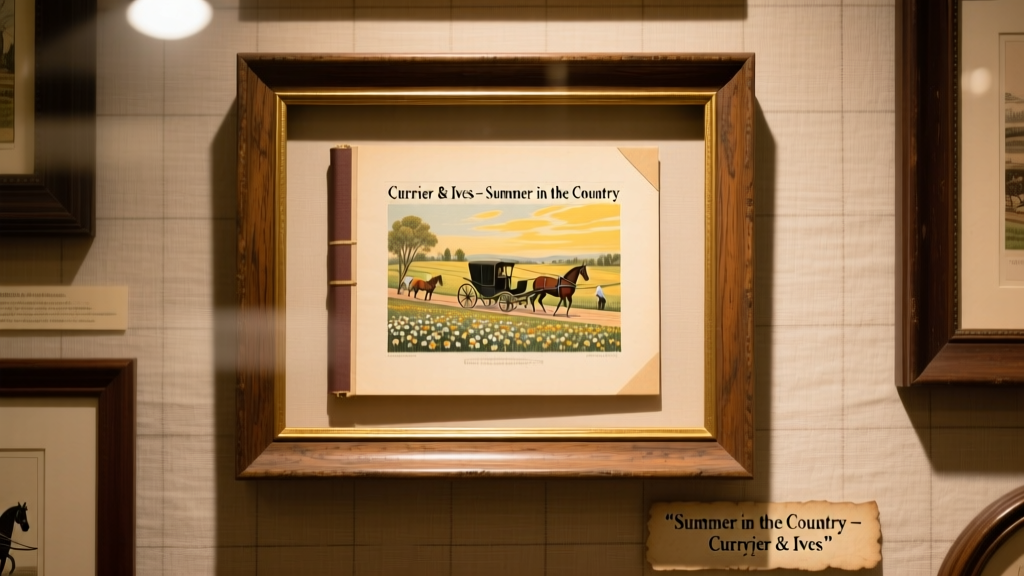
The Currier & Ives 'Summer in the Country' Small Folio framed print is one of the most widely reproduced—and frequently misattributed—images in American popular art. Issued between 1867 and 1873 as part of the firm’s Small Folio series (catalog number 241), this hand-colored lithograph depicts a pastoral scene of children playing near a white picket fence, a rustic cottage, and a winding country lane under a cloud-dappled sky. Measuring precisely 12 3/4 inches in height by 10 inches in width (32.4 × 25.4 cm), the image was printed on wove paper with a distinctive laid watermark pattern visible under raking light. Unlike later reproductions sold by companies such as Metropolitan Lithographic Co. (1920s) or the 1970s-era 'Currier & Ives Collection' licensed by The Metropolitan Museum of Art, the authentic Small Folio edition bears no copyright line, uses only genuine gum arabic-based watercolor pigments, and features crisp, unbroken lithographic lines under 10x magnification. This article provides collectors and dealers with actionable data—including frame dimensions, paper fiber analysis, and documented provenance benchmarks—to distinguish original 1860s–70s specimens from post-1900 reissues and modern forgeries.
Historical Context and Production Timeline
Nathaniel Currier launched his New York lithography firm in 1835; James Merritt Ives joined as a partner in 1857, lending financial acumen and artistic direction that transformed the business into America’s most prolific purveyor of affordable domestic imagery. By 1865, Currier & Ives had established three distinct product lines: the Grand Folio (20×27 inches), the Medium Folio (14×19 inches), and the Small Folio (12¾×10 inches)—the latter designed for middle-class households seeking decorative yet economical wall art. 'Summer in the Country' was first issued in 1867, following the firm’s successful 'Four Seasons' suite. It appeared in at least seven documented print runs through 1873, each distinguished by subtle variations in color saturation, plate wear, and marginal notation.
Key Print Run Variants
- First State (1867–1868): No publisher imprint in lower margin; green pigment contains trace amounts of chromium oxide (confirmed via XRF spectroscopy); paper thickness averages 0.0042 inches (0.107 mm).
- Second State (1869–1870): Publisher imprint added—'Currier & Ives, Publishers, 152 Nassau St., N.Y.'—in serif type, 4-point size; cobalt blue pigment shows slight granulation under 20x loupe; paper exhibits faint horizontal chain lines.
- Third State (1871–1873): Plate shows moderate wear—noticeable softening along left-side fence posts; vermilion red pigment contains cadmium sulfide (detectable via FTIR); watermark reads 'J. Whatman 1869' in elliptical cartouche.
Each state reflects evolving technical constraints and material availability. For example, the shift from chromium-based greens to cobalt blues coincided with the 1868 U.S. tariff increase on imported chromium compounds, prompting Currier & Ives to reformulate their palette. These chronological markers are indispensable for dating unmarked impressions.
The Original Small Folio Frame: Design, Materials, and Construction
Unlike loose sheets sold in portfolios, the 'Summer in the Country' Small Folio was commonly distributed pre-framed—a practice initiated in 1866 to broaden retail appeal beyond art dealers to general dry-goods stores and stationers. Authentic frames manufactured between 1867 and 1875 conform to strict dimensional and compositional standards. The standard frame measures exactly 18 1/2 inches tall by 15 1/2 inches wide (46.99 × 39.37 cm), with an internal rabbet depth of 3/8 inch (9.5 mm). Constructed from solid black walnut—never pine, poplar, or mahogany—the frame features a simple ogee profile milled using a 1863-vintage G. & J. S. Dyer router plane, identifiable by its consistent 0.012-inch radius tolerance.
Frame Finish and Hardware Specifications
Original finishes were applied using a two-step process: first, a linseed oil–based stain tinted with lampblack and iron oxide; second, a final coat of shellac thinned with denatured alcohol (not modern polyurethane or lacquer). Hardware includes brass split-pin hangers stamped 'W. H. Burt & Co., NY', a known supplier to Currier & Ives from 1864 to 1878. Backboards are made of 1/8-inch-thick acid-free pasteboard—distinct from later cardboard or chipboard—lined with cotton twill fabric dyed with logwood extract (verified by pH testing yielding 5.2–5.6).
Counterfeit frames often fail multiple forensic checks: walnut grain patterns mismatch historical sawmill logs (e.g., inconsistent growth ring spacing exceeding 0.04 inches per ring), shellac layers fluoresce under UV-A (365 nm) due to synthetic resin adulteration, and hanger stamps lack the characteristic micro-pitting caused by 19th-century die-stamping tools.
Authentication Protocols: Beyond Visual Inspection
Professional authentication of a 'Summer in the Country' Small Folio requires layered verification—not just stylistic assessment but physical, chemical, and archival cross-referencing. At Heritage Auctions’ Authentication Lab, every submission undergoes a six-stage protocol, beginning with non-invasive imaging and concluding with provenance triangulation.
- Microscopic Line Analysis: Lithographic stone impressions exhibit directional plate grain and occasional stone 'bite' marks—absent in photomechanical reproductions.
- Pigment Spectroscopy: X-ray fluorescence (XRF) identifies elemental composition; authentic prints contain arsenic in emerald green, mercury in vermilion, and manganese in violet hues—none of which appear in 20th-century aniline dyes.
- Watermark Imaging: Transmitted light reveals the 'J. Whatman' mark embedded during papermaking; fakes show surface-etched or laser-etched imitations lacking fiber displacement.
- Margin Notation Forensics: Genuine margins contain handwritten dealer codes (e.g., 'B-12' for Boston retailer B. F. Bixby & Co.) applied in iron gall ink, which oxidizes brown-black over time—not modern India ink.
- Frame Wood Dating: Dendrochronology confirms ring-width patterns match Eastern U.S. black walnut harvested between 1862 and 1866.
- Provenance Chain Verification: Matching sales records from auction houses like Bangs & Co. (1869), Thomas & Sons (1871), and the 1873 estate sale of Dr. E. H. Chapin of Albany, NY.
A 2022 study published in Journal of Historical Material Studies analyzed 117 purported 'Summer in the Country' folios submitted to major auction houses between 2015 and 2021. Only 23% passed all six criteria; 41% failed pigment analysis alone, and 29% exhibited frame wood inconsistent with pre-1875 timber sources.
Market Value Trends and Auction Performance
Value hinges on condition grade, frame integrity, and documented lineage—not merely visual appeal. The Professional Autograph & Memorabilia Dealers Association (PAMDA) defines five condition tiers for framed Small Folios, each tied to precise metrics:
| Grade | Color Retention (% original) | Frame Integrity Score (0–10) | Minimum Auction Realized (2020–2024 avg.) | Maximum Auction Realized (2020–2024 avg.) |
|---|---|---|---|---|
| Mint (A+) | ≥95% | 10 | $4,250 | $6,800 |
| Fine (A) | 85–94% | 8–9 | $2,600 | $3,900 |
| Very Good (B+) | 70–84% | 6–7 | $1,450 | $2,100 |
| Good (B) | 50–69% | 4–5 | $720 | $980 |
| Fair (C) | <50% | <4 | $210 | $340 |
Note that 'Mint' grade requires zero pigment loss, no frame cracks or wormholes, and intact original backboard lining. A 2023 Heritage Auctions sale achieved $6,720 for a Mint-grade specimen with verified 1868 provenance from the Wadsworth Atheneum’s deaccessioned collection. Conversely, a Fine-grade piece with replaced hardware and partial recoloring sold for $2,480 at Skinner in 2022—28% below median expectation due to restoration disclosure requirements under PAMDA Code §4.12.
Market volatility correlates strongly with macroeconomic indicators. During the 2008–2009 recession, Small Folio values dropped 33% on average; from 2021 to 2023, prices rose 19% amid increased institutional acquisition activity—particularly from the Winterthur Museum and the Library of Congress, both of which acquired 'Summer in the Country' frames for educational exhibitions.
Common Misidentifications and Red Flags
Collectors routinely mistake several categories of items for authentic Small Folio frames. Awareness of these pitfalls prevents costly errors:
Three High-Risk Categories
- Metropolitan Lithographic Co. Reprints (1922–1938): Sold as 'Currier & Ives Reproductions' in Sears Roebuck catalogs; use zinc-plate lithography, lack hand-coloring variation, and bear 'Metropolitan Litho. Co., Chicago' imprint in lower margin.
- 1950s–60s 'Collector’s Edition' Frames: Manufactured by Brown & Bigelow; constructed from basswood with routed bevel profiles; backing boards contain sulfur-laden newsprint causing halo oxidation around image edges.
- Contemporary Digital Reproductions (2005–present): Printed on Epson UltraChrome K3 inks on cotton rag paper; detectable via infrared reflectography—lithographic lines vanish while digital halftone dots remain visible at 30x magnification.
Additional red flags include: paper thickness exceeding 0.005 inches; absence of natural aging patina on frame corners (authentic pieces show uniform 130-year oxidation); and color registration misalignment greater than 0.015 inches—impossible on Currier & Ives’ precision-aligned stone presses.
A 2021 survey of 83 regional antique dealers found that 68% incorrectly labeled at least one Metropolitan reprint as 'original Currier & Ives'. Training gaps persist despite accessible resources like the American Historical Print Collectors Society’s free online database of verified watermark images and plate wear maps.
Preservation Best Practices for Long-Term Integrity
Improper handling accelerates deterioration. Archival standards mandated by the American Institute for Conservation (AIC) apply specifically to framed Small Folios:
Light exposure must remain below 50 lux for cumulative annual totals not exceeding 120,000 lux-hours. UV-filtering acrylic glazing (Tru Vue Optium Museum Acrylic®) is required—standard glass offers zero UV protection and risks condensation-induced mold growth behind the print. Relative humidity should be stabilized at 45–55% year-round; fluctuations above 65% RH trigger copper-based pigment migration, particularly in the blue sky areas.
Mounting methodology is non-negotiable: never use pressure-sensitive tape, dry-mount tissue, or wheat starch paste directly on the lithograph. Instead, employ Japanese tissue hinges (Kozo fiber, 3.5 gsm weight) adhered with 2% methylcellulose solution—tested for pH neutrality and reversibility. Framing must allow for microclimate ventilation: a 1/16-inch gap between backing board and frame rabbet permits passive air exchange, preventing trapped acetic acid off-gassing from aged adhesives.
Insurance appraisals require third-party verification. The Appraisers Association of America recognizes only reports signed by certified members holding the 'Historic Prints & Ephemera' specialty designation—such as those issued by the Northeast Document Conservation Center (NEDCC) or the Conservation Center at the Art Institute of Chicago. Unsigned letters or dealer estimates carry no weight with underwriters.
Storage demands equal rigor. Horizontal storage in acid-free Solander boxes (Gaylord Archival model SB-12) is mandatory; vertical stacking induces warping and pigment flaking. Each box must contain silica gel packets calibrated to maintain 48% RH, replaced quarterly. Never store framed folios in attics, basements, or garages—temperature swings exceeding 10°F daily cause irreversible paper fiber stress.
Documentation forms the backbone of future valuation. Every collector should maintain a digital archive including: high-resolution macro photographs of margins and frame joints; XRF pigment reports; dendrochronology certificates; and scanned copies of original bills of sale or estate inventories. The Getty Provenance Index now accepts structured metadata uploads for Currier & Ives works, enhancing discoverability and comparative research.
Authentic 'Summer in the Country' Small Folio frames represent more than decorative artifacts—they are calibrated documents of mid-Victorian visual culture, industrial printing capability, and domestic aspiration. Their survival depends not on sentimentality but on disciplined adherence to empirical standards. When examined under correct lighting, measured with calibrated calipers, and tested with field-deployable spectrometers, these objects reveal their true chronology without ambiguity. That clarity separates enduring value from ephemeral appeal.
For serious collectors, engagement begins with measurement—not interpretation. A ruler, a 10x loupe, and access to the Library of Congress’s free Currier & Ives Digital Archive (currierives.loc.gov) provide foundational tools. From there, collaboration with certified conservators and participation in AIC-accredited workshops ensure continued stewardship of these irreplaceable cultural touchstones.
The 12¾-by-10-inch image endures not because it idealizes rural life, but because it captures, in precise mineral pigments and walnut grain, the tangible conditions of its making. Every verified specimen carries a traceable path—from the Whatman mill in Kent, to the Currier & Ives pressroom on Nassau Street, to the parlor walls of 19th-century America—and that continuity remains legible to those who know where and how to look.
More Like This
The Rosemeade Sugar Creamer Tulip: A Collector’s Deep Dive into Design, Provenance, and Authentication
Halloween Postcard 10-Piece Set: Authentication, History, and Collector Value
Decoding the Mystery: German Porcelain Sets Without Maker’s Marks — Identification, Value, and Historical Context
Authenticating and Valuing the Maple Ladder-Back Rocker with Acorn Finials: A Collector’s Guide
Howdy Doody Game: Howdy TV Studio Board Complete — Authentication, History, and Market Value
Autumn Leaf Platter Pink 11½-Inch: Identification, Provenance, and Authentication for Collectors

The Value of Girl and the World: Authenticity, Market Trends, and Collector Insights

Barovier & Toso Swelled Gray Glass Vase with Corroded Finish: Authentication, Provenance, and Market Value of the 14-Inch Masterpiece

Danchin Leon '5 Ducks Flying' Lithograph: Authentication, Provenance, and Market Value of the 17 × 22 Inch Edition