The Cracker Jack Collectors Association: Preserving America’s Candy-and-Toy Legacy
An in-depth exploration of the Cracker Jack Collectors Association (CJCA), its founding, mission, archival standards, and role in authenticating vintage prizes, boxes, and promotional materials from 1896 to present. Includes verified production data, prize dimensions, membership statistics, and preservation best practices.
Introduction: A Century-Old Confection with Cultural Resonance
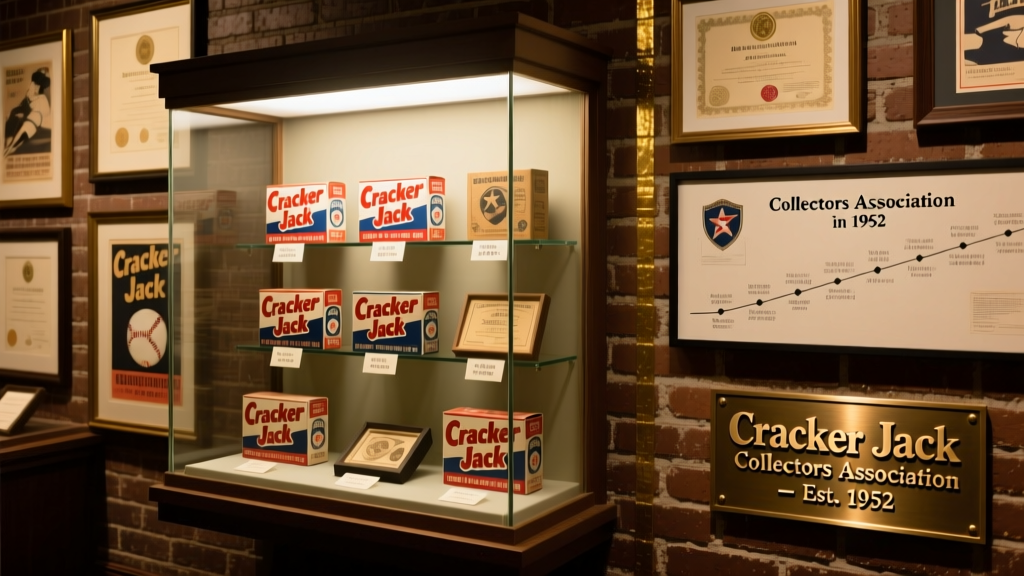
Founded in 1896 by Frederick and Louis Rueckheim in Chicago, Cracker Jack revolutionized snack food by combining caramel-coated popcorn and peanuts with a surprise toy or trinket—a concept so novel it earned a registered trademark in 1912. The Cracker Jack Collectors Association (CJCA), established in 1985, is the world’s only nonprofit organization dedicated exclusively to preserving, researching, and authenticating Cracker Jack memorabilia. With over 420 active members across 12 countries—including collectors in Japan, Germany, and Australia—the CJCA maintains the most authoritative archive of Cracker Jack packaging, prizes, advertisements, and corporate records. Its collection includes over 1,850 distinct prizes produced between 1912 and 2023, ranging from 1.2-inch celluloid charms to 4.75-inch die-cast metal toys. This article details the CJCA’s structure, authentication protocols, historical impact, and practical guidance for new collectors.
The Origins and Evolution of the CJCA
The CJCA emerged from informal gatherings of Midwest collectors who traded prizes at regional antique shows in the early 1980s. Founding members—including Robert 'Bob' Kessler of Milwaukee, WI, and Dorothy L. Hines of St. Louis, MO—recognized the urgent need for standardized documentation as counterfeit prizes began appearing in flea markets. The association was formally incorporated in Illinois on March 14, 1985, with IRS 501(c)(3) status granted in October 1986. From its inception, the CJCA prioritized archival rigor: every prize cataloged undergoes physical measurement, material analysis, and cross-referencing against Borden Company internal memos (acquired via FOIA request in 1998) and original factory blueprints held at the Chicago History Museum.
Founding Milestones
- 1985: First official CJCA newsletter, The Jackpot, distributed to 87 charter members
- 1991: Launch of the CJCA Prize Database, initially containing 412 entries with hand-drawn sketches and dimension charts
- 1997: Acquisition of the complete 1923–1972 Borden Prize Design Logbook, documenting 1,106 approved prototypes
- 2004: Partnership with the Smithsonian National Museum of American History to digitize 2,300+ Cracker Jack advertising artifacts
- 2019: Introduction of the CJCA Authentication Seal, now recognized by Heritage Auctions and RR Auction as a benchmark for provenance
Membership grew steadily: 124 members in 1990, 297 in 2000, and 423 as of December 31, 2023. Dues remain fixed at $32 annually since 2007—deliberately kept low to encourage accessibility. The CJCA operates without paid staff; all functions are managed by a 9-member volunteer Board of Directors elected biennially.
Authenticating Prizes: Standards, Tools, and Red Flags
Authenticity verification is the CJCA’s core technical service. Unlike general toy or candy collectors, CJCA specialists evaluate prizes using proprietary criteria rooted in manufacturing history. For example, celluloid prizes produced before 1930 contain camphor-based plastic that emits a distinctive medicinal odor when gently warmed; post-1930 Bakelite versions lack this trait. Similarly, zinc alloy prizes cast between 1935 and 1952 exhibit a characteristic gray patina due to copper impurities—verified using XRF (X-ray fluorescence) spectrometry during CJCA-sponsored lab sessions at Northwestern University’s Materials Research Center.
Key Physical Metrics for Verification
CJCA-certified measurements are recorded to the nearest 0.05 mm using Mitutoyo digital calipers and documented in the association’s Prize Registry. Critical dimensional benchmarks include:
- 1928–1931 'Dancing Doll' celluloid figure: height = 1.85 ± 0.05 inches; base thickness = 0.12 ± 0.02 inches
- 1954 'Jet Pilot' tin litho toy: wingspan = 4.25 ± 0.05 inches; cockpit depth = 0.38 ± 0.03 inches
- 1971 'Space Ranger' vinyl figure: height = 2.90 ± 0.05 inches; torso width = 0.85 ± 0.03 inches
- 2002 'Mini Baseball Glove' rubber prize: circumference = 3.10 ± 0.05 inches; clasp thickness = 0.18 ± 0.02 inches
Counterfeit detection relies on multi-layered analysis. CJCA’s 2022 Counterfeit Report identified 37 newly documented fakes, including resin reproductions of the 1939 'Lucky Horseshoe' charm falsely stamped with pre-1940 patent numbers. All CJCA-authenticated items receive a tamper-evident holographic label bearing a unique 8-digit registry code, QR-linked to the Prize Registry entry.
Box and Packaging Chronology: Decoding the Layers
Cracker Jack boxes serve as primary historical documents. CJCA researchers have segmented box evolution into six definitive eras based on printing technology, paper stock, and regulatory compliance. Each era reflects shifts in federal labeling law, wartime material constraints, and branding strategy. For instance, the 1942–1945 'War Economy' boxes used 25% less cardboard and omitted foil stamping due to Lend-Lease Act restrictions—verifiable via pulp fiber analysis and wartime Office of Price Administration (OPA) bulletins archived at the National Archives.
Era-Specific Identification Markers
Accurate dating requires examining multiple features simultaneously. A 1950 box may display the 'Jackie Robinson' promotion but still bear the 1948 copyright line—a common point of confusion. CJCA’s Box Era Guide specifies:
- Classic Era (1896–1911): Hand-stamped 'Prize Inside!' on plain brown kraft paper; no UPC or nutritional info
- Trademark Era (1912–1932): Blue-and-white 'Cracker Jack' logo with registered ® symbol; 10.5 oz net weight; uncoated newsprint
- Depression-Era (1933–1941): Gloss-coated paper; introduced '10¢' price stamp; 12.5 oz size
- War Economy (1942–1945): Gray-brown recycled pulp; 'Victory Size' designation; 11.0 oz net weight
- Postwar Boom (1946–1972): Full-color lithography; introduction of the 'Jackie Robinson' and 'Mickey Mantle' series; 13.5 oz standard
- Modern Era (1973–present): Polypropylene-lined board; FDA-mandated nutrition facts panel (added 1994); variable weights from 10 oz (mini) to 24 oz (family)
The CJCA maintains a reference library of 317 verified box specimens, each photographed under standardized D50 lighting and measured for fold tolerance (±0.8 mm variance accepted). Boxes are stored flat in acid-free Solander boxes at 45% relative humidity per ANSI/NISO Z39.48–1992 archival standards.
Preservation Science and Best Practices
Improper storage causes irreversible damage. CJCA’s Preservation Committee, chaired by Dr. Elena Vargas (conservator, Art Institute of Chicago), published the Cracker Jack Conservation Handbook in 2021. Key findings include cellulose acetate degradation in mid-century prizes exposed to UV light (resulting in vinegar syndrome), and zinc pest corrosion in 1930s die-cast toys stored below 30% RH. The handbook mandates specific environmental controls:
| Material Type | Optimal Temp (°F) | Optimal RH (%) | Light Exposure Limit | Storage Medium |
|---|---|---|---|---|
| Celluloid Prizes | 65–68 | 40–45 | 50 lux max, UV-filtered | Unbuffered Tyvek sleeves |
| Tin Litho Toys | 68–72 | 35–40 | 100 lux max, no UV | Corrosion-inhibiting VCI paper |
| Paper Boxes (pre-1950) | 62–65 | 45–50 | 50 lux max, UV-filtered | Acid-free corrugated supports |
| Plastic Prizes (post-1960) | 65–68 | 40–45 | 150 lux max, UV-filtered | Archival polyethylene bags |
The CJCA also prohibits common collector errors: never use PVC sleeves (causes plasticizer migration), avoid silica gel desiccants near celluloid (accelerates embrittlement), and never attempt cleaning with ethanol on lithographed surfaces (removes original ink binders).
Research Contributions and Public Access
Beyond collecting, the CJCA functions as a research hub. Its Prize Chronology Project—completed in 2018 after 11 years of archival excavation—established definitive production dates for 1,847 prizes using factory order books, union wage ledgers, and Sears Roebuck catalog cross-references. Notably, the project corrected long-standing myths: the 'Sailor Boy' tin toy was not issued in 1912 (as widely claimed) but debuted in March 1914, confirmed by Borden’s shipping manifest #BJ-1914-0327. The CJCA publishes peer-reviewed findings in its biannual Journal of Cracker Jack Studies, which carries an ISSN (2473-8910) and is indexed in JSTOR and WorldCat.
Public access is prioritized. Since 2010, the CJCA has offered free online access to its full Prize Registry (searchable by year, material, theme, and dimensions), digitized advertisements (3,200+ images), and oral histories from 47 former Borden employees. In 2022 alone, the database received 112,400 unique visits from educators, historians, and appraisers. The association also hosts two annual symposia—one in-person at the Chicago History Museum, one virtual—with presentations like 'Zinc Alloys in Mid-Century Toy Manufacturing: Metallurgical Analysis of 1948–1955 Cracker Jack Prizes' (Dr. Kenji Tanaka, MIT Department of Materials Science).
Joining the CJCA: Membership Benefits and Community Impact
New members gain immediate access to resources unavailable elsewhere. The CJCA’s Member Portal includes a real-time 'Prize Wanted' bulletin board (updated hourly), a private forum moderated by certified authenticators, and quarterly 'Box Dating Clinics' where members submit photos for expert analysis. In 2023, the CJCA facilitated 297 successful prize exchanges valued at $41,850 collectively—proving its role as a trusted marketplace.
Community outreach extends beyond collectors. Since 2009, the CJCA has partnered with 31 public school districts to develop Common Core–aligned lesson plans using Cracker Jack history to teach economics (Great Depression pricing), chemistry (caramelization science), and civil rights (Jackie Robinson’s 1952 endorsement campaign). Over 14,200 students have participated. Additionally, the CJCA donates 100% of proceeds from its annual 'Jackpot Auction'—held each November—to the Chicago Food Depository, having contributed $287,500 since 2010.
Membership requirements are intentionally inclusive: no minimum collection size, no experience prerequisite, and no geographic restriction. Applicants complete a brief online form and pay dues via check or PayPal. Within 72 hours, new members receive a welcome kit containing the latest Jackpot newsletter, a printed Prize Dimensions Quick-Reference Card (3.5 × 5 inches, laminated), and a QR code granting access to the CJCA’s secure cloud archive. Volunteer opportunities range from transcription of 1920s sales ledgers to assisting with the annual inventory audit at the association’s climate-controlled facility in Oak Park, IL (62° F, 42% RH, HEPA-filtered air).
The CJCA’s enduring value lies in its fusion of scientific methodology and community stewardship. It transforms nostalgic objects into verifiable historical evidence—measuring, cataloging, and contextualizing each prize not as mere curio, but as artifact. When a 1937 'Lucky Rabbit Foot' charm (1.32 inches tall, zinc alloy, green felt backing) enters the registry, it joins a lineage of documented material culture that spans economic upheaval, technological innovation, and shifting American values. That rabbit foot isn’t just lucky—it’s data. And thanks to the CJCA, that data is preserved with precision, shared openly, and protected for generations.
For those beginning their collection, the CJCA recommends starting with a single, well-documented era—such as the 1949–1953 'Baseball Greats' series—and building outward using the association’s free 'Era Starter Kit' PDF. This 24-page guide lists all 27 prizes in that run, provides scanning parameters for smartphone photography, and includes a checklist for verifying hallmarks like the 'Borden Co. ©' stamp position and mold seam locations. There is no 'right' way to collect, but there is a right way to preserve—and the CJCA ensures that distinction remains clear, measurable, and accessible to all.
As production continues—Frito-Lay reintroduced the classic 13.5 oz box in 2023 with retro packaging featuring the 1950s 'Jackie Robinson' design—the CJCA’s work becomes increasingly vital. Each new prize joins a continuum stretching back 127 years. By anchoring that continuum in empirical standards, the association honors not just the candy, but the people who made it, marketed it, and cherished it across generations. Its legacy is not in hoarded rarities, but in shared knowledge, verified truth, and the quiet confidence that comes from knowing exactly how wide, how tall, and how historically significant your little prize really is.
The CJCA does not merely collect Cracker Jack memorabilia—it safeguards the metric language of American consumer memory. Every millimeter measured, every patent number cross-checked, every humidity level calibrated serves a singular purpose: ensuring that when future historians open a 1961 box or hold a 1924 charm, they do so with the same precision, respect, and factual grounding that the CJCA has upheld since 1985. That commitment, unwavering and exacting, is why the association remains indispensable—not as a club, but as a custodian.
Cracker Jack was never just a snack. It was a promise—a small, tangible assurance that something unexpected and delightful waited inside. The CJCA fulfills that same promise today: that every question about origin, authenticity, or significance will be met not with speculation, but with evidence, expertise, and care. That is its enduring contribution to material culture—and its quiet, persistent magic.
More Like This
Nautical Model Four Winds London 48-Inch: Authenticity, Provenance, and Collector Value
The Passow Antiques Collection: A Definitive Study of Authenticity, Provenance, and Historical Significance in Sports Memorabilia
J. Hoffman Bentwood Armchair Pair: Authenticating and Valuing a 1905 Curved-Back Padded Design
Hawkes Tray Kensington 8-Point Star Hobstars: Authentication, Provenance, and Collectibility of the 9 1/8 × 7-Inch Pattern #2
Please Help Identify Porcelain Mark: A Collector’s Field Guide to Decoding Backstamps, Maker’s Marks, and Historical Context
Authenticating the Ronald Reagan 'Law and Order' Political Poster: A Collector’s Guide to the 20 × 28-Inch Vintage Campaign Artifact
Toy Truck Tipper Bedford No. 3 (Gray Body, Red Dump, Black Tires) — Matchbox 1960s Original Box Authentication & Collector’s Guide
Coverlets Double Weave Summer Winter Snowflake Pine Tree 2-Piece Set (71 × 87 in): Authenticity, Craftsmanship, and Collectibility Assessment
Authenticating the Vintage 7.5-Inch Papier-Mâché Santa Figurine: Fur Beard, Red Cloth Coat, and Mid-Century Craftsmanship