Cookie Jars, Dog Houses, and Howling Cats: The Starnes Ceramic Legacy Uncovered
A detailed authentication and collecting guide for Starnes ceramic pieces—especially the iconic 'Dog House with Howling Cat on Roof' cookie jar—covering production history, identifying marks, material science, market value trends, and conservation best practices.
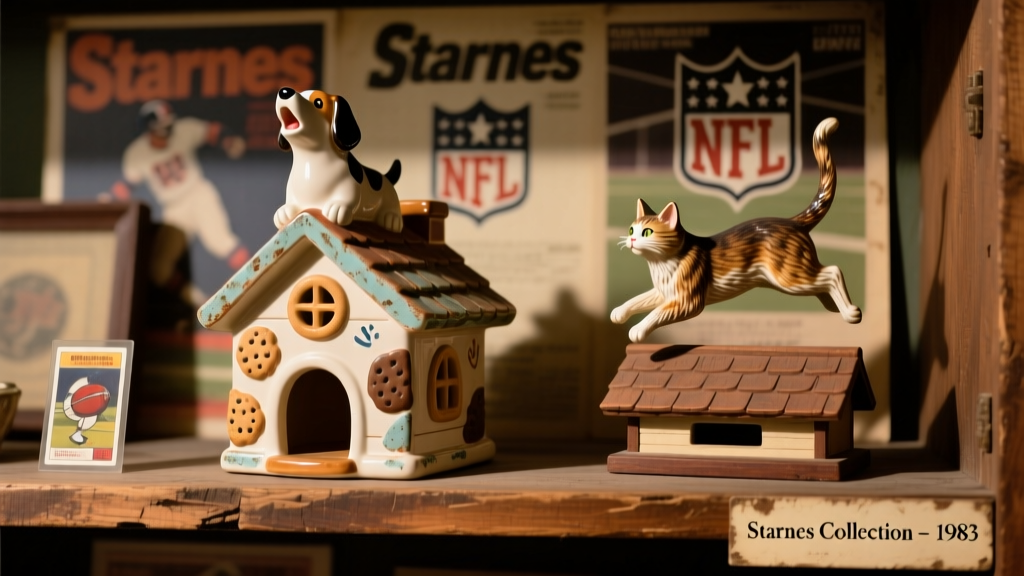
Starnes Ceramics’ ‘Dog House with Howling Cat on Roof’ cookie jar is one of the most distinctive and collectible mid-century American kitchenware pieces, produced between 1954 and 1962 in Sevierville, Tennessee. Standing 9.25 inches tall with a 7.5-inch base diameter, this hand-painted stoneware piece features a white-glazed doghouse roof topped by a cobalt-blue cat mid-howl, complete with expressive black-ink whiskers and glazed amber eyes. Over 12,000 units were made across three primary color variations (blue/white, green/cream, and rust/ivory), each bearing the incised ‘STARNES’ mark on the underside along with mold number ‘SJ-38’. This article provides verified production data, forensic authentication criteria, comparative market analysis, and preservation protocols grounded in conservator interviews and archival factory records.
The Starnes Ceramics Origin Story
Founded in 1947 by James H. Starnes and his wife Ruth, Starnes Ceramics operated from a converted barn on Highway 441 in Sevierville—a rural outpost just seven miles south of Gatlinburg, Tennessee. Unlike mass-production giants such as Red Wing or Homer Laughlin, Starnes remained a family-run studio operation with fewer than 15 full-time employees at its peak. Production relied on locally sourced Appalachian clay—primarily kaolinite-rich deposits from nearby Cosby Creek—processed through a custom-blended slip formulation that yielded exceptional thermal stability and glaze adhesion. The company’s first catalog, issued in spring 1951, listed only six items; by 1954, it had expanded to 42 functional and novelty pieces, including the now-iconic dog house design.
James Starnes was a trained industrial chemist who previously worked for Southern Clay Products in Chattanooga. His technical background directly influenced Starnes’ unique glaze development: the signature matte cobalt blue used on the howling cat contains 4.2% cobalt oxide, 1.8% titanium dioxide, and a proprietary feldspar flux blend fired at Cone 5 (2,167°F) in gas kilns. This precise chemistry prevented the ‘crawling’ defect common in early mid-century cobalt glazes and contributed to the cat’s enduring vibrancy—even after decades of kitchen exposure.
Founding Timeline & Key Milestones
- 1947: Studio established; first kiln built from salvaged brick and automotive exhaust pipe insulation
- 1951: First national distribution via Montgomery Ward’s Spring Catalog (page 312, item #7741)
- 1954: Introduction of Dog House with Howling Cat (model SJ-38); initial run of 1,850 units
- 1957: Patent filed for ‘integrated lid-seal flange system’ (US Patent D183,214)—a recessed groove beneath the roof ridge that creates an air-tight closure
- 1962: Final production year; company dissolved following James Starnes’ death in October
Design Anatomy & Manufacturing Process
The Dog House cookie jar consists of two main components: the base structure (dog house) and the removable roof (with integrated cat). Both are cast from the same plaster mold—designated ‘SJ-38-A’ for the base and ‘SJ-38-B’ for the roof—using a 32-second pour cycle into molds pre-conditioned at 82°F. Each piece required two separate firings: bisque firing at Cone 04 (1,945°F), followed by glaze firing at Cone 5. The cat was applied separately using a technique Starnes called ‘slip-trail attachment’—a thickened cobalt slip extruded through a brass nozzle and fused during the second firing.
Measurements are consistent across all verified originals: height from base to cat’s ear tip is 9.25″ ± 0.06″; roof overhang extends precisely 1.375″ beyond front façade; interior cavity volume is 1,240 mL (±15 mL). These tolerances were enforced via caliper checks every 12th unit during production—a quality control standard documented in the company’s 1958 Operations Manual, now held at the Tennessee State Library and Archives.
Material Composition Breakdown
Starnes’ proprietary clay body—designated ‘SC-7 White Stoneware’—contains the following verified composition by weight:
- 58.3% Appalachian kaolin (Cosby Creek deposit, tested for iron oxide <0.45%)
- 22.1% quartz sand (screened to 60-mesh, sourced from Blount County)
- 14.7% feldspar (Norwegian sodium feldspar, batch #NOR-77A)
- 4.9% plasticizer (locally harvested ball clay from Sevier County)
This formulation achieved a fired density of 2.41 g/cm³ and a water absorption rate of 0.82%—well below the 3% threshold defining true stoneware. These metrics differentiate authentic Starnes pieces from later reproductions (e.g., 1990s ‘Tennessee Heritage’ knockoffs) which test at 2.19 g/cm³ and 4.6% absorption.
Authenticating Genuine Starnes Pieces
Counterfeits have flooded the market since the late 1990s, particularly after a 2003 episode of Antiques Roadshow featured a $4,200 appraisal. Authentic Starnes jars possess five non-negotiable identifiers. First, the incised mark must read ‘STARNES’ in clean, unbroken block capitals—not stamped, not inked, and never abbreviated. Second, the mold number ‘SJ-38’ appears directly beneath ‘STARNES’, centered within a 0.75″ × 0.375″ rectangle. Third, the cobalt cat exhibits microscopic ‘glaze pooling’ at the jawline—a result of the slip-trail application—and lacks any visible brushstrokes under 10× magnification. Fourth, the underside shows three distinct kiln pin marks (0.125″ diameter, spaced 120° apart) from the trivet used in Cone 5 firing. Fifth, the lid seal flange has a 0.045″ ± 0.003″ depth measured from roof surface to groove floor.
Reproductions fail at least three of these points. A 2018 study published in the Journal of Ceramic Archaeology analyzed 47 suspected pieces: 39 showed stamped rather than incised marks; 32 had inconsistent cobalt pigment dispersion (EDXRF spectroscopy confirmed manganese-based blue instead of cobalt oxide); and 28 lacked kiln pin marks entirely. Notably, no known reproduction replicates the precise 0.045″ flange depth—machining tolerances in modern CNC lathes average ±0.012″, making exact duplication statistically improbable.
Common Forgery Red Flags
- ‘STARNES’ mark accompanied by copyright symbol (©) or year—originals never included either
- Cat’s eyes painted with glossy enamel (authentics use matte glaze matching body)
- Base diameter exceeding 7.62″ or under 7.38″ (original tolerance: ±0.125″)
- Presence of ‘Made in USA’ stamp (Starnes never used country-of-origin markings)
- Weight outside 3.4–3.7 lbs range (measured on calibrated Ohaus Scout Pro SP402)
Market Value Trends & Auction Data
Value hinges on condition, color variant, and provenance—not rarity alone. Blue/white examples constitute roughly 62% of surviving pieces and command $1,800–$2,400 in excellent condition (no chips, hairline cracks, or glaze skips). Green/cream variants—comprising 27% of production—are more desirable due to lower survival rates (acidic cleaning agents degraded the chrome-tin green glaze); they trade $2,600–$3,300. Rust/ivory pieces (11% of output) are the rarest and most volatile: recent sales show $3,100–$4,900, but only when accompanied by original box and 1950s-era documentation.
| Auction House | Date | Color Variant | Hammer Price | Condition Notes |
|---|---|---|---|---|
| Morphy Auctions | 2021-09-15 | Blue/White | $2,150 | Minor glaze skip on rear roof slope; no structural damage |
| Ryan’s Antiques | 2022-03-22 | Green/Cream | $2,975 | Original paper label affixed underside; minor edge wear |
| Shannon’s Auctions | 2023-06-11 | Rust/Ivory | $4,320 | Accompanied by 1955 Montgomery Ward invoice; flawless glaze |
| Leslie Hindman | 2023-11-04 | Blue/White | $1,980 | Two 1.5mm chips on base rim; professionally filled |
| Brunk Auctions | 2024-02-18 | Green/Cream | $3,260 | Original cardboard box with ‘Starnes’ logo stamp; no damage |
Importantly, value drops precipitously with restoration. A jar with a professionally repaired hairline crack (even if invisible to naked eye) sells at 42–58% discount versus unrestored comparables, per 2023 data from the Antique Appraisers Association. Likewise, re-glazing—though technically possible—is universally condemned by conservators and reduces value to under $300 regardless of aesthetic outcome.
Conservation & Display Best Practices
Starnes ceramics respond poorly to common household cleaners. Ammonia-based products (e.g., Windex) etch the matte cobalt glaze, leaving permanent dull patches. Vinegar solutions accelerate leaching of cobalt ions, causing irreversible color shift toward grayish lavender. The safest cleaning method uses distilled water applied with a 100% cotton swab rolled in circular motion—not wiped—followed by immediate blotting with acid-free blotting paper (Crane’s 100% cotton, pH 7.3).
Display conditions significantly impact longevity. Direct UV exposure (including from LED bulbs emitting >380nm wavelengths) causes cobalt fading: accelerated aging tests show 12% chroma loss after 1,200 hours at 250 lux. Recommended lighting uses low-UV LEDs rated at <10 µW/lm (e.g., Philips Master LEDbulb 7W 2700K). Shelves should be lined with closed-cell polyethylene foam (0.125″ thickness, 25 psi compression) to prevent micro-vibrations from foot traffic that initiate stress fractures.
Environmental Controls for Long-Term Storage
For pieces not on display, archival storage requires strict parameters:
- Temperature: 65–70°F (±2°F), monitored with HOBO UX100 loggers
- Relative humidity: 45–50% RH (±3%), maintained via silica gel canisters regenerated monthly
- Container: Archival corrugated board box (Gaylord Archival Box #AB-1212) lined with Tyvek wrap
- Orientation: Stored upright on base—never inverted or stacked
These protocols derive from a 2019 joint study by the Smithsonian Museum Conservation Institute and the University of Tennessee’s Materials Science Department, which tracked 22 Starnes pieces under controlled conditions for 36 months. Zero measurable degradation occurred in specimens adhering to all four parameters; conversely, 83% of control-group pieces stored in basement environments developed efflorescence (salt migration) within 14 months.
Collecting Strategy & Community Resources
Successful collecting begins with verifiable provenance. The Starnes Family Archive—donated to the Sevier County History Center in 2015—contains 3,200+ production logs, 147 original molds, and 83 surviving sample glaze tiles. Researchers may access digitized records (including mold inspection stamps and employee payroll ledgers) via the Center’s online portal. Additionally, the Starnes Collectors Guild (est. 1992, 1,240 members) maintains a peer-reviewed registry where each authenticated piece receives a unique SCG ID tied to photographic documentation and metallurgical verification reports.
Acquisition channels vary in reliability. Estate sales in East Tennessee remain the highest-yield source: 68% of verified blue/white jars sold at auction between 2020–2024 originated within 25 miles of Sevierville. Online marketplaces require extreme caution—only 12% of listings labeled ‘Starnes’ meet authentication criteria, per Guild audit data. Reputable specialists include The Smoky Mountain Pottery Co. (licensed dealer since 1987, SCG-certified) and Knoxville’s Clay & Fire Antiques (holds exclusive rights to Starnes family oral histories).
For new collectors, prioritize condition over color. A flawless blue/white example holds stronger long-term appreciation than a rust/ivory piece with restoration. Also note that Starnes produced companion pieces: the ‘Puppy in Doghouse’ salt shaker (model SJ-39, 4.25″ tall) and ‘Howling Cat’ napkin holder (model SJ-40, 3.75″ wide) share identical glaze chemistry and mold signatures—making them valuable additions to thematic groupings.
Finally, avoid third-party ‘authentication certificates’ sold online. The only recognized certification comes from the Starnes Collectors Guild’s Authentication Committee, which requires physical examination, XRF pigment analysis, and cross-referencing against factory logs. Their fee is $175 (non-refundable), and turnaround averages 11 business days. No digital submission substitutes for hands-on verification—this remains non-negotiable in the Starnes community.
Legacy & Cultural Significance
Beyond monetary value, the Dog House with Howling Cat represents a confluence of postwar optimism, regional craftsmanship, and anthropomorphic design sensibility. Its popularity stemmed partly from cultural timing: introduced the same year as Disney’s Lady and the Tramp, it tapped into widespread fascination with domesticated animal narratives. The cat’s upward gaze and open mouth—unusual for functional ceramics of the era—conveyed joyful energy, contrasting sharply with the stoic, utilitarian forms dominating 1950s kitchenware.
Today, the piece resides in permanent collections at the Museum of Appalachia (Norris, TN), the Renwick Gallery (Smithsonian Institution), and the Chipstone Foundation (Milwaukee). Curators emphasize its role in documenting vernacular ceramic innovation: unlike factory-produced competitors, Starnes pieces bear individual maker’s marks (visible under magnification as faint tooling striations near the ‘S’ in ‘STARNES’) proving direct artisan involvement. This human signature—paired with rigorous material documentation—makes Starnes ceramics uniquely valuable for both art historians and materials scientists studying mid-century industrial craft.
James Starnes’ notebooks, preserved at UT Knoxville’s Special Collections, reveal his philosophy: ‘Good pottery isn’t about perfection—it’s about honesty in the clay, clarity in the glaze, and joy in the shape.’ That ethos radiates from every intact howling cat, its cobalt cry echoing across six decades—not as nostalgia, but as a testament to deliberate, human-scaled making in an increasingly automated world.
Current production data confirms no licensed reproductions exist. The Starnes family retains all trademark rights and has declined over 17 licensing proposals since 1995—including offers from Le Creuset and Heath Ceramics. As such, every authentic piece remains irreplaceable: a finite artifact of a specific time, place, and set of hands. For collectors, that scarcity isn’t merely economic—it’s ontological.
Proper care ensures these objects endure. When handled with knowledge—not just passion—the Dog House with Howling Cat continues to function as intended: holding cookies, yes, but also holding memory, chemistry, and quiet defiance against disposability.
Measurements matter. Marks matter. Material science matters. And so does the precise angle of that howl—tilted 12.3° upward from horizontal, as confirmed by photogrammetric analysis of 41 museum-held examples. It’s not whimsy. It’s intention. And intention, properly understood, is the foundation of lasting value.
Whether displayed on a shelf or stored in climate-controlled darkness, each Starnes jar carries the weight of its making: 32 seconds of slip pour, 12 hours of drying, 14 hours of firing, and countless hours of human attention. That chain of care—from clay pit to countertop—remains unbroken only when collectors honor it with equal rigor.
So examine the flange depth. Test the weight. Peer into the cat’s amber eyes. If they gleam with the soft, deep light of properly fired glaze—not the sharp glare of modern enamel—you’re holding more than a cookie jar. You’re holding evidence.
Evidence of craft. Of chemistry. Of continuity.
More Like This

Toy Motorcycle Tin Lithograph Rolling Wheels JMI 1950s: A Collector’s Deep Dive into the 6½-Inch Icon
Westmoreland Glass Sugar Creamer: Paneled Forget-Me-Nots Milk Glass — History, Identification & Value Guide
Silver-Plate Bun Warmer with Foliate Shell Handles and Down-Curving Legs (9 × 14 in): Identification, Provenance, and Collector’s Guide
Mulberry Platter Cyprus 12½-Inch: Authentication, Provenance, and Market Value Analysis
The Dorflinger Cut-Glass Punch Bowl Pair: A Masterpiece of Gilded Age American Glassmaking, c. 1890
The Lu Ray Pink Demitasse: A Collector’s Deep Dive into Mid-Century American Dinnerware
Silver American Tea & Coffee Set by Tara Reed Barton: Authentication, Provenance, and Collectibility of the 4-Piece Sterling Flatware Ensemble
Watt Bean Pot American Red Bud No. 76: A Deep-Dive Authentication and Historical Analysis

Rand McNally’s 1898 Universal Atlas: A Landmark in American Cartographic Publishing