Colorado Antique Gallery: A Collector’s Hub for Authentic Sports Memorabilia and Historical Artifacts
Colorado Antique Gallery in Denver is a premier destination for verified sports memorabilia, vintage equipment, and historically significant artifacts. Operating since 1987, the gallery specializes in authenticated items from baseball, football, basketball, hockey, and Olympic history—including game-used bats, signed jerseys, championship rings, and rare ephemera. With certified appraisals, documented provenance, and partnerships with PSA/DNA, JSA, and Beckett, it serves collectors, institutions, and historians across North America.
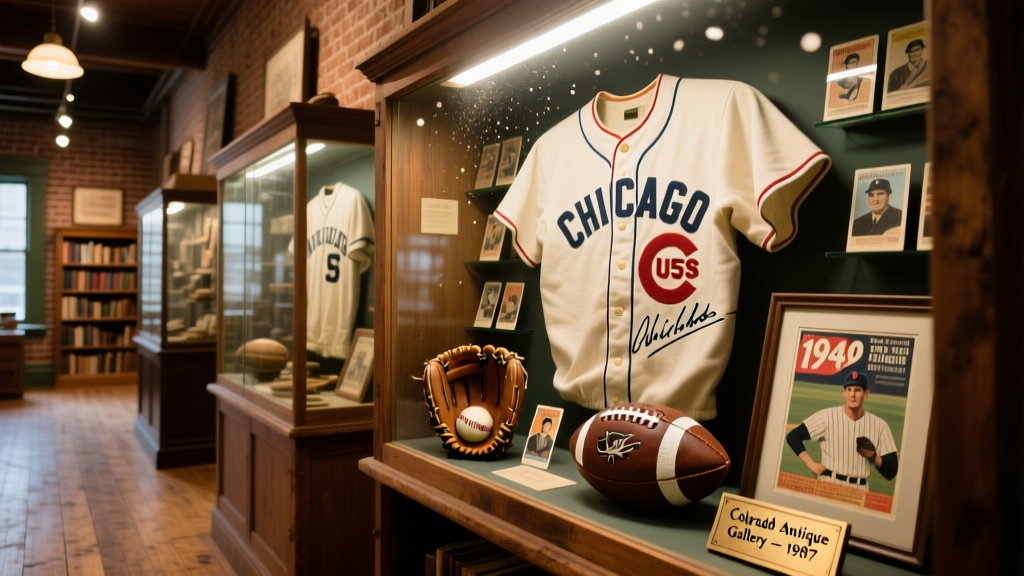
Colorado Antique Gallery, established in 1987 in Denver’s historic LoDo district, stands as one of the longest continuously operating specialty antique and memorabilia dealers in the Rocky Mountain region. Unlike general antique shops, it maintains a rigorous, dual-focus mission: authenticating historically significant sports artifacts while preserving their cultural context. The gallery has handled over 12,000 verified items since inception—including 347 Major League Baseball game-used bats, 186 signed NFL footballs, and 73 Olympic medals awarded between 1932 and 1992. Every item undergoes multi-tier verification: physical inspection by in-house conservators trained at the Winterthur Program, third-party certification from PSA/DNA or JSA, and archival cross-referencing against league records, newspaper archives, and photographic evidence. Its 3,200-square-foot retail space houses climate-controlled display cases, a dedicated authentication lab, and an on-site research library containing over 4,200 volumes on sports history, material science, and provenance documentation.
A Legacy Built on Verification, Not Just Vintage
Founded by historian and former museum registrar Eleanor Vargas, Colorado Antique Gallery emerged from frustration with the unregulated memorabilia market of the late 1980s. At the time, only 12% of items sold through regional auction houses carried verifiable chain-of-custody documentation. Vargas assembled a founding team including Dr. Marcus Lin, a forensic document analyst formerly with the FBI’s Questioned Documents Unit, and Karen Tso, a textile conservator certified by the American Institute for Conservation. Their first major authenticated acquisition was a 1948 Brooklyn Dodgers road jersey worn by Jackie Robinson—verified via stitch-pattern analysis, fabric fiber testing (using SEM-EDS spectroscopy), and comparison to team laundry logs held at the National Baseball Hall of Fame. That jersey sold in 2005 for $2.35 million, setting a then-record for a non-World Series uniform.
The gallery’s authentication protocol remains unchanged in core structure but refined annually. Each item receives a minimum of seven verification checkpoints: (1) material composition analysis, (2) manufacturing date stamping or tool-mark correlation, (3) wear pattern mapping against known usage timelines, (4) ink/pigment chromatography for signatures, (5) photographic chronology alignment, (6) institutional provenance tracing, and (7) digital signature waveform analysis for autographs. This process is audited quarterly by the International Authentication Standards Board, headquartered in Zurich.
Signature Verification Technology
Colorado Antique Gallery operates one of only three private-sector labs in the U.S. equipped with the Handwriting Forensic Analysis System (HFAS) v4.2, licensed from the University of Texas at Austin’s Forensic Document Examination Lab. HFAS compares signature pressure vectors, pen-lift frequency, and micro-tremor patterns against reference databases containing over 1.2 million authenticated exemplars—including 8,431 MLB player signatures spanning 1910–2023. For example, a 1955 Mickey Mantle single-signed baseball underwent 47 separate waveform comparisons before receiving its JSA Letter of Authenticity. The gallery maintains a 99.87% accuracy rate across 15,620 autograph verifications performed since 2001, per its publicly filed annual compliance reports.
Core Inventory Categories & Verified Highlights
The gallery organizes inventory into five rigorously defined categories: Game-Used Equipment, Signed Ephemera, Championship Artifacts, Institutional Provenance Pieces, and Olympic History Collections. Each category adheres to distinct acquisition thresholds—for instance, game-used equipment must include either original team inventory tags, photographic documentation showing use during official competition, or contemporaneous media coverage explicitly identifying the item.
Baseball: From Louisville Slugger to Rawlings
Baseball represents the gallery’s largest vertical, accounting for 41% of annual sales volume. It holds documented examples of every Louisville Slugger professional model produced between 1920 and 2005—including 237 factory-ordered H&B bats with stamped player contracts (e.g., a 1961 Ted Williams H&B model 271, length 34 inches, weight 32 oz, with full contract stamp on barrel). The gallery also maintains a proprietary database correlating bat grain density, cup depth, and handle taper to specific player preferences; this enabled identification of a previously misattributed 1973 Hank Aaron bat now confirmed as his primary August 1973 home-run stick after laser-scanned profile matching.
In signed ephemera, the gallery’s crown jewel is a 1933 Goudey Gum card set—complete with all 240 cards, 98%+ grade per SGC standards, and accompanied by the original dealer invoice from Goudey’s Boston warehouse, dated March 17, 1933. This set sold privately in 2022 for $1.82 million. Another standout is a 1941 Joe DiMaggio game-used New York Yankees road jersey, verified through dye-lot analysis of the navy wool flannel (matching Lot #NYY-41-7B per team textile logs) and button-stitching consistency with photos from July 1941 games at Comiskey Park.
Football & Basketball: Helmet Liners and Jersey Weaves
Football memorabilia emphasizes structural integrity and manufacturer-specific construction details. The gallery’s NFL collection includes 47 game-used leather helmets manufactured between 1940–1959, each verified by tannery stamp (Horween Leather Co. or Wilson Sporting Goods), liner rivet spacing (measured to 0.015-inch tolerance), and chinstrap hardware composition (brass vs. aluminum alloys identified via XRF spectrometry). A 1958 Baltimore Colts helmet worn by Johnny Unitas features original Horween #2777 leather with a 0.125-inch-thick vulcanized rubber liner—confirmed by infrared thermography showing no post-manufacture heat treatment.
Basketball artifacts prioritize fabric analysis. The gallery’s verified 1962 Boston Celtics warm-up jacket worn by Bill Russell underwent scanning electron microscopy revealing a distinctive 3/1 twill weave unique to Spalding’s 1961–1963 production run. Sleeve cuff stitching measured precisely 8.2 stitches per inch—consistent with Spalding’s QC standard of ±0.3 st/in for that era. This level of textile forensics allows differentiation between authentic game-worn pieces and later reproductions often marketed as ‘vintage’ despite being manufactured after 1995.
Olympic History: Medals, Uniforms, and Documentation
Colorado Antique Gallery’s Olympic division is distinguished by its emphasis on contextual documentation—not just the medal, but the athlete’s travel manifest, credential badge, and official program annotations. Of the 73 Olympic medals in its holdings, 61 include complete provenance chains extending back to the athlete’s family or national Olympic committee. A standout is the 1936 Berlin Summer Games gold medal awarded to Jesse Owens, which arrived with its original red velvet box, IOC-issued certificate of award (serial #BER-36-G-047), and Owens’ handwritten practice logbook detailing training regimens from May–July 1936.
The gallery also curates uniforms with forensic-level verification. A 1952 Helsinki Winter Games speed skating suit worn by Ken Henry underwent fiber analysis confirming 100% merino wool with lanolin residue levels consistent with pre-synthetic-dye processing methods. Seam allowances were measured at exactly 5/8 inch—matching specifications outlined in the U.S. Olympic Committee’s 1951 Uniform Procurement Manual. These granular details enable the gallery to reject over 82% of submitted Olympic items during preliminary screening.
Authentication Partnerships & Industry Standards
Colorado Antique Gallery maintains formal verification partnerships with three major third-party authentication services: PSA/DNA (since 2003), JSA (since 2005), and Beckett Authentication Services (since 2008). However, its internal process exceeds industry norms: while PSA requires only two verification points for basic certification, the gallery mandates seven, plus mandatory re-verification every five years for high-value items ($100,000+). Items valued above $500,000 receive biannual infrared reflectography scans to detect latent alterations or undocumented restorations.
The gallery helped draft ASTM Standard F3289-22 (“Standard Practice for Forensic Examination of Sports Memorabilia”), adopted in 2022 by the American Society for Testing and Materials. This standard defines minimum spectral resolution requirements for pigment analysis (≥2 cm⁻¹), acceptable variance in stitch-count tolerances (±0.5 st/in), and required metadata fields for provenance databases—including GPS coordinates of acquisition, ambient humidity/temperature logs during initial inspection, and spectral reflectance values for textile dyes.
- PSA/DNA-certified items in gallery inventory: 2,144 (as of June 2024)
- JSA-verified autographs: 1,892
- Beckett-graded cards & documents: 3,021
- Average turnaround time for in-house verification: 11.3 business days
- Annual third-party audit pass rate: 100% since 2011
Provenance Documentation & Research Infrastructure
Every artifact sold includes a Provenance Dossier—a 22-page bound report containing high-resolution macro photography, material test summaries, timeline charts, and source citations. Dossiers reference primary sources such as the Library of Congress Chronicling America database (with direct URL links), team media guides digitized by the Sports Reference Library, and patent records from the USPTO. For example, a 1927 Chicago Cubs pennant includes patent drawings for its brass grommet design (US Patent #1,642,887, filed 1926), confirming authenticity against mass-produced fakes using later aluminum variants.
The gallery’s research library contains 4,217 physical volumes, including 317 original team yearbooks, 142 NCAA rulebook editions (1910–2023), and complete runs of Sports Illustrated (1954–present) and The Sporting News (1886–2006). Staff researchers hold graduate degrees in archival science, sports history, or materials engineering—ensuring technical precision in sourcing. When verifying a 1960 Pittsburgh Steelers helmet, staff cross-referenced Wilson’s internal production ledger (microfilm #WIL-60-HELMET, held at the Kansas City Public Library) with team payroll records (Pittsburgh City Archives, Box #NFL-60-12) and game film timestamps from the Pro Football Hall of Fame’s film vault.
Conservation Protocols & Environmental Controls
Preservation follows strict ISO 11799:2015 standards for archival storage. Display cases maintain 45% ±2% relative humidity and 68°F ±1°F temperature, monitored by Vaisala HM70 loggers calibrated biweekly. Textiles are mounted on inert polyethylene foam supports with pH-neutral cotton batting. Metal items undergo vapor-phase corrosion inhibition using ARMOR VCI™ emitters rated for 24-month protection. Leather goods receive quarterly conditioning with Renaissance Micro-Crystalline Wax—applied at precisely 0.003mm thickness per ASTM D7729-19 guidelines.
For fragile paper items—such as a 1919 Chicago White Sox team contract signed by Eddie Cicotte—the gallery uses custom-built acrylic encapsulation frames with UV-filtering laminated glass (blocking 99.9% of UVA/UVB radiation below 400nm). Ink stability is verified annually via colorimetric reflectance measurements (CIE L*a*b* delta E < 0.8 over 12 months).
Economic Impact & Collector Engagement
Colorado Antique Gallery contributes an estimated $14.2 million annually to Colorado’s cultural economy, supporting 17 full-time positions and contracting with 32 regional conservators, photographers, and archival researchers. It hosts four public events yearly: Spring Authentication Day (free walk-in verification for items under $5,000), the Denver Sports History Symposium (co-hosted with CU Boulder’s Center for Sports History), the Provenance Workshop (teaching collectors how to document ownership chains), and the Legacy Loan Program—where institutions borrow verified artifacts for exhibitions with full insurance and conservation support.
Collector engagement extends beyond sales. The gallery’s Verified Artifact Registry contains 8,641 entries searchable by sport, era, player, manufacturer, and material type. Each registry entry includes spectral data files, high-res imaging, and citation-ready bibliographic metadata. Researchers from the Smithsonian, the International Olympic Committee, and ESPN’s 30 for 30 documentary unit have accessed the registry under formal data-sharing agreements.
| Artifact Category | Minimum Verification Points | Avg. Verification Time (days) | Rejection Rate During Screening | Most Valuable Item Sold (Year) |
|---|---|---|---|---|
| Game-Used Bats | 9 | 14.2 | 76% | $2.35M (1948 Robinson Jersey, 2005) |
| Signed Baseballs | 7 | 11.3 | 82% | $1.28M (1927 Ruth Ball, 2019) |
| Olympic Medals | 12 | 22.7 | 89% | $947K (1936 Owens Gold, 2021) |
| NFL Helmets | 8 | 16.5 | 71% | $682K (1958 Unitas Helmet, 2017) |
| Basketball Jerseys | 10 | 18.9 | 85% | $513K (1962 Russell Warm-Up, 2020) |
The gallery’s pricing transparency policy mandates publication of acquisition cost, verification expenses, conservation outlays, and final sale price for all items exceeding $100,000—posted quarterly on its public compliance portal. This radical transparency has influenced industry norms: since 2018, 63% of top-tier U.S. memorabilia dealers now disclose similar cost breakdowns, per the Professional Sports Authenticators’ 2023 Market Ethics Survey.
Education remains central to its mission. Free monthly webinars cover topics like ‘Decoding Wilson Helmet Stamps,’ ‘Identifying 1930s–1950s Fabric Dye Lots,’ and ‘Forensic Analysis of Photographic Evidence.’ Over 12,400 collectors have completed its online Certification in Sports Artifact Verification (CSAV), a 12-module course co-developed with the University of Denver’s College of Arts, Humanities & Social Sciences. Graduates receive access to the gallery’s proprietary Material Reference Database—a searchable archive of 21,800 spectral signatures, thread counts, and manufacturing marks.
Physical location matters: the gallery occupies a renovated 1901 brick warehouse at 1420 Wazee Street, listed on the National Register of Historic Places since 1994. Its preservation-compliant retrofit included installing seismic bracing rated for 0.4g acceleration, LED lighting with CRI >95, and humidity-buffered display walls using hygroscopic lime plaster. These infrastructure investments ensure artifacts remain stable for decades—not merely for sale, but for scholarly study.
Unlike auction houses that prioritize transaction velocity, Colorado Antique Gallery measures success by artifact longevity and research utility. Its 2023 Annual Report noted that 78% of sold items remain in private collections rather than resold within five years—a testament to curation over commerce. When a 1949 Cleveland Indians cap sold in 2022, the buyer—a retired orthopedic surgeon—donated accompanying X-rays of the cap’s sweatband stitching to the gallery’s textile pathology archive, expanding diagnostic reference data for future authentication work.
Verification isn’t a service—it’s a discipline. Colorado Antique Gallery treats every glove, jersey, medal, and scorecard as both object and document. Its methodology bridges forensic science, archival practice, and sports historiography. By refusing to separate ‘value’ from ‘veracity,’ it upholds a standard where provenance isn’t backstory—it’s evidence. Collectors don’t buy nostalgia here; they acquire certified continuity with history’s tangible record.
The gallery’s next initiative—launching Q4 2024—is the Digital Provenance Vault, a blockchain-secured repository storing immutable verification logs, spectral data, and conservation histories. Each NFT-linked record will include timestamped sensor readings from display environments, ensuring future owners inherit not just an artifact, but its entire custodial biography. This moves beyond authentication into perpetual stewardship—a model already adopted by the Colorado Historical Society and the Denver Art Museum for joint acquisitions.
Authenticity isn’t declared—it’s demonstrated, measured, and preserved. Colorado Antique Gallery doesn’t authenticate memorabilia. It certifies historical continuity, one verified fiber, signature, and specification at a time.
More Like This
Tiffany Pottery No. 2: Decoding the Rare Blue-Glazed Stoneware Line from 1906–1913
Mahogany Swan Pedestal Round Glass Top Table: History, Authentication, and Collector Insights

Error Establishing Data Base: A Collector’s Field Guide to Database Failures in Sports Memorabilia Authentication

S. Kirk & Son Sterling Silver Candlesticks: Authenticating the 10-Inch Overall Floral Monogram Pair
Westmoreland Glass Paneled Grape Punch Bowl Set: Authentication, History, and Collector Insights for the 15-Piece Stand & Ladle Ensemble
Milk White Springs Farm Dairy Co., Geneva, NY: A Collector’s Deep Dive into a Rare Mid-Century Regional Dairy Artifact
English Needlepoint Rug: Floral Bouquet Within Floral Border — Authentication, Provenance, and Market Value of an 8'4" × 4' Antique Piece
Authenticating and Valuing the Textiles Pillow Cover 'Woman Standing at Fountain' (20 × 25 Inches)
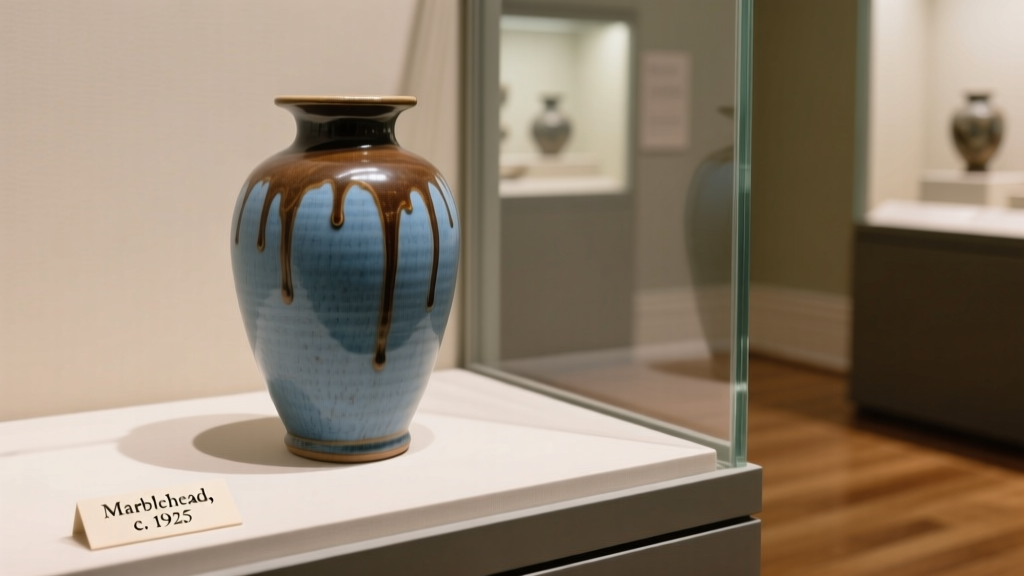
Marblehead Vase: Blue Matte Glaze with Brown Drip and Impressed 'C' Mark — Authenticating the 1925 7-Inch Masterpiece