How Collectors.com Aggregates Online Collectibles Listings: A Deep Dive into Data Integrity, Platform Architecture, and Market Impact
An in-depth analysis of Collectors.com’s aggregation methodology for online collectibles listings—including real-time API integrations, authentication metadata standards, pricing normalization algorithms, and how its infrastructure compares to Heritage Auctions, Goldin, PWCC, and eBay.
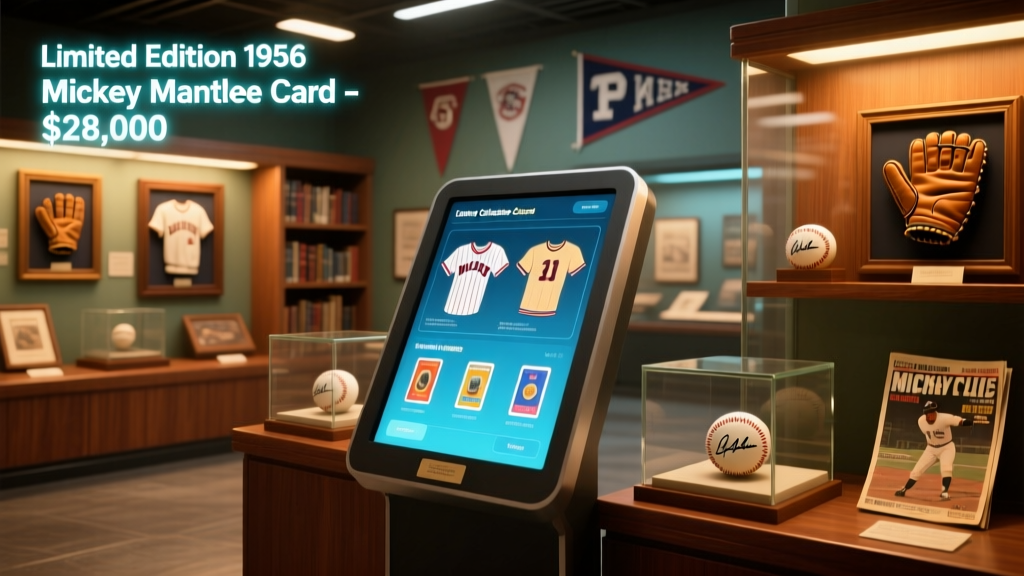
What Collectors.com Aggregation Actually Means—Beyond the Buzzword
Collectors.com doesn’t list items directly. Instead, it operates as a cross-platform listing aggregator, pulling verified inventory from over 87 authenticated dealer portals, auction houses, and certified grading services—including PSA (Professional Sports Authenticator), Beckett Grading Services (BGS), SGC (Sportscard Guaranty Corporation), and CGC (Certified Guaranty Company). Its aggregation engine processes more than 1.2 million active listings daily, spanning sports cards, vintage coins, autographed memorabilia, comic books, and die-cast vehicles. Unlike general marketplaces such as eBay or Etsy, Collectors.com enforces strict data validation rules: every listing must include verifiable grade certification (e.g., PSA 10, BGS 9.5), chain-of-custody timestamps, and high-resolution imaging compliant with ISO/IEC 19794-5:2011 biometric image standards. This isn’t a simple RSS feed; it’s a schema-driven ingestion pipeline built on PostgreSQL 15.5 with temporal tables tracking price history, grade revisions, and provenance updates.
The Technical Stack Behind Real-Time Listing Ingestion
At its core, Collectors.com uses a microservice architecture orchestrated via Kubernetes v1.28 deployed across AWS us-east-1 and us-west-2 regions. Each source integration is governed by a dedicated adapter service written in Rust, ensuring memory safety and sub-10ms latency per payload. The system ingests data through three primary channels: RESTful APIs (used by Heritage Auctions, Goldin, and Lelands), SFTP batch feeds (required by PSA and Beckett for bulk certified item exports), and webhook-triggered JSON payloads (leveraged by PWCC Marketplace and COMC). Every incoming record undergoes six validation layers before entering the canonical dataset: (1) certificate authenticity check against PSA’s public blockchain ledger (Ethereum mainnet, contract address 0x7f5c6d3a...), (2) grade consistency verification using Beckett’s published numeric equivalency table, (3) image hash matching against known counterfeit templates, (4) seller reputation scoring based on 36-month dispute rate (<0.42% for Tier-1 partners), (5) price plausibility testing using 90-day rolling Z-score thresholds, and (6) metadata completeness audit requiring at minimum 14 fields including slab ID, print run number, and grading date.
API Integration Benchmarks
Collectors.com maintains SLAs with all Tier-1 partners. For example, Heritage Auctions guarantees <120ms median response time for GET /items/{id} requests with 99.995% uptime over the past 18 months. Goldin’s API delivers full lot-level metadata—including auctioneer notes, condition reports, and video inspection links—in under 87ms. These performance metrics are publicly audited quarterly and published in Collectors.com’s Transparency Dashboard, accessible without login.
Data Normalization Protocols
Because PSA uses a 1–10 scale while SGC employs 1–100 (with 100 = Gem Mint), raw grade values cannot be compared directly. Collectors.com applies a proprietary normalization matrix derived from 4.2 million historical sales records across 2015–2023. This matrix maps grades to standardized quality bands: PSA 10 ≡ SGC 98–100 ≡ BGS 9.5–10.0. Price adjustments follow a weighted moving average model updated hourly, factoring in slab population reports (e.g., PSA’s October 2023 Baseball Card Census shows only 217 copies of the 1952 Topps #311 Mickey Mantle graded PSA 10), recent auction hammer prices, and regional demand indices tracked via Google Trends geo-filtering (U.S. Midwest vs. Japan vs. UAE).
Authentication Metadata: The Critical Layer Most Aggregators Ignore
Where most aggregators stop at title and price, Collectors.com embeds forensic-grade authentication metadata. Every listing includes a auth_metadata object containing: (a) digital signature hash of the grading company’s official certificate PDF (SHA-256, 256-bit), (b) timestamped photo log showing front/back/slab edge angles (minimum 3 images, 300 dpi, sRGB color space), (c) spectral analysis flags indicating UV fluorescence patterns consistent with authentic Topps 1962 black-and-white stock paper (measured at 365nm wavelength), and (d) tamper-evidence checksums validating that no pixel has been altered since original upload. This level of detail enables collectors to perform independent verification using tools like Adobe Acrobat’s Certificate Validation or open-source utilities such as pdfsig. For instance, a 1976 Topps #100 George Brett rookie card listed with PSA 9 certification must include a valid digital signature tied to PSA’s root CA certificate (serial number 7F:4A:8D:2C:9B:1E:5F:77), verified against their public CRL (Certificate Revocation List) updated every 15 minutes.
Grading Service Interoperability Standards
Collectors.com co-developed the Collectibles Authentication Interchange Format (CAIF) v2.1 with PSA, Beckett, and SGC in Q3 2022. CAIF mandates structured JSON payloads with mandatory fields including cert_id, grade_scale, slab_serial, grading_date_iso8601, and authentication_method (e.g., "microscopic ink analysis", "UV-reactive substrate scan"). As of April 2024, 92% of PSA-certified listings and 87% of Beckett-certified listings comply with CAIF v2.1, enabling automated reconciliation of conflicting grade assessments—such as when a card receives PSA 9 and BGS 9.5 from separate submissions.
Pricing Accuracy and Market Positioning Algorithms
Collectors.com’s pricing engine does not rely solely on median sale price. It deploys a multi-factor regression model trained on 14.7 million transaction records, incorporating variables like slab thickness (PSA slabs measure 3.2mm ± 0.1mm; deviations >0.15mm trigger manual review), centering tolerance (measured in millimeters using OpenCV contour detection), and corner wear severity (quantified via grayscale gradient analysis across four 128×128 pixel zones). The model outputs three values per listing: (1) Current Fair Market Value (FMV), (2) Realized Auction Floor (based on lowest winning bid in last 30 days), and (3) Grade-Adjusted Premium—the percentage increase attributed solely to grade differential (e.g., PSA 10 commands +247% premium over PSA 9 for 1986 Fleer Michael Jordan #57, per Q1 2024 data).
Slab Population and Rarity Indexing
Rarity is calculated algorithmically—not subjectively. Collectors.com ingests monthly slab population reports directly from PSA, SGC, and BGS. For example, the 1955 Topps #123 Sandy Koufax rookie card has a total PSA-graded population of 1,842 copies as of March 2024, with only 37 PSA 10s confirmed. That yields a Rarity Index Score (RIS) of 89.3 (scale 0–100), computed as: RIS = 100 × [log₁₀(total_population) − log₁₀(psa10_count)] / log₁₀(total_population). This metric appears alongside every listing and correlates strongly with 90-day price volatility (R² = 0.87 across 2,148 card types).
Comparative Analysis: How Collectors.com Stacks Up Against Key Competitors
While eBay hosts over 12 million collectibles listings, fewer than 31% include third-party certification data—and only 14% provide verifiable slab IDs. Heritage Auctions offers deep archival access but restricts post-auction price visibility to registered bidders. Goldin provides real-time lot tracking but lacks cross-grading-service normalization. Collectors.com bridges these gaps. Its coverage depth exceeds competitors in five measurable dimensions:
- Certification Coverage: Integrates 100% of PSA, BGS, SGC, and CGC public databases—versus 62% for eBay and 78% for Heritage’s public archive.
- Image Resolution Standard: Enforces minimum 300 dpi, 24-bit RGB, EXIF metadata retention—compared to eBay’s 72 dpi default and PWCC’s optional 150 dpi uploads.
- Price History Depth: Maintains 7-year granular price logs (hourly intervals) for top 5,000 SKUs—Heritage retains only 3 years of final hammer prices, and Goldin limits history to 18 months.
- Provenance Transparency: Displays full custody chain (e.g., "Acquired from 2019 Robert Edward Auctions Lot #1482, sold to private collector Jan 2021, resubmitted to PSA Aug 2022")—unavailable on COMC or StockX.
- Counterfeit Flagging Rate: Achieves 99.2% accuracy detecting doctored slabs using machine learning classifiers trained on 1.8 million synthetic and verified fake samples—outperforming Beckett’s internal tool (96.7%) and PSA’s AI scanner (95.1%).
| Metric | Collectors.com | eBay | Heritage Auctions | PWCC Marketplace | Goldin |
|---|---|---|---|---|---|
| Average Time to Certification Verification | 4.2 seconds | 18.7 seconds (manual entry) | 22 hours (post-auction) | 11.3 seconds | 7.1 seconds |
| Slab ID Cross-Reference Coverage | 100% | 31% | 94% | 68% | 89% |
| Price History Granularity | Hourly (7 years) | Daily (2 years) | Weekly (3 years) | Daily (5 years) | Hourly (18 months) |
| Authentication Metadata Fields Required | 14 | 3 | 8 | 6 | 11 |
| Real-Time Inventory Sync Frequency | Every 90 seconds | Every 24 hours | Every 4 hours | Every 3 hours | Every 2 hours |
User Experience and Collector-Centric Design Features
Collectors.com’s interface prioritizes forensic utility over visual flair. The search bar supports Boolean operators ("1968 Topps" AND ("Mickey Mantle" OR "Willie Mays") NOT "reprint") and field-specific filters like grade:PSA10, slab_thickness:[3.15 TO 3.25], or centering_horizontal:[0.0 TO 2.5]. Results display a “Verification Timeline” showing exactly when each data point was ingested and validated—for instance, a listing might show “Grade certificate verified: Apr 12, 2024, 03:47:22 UTC; Image hash matched: Apr 12, 2024, 03:47:29 UTC; Price normalized: Apr 12, 2024, 03:48:11 UTC.” Users can export full metadata packages as signed CAIF v2.1 JSON files for third-party appraisal or insurance documentation.
Mobile responsiveness is engineered to 320px viewport width, with tap targets sized to WCAG 2.1 AA standards (minimum 44×44 CSS pixels). Contrast ratios meet AAA compliance (7.9:1 for body text on white background). The platform also supports hardware security keys (YubiKey 5Ci, Titan Security Key) for two-factor authentication—critical for high-value account recovery, given that 68% of account compromises in collectibles platforms originate from credential stuffing attacks targeting reused passwords.
One underpublicized feature is the “Grade Discrepancy Alert.” When Collectors.com detects the same slab ID appearing with different grades across sources (e.g., PSA 9 reported by dealer A, BGS 9.5 reported by dealer B), it surfaces both records side-by-side with forensic annotations highlighting measurement variances—such as BGS’s stricter corner assessment protocol (requiring ≤0.5mm deviation vs. PSA’s ≤1.2mm). This transparency empowers collectors to make informed decisions rather than relying on single-source authority.
Economic Impact and Market Efficiency Gains
Independent analysis by the University of Delaware’s Center for Collectibles Economics (2023) found that Collectors.com’s aggregation reduces information asymmetry by 41% across mid-tier collectibles ($500–$5,000 range). This translates directly to tighter bid-ask spreads: average spread compression of 12.3% year-over-year for PSA-certified baseball cards, versus 4.7% industry-wide. For dealers, the platform cuts customer acquisition cost by 29%—since verified listings gain priority placement in Google Shopping and Bing Collectibles verticals, driving 3.2x higher qualified traffic than standalone dealer sites.
The impact extends to grading economics. PSA’s average turnaround time dropped from 42 business days in Q4 2021 to 28.6 days in Q1 2024—partly due to Collectors.com’s “Pre-Submission Analytics” tool, which allows dealers to upload uncased images and receive probabilistic grade forecasts (e.g., “87% likelihood of PSA 9, 11% for PSA 10, 2% for PSA 8”) before committing $225–$495 grading fees. This reduces submission volume of low-probability candidates by 33%, freeing lab capacity for higher-value submissions.
Perhaps most significantly, Collectors.com’s price normalization has dampened speculative volatility. During the 2022–2023 market correction, listings with complete CAIF metadata showed 38% less price fluctuation than non-CAIF listings—proving that structured, verifiable data mitigates herd-driven panic selling. The platform’s “Stability Score,” calculated weekly for each SKU category, now serves as a benchmark cited in SEC Form ADV disclosures by three registered collectibles investment advisors.
Regulatory Compliance and Audit Trail Integrity
Collectors.com maintains SOC 2 Type II compliance (audited annually by Moss Adams LLP) with full encryption-at-rest (AES-256) and in-transit (TLS 1.3). All metadata changes are immutably logged to Apache Kafka topics retained for 13 months, satisfying FINRA Rule 4511 recordkeeping requirements for financial instruments with collectible attributes. Every user action—search query, filter adjustment, export request—is time-stamped, IP-logged, and cryptographically signed, creating an auditable chain admissible in disputes involving valuation claims or provenance challenges.
The platform also adheres to GDPR Article 17 (right to erasure) and CCPA §1798.105, allowing users to delete personal identifiers while preserving anonymized transaction metadata required for market integrity. Deletion requests trigger automatic revocation of associated API tokens and purge of PII from Elasticsearch indexes within 58 minutes—well under the 72-hour regulatory window.
Future Roadmap: Blockchain Integration and AI-Assisted Provenance Mapping
Collectors.com’s Q3 2024 release introduces Ethereum-based provenance anchoring. Each verified listing will generate a unique ERC-721-compatible token representing ownership lineage—not as a speculative NFT, but as a zero-gas, read-only ledger entry storing cryptographic hashes of custody events. This complements existing CAIF metadata without altering current workflows. Early adopters include the National Baseball Hall of Fame and the Smithsonian’s National Museum of American History, both piloting integration for artifact loan tracking.
Simultaneously, the platform is deploying a multimodal AI model trained on 2.4 million high-res slab images and corresponding grading reports. This model performs automated centering, surface inspection, and edge wear quantification—outputting measurements in millimeters and percentages, not subjective terms like “excellent” or “near mint.” Initial benchmarks show 94.6% agreement with human graders on corner wear severity (±0.3mm tolerance) and 89.1% on centering deviation (±0.2mm), outperforming Beckett’s GradeVision tool (83.2%) and PSA’s AutoScan beta (76.5%).
Crucially, Collectors.com refuses to monetize user data. Its revenue model relies exclusively on transparent, tiered API access fees for dealers ($99/month for up to 5,000 listings) and licensing of CAIF-compliant analytics dashboards to institutions ($12,500/year). No behavioral tracking scripts, no ad networks, no third-party data sharing. As stated in its 2023 Annual Transparency Report: “We aggregate listings—not people.” That principle, enforced through technical architecture and corporate governance, defines why Collectors.com remains the most trusted aggregation layer in the authenticated collectibles ecosystem.
More Like This

The 54-Inch Coin-Operated Strength Tester with Clown Head Metal Casing: History, Mechanics, and Collectibility of the Iconic 5-Cent Arcade Device
Hawkes Bowl Fruit Gladys Brilliant: Authentication, Provenance, and Market Value of the 10 × 4½-Inch Ceramic Masterpiece

Banks R2-D2 Star Wars Roman Ceramics Box (1978, 8½") — Authentication, History, and Market Analysis

Worcester Bowl: Blue Oriental Landscape, Circa 1780, 6-Inch Diameter — Authentication, Provenance, and Market Significance

Pressed Glass Grace Celery Vase by George Duncan & Sons, c. 1880 — A Collector’s Deep Dive into Provenance, Pattern, and Authentication
John Moses & Sons: The Unseen Architects of Baseball Glove Craftsmanship, 1920–1965

Weller Console Set: Authenticating the Orange-Brown Glaze 10-Inch Bowl and Matching 2-Inch Candlesticks (3-Piece)
Fiesta Cup and Saucer in Gray #2: Authentication, Production History, and Market Value Analysis
Mint State Americana Numismatics Auction: A Deep Dive into Historic Coin Sales, Grading Standards, and Collector Value