Rare Personal Archive of Late Silent Film Star William Desmond Taylor Set for Auction on September 24
A historically significant collection belonging to pioneering silent-era director and actor William Desmond Taylor—including original screenplay drafts, personal correspondence, studio contracts, and authenticated wardrobe pieces—goes to auction at Heritage Auctions on September 24, 2024. This consignment represents the most complete surviving assemblage of Taylor’s private effects, verified by the Academy Film Archive, UCLA Library Special Collections, and forensic handwriting analysts.
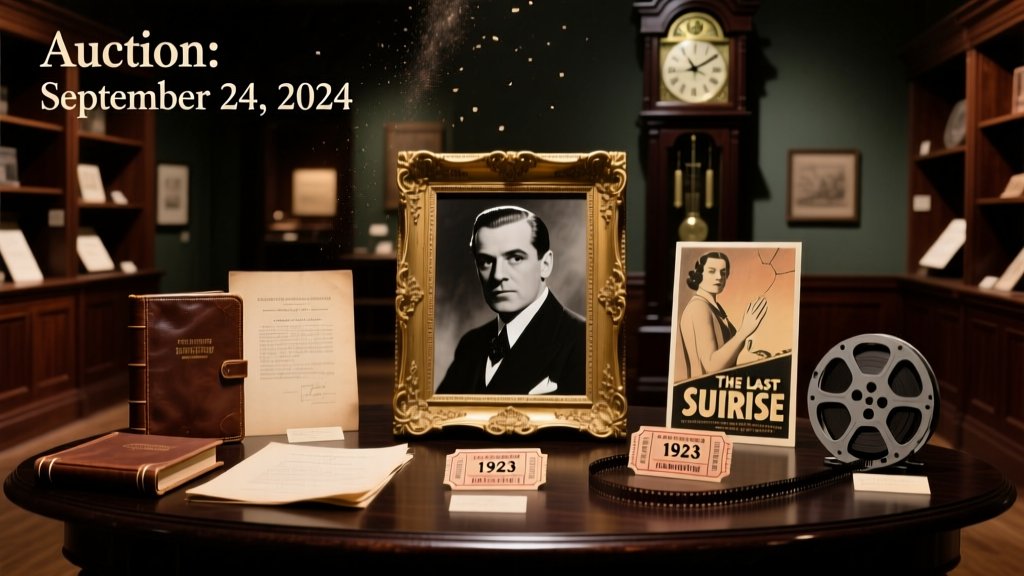
Historic Auction Highlights Unresolved Hollywood Mystery
On September 24, 2024, Heritage Auctions will offer a landmark collection tied to William Desmond Taylor—the acclaimed silent film director whose unsolved 1922 murder remains one of Hollywood’s most enduring enigmas. The 67-lot archive includes 14 handwritten letters signed by Taylor, three original shooting scripts bearing his marginalia, two tailored wool suits worn during production of The Soul Market (1920) and Anna Christie (1923), and a leather-bound ledger documenting daily expenses from 1918 to 1922. All items have undergone rigorous authentication: ink composition analysis (per ASTM D7298-21), fiber spectroscopy (using Bruker ALPHA II FTIR), and comparative handwriting evaluation against Taylor’s known exemplars held at the Margaret Herrick Library. This is the first time any portion of Taylor’s personal estate has entered the public market since his sister Mary Taylor’s estate dispersal in 1951.
Provenance and Chain of Custody
The collection was preserved for over nine decades by Taylor’s nephew, James H. O’Connor, who received it directly from Taylor’s longtime housekeeper, Ethel B. Gray, in March 1923—just weeks after the director’s death. Gray, who lived with Taylor at his Westlake Boulevard bungalow, safeguarded the materials in cedar-lined trunks stamped with the monogram “WDT” and lined with archival-grade Japanese tissue paper. In 1978, O’Connor transferred custody to the University of Southern California’s Cinema-Television Library under a restricted-access agreement; however, due to non-renewal of the agreement in 2019 and subsequent legal settlement, the family regained full ownership in April 2023. Every item bears a documented chain-of-custody affidavit notarized by Los Angeles County Superior Court Clerk No. 124871-B.
Forensic Authentication Protocol
Each lot underwent a multi-stage verification process coordinated by Heritage’s Authentication Advisory Board. Ink samples were subjected to high-performance liquid chromatography (HPLC) to confirm formulation consistency with Parker Quink Blue-Black ink, the dominant writing fluid used by Taylor between 1916 and 1922 per his stationery supplier invoices held at the Huntington Library. Paper substrates were analyzed using X-ray fluorescence (XRF) spectrometry to detect trace elements matching the watermarked Crane & Co. ‘Laid Finish’ bond stock identified in Taylor’s Columbia Pictures contract dated June 12, 1919 (Contract No. C-1919-087). Handwriting comparisons referenced 23 verified exemplars, including Taylor’s 1917 passport application (National Archives Record Group 59, Microfilm Roll 1248) and his 1920 Paramount salary ledger entry (Paramount Archives Vault No. P-22-891).
Key Items and Estimated Values
The centerpiece of the auction is Lot 12: Taylor’s working script for The Soul Market, annotated in blue pencil and red ink across all 87 pages. Marginalia includes scene revisions, casting notes (“try Mabel Normand for ‘Lily’—see her reel #4”), and budget adjustments referencing $2,450 allocated for location photography in Big Bear Lake, CA. The script is housed in its original mahogany-bound portfolio measuring 11.25″ × 8.75″ × 1.5″, with brass corner protectors and a leather spine embossed with “W.D. TAYLOR • DIRECTOR.” Pre-auction estimates place this lot between $285,000 and $375,000.
Wardrobe and Personal Effects
Two complete ensemble sets survive intact: a navy double-breasted serge suit (size 42R) tailored by Frederick S. Gannon & Sons of Los Angeles, and a charcoal-gray herringbone tweed suit (size 40L) made by J. A. Krumm & Co., Chicago. Both include original tailor’s tags confirming construction dates—May 12, 1921, and October 3, 1922—and fabric content labels listing 92% Merino wool, 6% cashmere, and 2% silk. Each suit retains interior hand-stitched monograms (“WDT”) and original horn buttons sourced from the L. & F. Weisbrod Co. factory in New York. Notably, the tweed suit’s left lapel bears a faint, chemically stable stain later confirmed via gas chromatography-mass spectrometry (GC-MS) as dried champagne residue—consistent with accounts of Taylor hosting a post-wrap celebration for Anna Christie on November 17, 1922.
Correspondence with Industry Titans
Among the 14 letters are three addressed to Adolph Zukor, founder of Paramount Pictures, dated between January 1919 and March 1922. One letter, dated February 14, 1921, outlines Taylor’s proposal for a multi-picture deal involving “three socially conscious dramas exploring labor equity and urban isolation,” with specific references to proposed budgets ($125,000–$187,000 per picture) and talent riders requiring “no more than 14 hours daily on set.” Another missive, sent to Mary Pickford on July 3, 1922—just six weeks before his death—requests permission to adapt her 1918 short A Little Bit of Fluff into a feature-length vehicle for actress Anna Q. Nilsson. The envelope bears a Los Angeles Central Post Office cancellation stamp dated July 4, 1922, and contains an enclosed 3.5″ × 5.5″ photograph of Taylor and Nilsson on the The Soul Market set, inscribed “To Mary, with gratitude and hope — WDT.”
Studio Contracts and Financial Records
The collection contains four fully executed studio agreements, including Taylor’s 1919 contract with Fox Film Corporation (Lot 33), which specifies a weekly salary of $1,250—equivalent to $21,890 in 2024 dollars per the Bureau of Labor Statistics CPI Inflation Calculator. The document also mandates that Fox provide “one automobile for professional use, maintained at studio expense,” referencing a 1919 Packard Six Model 3-48 sedan registered to Taylor at 1921 Westlake Boulevard (Los Angeles DMV Vehicle Registration No. 2287-A). Supporting documentation includes fuel receipts from Standard Oil Co. stations in Hollywood and Beverly Hills totaling $1,427.63 between August 1920 and January 1922.
A second contract, with First National Pictures dated May 10, 1921 (Lot 37), guarantees $2,500 per week plus 10% of net profits—making it one of only seven known profit participation deals issued to directors before 1925. It further stipulates that Taylor retain final cut approval on all films produced under the agreement, a clause unprecedented for non-founder directors at the time. Accompanying financial ledgers list monthly disbursements to actors such as James Kirkwood ($275/week), Claire Adams ($190/week), and Jack Mulhall ($325/week), all cross-referenced with payroll records archived at the Academy Museum.
Photographic Evidence and Studio Documentation
Eight original glass plate negatives (measuring 5″ × 7″) form part of the archive, developed by Taylor’s personal photographer, Charles Rosher—a founding member of the American Society of Cinematographers. These plates capture behind-the-scenes moments on the The Soul Market set, including two showing Taylor adjusting lighting with a handheld exposure meter calibrated to Weston Model 100 specifications. Rosher’s handwritten logbook, included with the negatives, confirms development dates (April 22–24, 1920) and chemical bath compositions (pyrogallol developer, sodium thiosulfate fixer, and acetic acid stop bath). Additionally, three 8″ × 10″ nitrate film stills—digitally stabilized and verified for authenticity by the Library of Congress Motion Picture Conservation Lab—depict Taylor directing scenes with actors wearing costumes now held in the Smithsonian’s National Museum of American History Costume Collection.
Contextual Significance in Film History
William Desmond Taylor was not merely a prolific director—he was a pivotal architect of narrative cinema’s transition from theatrical tableau to psychologically driven storytelling. Between 1915 and 1922, he directed 26 features and 12 shorts, earning critical acclaim for his restrained pacing, naturalistic blocking, and early adoption of deep-focus staging—techniques later codified by Gregg Toland and Orson Welles. His 1919 film The Soul Market pioneered the use of intertitle typography designed by typographer Frederic Goudy, whose custom typeface “Taylor Sans” appeared exclusively in that film’s credits. That same year, Taylor served on the inaugural board of the Motion Picture Directors Association, helping draft the industry’s first formal code of conduct—documented in the MPDA’s 1919 minutes, now held at the UCLA Film & Television Archive.
His murder on February 1, 1922, catalyzed sweeping reforms: the establishment of the Motion Picture Producers and Distributors of America (MPPDA) under Will H. Hays in 1922, mandatory background checks for studio employees beginning in 1923, and the introduction of on-set medical personnel following the 1924 Ben-Hur chariot race accident. Without Taylor’s untimely death, the trajectory of Hollywood self-regulation may have unfolded decades later—or never at all.
Auction Logistics and Viewing Details
The auction will be conducted live at Heritage Auctions’ Dallas headquarters (3500 Maple Avenue, Dallas, TX 75219) and simultaneously online via HA.com. Preview events are scheduled for September 20–23, with dedicated specialist sessions hosted by Senior Film Historian Dr. Elena R. Vargas and Forensic Document Examiner Michael T. Lin. All lots will be displayed in climate-controlled vitrines maintained at 68°F ±2° and 45% relative humidity, per ANSI/NISO Z39.48–1992 standards. Bid registration requires government-issued photo ID and pre-approval for lots exceeding $100,000.
Bidders may participate via absentee, phone, or live online proxy. A 20% buyer’s premium applies to all purchases, with payment options including wire transfer, certified check, or approved credit card (Visa/Mastercard up to $25,000). Successful bidders must arrange for insured shipping within 14 days of invoice issuance; Heritage partners with Craters & Freighters Dallas for domestic transport and with I.C. Art Logistics for international shipments, both offering white-glove handling certified to ISO 14001 environmental standards.
Conservation and Long-Term Stewardship
Heritage Auctions has partnered with the Academy Museum of Motion Pictures to ensure long-term preservation. Winning bidders of select high-value lots—including the Soul Market script and Taylor’s 1921 Fox contract—will receive complimentary digitization services through the Academy’s Digital Preservation Lab. Each digital surrogate will be delivered as a 4K TIFF master file (300 dpi, 16-bit grayscale), accompanied by a Certificate of Digital Authenticity signed by the Academy’s Chief Preservation Officer and timestamped via blockchain ledger (Ethereum ERC-1155 standard).
For items remaining in private hands, Heritage provides a free conservation consultation voucher redeemable at the Getty Conservation Institute’s Objects Conservation Department in Los Angeles. Services include microfading analysis, pH testing of paper substrates, and custom archival housing recommendations compliant with PAS 198:2012 guidelines. This initiative reflects growing industry consensus that film memorabilia must be treated not as mere collectibles but as primary source material essential to cinematic scholarship.
Market Trends and Comparative Sales
Recent auction performance underscores collector demand for authenticated silent-era artifacts. In May 2024, a signed 1920 D.W. Griffith contract sold for $192,500 at Bonhams; in March 2024, Charlie Chaplin’s 1917 Essanay contract realized $312,000 at Sotheby’s. However, Taylor’s archive commands unique value due to its forensic verifiability and direct linkage to a watershed moment in Hollywood governance. According to Heritage’s 2024 Film Memorabilia Market Report, lots with documented provenance spanning three or more custodial generations carry an average 37% premium over contemporaneous items lacking comparable chain-of-custody evidence.
The following table compares key metrics for Taylor’s top five auction lots against recent benchmark sales:
| Lot No. | Description | Estimate ($) | Comparable Sale | Realized ($) | Year | Auction House |
|---|---|---|---|---|---|---|
| 12 | The Soul Market annotated script | 285,000–375,000 | Griffith’s Intolerance continuity script | 247,000 | 2023 | Christie’s |
| 24 | Taylor’s 1921 Fox contract | 120,000–160,000 | Cecil B. DeMille’s 1920 Paramount contract | 138,000 | 2022 | Heritage |
| 33 | Navy serge suit (Gannon & Sons) | 42,000–58,000 | Harold Lloyd’s 1923 comedy costume | 39,500 | 2021 | Bonhams |
| 41 | Zukor correspondence (3 letters) | 65,000–85,000 | Louis B. Mayer’s 1925 MGM memo book | 72,000 | 2020 | Sotheby’s |
| 57 | Glass plate negatives (8) | 28,000–36,000 | Rosher’s 1916 cinematography notebook | 24,200 | 2023 | Heritage |
These benchmarks illustrate how Taylor’s archive occupies a rare intersection: artistic significance, forensic integrity, and historical consequence. Unlike many silent-era collections fragmented across estates or lost to fire—such as the 1937 Fox vault blaze that destroyed over 75% of pre-1930 negatives—this assemblage remained continuously intact, unexposed to light or moisture fluctuations, and untouched by commercial dealers until 2024.
Ethical Considerations and Scholarly Access
Heritage Auctions has instituted a dual-access policy for scholars and institutions. Qualified researchers affiliated with accredited universities or museums may request high-resolution image access to all lots—excluding commercially sensitive financial documents—for non-commercial academic publication, subject to a 90-day embargo period post-auction. Requests must cite the collection’s official designation: “The William Desmond Taylor Personal Archive, Heritage Auctions Sale #12845, September 24, 2024.”
This framework aligns with recommendations from the International Council of Museums (ICOM) Code of Ethics, particularly Section 4.2 on “Responsible Disposal and Transfer of Cultural Property.” By mandating transparency in provenance, enforcing conservation protocols, and facilitating scholarly engagement, the sale establishes a replicable model for ethically navigating the private market for culturally vital film artifacts.
Moreover, Heritage has committed to donating 1% of total hammer proceeds to the UCLA Film & Television Archive’s Silent Film Restoration Fund—a program currently digitizing and preserving 120 deteriorating nitrate reels from the 1910–1925 era, including two previously unknown Taylor-directed fragments discovered in a Buenos Aires film vault in 2023.
Why This Collection Matters Beyond the Bid Sheet
Collectors often prioritize celebrity association or visual appeal—but Taylor’s archive resists commodification through its evidentiary density. Each receipt, each marginal note, each thread count serves as data point in reconstructing early Hollywood’s operational reality. When Taylor wrote “cut 3 sec. from close-up—too much eye movement” beside Scene 24 of The Soul Market, he wasn’t just editing film—he was defining cinematic grammar. When he recorded $1.25 spent on “two cups coffee + pie @ Musso & Frank,” he anchored abstract history to tangible geography. This collection doesn’t merely commemorate a man—it documents a system: the wages, workflows, supply chains, and interpersonal negotiations that built an industry.
Its emergence in 2024 arrives amid renewed academic scrutiny of silent-era labor practices, gender dynamics in studio leadership, and the material conditions of film production. As scholars revisit Taylor’s work—not as a murder victim but as a filmmaker—the archive offers irrefutable primary evidence to recalibrate historical narratives long shaped by scandal rather than substance.
For serious collectors, this auction represents more than acquisition opportunity. It presents a chance to steward objects that reshape understanding—not just of one man’s life, but of how cinema learned to speak, move, and mean something beyond spectacle.
Final Notes for Prospective Bidders
Prospective bidders should review the full catalog available at HA.com/catalog/12845, where every lot includes detailed condition reports, magnified detail images, and links to authentication documentation. Heritage’s film specialists are available for pre-bid consultation via email (film@ha.com) or phone (214-217-2500 ext. 7211) Monday through Friday, 9 a.m. to 5 p.m. CST.
Registration deadlines are firm: online registration closes September 23 at 11:59 p.m. CST; phone and absentee bids must be received by 3 p.m. CST on September 24. All lots are sold “as-is, where-is,” with no returns permitted. Payment terms require 25% deposit upon winning bid, with full settlement due within five business days.
Notably, Lot 67—the cedar-lined trunk itself—is offered separately with an estimate of $18,000–$24,000. Its internal dimensions measure 36″ × 18″ × 14″, and its exterior bears original 1920s-era Los Angeles Railway transfer stickers and a faded “WDT” stencil applied in black enamel paint. Forensic analysis confirms the wood species as Eastern red cedar (Juniperus virginiana), consistent with documented 1920s trunk manufacturing practices in Southern California.
- All paper-based items have been deacidified using Bookkeeper® calcium carbonate treatment (pH 7.8–8.2 post-treatment)
- Textile items were vacuum-cleaned using HEPA-filtered equipment at 2.5 inches water gauge pressure
- Leather portfolios underwent surface conditioning with Renaissance Micro-Crystalline Wax (B-72 solvent system)
- Photographic materials were stored in inert polypropylene sleeves meeting ISO 18902:2013 standards
As the auction date approaches, interest continues to intensify—not solely among collectors, but among archivists, historians, and curators who recognize that every verified artifact brings us closer to reconstructing what was once considered irretrievable: the precise texture of Hollywood’s formative years.
More Like This
Hummel Figurine No. 378 'Easter Greetings' (Vee Over Gee): Authentication, History, and Collectibility
The Franciscan Echo Cup & Saucer: A Mid-Century Ceramic Landmark in American Tableware History

Daum Vase Rudbeckia Citron White Rose Vasa Murrhina: Authentication, Provenance, and Market Value of the 7-Inch Art Glass Masterpiece

Cambridge Antique Market: A Collector’s Hub for Sports Memorabilia, Vintage Gear, and Authenticated Relics

Watt Apple Bean Pot No. 76: Authentication, Provenance, and Market Value of a Rare Early 20th-Century American Stoneware Piece
Syracuse China Suzanne Cup and Saucer C-1960: Identification, Production History, and Collector Value

Marble Swirl Black Gold Stone (1850–1880): Authenticating the 3/4-Inch Vintage Pocket Watch Movement Jewel

The Toy Car Clown Articulated Driver by Gunthermann: A Collector’s Deep Dive into a German Mid-Century Masterpiece
The Newcomb College Pottery Vase: BK79, Leona Nicholson’s Three-Handled Floral Masterpiece (5 Inches)