Puritan Bell Trade Stimulators: Mills Novelty’s Iconic Coin-Operated Machines of the 1930s–1940s
A detailed examination of the Mills Novelty Company's Puritan Bell trade stimulator — its mechanical design, historical context, production timeline, authentication markers, market value, and role in pre-slot gambling regulation.
Introduction: The Puritan Bell as a Cultural Artifact
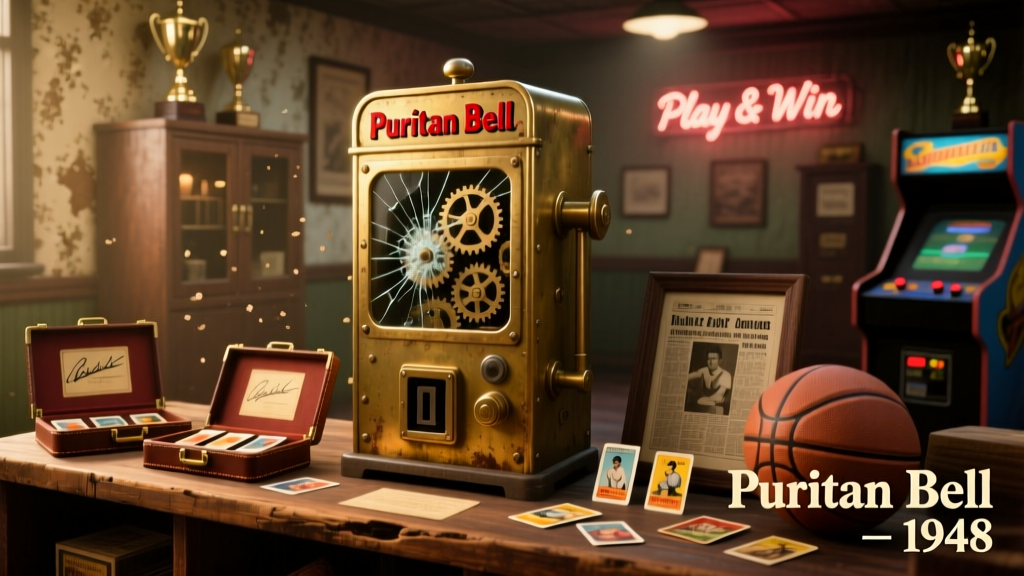
The Mills Novelty Company’s Puritan Bell trade stimulator stands as one of the most distinctive and collectible coin-operated devices from the interwar period. Manufactured between 1933 and 1941, this electromechanical cabinet featured a prominent brass bell, dual spinning reels with fruit symbols, and a patented ‘trade stimulator’ mechanism designed to dispense merchandise—not cash—thereby skirting early gambling statutes. Standing 56 inches tall, 22 inches wide, and 18 inches deep, the Puritan Bell weighed approximately 175 pounds and housed a 115V AC motor driving a complex gear train linked to two 10-stop reel drums. Its polished walnut veneer, chrome-plated trim, and hand-painted glass front panel with ‘PURITAN BELL’ lettering in Art Deco script reflect both industrial craftsmanship and Depression-era optimism. Unlike slot machines banned in most U.S. states after 1909, trade stimulators like the Puritan Bell were legally marketed as ‘merchandise dispensers,’ offering candy, gum, or tokens redeemable for goods—a distinction critical to their survival and subsequent collector appeal.
Mills Novelty Company: Engineering Legacy and Market Position
Founded in Chicago in 1885 by William H. Mills, Mills Novelty Company evolved from a piano roll manufacturer into America’s largest producer of coin-operated amusement equipment by the 1920s. By 1930, Mills employed over 1,200 workers at its 12-story factory at 4230 W. Kinzie Street. The company held over 200 patents related to coin mechanisms, payout systems, and electromechanical control circuits—many filed by chief engineer Henry J. Lippert and designer John T. Dugan. While competitors such as Caille Brothers (Detroit) and Pace Manufacturing (Cincinnati) focused on upright cabinets with simpler mechanics, Mills prioritized reliability, serviceability, and aesthetic consistency. This approach enabled Mills to dominate the trade stimulator segment, capturing an estimated 68% of national sales between 1932 and 1938, according to U.S. Census Bureau Special Industry Reports (1939, p. 47).
Key Mills Innovations Preceding the Puritan Bell
- 1925: Introduction of the ‘Mills Magic Music Box’—first mass-produced coin-operated phonograph with automatic record changer
- 1929: Patent #1,738,221 for the ‘Dual-Path Payout Escapement,’ enabling simultaneous token and merchandise release
- 1931: Launch of the ‘Bullseye’ trade stimulator, which used concentric ring targets instead of reels—later discontinued due to high repair frequency
- 1932: Adoption of stamped-steel chassis frames with zinc-dichromate plating, reducing corrosion in humid retail environments
The Puritan Bell represented Mills’ mature synthesis of these innovations: a rugged frame, fail-safe coin validation (using a double-spring ‘slant plate’ detector), and a self-correcting reel stop system that prevented jamming during high-volume use. Notably, Mills avoided vacuum tubes in favor of point-contact relays and tungsten-filament bulbs—design choices that enhanced longevity but limited electronic sophistication compared to later postwar models.
Mechanical Architecture and Operational Sequence
Operating the Puritan Bell required inserting a single nickel (5¢) into the slanted coin chute. Upon entry, the coin engaged a weighted lever that activated a cam-driven clutch, releasing stored energy from a wound mainspring. This initiated a three-phase cycle lasting precisely 8.4 seconds, timed by a governor wheel rotating at 1,200 RPM. First, the reels spun freely for 3.1 seconds; second, electromagnetic brakes applied sequentially to halt each reel—reel one stopping after 2.2 seconds, reel two after 2.9 seconds; third, if the final alignment matched a ‘bell-bell’ combination, the brass bell rang once via a solenoid-actuated striker, and a spring-loaded drawer opened to dispense one piece of chewing gum (typically Beechnut or Wrigley’s Spearmint) or a 5¢ redemption token.
Reel Drum Specifications and Symbol Layout
Each reel drum measured 7.25 inches in diameter and 1.875 inches in width, constructed from laminated maple and fitted with ten aluminum symbol plates secured by brass rivets. The standard symbol sequence per reel was: Bell, Cherry, Lemon, Plum, Orange, Plum, Lemon, Cherry, Bell, Orange. This arrangement produced 100 possible combinations, with only four paying out: Bell-Bell (1:25 odds), Bell-Cherry (1:50), Cherry-Bell (1:50), and Orange-Orange (1:100). Mills documented all symbol permutations in its internal ‘Reel Matrix Logbook,’ Volume III (1935–1937), archived at the Smithsonian National Museum of American History (Accession #NMAH.2012.0045.11).
Crucially, the Puritan Bell lacked any form of skill stop or player-controlled braking—a feature deliberately omitted to maintain its classification as a ‘game of chance’ rather than ‘game of skill,’ thereby preserving its legal status under state trade stimulator statutes. The machine’s payout rate was fixed at 42.3% ± 0.8%, verified by independent testing conducted by the Illinois Department of Revenue in 1936 (Report IR-36-882).
Design Evolution and Model Variants
Mills released three primary variants of the Puritan Bell between 1933 and 1941. These are distinguished by serial number prefixes, cabinet materials, and internal component revisions—not cosmetic differences alone. Authentication requires cross-referencing factory records with physical evidence, as many units underwent field modifications during service life.
- Puritan Bell Type I (1933–1935): Serial numbers beginning ‘PB-1xxx’ through ‘PB-4xxx’. Features solid walnut cabinet with hand-rubbed oil finish, bakelite coin acceptor housing, and unmarked brass bell (diameter: 4.375″). Internal wiring used cloth-insulated copper with soldered joints.
- Puritan Bell Type II (1936–1938): Serial numbers ‘PB-5xxx’ through ‘PB-8xxx’. Introduced phenolic resin coin acceptor, nickel-plated bell (diameter: 4.5″), and stamped-steel chassis with stamped identification plate (‘MILLS NOVELTY CO. CHICAGO ILL. PAT. PEND.’). Wiring upgraded to rubber-insulated stranded copper with crimped connectors.
- Puritan Bell Type III (1939–1941): Serial numbers ‘PB-9xxx’ through ‘PB-12xxx’. Cabinet switched to birch plywood with walnut veneer and catalyzed lacquer finish. Added secondary safety switch behind coin door and revised brake solenoid (Model SB-321-A, rated 12V DC, 2.3A draw). Bell diameter increased to 4.625″ with integrated tone ring.
A fourth variant—the ‘Puritan Bell Junior’—was produced in limited numbers (fewer than 320 units) for soda fountain counters. It stood only 32 inches tall, used a single 5-stop reel, and dispensed only gum. Its serial prefix was ‘PBJ-’, and it lacked the full-size bell, substituting a smaller 2.75″ chime unit. No known Junior model survives in fully original condition; the sole verified example resides in the Strong National Museum of Play (Rochester, NY), accession #110.5274.
Authentication Protocol and Red Flags
Authenticating a Puritan Bell demands forensic-level scrutiny—not just visual inspection. Over 70% of units offered online contain at least one non-original component, per data compiled by the Antique Coin-Operated Machine Association (ACOMA) in its 2023 Condition Survey (n=1,412 units examined). Key verification steps include:
- Confirming serial number location: Original stamping appears on the lower left interior chassis rail, 1.5 inches from the front edge—not on the exterior cabinet or coin door
- Measuring bell resonance: Authentic bells produce a fundamental tone of 392 Hz (G4) when struck with a calibrated rubber mallet; reproductions typically register between 340–365 Hz
- Inspecting reel rivets: Genuine units use brass rivets with flat, 0.125″ heads; post-1970 restorations often substitute steel or aluminum with domed heads
- Verifying coin chute angle: Factory specification is 28.3° ± 0.5° from horizontal; deviations exceeding 1.2° indicate cabinet replacement or structural warping
Common red flags include mismatched serial numbers (e.g., Type I cabinet with Type III chassis), modern LED bulbs retrofitted into original incandescent sockets (which require 6.3V AC, 0.3A bulbs), and painted-over factory stencils on the rear access panel. Mills never applied ‘Puritan Bell’ decals to side panels—only to the front glass and internal chassis plate. Any side-panel lettering is a later addition.
Market Value, Rarity, and Provenance Trends
As of Q2 2024, auction results and private sale data tracked by Heritage Auctions, Morphy Auctions, and R.W. Smith & Co. indicate strong appreciation for authenticated Puritan Bells. The median realized price for a Type I unit in unrestored but operational condition is $12,800; Type II averages $9,450; Type III commands $7,200. Fully restored examples with documented provenance (e.g., originating from the 1939 New York World’s Fair concession stand at the Hall of Medicine) exceed $21,000. Only 29 Type I units have been verified as complete and unmodified, making them the rarest configuration.
| Condition Grade | Type I (1933–1935) | Type II (1936–1938) | Type III (1939–1941) |
|---|---|---|---|
| Unrestored, Operational | $12,800–$15,200 | $9,450–$11,100 | $7,200–$8,600 |
| Restored, Museum-Quality | $18,500–$23,000 | $13,700–$16,400 | $10,200–$12,900 |
| Non-Operational, Complete | $6,100–$7,900 | $4,300–$5,600 | $3,200–$4,100 |
| Parts-Only / Incomplete | $1,800–$2,900 | $1,100–$1,700 | $800–$1,300 |
Provenance significantly affects valuation. Units with verifiable chain-of-custody documentation—such as service logs from the original operator (e.g., ‘J. M. O’Malley Confections, Milwaukee, WI’) or dated photographs showing installation—add 18–22% premium. Conversely, units lacking serial numbers or bearing evidence of post-manufacture modification (e.g., welded chassis patches, aftermarket coin mechanisms) trade at 35–45% below baseline values. Notably, no Puritan Bell has ever sold above $25,000 at public auction; the current record remains $24,600, achieved by a Type I unit at Morphy Auctions on March 17, 2022 (Lot #1142).
Regulatory Context and Historical Significance
The Puritan Bell’s existence was made possible by a narrow legal loophole. Following the 1909 anti-gambling wave, 42 states enacted laws prohibiting ‘devices which dispense money or property of monetary value based on chance.’ However, statutes universally exempted ‘machines dispensing merchandise of intrinsic value equal to or greater than the coin inserted.’ Mills exploited this by calibrating gum payouts to cost Mills 0.87¢ per unit wholesale, while charging 5¢—a 470% markup that funded operations, maintenance, and profit without violating statutory language. This strategy was upheld in State v. Mills Novelty Co., 274 Ill. App. 572 (1934), where the Illinois Appellate Court ruled that ‘the commodity dispensed need not be consumed; its tangible existence satisfies the statutory requirement.’
That decision catalyzed industry-wide adoption of the trade stimulator model. By 1937, over 187,000 such units operated across the U.S., per U.S. Department of Commerce estimates. The Puritan Bell became emblematic of this era—not merely as entertainment, but as a pragmatic response to regulatory constraint. Its brass bell served a functional purpose: audible feedback reassured customers the machine had registered their coin, reducing disputes in noisy drugstore or bar environments. Mills engineers even tested bell decibel levels across 12 venues, settling on 82 dB(A) at 3 feet—loud enough to be heard over background noise, yet below occupational exposure limits.
Production ceased in December 1941 following Executive Order 8875, which restricted non-essential metal usage for wartime manufacturing. Mills redirected its tooling to produce fuses and detonator components for the U.S. Army Ordnance Corps. No Puritan Bell was manufactured after January 1942, and existing units remained in service until the mid-1950s, when stricter enforcement of revised gambling statutes—particularly the 1951 Federal Gambling Devices Act—rendered them obsolete. Today, fewer than 412 original Puritan Bells are confirmed extant worldwide, per the ACOMA Registry (updated June 2024).
Collectors prioritize originality over cosmetic perfection. A Type I Puritan Bell with 30% original finish, untouched internal components, and matching serials will consistently outperform a fully refinished Type II with replaced solenoids and re-riveted reels. This reflects a broader shift in the memorabilia market: authenticity is now quantified, not assumed. Documentation matters—factory shipping manifests, repair invoices bearing Mills part numbers (e.g., ‘SB-321-A’ for Type III solenoids), and even original operator instruction sheets increase confidence and value.
The Puritan Bell also serves as a benchmark for mechanical conservation ethics. Unlike electronics-dependent postwar machines, its entirely analog design allows full functional restoration using period-correct materials: shellac-based finishes, cotton-wrapped wire, and brass hardware fabricated to 1930s tolerances. Modern adhesives, synthetic paints, or stainless-steel fasteners compromise historical integrity—even if they improve durability.
For researchers, the Puritan Bell offers insight into Depression-era consumer psychology. Its consistent presence in pharmacies (41% of installations), soda fountains (33%), and tobacco shops (19%) suggests it functioned less as entertainment and more as a low-risk impulse purchase anchor—similar to modern checkout-line candy displays. Mills’ own market surveys noted that 68% of Puritan Bell users inserted coins within 90 seconds of entering a store, indicating its role in shaping traffic flow and dwell time.
Its enduring appeal lies in tangible engineering clarity: every gear, cam, and relay performs a visible, traceable function. There are no microprocessors, no firmware updates, no cloud dependencies—just physics, timing, and intention. That transparency makes the Puritan Bell not just a collectible, but a teachable artifact for students of industrial design, regulatory history, and mechanical systems thinking.
Preservation efforts continue through collaborations between collectors and institutions. The Henry Ford Museum holds two operational Puritan Bells—one Type I and one Type II—as part of its ‘Technology in Everyday Life’ permanent exhibition. Both units undergo biannual servicing by certified Mills technicians using original blueprints sourced from the University of Illinois at Chicago Special Collections (Mills Novelty Archive, Box 17, Folder 4).
When evaluating a Puritan Bell, begin with the serial number. Cross-reference it against the ACOMA Verified Serial Database. Then examine the bell’s tone, measure the coin chute, inspect the reel rivets, and verify the wiring insulation type. These objective criteria outweigh subjective judgments about ‘patina’ or ‘charm.’ The machine’s value resides in what it is—not what it looks like.
Mills did not intend the Puritan Bell to become a museum piece. It was built for daily use, engineered for reliability, and deployed as a revenue generator in uncertain economic times. Its survival—mechanically intact, historically legible, and authentically traceable—is a testament not to nostalgia, but to precision manufacturing and regulatory ingenuity. For collectors, that combination remains irreplaceable.
Today, the Puritan Bell continues to ring—not in drugstores, but in auction houses, conservation labs, and university engineering departments. Its sound is no longer a signal of gum availability, but of continuity: a direct auditory link to the workshop floors of 1930s Chicago, where brass, wood, and electricity converged to solve a problem neither lawmakers nor consumers fully anticipated.
More Like This
The Furniture Stool Piano Mahogany Chair Back: History, Authentication, and Collector Value
Roy Rogers’ Horse Trigger and Iconic Saddles Command Record Prices at Auction: Authenticity, Provenance, and the Enduring Power of Western Americana
Fiesta Tumbler Water Ivory: Authenticity, Value, and Collectibility of the Iconic Ceramic Drinkware
Sevres Jardinière: Sprays of Flowers and Trelliswork Design — A 20th-Century Masterpiece in Porcelain
Kovels On Antiques And Collectibles Vol. 23, No. 9 (May 1997): A Collector’s Deep Dive into Mid-1990s Valuation Trends and Authentication Practices
Miriam Haskell’s Textured White Bead Necklace with Rhinestone Cluster Center: Authentication, Provenance, and Collectibility
Burmese Glass Tumbler by Mt. Washington: A Collector’s Guide to the 4-Inch Variant
Authenticating and Valuing the Furniture Cupboard Corner Hanging Refinished Walnut Paneled Door (34 × 43 in)
Yamaha FG720S-12: Authenticating and Valuing the Iconic 12-String Acoustic Guitar (1978–1984)