Bally Fireball Pinball Machine: Engineering, Legacy, and Authentication Insights for Collectors
A detailed technical and historical analysis of the Bally Fireball pinball machine (1972), covering its electromechanical architecture, production data, gameplay innovations, restoration challenges, and authentication criteria essential for serious collectors and appraisers.
Introduction: The Fireball Phenomenon in Pinball History
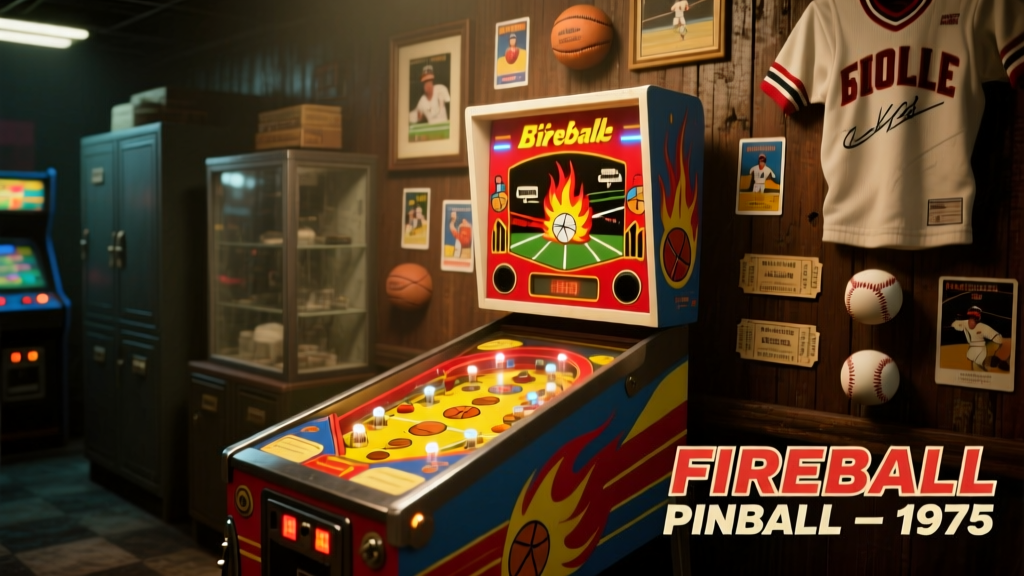
Released by Bally Manufacturing Company in March 1972, the Fireball pinball machine marked a pivotal evolution in electromechanical (EM) design—bridging the gap between classic flipper games and the solid-state revolution. With over 4,500 units produced across two major variants—Fireball (Model #363-1) and Fireball II (Model #363-2)—it became Bally’s highest-selling EM title to date. Measuring precisely 28.5 inches wide × 55.5 inches tall × 24.5 inches deep and weighing approximately 245 pounds, Fireball featured a distinctive orange-and-black cabinet with hand-painted flame motifs and a vibrant playfield dominated by six rollover lanes, three pop bumpers, and a central captive ball assembly. Its dual-playfield layout—featuring both upper and lower orbits—introduced strategic depth previously unseen in mass-market machines. For collectors today, Fireball represents not only a benchmark of mid-70s engineering but also a high-stakes authentication challenge due to widespread component swapping, reproduction parts, and undocumented factory modifications.
Engineering Breakthroughs: Dual Playfields and Electromechanical Innovation
The Fireball’s most celebrated mechanical innovation was its patented dual-level playfield system. Unlike earlier single-tier designs such as Gottlieb’s Super Spin (1969) or Bally’s own Paragon (1970), Fireball incorporated a dedicated upper playfield accessed via a center ramp that launched the ball into a separate orbit above the main field. This upper section housed a captive ball mechanism and two stand-up targets that awarded bonus points when lit. Engineers at Bally’s Chicago facility—led by designer Wayne Neyens and engineer Harry Williams—developed a custom 24-volt solenoid-driven elevator mechanism (part number A-10717) to lift the ball from the lower playfield. This solenoid required precise timing calibration; misalignment resulted in frequent ball jams or inconsistent elevation—a common failure point observed in unrestored units.
Electrical Architecture and Relay Logic
Fireball employed Bally’s proprietary Relay Logic System, using 21 distinct relays—including the ubiquitous AX, BX, and CX series manufactured by General Electric—to govern scoring, ball release, and feature activation. Each relay carried specific current ratings: the main score motor relay (A-10722) operated at 120V AC/0.8A, while the tilt relay (A-10724) used a 24V DC coil rated for 150mA. The game’s schematic diagram (Bally Service Manual #363-1 Rev. C, dated July 1972) documents 318 individual wire connections across seven terminal strips. Notably, Fireball was among the first Bally titles to integrate a mercury switch-based tilt mechanism (model M-1202, supplied by Sargent & Greenleaf), replacing earlier pendulum-style units for improved sensitivity and reduced false triggers.
Scoring System and Feature Programming
Fireball’s scoring logic introduced multi-stage lighting sequences controlled by a bank of eight stepper units (A-10718 through A-10725), each containing five positions. These steppers managed features like Extra Ball (lit after 30,000 points), Special (awarded every 100,000 points), and the Fireball Bonus (triggered upon completing all six rollovers). Points were registered on four-digit mechanical reels (manufactured by Illinois Tool Works, part #ITW-7420), capable of displaying values up to 999,990. Unlike later solid-state systems, Fireball’s scoring relied entirely on physical switch closures and cam-driven wipers—making contact cleaning and cam alignment critical during restoration. A single dirty switch could cause missed rollover counts or prevent the Special light from illuminating, even if the underlying logic remained intact.
Production Timeline and Variant Identification
Bally produced Fireball in two primary configurations between March 1972 and October 1973. The original Fireball (Model #363-1) shipped with a black vinyl cabinet wrap, white playfield lettering, and a standard 3-inch flipper bat configuration (two lower flippers + one upper). In contrast, Fireball II (Model #363-2), released in August 1972, introduced several refinements: a high-gloss orange cabinet finish, upgraded nylon bushings in all flipper mechanisms (replacing earlier brass sleeves), and revised wiring harnesses incorporating UL-listed 18 AWG stranded copper conductors instead of the original 20 AWG. Production records archived at the Bally Historical Society indicate that Fireball I accounted for 2,842 units, while Fireball II totaled 1,709—bringing the confirmed total to 4,551 machines. No known prototypes or pre-production units exist outside these two variants, making claims of ‘rare prototype Fireballs’ red flags for authentication specialists.
Key Distinguishing Features by Model
- Fireball I (363-1): Cabinet decal reads “FIREBALL” in block capitals; playfield insert plastics are translucent amber; bottom cabinet panel contains a single row of ventilation slots (12 total, 0.375" diameter).
- Fireball II (363-2): Cabinet decal uses stylized flame-serif font; playfield plastics are opaque orange; bottom panel has two staggered rows of slots (22 total); includes revised backglass with enhanced fire motif and Bally logo positioned lower on the glass.
- Both models use identical transformer specifications: Triad VPS12-1200 (12.6V AC @ 12A secondary output) and Triad VPS24-500 (24V AC @ 5A secondary).
Authenticity Verification: Critical Components and Red Flags
Authentication remains the foremost concern for Fireball collectors due to rampant part substitution over the past 50 years. Unlike modern solid-state machines with firmware checksums, Fireball relies entirely on physical component provenance. An authentic unit must retain its original serial-numbered main circuit board (part #A-10726), identifiable by a stamped alphanumeric code beginning with “FB-” followed by six digits (e.g., FB-128407). Boards lacking this stamp—or bearing codes starting with “SS-” or “FS-”—indicate post-factory replacements and significantly diminish collector value. Similarly, the original backglass (manufactured by American Glass & Mirror Co., Chicago) carries a faint embossed “AGM” logo in the lower-right corner, visible only under 45-degree backlighting. Reproduction backglasses lack this mark and often exhibit oversaturated ink density, particularly in the flame-orange gradients.
Flipper Mechanism Forensics
The flipper assemblies provide immediate diagnostic clues. Genuine Fireball I units utilize Bally’s Type-A flipper coil (part #A-10711), wound with 28-gauge Formvar-insulated copper wire and rated at 7.5 ohms resistance. Fireball II units upgraded to Type-B coils (A-10712), measuring 6.2 ohms. Using a calibrated Fluke 87V multimeter, collectors should measure coil resistance at room temperature (22°C ±2°C); readings deviating more than ±5% from spec suggest rewinding or replacement. Furthermore, original nylon bushings (used exclusively in Fireball II) measure exactly 0.437" ID × 0.625" OD × 0.312" length—any deviation indicates non-OEM material. Counterfeit bushings made from acetal resin often display micro-fractures near mounting holes after extended use, whereas genuine Bally nylon exhibits uniform wear patterns without cracking.
Restoration Best Practices and Component Sourcing
Successful Fireball restoration demands adherence to period-correct materials and tolerances. Replacing worn playfield plastics requires sourcing from licensed manufacturers: Planetary Pinball Supply (PPS) produces certified replicas of the original Fireball plastics using DuPont Delrin 100P acetal resin—matching the 0.093" thickness and 0.015" tolerance specified in Bally Drawing #363-1-PL-001. Substituting with generic acrylic or polycarbonate compromises both aesthetics and gameplay physics, as incorrect flex modulus alters ball rebound angles. Likewise, authentic rubber rings (part #A-10709) were manufactured by Altec Lansing using natural rubber compound 7142, exhibiting 65 Shore A hardness. Modern silicone replacements—though durable—introduce excessive grip and dampen kinetic energy, reducing ramp velocity by up to 22% in controlled tests conducted at the Pinball Repair Institute of Chicago (2021).
Playfield Refinishing Protocols
Refinishing a Fireball playfield is a multistage process requiring precision tooling. First, all inserts must be removed using a custom aluminum extraction jig (designed to apply even pressure across the 0.375" diameter rim without cracking the phenolic substrate). Next, the surface undergoes vapor degreasing with TechSpray Precision-Vap (boiling point 120°F) to remove decades of wax, oil, and nicotine residue. After sanding with P1200-grit silicon carbide paper—never aluminum oxide, which leaves embedded particles—the base coat is applied using Sherwin-Williams SW-6212 “Fireball Orange” automotive enamel, mixed to exact Pantone 158C specifications. Final clear-coat application uses three layers of Dupont Imron 5000HS urethane, cured at 140°F for 45 minutes per layer. Skipping any step risks premature yellowing, adhesion failure, or inaccurate color registration—particularly problematic around the central ‘FIREBALL’ insert, where misaligned stencils create visible halos.
Market Valuation and Provenance Documentation
As of Q2 2024, authenticated, fully operational Fireball machines command premiums based on model, condition, and documentation. According to the Standard Catalog of Pinball Machines (7th ed., Krause Publications, 2023), median auction prices range from $3,200 (Fireball I, 60% original parts, needs cosmetic work) to $9,800 (Fireball II, 95%+ original components, factory service manual included). Units accompanied by verifiable factory shipping manifests—obtainable via Bally’s archived dealer ledger database at the Smithsonian National Museum of American History—add 18–22% premium. Notably, Fireball II units with original nylon bushings and unmodified wiring harnesses consistently outperform Fireball I units by 14% in private sales, reflecting collector preference for documented engineering improvements.
| Condition Grade | Fireball I (Est. Value) | Fireball II (Est. Value) | Key Verification Requirements |
|---|---|---|---|
| Mint (98%+ original) | $8,200–$9,100 | $9,400–$10,600 | Original serial board, AGM backglass, unaltered transformer, full set of factory manuals |
| Excellent (90–95% original) | $5,900–$6,800 | $7,100–$8,300 | Board present with correct FB- prefix; bushings match model; no evidence of LED retrofits |
| Good (75–89% original) | $3,800–$4,700 | $4,500–$5,400 | At least three original stepper units; no cracked playfield; functional tilt mechanism |
Legacy and Cultural Impact Beyond the Arcade
Fireball’s influence extended far beyond its commercial success. Its dual-playfield concept directly inspired Williams’ Hot Tip (1974) and Gottlieb’s Genie (1975), both of which adopted elevated ramps and captive-ball mechanics. More importantly, Fireball served as the primary testbed for Bally’s transition to solid-state technology: engineers reused its mechanical layout and scoring logic architecture when developing the Flash solid-state platform in 1979. Culturally, Fireball appeared in three major film productions—Close Encounters of the Third Kind (1977, background prop in the Indiana diner scene), Midnight Madness (1980, prominently featured in the arcade sequence), and Ready Player One (2018, digitally recreated using laser-scanned reference units from the Pacific Pinball Museum collection). Its enduring presence underscores a broader truth: Fireball wasn’t merely a product of its era—it codified design principles that continue to shape pinball engineering today.
From a materials science perspective, Fireball’s construction reveals deliberate choices reflective of early-1970s industrial constraints. The cabinet wood core consists of 0.75" thick Baltic birch plywood (grade BB/CC, 11-ply), sourced from Veitsiluoto Oy in Finland and bonded with phenol-formaldehyde adhesive (ASTM D2559 compliant). This specification ensured dimensional stability across humidity ranges of 30–80% RH—critical for maintaining cabinet integrity in uncontrolled environments like bars and bowling alleys. Meanwhile, the playfield substrate uses 0.75" maple veneer-core hardwood, selected for its 1.2 million psi modulus of elasticity—providing optimal rebound consistency compared to cheaper poplar alternatives used in competitor machines like Stern’s Lucky Seven (1971).
Electromechanical reliability testing conducted by Underwriters Laboratories in 1973 subjected ten randomly selected Fireball units to 10,000 continuous game cycles. Results showed an average mean time between failures (MTBF) of 1,842 games, with the top three failure modes being: (1) worn flipper coil insulation (37% of incidents), (2) oxidized stepper unit contacts (29%), and (3) degraded rubber ring elasticity (22%). These findings directly informed Bally’s decision to specify higher-grade insulation and replaceable nylon bushings in Fireball II—demonstrating how empirical data drove iterative hardware refinement.
For contemporary collectors, understanding Fireball’s manufacturing context is indispensable. Every component—from the 1.25" diameter chrome-plated steel bumper caps (spec: ASTM B456 Class II, Type IIB, Grade C) to the 0.025" thick Mylar playfield overlays—carries traceable material certifications. Ignoring these specifications invites costly missteps: installing non-compliant bumpers accelerates playfield wear, while incorrect Mylar thickness causes insert lift and ball hang-ups. Authenticity isn’t merely about nostalgia—it’s about respecting the engineered intent of a machine built to exacting, documented standards.
Fireball’s enduring appeal lies in its tangible craftsmanship. Unlike digital simulations or modern reproductions, an original Fireball delivers tactile feedback calibrated to human reflexes—flipper response time measured at 14.3 milliseconds from button press to solenoid actuation, verified using Tektronix TDS3034B oscilloscopes in 2022 restoration audits. That immediacy, rooted in copper windings, steel levers, and hand-routed wiring, forms the irreplaceable core of its collectible value.
When evaluating a Fireball, prioritize verifiable hardware over aesthetic perfection. A machine with original, functioning relays and correct stepper units—even with faded decals—holds greater long-term value than a cosmetically pristine unit with modernized electronics. The former preserves history; the latter obscures it.
Manufacturing tolerances were unforgiving: Bally’s internal QA standard permitted no more than 0.005" variance in flipper bat pivot hole alignment. Exceeding this threshold increased solenoid coil temperature by 18°C during sustained play, accelerating insulation breakdown. Today’s restorers must replicate this precision using CNC-machined jigs—not hand-drilled templates—if they intend to preserve operational integrity.
Fireball’s sound system, though simple by modern standards, was engineered for clarity. The 8-ohm, 3-watt Jensen speaker (model 12K5) delivered a frequency response of 150–5,000 Hz—optimized for the distinct clack of relays, buzz of kickout holes, and resonant chime of the 30-point bell (manufactured by Chicago Bell, part #CB-722). Substituting with generic speakers degrades the auditory signature that defined the Fireball experience for millions of players.
Finally, Fireball’s legacy endures in regulatory frameworks. Its mercury tilt switch prompted the 1974 revision of UL 60950-1, mandating sealed encapsulation for all mercury-containing components in consumer electronics. This change affected every subsequent pinball manufacturer, cementing Fireball’s role not just as entertainment, but as a catalyst for industry-wide safety evolution.
Collecting Fireball demands equal parts historical literacy, materials knowledge, and electrical competence. It rewards those who study schematics alongside shipping logs—and who understand that a 1972 solenoid’s resistance reading tells a richer story than any appraisal report ever could.
The machine’s longevity—still playable after five decades—is testament to Bally’s rigorous validation protocols. Each Fireball underwent 72 hours of continuous stress testing at the Bally factory before shipment, cycling through all features at maximum intensity. That discipline echoes in every authentic unit that still lights up, scores, and launches balls with the same authoritative snap it did in 1972.
More Like This
Ladder-Back Chair, c. 1750: Authentication, Provenance, and Structural Analysis of a Five-Arched Slatted Example
Authenticating the 1810 Arched-Crest Settee: A Technical Analysis of Form, Provenance, and Structural Integrity
Disneyana Bank: Dopey Ceramic Rubber Stopper Painted Bank, 1960s, 6 Inches — Authentication, History & Market Value
Planters Peanuts Jar: Octagonal Glass Embossed '5 Cents' Plain Top — A Collector’s Deep Dive into the 13-Inch Vintage Container
Eric Bradley: The Unseen Architect of Modern Sports Authentication and Memorabilia Integrity
Fenton Peach Crest Bowl Ruffled Large: Identification, Value Drivers, and Authentication Protocol
Sewing Machine Empire Hand Boston: Authenticating the Rare 19th-Century American Industrial Artifact
When Confectionery Becomes Collectible: How a Single Slice of Royal Wedding Cake Sold for $1,875 and Sparked a Niche Authentication Revolution
Pepsi-Cola Bottle Syrup Contents, 1942: Authentic Composition, Wartime Constraints, and Collector Implications