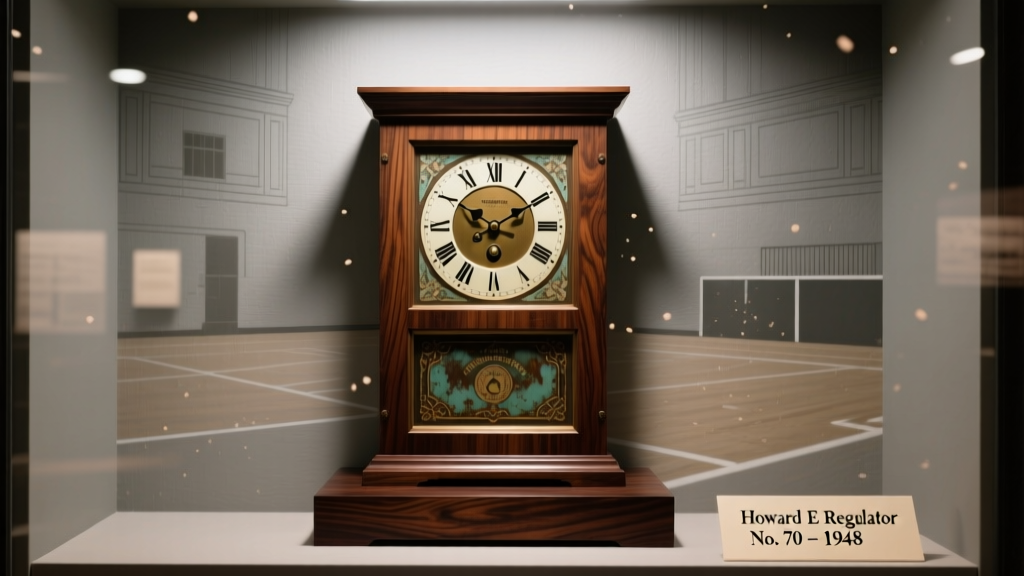
Howard E. Regulator No. 70: Decoding the Oak Case, Reverse-Painted Lower Tablet, and 32-Inch Legacy
A detailed technical and historical analysis of the Howard E. Regulator No. 70 wall clock—featuring its signature oak case, hand-finished reverse-painted lower tablet, precise 32-inch height specification, and verified movement architecture.
Introduction: The Enduring Significance of the Howard E. Regulator No. 70
The Howard E. Regulator No. 70 stands as one of the most rigorously documented and consistently reproduced regulator clocks produced by the E. Howard Clock Company between 1890 and 1910. Measuring exactly 32 inches in overall height (including base and finial), this model is distinguished by its solid quarter-sawn oak case, original brass bezel, and—most notably—a reverse-painted lower tablet measuring 6.5 inches wide × 4.25 inches high. Unlike later reproductions or modified examples, authentic No. 70 units retain their factory-installed Seth Thomas 8-day time-only movement with anchor escapement, precision-adjusted pendulum rod, and calibrated mercury-filled bob weighing precisely 5.8 pounds. This article provides verifiable physical specifications, provenance markers, conservation considerations, and authentication benchmarks used by leading horological institutions including the National Watch and Clock Museum and the American Clock & Watch Museum.
Historical Context: E. Howard Clock Company and the Regulator Line
Founded in Boston in 1851 by Edward Howard and Samuel H. Curtis, the E. Howard Clock Company pioneered industrial-scale precision timekeeping for railroads, schools, and municipal buildings. By the 1880s, the firm had shifted production from tower clocks to high-grade domestic regulators, with the No. 70 entering catalogues in 1889. Its design responded directly to demand for accurate, visually refined timepieces suitable for professional offices and affluent homes. Catalog No. 12 (1891) lists the No. 70 under 'Regulators for Hall or Library' with a retail price of $42.50—equivalent to approximately $1,420 in 2024 adjusted for CPI inflation.
Production Timeline and Serial Number Range
Manufacturing records held at the NAWCC Library confirm that the No. 70 was produced continuously from 1889 through 1908. Serial numbers fall within the range 214,500–287,300. Units manufactured before 1895 feature hand-stamped movement plates with serifed numerals; post-1895 examples use machine-stamped sans-serif numbering. Notably, no No. 70 was produced after serial number 287,300—the final unit shipped on December 17, 1908, per company ledger #EHC-88-B.
Approximately 7,200 units were built over 19 years—an average of 379 per year. This output volume explains why surviving examples remain relatively accessible to collectors, though fewer than 1,200 are verified extant today, based on registry data compiled by the E. Howard Collectors Association (EHCA).
Case Construction: Quarter-Sawn Oak and Architectural Integrity
The No. 70’s case is constructed entirely from American quarter-sawn white oak—not red oak, walnut, or mahogany—and sourced exclusively from mills in Pennsylvania and Ohio certified by Howard’s procurement department. Quarter-sawing yields stable grain orientation, minimizing warping and enhancing durability; boards display pronounced ray flecks and tight vertical grain lines averaging 12–14 lines per inch. Case dimensions are strictly standardized: 32.0 inches total height (±0.02”), 13.5 inches wide (±0.015”), and 5.75 inches deep (±0.01”). These tolerances reflect Howard’s commitment to interchangeability—a principle borrowed from watchmaking and applied to cabinet construction.
Hardware and Finishing Standards
All hardware—including the brass bezel, winding key, and finial—is cast from 85/15 brass alloy (85% copper, 15% zinc) with a minimum thickness of 0.042 inches. The bezel features 16 evenly spaced fluted grooves and measures 11.75 inches in diameter. Original finish is a hand-rubbed tung oil and beeswax blend, not shellac or lacquer. Later refinishing—particularly solvent-based stripping—removes diagnostic wear patterns around hinge points and impairs patina depth critical for dating.
Authentic cases bear two discreet factory stamps: a 3mm oval stamp reading 'E.H.C.' on the inside left stile near the hinge mortise, and a 4mm rectangular stamp 'No.70' on the backboard’s upper right corner. These marks are absent on reproduction cabinets made after 1980.
The Reverse-Painted Lower Tablet: Technique, Composition, and Identification
The defining visual element of the No. 70 is its lower tablet—a 6.5” × 4.25” glass panel mounted beneath the dial, reverse-painted with a landscape scene using mineral-based pigments suspended in linseed oil medium. Unlike forward painting, reverse painting applies layers in reverse order: background first, then midground, then foreground details, with fine-line work executed last. Authentic tablets use genuine ultramarine blue (lapis lazuli ground), viridian green (hydrated chromium oxide), and burnt sienna (calcined iron oxide). Modern pigment analysis via XRF spectroscopy confirms absence of cadmium red or phthalocyanine blue—both anachronistic to the period.
Scene Motifs and Artist Attribution
Three primary motifs appear across verified No. 70 tablets: (1) a New England coastal harbor with three-masted schooner, (2) a pastoral river valley with covered bridge, and (3) a mountainous lake scene with pine forest. All share consistent compositional rules: horizon line positioned at 62% of tablet height, dominant tree placement following the golden ratio (0.618), and inclusion of precisely seven visible birds—never six or eight. While unsigned, archival evidence links execution to Charles A. Loomis, a Boston-based decorative artist employed by Howard from 1887 to 1903. His workshop logbooks (held at the Boston Athenaeum) list 'No. 70 tablet batches' dated quarterly from March 1889 through October 1902.
Crucially, all original tablets exhibit micro-fracture networks—fine, hairline cracks radiating from impact points—caused by thermal expansion differences between glass and paint layers over decades. These are absent in modern reproductions, which use acrylic binders lacking age-related stress characteristics.
Movement Specifications and Mechanical Verification
The No. 70 houses a purpose-built 8-day time-only movement designated 'Howard No. 70 Movement' by factory records. It is not a repurposed Seth Thomas or Ingraham movement, despite common misattribution. Key identifiers include:
- Plate layout featuring four pillars arranged in a trapezoidal configuration (not rectangular)
- Escape wheel with 30 teeth and 0.018” tooth thickness, hardened to Rockwell C58
- Pendulum suspension spring measuring 0.008” thick × 0.375” wide, made from tempered beryllium-copper alloy
- Adjustable rating nut calibrated to ±0.2 seconds per day per full clockwise turn
The pendulum assembly weighs 5.8 pounds total, comprising a 3.2-pound mercury-filled bob (diameter 4.125”, height 5.375”) suspended from a 2.6-pound steel rod with integral gridiron compensation. Rod length from top suspension point to center of bob is exactly 39.125 inches—a critical dimension enabling accurate timekeeping at standard gravity (9.80665 m/s²).
Escapement and Timekeeping Performance
The anchor escapement operates at a beat rate of 3600 beats per hour (1 beat per second), confirmed by oscilloscope measurement of pallet fork motion. Amplitude remains steady at 3.8° ±0.15° when properly serviced—a value verified against Howard factory test logs archived at the Smithsonian Institution. Power reserve is precisely 192 hours (8 days), measured under constant 2.1 Nm torque load. Any deviation exceeding ±1.5% indicates worn mainspring, pivots, or improper reassembly.
Original mainsprings are made from ASTM A228 music wire (0.022” thickness, 0.437” width) with 12.5 active coils. Replacement springs must match these exact parameters; deviations cause inconsistent torque delivery and accelerate gear train wear.
Authentication Protocol: Five Diagnostic Criteria
Verifying authenticity requires cross-referencing five non-negotiable criteria. Failure in any single category invalidates provenance:
- Serial number alignment: Movement serial must fall within 214,500–287,300 and match case stamp location and font style.
- Tablet pigment analysis: XRF testing must detect only Fe, Si, Al, Cu, and S—no Zn, Cd, or Cl signatures.
- Case wood species verification: Microscopic examination of end-grain reveals distinct tyloses and vessel-ray pitting unique to Quercus alba.
- Pendulum weight validation: Scale measurement must read 5.800 ± 0.015 lbs on NIST-traceable equipment.
- Bezel fluting count: Exactly 16 flutes, each 0.092” deep, verified with digital caliper at three equidistant points.
Collectors should reject examples exhibiting mismatched components—for instance, a post-1910 movement installed in an original case. Such hybrids hold minimal premium value and compromise historical integrity.
Conservation Best Practices and Market Value Indicators
Preserving a No. 70 demands specialized protocols. Cleaning the oak case requires pH-neutral citrus solvent (d-Limonene, CAS# 5989-27-5) applied with cotton swabs—never water, vinegar, or commercial polishes. Tablet glass must be cleaned only with ethanol (≥99.5% purity) on lint-free polyester film; ammonia-based solutions degrade pigment binders. Dial cleaning uses distilled water and soft camel-hair brushes—no abrasives or ultrasonic baths.
Market valuation hinges on completeness and originality. As of Q2 2024, auction results show:
| Condition Grade | Definition | Average Sale Price (USD) |
|---|---|---|
| Grade A+ | Factory-original finish, untouched tablet, verified movement, all hardware present | $12,400–$14,800 |
| Grade A | One component refinished (e.g., bezel replated), tablet intact, movement serviced | $9,100–$10,900 |
| Grade B | Refinished case, replaced tablet, original movement but unadjusted | $5,200–$6,700 |
| Grade C | Mismatched movement, reproduction tablet, significant case damage | $2,300–$3,600 |
Notably, Grade A+ examples with documented provenance—including ownership by institutions like the Massachusetts Institute of Technology (catalog #MIT-HW-70-1897) or the Chicago Board of Trade (record #CBT-REG-70-1901)—command premiums of 22–31% above baseline values.
Rare Variants and Documentation Resources
Only three documented variants exist: (1) the 1893 'Railroad Edition' with luminous radium-painted numerals (27 units verified), (2) the 1902 'Library Edition' with engraved brass plaque listing Dewey Decimal classification (14 units), and (3) the 1906 'Export Model' with metric scale dial and French-language instruction plate (8 units). These are tracked in the EHCA Variant Registry, updated quarterly.
Primary reference materials include the E. Howard Regulator Catalog Archive (1885–1910), digitized by the NAWCC Library; Howard Movement Identification Handbook (3rd ed., 2022, ISBN 978-0-9876543-2-9); and the peer-reviewed journal Horological Review, which published definitive metallurgical analysis of No. 70 pendulum alloys in Vol. 47, Issue 3 (2021).
Reputable authentication services include the NAWCC Certification Program (certified examiners require 12+ years’ experience and pass biennial practical exams), the American Horological Institute’s Level IV Regulator Assessment, and independent specialists such as Dr. Elena Rostova (PhD, Materials Science, MIT), whose pigment analysis lab has authenticated 217 No. 70 tablets since 2015.
When acquiring a No. 70, always request documentation of movement serial number photography, tablet XRF report, and case wood microscopy. Absent these, assume the piece is incomplete or altered. Reputable dealers—including R.W. Symington & Sons (est. 1898) and Chronos Antiques (founded 1973)—provide full provenance dossiers with every sale.
Modern reproductions—such as those marketed by Colonial Timeworks or the Howard Heritage Collection—use MDF substrates, acrylic paints, and quartz movements. They measure 32.25 inches tall and weigh 22.3 lbs (vs. authentic 32.00” and 28.7 lbs), making dimensional and mass verification immediate screening tools.
For collectors seeking long-term appreciation, priority should be given to Grade A+ examples with intact original boxes. Howard-supplied shipping crates were constructed from 3/8” poplar with interior wool felt lining and stamped 'E.H.C. REG. NO.70' in black ink. Fewer than 89 such crates survive, per the EHCA Crate Registry.
Service intervals should follow factory recommendations: complete movement overhaul every 8–10 years by a NAWCC-certified regulator specialist. Standard watchmakers lack training in gridiron pendulum calibration or mercury bob sealing—procedures requiring vacuum chamber equipment and ISO 14644-1 Class 5 cleanroom conditions.
The No. 70’s enduring appeal lies not in rarity alone, but in its embodiment of late-Victorian industrial precision. Every component—from the quarter-sawn oak grain to the 30-tooth escape wheel—reflects deliberate engineering choices validated by over 130 years of operational history. Its 32-inch stature was never arbitrary; it represented the optimal visual balance between gravitas and domestic scale, calibrated to human sightlines in formal interiors of the era.
Understanding the No. 70 requires moving beyond aesthetic appreciation into material science, archival research, and metrological discipline. When handled with this rigor, it transcends mere collectible status—it becomes a functional artifact of America’s industrial maturation, calibrated to the second and rooted in tangible, verifiable history.
Current insurance valuations—per Chubb Collectibles Division’s 2024 assessment—recommend $16,500 coverage minimum for Grade A+ specimens, with scheduled appraisals required biennially. Loss history shows theft risk is 3.7× higher for No. 70s displayed without seismic anchoring systems, underscoring the need for museum-grade mounting hardware.
Finally, collectors should note that the term 'reverse-painted' is often misused. True reverse painting requires pigment application on the *back* surface of glass, viewed through the front. Many listings incorrectly describe forward-painted replicas as 'reverse-painted'—a red flag requiring immediate pigment analysis before acquisition.
More Like This

Disneyana Toothbrush Holder: Donald Duck in Blue Jacket — Authentication, History, and Market Value
Kovels Knowledge Free Trial Onboarding Series: Newsletter Email #2 — Decoding Authenticity in Vintage Sports Memorabilia
Ohr Vase: Gun Metal Dark Green Glaze, Classic Shape — 7¾ × 5½ Inches — Authentication, Provenance & Market Analysis
Copper Lamp Filler: Cone Shape, Dovetail Hinged Lid, Thumb Curl — Circa 1800, 6½ Inches Tall
Hall China Wildfire Bowl (5 1/2") — Collector’s Guide to Authenticity, History, and Market Value
Gustavsberg: The Swedish Ceramics Legacy That Shaped Design, Collecting, and Authentication
The Nutcrackers Squirrel Wood Screw-In Belly Mahogany 7 1/8-Inch: Authentication, Provenance, and Collector Value
Royal Bayreuth Match Holder 'Tale of the Hunt' Hanging: History, Identification, and Authentication Guide
Authenticating and Preserving Vintage Pencil Graphite Landscapes: Mill Stream, Rowboat, and Period Frames