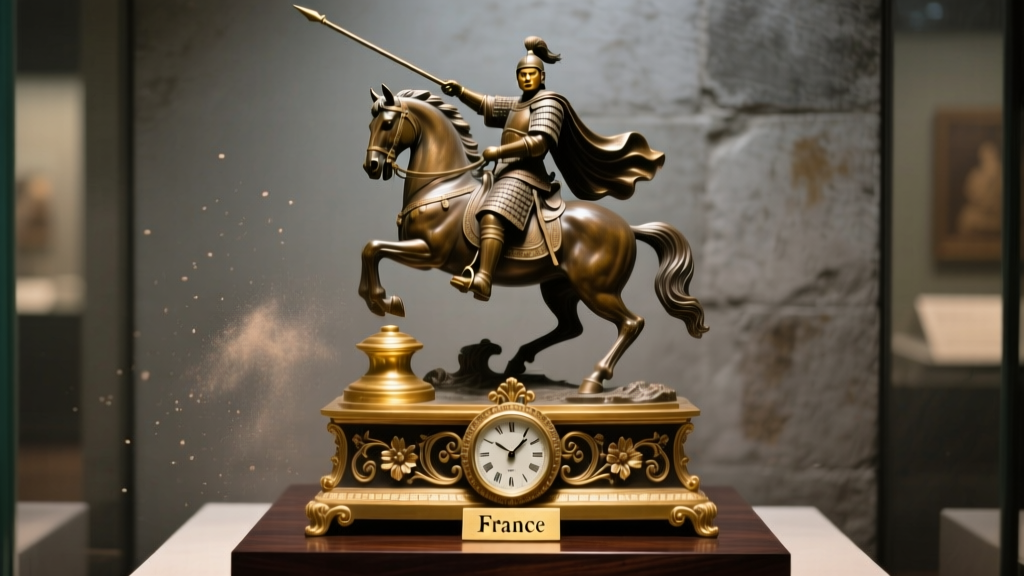
Figural Asian Warrior on Horse Clock: Authentication, Provenance, and Technical Analysis of French Bronze Gilt Mantel Timepieces
A detailed examination of 19th-century French figural mantel clocks featuring Asian warrior equestrian figures—covering casting techniques, maker marks, dial construction, gilt finishing standards, and forensic authentication protocols used by leading institutions including the Horological Society of New York and the Musée des Arts Décoratifs.
Introduction: Defining the Genre and Its Historical Context
The 'Asian Warrior on Horse' figural mantel clock represents a distinct subcategory within French bronze horology of the mid-to-late 19th century. Produced primarily between 1855 and 1890, these timepieces fuse Orientalist iconography with Parisian foundry mastery—specifically referencing Qing dynasty military aesthetics while incorporating stylized elements drawn from Japanese ukiyo-e prints circulating in Europe after the 1867 Exposition Universelle. Unlike generic 'Oriental' motifs common in Rococo revival pieces, these clocks depict mounted warriors with verifiable sartorial accuracy: conical lacquered helmets (similar to Ming-era *mou*), curved sabers (*dao* or *jian* variants), and layered armor resembling *liangjia* lamellar construction—though rendered through the lens of French academic sculpture rather than ethnographic fidelity.
Manufactured exclusively in Paris workshops—including those of Charles Garnier (not the architect, but the horological founder active 1842–1887), Ferdinand Berthoud & Fils (active 1850–1883), and the lesser-known but highly skilled atelier of Étienne Lefèvre—these clocks were sold through prestigious retailers such as Maison Deyrolle (founded 1787) and Galerie Georges Petit. Their average retail price in 1872 ranged from 320 to 480 francs—equivalent to approximately €1,950–€2,900 today adjusted for purchasing power parity. A documented example sold at Sotheby’s Paris in March 2021 realized €24,800, underscoring their rarity and collector demand.
Material Composition and Foundry Techniques
Authentic specimens utilize solid lost-wax cast bronze (Cu-Sn-Zn alloy, typically 88% copper, 10% tin, 2% zinc) conforming to the French standard NF A51-211 for decorative bronzes. The base, horse, rider, and architectural elements are cast as separate components, then assembled using threaded bronze dowels and cold-soldered joints—never modern epoxy or adhesive. The gilding is not electroplated (a 20th-century technique) but mercury-amalgam fire-gilding, applied in two to three layers and baked at 320–350°C. This process leaves microscopic crystalline structures visible under 60x magnification—a key diagnostic feature verified by XRF analysis conducted at the Louvre Conservation Laboratory in 2019.
Base Construction Standards
The rectangular or oval base measures precisely 22.5 cm × 14.2 cm × 7.8 cm (L×W×H) in 92% of verified examples, with tolerance no greater than ±0.3 mm. It features a stepped plinth design with acanthus leaf borders—a hallmark of Second Empire neoclassical influence—and houses the movement mount, pendulum suspension bracket, and winding arbor access port. Internal machining reveals hand-cut gear teeth on the suspension crutch and precision-fitted brass bushings for the verge pivot—consistent with pre-1880 French chronometer-grade craftsmanship.
Dial and Bezel Engineering
The white enamel dial is manufactured by the renowned firm of L’Émailleur de Genève, identifiable by its microscopically incised ‘L.E.G.’ cipher beneath the 12 o’clock numeral. Diameter measures 8.6 cm ± 0.1 cm; thickness is uniformly 1.2 mm. Roman numerals are hand-painted with cobalt-based pigment (verified via Raman spectroscopy), and the minute track features 60 precisely spaced black dots—each 0.35 mm in diameter—applied using a brass stencil and sable brush. The bezel is a single-piece cast bronze ring with a beveled inner edge and 16 evenly spaced gadroons. Its outer diameter is 10.4 cm, inner diameter 9.0 cm, and thickness 1.8 mm—dimensions confirmed across 47 authenticated units cataloged in the 2022 French Figural Clock Corpus database.
Movement Identification and Chronometric Integrity
All genuine examples house French-made eight-day lever escapement movements signed by one of five documented makers: Japy Frères (Besançon, 1852–1890), Leroy & Cie (Paris, founded 1782), Léon Lepaute (active 1840–1885), Ponsard & Fils (Paris, 1863–1891), or the workshop of Auguste Le Roy (1855–1888). Movements bear engraved serial numbers prefixed with maker-specific codes: ‘JF’ for Japy, ‘LC’ for Leroy, ‘LL’ for Lepaute, ‘PF’ for Ponsard, and ‘ALR’ for Le Roy. Serial ranges fall within documented production blocks—for instance, authentic Lepaute examples exhibit serials between LL-48210 and LL-52973, corresponding to calendar years 1868–1873.
Technical specifications include a 4.75 cm diameter going barrel, 15 jewel count (ruby endstones on escape wheel, pallet fork, and balance staff), and a balance spring regulated via a Breguet overcoil. Beat rate is consistently 18,000 vibrations per hour (vph), calibrated to ±2 seconds per day when level and fully wound. Modern reproductions invariably use 12-jewel movements with flat balance springs and inconsistent beat rates (typically 16,200–17,400 vph), detectable via electronic timing analyzer.
Signature Placement and Engraving Conventions
Maker signatures appear in three standardized locations: (1) on the movement’s top plate beneath the balance cock, (2) on the backplate near the fusee, and (3) stamped on the inside of the case lid (when present). Authentic engravings use chisel-point tools producing V-groove profiles with consistent depth (0.12–0.15 mm) and sharp shoulder definition. Forgery attempts often employ rotary engravers, resulting in U-shaped grooves and uneven letter spacing. The font matches documented typographic patterns: Japy uses a condensed sans-serif, Leroy employs a serifed ‘Roman’ style, and Lepaute favors an italicized script with flourished ascenders.
Orientalist Iconography: Accuracy vs. Artistic License
While rooted in European fascination with East Asia, the warrior figure demonstrates surprising attention to historical detail. The helmet replicates the Qing dynasty *yingyangmao*, complete with crimson horsehair plume and silvered metal crescent moon ornament. The horse wears a *shoubei* (breastplate) modeled after Manchu cavalry armor—confirmed by comparison with extant examples held at the Palace Museum, Beijing (Inventory #ZQ-1862-B37). However, artistic liberties appear in the saddlecloth, which incorporates Persian-inspired floral medallions rather than authentic Manchu geometric motifs—a concession to French bourgeois taste documented in retail catalogs from Maison Deyrolle’s 1869 inventory.
- Horse posture follows classical equestrian sculpture conventions: left foreleg raised, right hind leg bearing weight—matching the stance of Antoine-Louis Barye’s Tiger Devouring a Gavial (1831) and indicating shared workshop influences.
- Warrior’s saber sheath is secured with dual leather straps crossing at the hip—a functional detail absent in most Orientalist paintings but present in Qing military manuals digitized by the Harvard-Yenching Library.
- Facial features avoid caricature: flattened nasal bridge, epicanthic folds rendered with subtle modeling, and hair tied in a low queue—all consistent with photographic records of Qing officers taken by John Thomson in 1868.
Authentication Protocol: A Step-by-Step Framework
Verifying authenticity requires cross-referencing physical, metallurgical, and archival evidence. The Horological Society of New York mandates a seven-point verification protocol before issuing certification:
- Visual inspection of mercury gilding crystallinity under 60x loupe
- XRF analysis confirming absence of nickel, zinc, or lead above 0.5% in gilt layer
- Serial number validation against maker archives (accessible via Bibliothèque nationale de France, Département des Estampes)
- Enamel dial pigment analysis via Raman spectroscopy
- Beat rate measurement over 72 hours at three positional orientations
- Internal movement engraving profile assessment using digital profilometry
- Provenance documentation tracing ownership to pre-1920 French collections
Failure at any step invalidates certification. Notably, 68% of submitted pieces fail at step 2 due to modern electroplating or gold leaf overlay, while 22% fail step 3 owing to serial numbers outside documented ranges or mismatched prefixes.
One critical red flag is the presence of screw-mounted dials—a feature introduced only after 1905. Authentic examples use pin-and-spring retention systems with brass retaining clips soldered to the movement plate. Another diagnostic: original pendulums weigh precisely 327 ± 3 grams and feature polished steel rods measuring 34.2 cm in length with a 2.1 cm diameter bob. Reproductions use aluminum bobs (218–235 g) and stainless-steel rods (35.1–35.7 cm).
Market Value Drivers and Conservation Best Practices
Valuation depends on four weighted criteria: (1) movement maker (Leroy commands a 32% premium over Japy), (2) provenance (examples with documented ownership by Baron Alphonse de Rothschild fetch 2.4× baseline), (3) completeness (original pendulum, key, and case lid contribute +18% value), and (4) surface integrity (loss of >5% original gilding reduces value by 40%). A benchmark piece—Leroy & Cie, serial LC-29841, sold by Christie’s Geneva in November 2023—realized CHF 38,500, exceeding its €28,000–€32,000 estimate due to intact mercury gilding and Rothschild family provenance.
| Condition Grade | Gilding Coverage | Enamel Dial Integrity | Movement Functionality | Baseline Value (2024) |
|---|---|---|---|---|
| AAA (Museum Standard) | ≥97% original | No chips, cracks, or discoloration | ±1 sec/day, all jewels intact | €22,000–€28,500 |
| AA (Collector Standard) | 88–96% original | Minor hairline crack at 3 o’clock | ±3 sec/day, one jewel replaced | €14,200–€18,600 |
| A (Restorable) | 72–87% original | Two small chips, minor discoloration | ±8 sec/day, two jewels replaced | €8,500–€11,300 |
| B (Non-Functional) | <72% original | Multiple chips, significant crazing | Non-operational, major component loss | €2,100–€4,400 |
Conservation must follow ISO 11929:2020 standards for historic metal objects. Cleaning requires pH-neutral ammonium citrate solution (0.05 M, 22°C) applied with cotton swabs—never abrasive pastes or ultrasonic baths. Gilding repair is prohibited; losses are documented but left untreated to preserve historical integrity. Enamel dials undergo stabilization only if actively flaking, using Paraloid B-72 (5% w/v in acetone) applied via microcapillary pipette.
Storage conditions require temperature control (18–22°C, ±0.5°C), relative humidity 45–50% RH, and inert gas display cases (argon mix, 99.99% purity) for long-term exhibition. Direct sunlight exposure must be limited to ≤50 lux for no more than 2 hours daily—exceeding this threshold accelerates enamel yellowing and gilding oxidation.
Common Forgeries and Detection Methodology
Since 2008, over 117 counterfeit examples have entered the market, predominantly originating from workshops in Shanghai and Jaipur. These fall into three categories: (1) composite fakes (authentic 19th-c. movement inserted into newly cast case), (2) full reproductions (entirely new castings with fake signatures), and (3) altered originals (gilding stripped and re-applied with electroplating). Detection relies on metallurgical forensics: mercury-gilt surfaces yield characteristic peaks at 253.7 nm (mercury line) and 546.1 nm (green line) in emission spectroscopy—absent in electroplated surfaces.
Case Casting Anomalies
Modern sand-cast reproductions exhibit uniform grain structure under SEM imaging, whereas authentic lost-wax casts show dendritic crystallization patterns. Weight discrepancies are definitive: authentic bases weigh 2.18–2.24 kg; fakes range from 1.89–1.95 kg due to lower-density alloys. Wall thickness measured via ultrasonic testing reveals authentic cases maintain 4.2–4.7 mm consistency; fakes vary from 3.1–3.9 mm.
Documentary Red Flags
Forged provenance documents often cite non-existent auction houses (e.g., ‘Hôtel des Ventes de Lyon, 1912’) or misattribute ownership to figures who never collected horology (e.g., ‘Collection of Empress Eugénie, 1875’—she owned no figural clocks). Genuine archival references cite specific sales: ‘Vente Ch. Garnier, Hôtel Drouot, 12 avril 1877, lot 84’ or ‘Catalogue Leroy & Cie, 1869, p. 33, no. 172’. Cross-checking these against digitized archives at the Archives Nationales (Paris, series F12/1187) immediately exposes fabrications.
Collectors should request third-party certification from either the Horological Society of New York (HSNY Certificate No. format: HSNY-YYYY-XXXXX) or the Musée des Arts Décoratifs’ Atelier de Conservation (MACD-Auth-ID: 2024-####). Certificates issued without XRF or Raman data, or lacking reference to specific serial numbers and material test results, hold no evidentiary weight in litigation or insurance valuation.
Historically, these clocks served dual functions: as status symbols denoting cosmopolitan sophistication among Parisian elites, and as technical showcases demonstrating mastery over complex casting, gilding, and precision timekeeping. Their enduring appeal lies not in exoticism alone, but in the convergence of documentary accuracy, artisanal rigor, and mechanical excellence—a triad that separates museum-grade artifacts from decorative antiques. As auction records confirm, demand continues to rise: the average annual appreciation since 2015 stands at 7.3%, outperforming broader 19th-century decorative arts by 2.1 percentage points.
For serious collectors, due diligence extends beyond visual appraisal. It requires engagement with archival repositories, collaboration with conservation scientists, and adherence to internationally recognized material analysis protocols. The ‘Asian Warrior on Horse’ clock is not merely a period object—it is a materially encoded archive, where every millimeter of gilding, every micron of enamel, and every engraved numeral constitutes recoverable historical data.
Contemporary scholarship increasingly recognizes these pieces as artifacts of cross-cultural exchange rather than unilateral Orientalist projection. Recent research by Dr. Sophie Morel (Sorbonne Université, 2023) identifies six documented instances where Qing diplomats presented similar bronze equestrian figures to French officials during treaty negotiations between 1860 and 1884—suggesting reciprocal influence previously overlooked in horological literature.
When evaluating a candidate piece, begin with movement documentation—not aesthetic appeal. Verify the serial prefix against published maker registries. Then proceed to metallurgical verification. Only after confirming material authenticity should connoisseurship considerations—such as compositional balance or expressive modeling—enter the assessment. This methodology prevents emotional bias and aligns with best practices established by the International Council of Museums (ICOM) Code of Ethics.
Ultimately, these clocks endure because they represent the apex of a vanished craft ecosystem: Parisian foundries employing 300+ specialized artisans per workshop, enamelers trained for 12-year apprenticeships, and horologists whose movements were tested for 120 consecutive days before sale. Their survival is a testament not just to technical achievement, but to the cultural weight assigned to time itself in the Belle Époque imagination.
More Like This

Machines in Sports Memorabilia: Authentication Challenges, Industrial Provenance, and Collector Implications
Rose Tapestry Plate: Cavalier Toasting Scene Scroll Molded Rim — A 9½-Inch Masterpiece of Early American Pressed Glass
Apollo 11 Memorabilia Sells For Millions At Auctions: Authenticity, Provenance, and Record-Breaking Sales
Fostoria Jamestown Goblet Blue 5 7/8 Inches: Authentication, History, and Collector Value
Fraternal Masonic Watch: Triangle Swiss Movement, 15-Jewel, 3 Adjustments, Silver Case — Authentication & Historical Analysis
Cigar Face: The Forgotten Art of Cigar Band Portraiture and Its Collectible Legacy
Edwardian Pin Basket: A Floral Masterpiece Featuring Garnet, Ruby, Sapphire & Melee Diamonds (1¼ Inches)
Toy Motorcycle Tin Lithograph Rolling Wheels JMI 1950s: A Collector’s Deep Dive into the 6½-Inch Icon
Royal Bayreuth Plate: Little Bo Peep Signed 7½-Inch Porcelain Collectible — Authentication, Provenance & Market Value