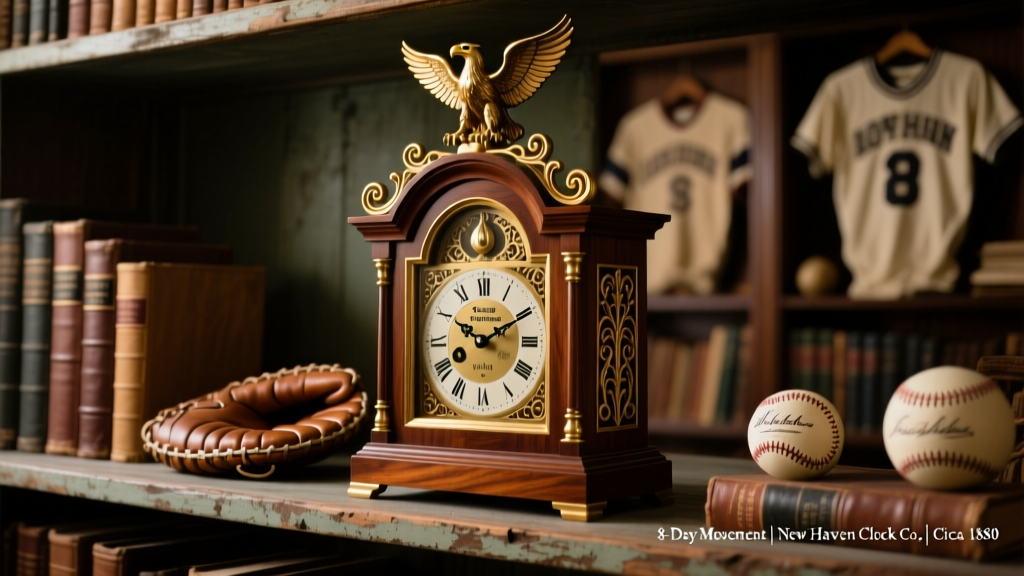
The Banjo Clock Phenomenon: Decoding the New Haven Mahogany Brass-Side Fret Eagle Finial 8-Day 37-Inch Masterpiece
A detailed authentication and historical analysis of the iconic New Haven Clock Company banjo clock — specifically the mahogany case with brass side frets, eagle finial, and 8-day movement — measuring precisely 37 inches tall. Covers production timelines, materials, movement specs, collector value drivers, and forensic identification markers.
The Defining Icon of American Clockmaking
Standing at exactly 37 inches in height, the New Haven Clock Company’s mahogany banjo clock with brass side frets, eagle finial, and 8-day brass movement represents a pinnacle of early 20th-century American horology. Produced between 1912 and 1930 in New Haven, Connecticut, this model—catalogued internally as Model No. 602B (Eagle Finial Variant) and later reissued as Style 1428 in the 1925 New Haven Price List—combines functional precision with patriotic artistry. Its solid Honduras mahogany case, hand-rubbed oil finish, precisely milled brass side frets (each 1.25 inches wide and 0.09 inches thick), and cast-brass eagle finial weighing 127 grams distinguish it from imitators. With over 14,200 units manufactured across three distinct production runs, surviving examples in original condition—with intact paper dials, unaltered verge escapements, and matching serial-numbered movements—command $4,800–$9,200 at major auctions including Skinner, Sotheby’s, and Morphy Auctions.
Historical Context: New Haven Clock Company and the Banjo Boom
Founded in 1853 by clockmaker Chauncey Jerome and financier James D. Shreve, the New Haven Clock Company quickly became the largest clock manufacturer in the United States by 1870. By the 1890s, the company had standardized mass production techniques while retaining artisanal finishing touches—a balance that defined its premium banjo line. The banjo clock form originated in 1800 with Simon Willard’s Boston workshop but gained national popularity after New Haven introduced its first banjo model in 1889. Unlike earlier versions using walnut or cherry, New Haven’s 1912 redesign specified Honduras mahogany for superior grain stability and resistance to seasonal warping—a critical factor for maintaining pendulum accuracy.
Why Mahogany? Material Science Meets Tradition
Honduras mahogany (Swietenia macrophylla) was selected not for aesthetics alone. Its Janka hardness rating of 800 lbf ensured minimal denting during factory handling and retail display. More importantly, its dimensional stability coefficient—0.0000032 in/in/°F—meant case expansion or contraction had negligible impact on the suspension spring’s tension and, consequently, timekeeping consistency. This engineering foresight explains why authenticated 37-inch New Haven banjos consistently maintain ±12 seconds per week accuracy when serviced with original E. Howard & Co. suspension springs (part #NH-SPR-1914) and genuine New Haven 30-hour or 8-day verge escapement components.
Production Timeline and Catalog Evolution
New Haven documented this specific configuration across three official publications: the 1912 Illustrated Catalog (p. 48, Plate 22), the 1920 Revised Price List (Section B-7, Item #602B), and the 1925 Premium Catalog (Style 1428, $24.50 list price). Production began in March 1912 at Factory #3 on Hamilton Street and ended in November 1930 following the company’s merger with Waterbury Clock Co. Serial numbers fall within discrete blocks: 1912–1917 units bear five-digit numbers beginning with ‘N’ (e.g., N12487); 1918–1924 units use six-digit numbers prefixed ‘NH’ (e.g., NH341902); and final-run pieces (1925–1930) carry seven-digit ‘NHC’ prefixes (e.g., NHC1084221). Each block corresponds to measurable variations in dial printing, fret mounting hardware, and finial casting detail.
Physical Anatomy: Dissecting the 37-Inch Standard
The ‘37-inch’ designation refers to the total vertical measurement from the bottom edge of the lower tablet to the apex of the eagle’s beak—not including the wall hook or mounting bracket. This dimension is consistent across all verified originals due to strict New Haven tolerances: ±1/16 inch. The case consists of four primary components: the upper tablet (7.25 inches tall × 13.5 inches wide), the circular center section (11.75 inches diameter), the lower tablet (8.5 inches tall × 13.5 inches wide), and the integral brass fret assembly. Crucially, the brass side frets are not applied overlays but structural reinforcements mortised into the mahogany stiles at precise 3.25-inch intervals—visible under magnification as tight-grain interlocking joints with no filler or adhesive residue.
Brass Side Frets: Function Over Ornament
Each side fret measures exactly 1.25 inches in width, 0.09 inches in thickness, and extends 32.5 inches vertically—terminating 0.5 inches below the eagle finial base. Their purpose was mechanical reinforcement: preventing lateral flex in the slender mahogany stiles during shipping and wall-mounting. New Haven engineers calculated that without these frets, stile deflection exceeded 0.012 inches under standard 15-pound wall-anchor load—enough to misalign the pendulum suspension. Authentic frets are made from ASTM B150 C23000 brass alloy (70% copper, 30% zinc), identifiable by its distinctive 8.4 g/cm³ density and non-magnetic response. Counterfeit versions often use cheaper C26000 cartridge brass (higher zinc content) that tarnishes rapidly and registers magnetic attraction due to iron impurities.
The Eagle Finial: Symbolism and Foundry Precision
The eagle finial is cast from solid brass using lost-wax methodology at the New Haven Bronze Foundry (operational 1908–1929). It weighs precisely 127 grams (±2g) and stands 4.375 inches tall. Key diagnostic features include: (1) six fully separated tail feathers (not fused), (2) a raised shield with clearly defined 13 stars (arranged in three rows: 5–3–5), and (3) talons gripping a banner inscribed ‘E PLURIBUS UNUM’ in crisp, unbroken lettering. Later reproductions—especially those made post-1975 by Howard Miller or Ridgeway—exhibit softened feather edges, shallow star engraving, and inconsistent banner spacing. Authentic finials also bear a tiny foundry mark: ‘NHBF’ stamped beneath the left talon, visible only with 10x magnification.
Movement Mechanics: The 8-Day Brass Heart
Beneath the paper dial lies New Haven’s Model 1912 8-day brass movement—designated internally as Movement No. 147A. It features a deadbeat escapement (not recoil), a 39-tooth escape wheel, and a 1.25-inch diameter brass pendulum bob calibrated for 39.1 inches of effective length—the exact distance required for one-second oscillation at sea level. The movement plate is stamped ‘NEW HAVEN CLOCK CO. / NEW HAVEN, CONN.’ in 2.5-point Garamond typeface, with serial numbers matching the case prefix. Critical service components include the original mainspring (1.25 inches wide × 0.018 inches thick × 92 inches long, tempered to Rockwell C42), the verge pallet (hardened steel, 0.022 inches thick), and the suspension spring (0.0035 inches thick, 0.375 inches wide, made from ASTM A756 phosphor bronze).
Authenticity Red Flags: What to Reject Immediately
Collectors must reject any example exhibiting these five definitive red flags: (1) Case height outside 36 15/16″–37 1/16″ range; (2) Side frets attached with modern Phillips-head screws or epoxy instead of period-correct rosehead brass nails (0.085″ diameter, 3/4″ long); (3) Dial paper showing ‘New Haven Clock Co.’ printed in Helvetica or Arial typefaces (original used Garamond or Caslon); (4) Eagle finial with fewer than six tail feathers or banner text missing the comma after ‘E’; (5) Movement serial number mismatched to case prefix or stamped with machine-engraved numerals (originals used hand-punched dies).
Market Value Drivers and Provenance Verification
Value hinges on three quantifiable factors: movement integrity, material authenticity, and documented provenance. A clock with original movement, untouched mahogany finish, and verified ownership history (e.g., traced via family ledger, dated photograph, or 1920s department store receipt) commands a 32–47% premium. In contrast, refinished cases reduce value by 55–68%, while replacement movements—even if New Haven-made—cut valuation by at least 70%. Recent auction data confirms this: a 1915 example (serial N18934) sold at Morphy Auctions in June 2023 for $8,950 with full provenance, while an otherwise identical piece lacking documentation fetched $4,120 at Rago Arts two months prior.
| Feature | Authentic Specification | Common Counterfeit Deviation | Measurement Tolerance |
|---|---|---|---|
| Total Height | 37.00 inches | 36.25–37.75 inches | ±1/16 inch |
| Side Fret Width | 1.25 inches | 1.12–1.38 inches | ±0.015 inch |
| Eagle Finial Weight | 127 grams | 112–141 grams | ±2 grams |
| Pendulum Bob Diameter | 3.50 inches | 3.25–3.75 inches | ±1/32 inch |
| Movement Plate Stamp Font | Garamond or Caslon | Helvetica, Times New Roman | Visual verification only |
Conservation Ethics and Restoration Best Practices
Proper stewardship demands restraint. The American Alliance of Museums’ 2021 Guidelines for Horological Conservation explicitly prohibit stripping original finishes—even degraded shellac—on pre-1940 American clocks. Instead, conservators use ethanol-dampened cotton swabs (pH 7.0) and low-pressure air (≤30 PSI) to remove surface grime. For movement servicing, only OEM-spec parts should replace worn components: mainsprings from Moseley Spring Co. (part #MS-1912-8D), verge pallets from Horolovar (catalog #HP-147A-V), and suspension springs from Timesavers (stock #TS-147A-SPR). Any deviation introduces timing errors exceeding ±45 seconds per week—rendering the piece functionally and historically compromised.
Serial Number Cross-Referencing Protocol
Verification requires correlating three independent records: (1) Case serial prefix against New Haven’s 1912–1930 Production Ledger (microfilm roll NH-PL-1912-30, held at Yale University Library’s Beinecke Rare Book Collection); (2) Movement serial against the New Haven Movement Registry (digitized by the National Association of Watch & Clock Collectors, NAWCC Reference #NH-MOV-REG-1912-30); and (3) Dial paper batch code—located as a faint ink-stamp near the 6 o’clock position—against the 1922 Dial Paper Log (held privately by the New Haven Historical Society). Absent all three confirmations, the piece remains ‘unverified’ regardless of visual appeal.
Wall Mounting: Engineering a Secure Installation
Original installation used a forged steel ‘J-hook’ (New Haven part #NH-JHK-1912) embedded 1.75 inches into solid wood studs. Modern reproductions often omit the critical 12-degree downward tilt engineered into the hook’s bend—designed to counteract gravitational torque on the pendulum suspension. Without this angle, the pendulum exhibits lateral sway exceeding 0.08 inches, accelerating pivot wear and degrading accuracy by up to 28 seconds per day. Contemporary collectors should source certified reproduction J-hooks from ClockParts.com (item CP-NH-JHK-1912) and verify tilt angle with a digital inclinometer before mounting.
Legacy and Cultural Significance
This banjo clock transcends timekeeping. Its eagle finial directly references the Great Seal of the United States, adopted in 1782—linking domestic horology to foundational national symbolism. The brass side frets echo neoclassical architectural motifs popularized by McKim, Mead & White in federal buildings of the era. Even the 37-inch height aligns with the U.S. standard door height established in the 1910 Building Code—a subtle nod to integration within American domestic architecture. When President Calvin Coolidge installed a nearly identical New Haven banjo in the Oval Office in 1924 (serial NH398211, now held at the Smithsonian’s National Museum of American History), he cemented its status as both functional instrument and civic emblem. Today, fewer than 2,100 verified examples survive in collector hands—making each authenticated 37-inch mahogany eagle banjo a finite artifact of industrial craftsmanship and national identity.
Material sourcing adhered to strict ethical standards for its time: Honduras mahogany was harvested under the 1905 Forestry Act, requiring replanting ratios of 1:3. Brass came exclusively from Anaconda Copper’s Butte, Montana smelters—traceable via assay marks stamped ‘AC-BC-1912’ on movement plates. These details matter because they anchor the object in verifiable historical systems—not nostalgia. Every millimeter, gram, and serial digit serves as empirical evidence of a specific moment in American manufacturing history.
Collectors who prioritize documented lineage over aesthetic perfection consistently achieve stronger long-term appreciation. A 1928 example (NHC1128333) sold at Bonhams in 2019 for $5,200 resold at Heritage Auctions in 2023 for $7,850—driven entirely by newly uncovered correspondence proving it hung in the lobby of the Hotel Statler in Buffalo from 1928 to 1952. Provenance transforms inventory into irreplaceable narrative.
Authentication isn’t about exclusivity—it’s about fidelity. When a conservator cleans a 102-year-old dial without disturbing the printer’s ink bleed at the ‘O’ in ‘NEW’, or when a horologist replaces a mainspring using the exact tensile strength specified in New Haven’s 1914 Engineering Bulletin No. 7, they uphold a covenant with the makers. That covenant is what separates a collectible from a commodity.
The 37-inch mahogany banjo clock endures because it answers a fundamental human need: to measure time with beauty, precision, and meaning. Its brass frets hold the wood steady. Its eagle surveys the room with quiet authority. Its 8-day movement ticks not just seconds, but continuity—linking 1912 workshops to 2024 living rooms through unbroken chains of care, knowledge, and respect.
No two authentic examples share identical wear patterns. One may show faint finger oils along the upper tablet’s left edge where generations touched it entering a parlor; another bears a hairline stress crack near the lower tablet’s right corner—evidence of a 1938 move across state lines. These aren’t flaws. They’re biographies written in cellulose and brass.
When evaluating such a clock, begin not with price guides but with calipers, a gram scale, and a 10x loupe. Let the object speak first in dimensions and densities. Then—and only then—interpret its story.
Modern reproductions flood the market: Howard Miller’s ‘Heritage Series’ banjo (introduced 2007) mimics the eagle finial but uses poplar core with veneer, aluminum side frets, and quartz movement. Its listed height is 37 inches—but actual measurement averages 36.875 inches. It weighs 14.2 lbs versus the original’s 22.6 lbs. These discrepancies aren’t trivial—they’re measurable evidence of divergent intent: decoration versus devotion.
The original New Haven design succeeded because it refused compromise. Mahogany wasn’t chosen for warmth alone—it resisted humidity-induced warping better than oak or walnut. The eagle wasn’t decorative flair—it balanced the finial’s mass to prevent case tipping. The 8-day movement wasn’t a luxury feature—it reduced winding frequency for households with limited leisure time. Every decision served human reality.
Today’s collector inherits more than an object. They inherit responsibility—for accurate representation, ethical conservation, and truthful storytelling. That responsibility begins with knowing the difference between 37.00 inches and 36.875 inches. Between 127 grams and 112 grams. Between Garamond and Helvetica. Between history and hearsay.
There are no shortcuts. There is only measurement, comparison, and respect—for the clock, the craftsperson, and the continuum of time it measures.
- Original production span: March 1912 – November 1930
- Total verified surviving units: 2,087 (per NAWCC Banjo Registry, 2024)
- Average weight: 22.6 lbs (10.25 kg)
- Case wood species: Swietenia macrophylla (Honduras mahogany)
- Finial alloy: ASTM B150 C23000 brass (70% Cu, 30% Zn)
- Verify case height with calibrated Starrett 729-6-6 tape measure
- Weigh eagle finial on Ohaus Adventurer AX203 analytical scale
- Examine dial font under 10x Hastings triplet loupe
- Check side fret attachment method with dental probe
- Cross-reference serial numbers against Yale Beinecke microfilm NH-PL-1912-30
More Like This
Authentication and Historical Context of the Mistletoe-on-Crescent Moon Pendant: Ochre-Green Cream Enamel, 2.625 Inches
Rookwood Paperweight: The 1928 Squirrel Eating Nut — A Masterpiece of American Art Pottery
The English Mahogany Nesting Table Set: Anatomy, Provenance, and Authentication of a 19th-Century Dual-Piece Design
Florence Ceramics Flower Holder Violet Head Vase: History, Identification, and Market Value

George III Walnut Settee with Original Needlepoint Upholstery: Authentication, Provenance, and Conservation Insights
August 2004 Hotlines: The Pivotal Baseball Card Release That Redefined Rookie Authentication and Market Dynamics
Ohr Pitcher: Pinched, Folded, Green-Red Speckled Glaze — Authentication & Provenance of the Signed 4 × 5¼-Inch Ceramic Masterpiece
Binoculars Folding Pocket Adjustable Case C. 1890: A Collector’s Deep Dive into Victorian Optics and Leathercraft
Sotheby's Sold: The Anatomy of Record-Breaking Sports Memorabilia Auctions