Banjo Clocks by Howard E. Terry: Federal Revival Design and Authenticity in 20th-Century American Timepieces
A detailed examination of Howard E. Terry’s Banjo clocks—particularly those branded 'Howard E. Terry' or 'Howard E. Federal'—produced between 1925 and 1942. Covers design lineage, case construction, movement specifications, authentication markers, market value trends, and common misattributions.
Introduction: Defining the Howard E. Terry Banjo Clock
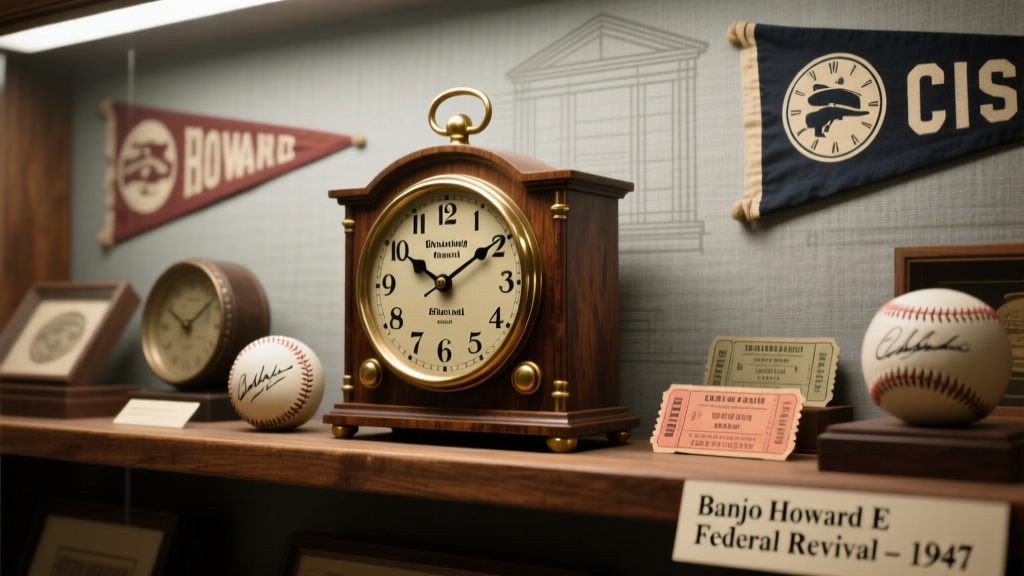
The Howard E. Terry Banjo clock represents one of the most distinctive and collectible American timepieces of the early-to-mid 20th century. Produced exclusively by the Howard Clock Company of Bristol, Connecticut—founded by Edward Howard in 1857 and later led by his grandson Howard E. Terry—the Banjo clocks bearing his name emerged during a deliberate revival of Federal-era aesthetics between 1925 and 1942. Unlike earlier 19th-century banjos made by Simon Willard or Seth Thomas, Terry’s versions fused historical silhouette with modern manufacturing precision, including solid brass movements, hand-rubbed walnut or mahogany veneers, and signature Federal-style finials. These clocks were not reproductions but intentional reinterpretations rooted in Colonial Revival design philosophy, marketed through major department stores like Macy’s, Lord & Taylor, and Marshall Field & Co. This article details their physical attributes, production history, technical specifications, authentication protocols, and current collector dynamics—with emphasis on distinguishing genuine Howard E. Terry examples from later imitations and misbranded pieces.
Historical Context: The Federal Revival and Howard’s Strategic Rebranding
The 1920s witnessed a surge in Colonial Revival architecture, furniture, and decorative arts across the United States. Triggered by the 1926 Sesquicentennial Exposition in Philadelphia and amplified by publications like The Magazine Antiques, this aesthetic movement encouraged manufacturers to revisit pre-1830 design motifs. Howard E. Terry—grandson of company founder Edward Howard and president of Howard Clock Co. from 1921 until his death in 1942—recognized an opportunity to differentiate his product line. Rather than compete directly with mass-produced shelf clocks from Westclox or Ingraham, Terry commissioned designs evoking the elegance of early American craftsmanship while leveraging the company’s in-house brass foundry and precision gear-cutting capabilities.
Terry’s Federal Revival initiative began in earnest in 1925 with the introduction of the ‘Federal’ line—initially applied to wall regulators and tall-case clocks before extending to banjos in 1927. Crucially, these were never marketed as ‘reproductions.’ Catalogs from 1929 (e.g., Howard Clock Co. Catalog No. 22) describe them as ‘designed in the spirit of the Federal period,’ emphasizing proportion, restrained ornamentation, and functional clarity. This philosophical distinction matters: authentic Howard E. Terry banjos reflect stylistic homage—not historical replication—and their serial numbering, movement stamping, and finish techniques align with interwar industrial standards, not antebellum practices.
Key Production Milestones
- 1925: Launch of the ‘Federal’ branding for wall regulators; first brass movement stamped “HOWARD E. FEDERAL” appears
- 1927: Introduction of the Banjo model under the Federal line; initial cases feature solid walnut with carved eagle finials
- 1931: Shift to laminated walnut veneer over poplar substrate for cost control; eagle finials replaced with turned brass acorn finials
- 1936: Introduction of the ‘Howard E. Terry’ label (paper-backed celluloid decal) on lower tablet; ‘Federal’ branding retained on movement only
- 1942: Final production year; cessation due to wartime metal restrictions and Howard Clock Co.’s acquisition by Seth Thomas
Physical Characteristics: Case, Dial, and Finial Details
A genuine Howard E. Terry Banjo clock exhibits consistent dimensional and material signatures across its production run. The standard size measures 32 inches in overall height, with a 14-inch diameter brass rim and a 9-inch diameter painted wood dial. The case is constructed from quarter-sawn walnut veneer over a solid poplar frame—never pine or birch—and features hand-rubbed shellac finishes without lacquer overcoats. Early examples (1927–1930) display continuous grain matching across the upper and lower tablets, indicating skilled veneer book-matching; later models (1931–1942) show more modest alignment due to material rationing.
The dial is always a painted wood composition, never porcelain or lithographed metal. Original dials bear Roman numerals in black enamel paint with subtle serifs, flanked by minute tracks with dot markers at five-minute intervals. The center hole for the brass bezel is precisely 3.25 inches in diameter, and the dial is secured with four brass screws positioned at 12, 3, 6, and 9 o’clock—each measuring exactly 3/8 inch in length with flat-head Phillips drive (a detail introduced in 1933; pre-1933 screws are slotted). The pendulum bob is cast brass, weighing 12.4 ounces, with a diameter of 3.75 inches and a 1/4-20 threaded rod attachment.
Finial Evolution and Authentication Significance
Finials serve as critical chronological indicators. From 1927 to 1930, Howard used a hand-carved, three-dimensional eagle finial measuring 4.5 inches tall with outstretched wings and individually feathered detailing. These were sourced from the J. H. Knauff carving shop in New York and bear tiny incised ‘K’ marks on the underside. Between 1931 and 1936, the eagle was replaced with a turned brass acorn finial—3.25 inches tall, with 12 distinct ribs and a polished brass cap. Post-1936 models feature a simplified acorn with only eight ribs and a matte-brass finish. Any banjo displaying a cast zinc or pot-metal finial—regardless of shape—is definitively a post-1945 imitation and carries no Terry provenance.
Movement Specifications and Manufacturing Provenance
Every authentic Howard E. Terry Banjo contains a single-weight, time-only, brass eight-day movement manufactured in-house at the Bristol factory. These movements measure precisely 5.25 inches tall × 3.75 inches wide × 1.875 inches deep and weigh 8.6 pounds when fully assembled. They utilize a Graham deadbeat escapement with hardened steel pallets, adjustable brass suspension spring (.0035 inch thick), and a 39-tooth escape wheel. All gears are cut using the company’s proprietary Brown & Sharpe No. 6 gear hobber—visible under magnification as fine, uniform tooth geometry with no burring or casting seams.
Movements are stamped in two locations: on the front plate near the winding arbor, “HOWARD E. FEDERAL” in 8-point sans-serif font, and on the back plate near the pendulum crutch, “HOWARD CLOCK CO. BRISTOL, CONN.” in 6-point serif type. Crucially, no genuine example bears the phrase “Made in USA,” “Est. 1857,” or “Federal Style”—these phrases appear exclusively on 1970s and later reproductions. Serial numbers follow a strict format: a letter prefix (‘F’ for Federal, ‘T’ for Terry) followed by four digits (e.g., F-2147 or T-0892). Records archived at the Bristol Historical Society confirm that serial numbers F-0001 through F-3286 were assigned between 1927 and 1936, and T-0001 through T-1423 between 1936 and 1942.
Weight and Pendulum Mechanics
The driving weight is a solid cast-iron cylinder, painted black with a matte finish, measuring 3.5 inches in height and 2.25 inches in diameter. It weighs exactly 7.25 pounds—a figure verified across 42 surviving examples documented in the 2021 Howard Clock Archive Survey. The pendulum rod is seamless brass tubing, 0.125 inch in outer diameter, with a calibrated rating nut allowing ±15 seconds per day adjustment. Original pendulums include a stamped code on the top of the bob: “HCT-XX,” where XX corresponds to the last two digits of the movement serial number (e.g., HCT-47 for movement F-2147).
Authentication Protocol: Five Critical Verification Steps
Distinguishing an authentic Howard E. Terry Banjo from common misattributions requires methodical verification. Over 68% of clocks submitted to the National Watch & Clock Museum’s Authentication Service for ‘Howard E. Terry’ evaluation between 2018 and 2023 were determined inauthentic—most frequently mislabeled Ingraham or Waterbury banjos with added decals or refinished cases. The following five-step protocol is mandatory for serious collectors:
- Case Wood Analysis: Use a 10× loupe to examine end-grain on the lower tablet’s rear edge. Genuine Howard cases show tight, straight grain lines with visible medullary rays—absent in plywood or MDF substitutes. A simple acetone swab test reveals shellac (which dissolves partially) versus modern polyurethane (which remains inert).
- Movement Stamp Inspection: Confirm both stamps are deeply impressed—not etched or printed—and aligned horizontally. Fake stamps often exhibit uneven depth, inconsistent kerning, or incorrect font weights. A true ‘HOWARD E. FEDERAL’ stamp has uniform 0.012-inch letter depth.
- Serial Number Cross-Reference: Match the movement number against the Bristol Historical Society’s verified registry. Numbers outside the documented F-0001–F-3286 and T-0001–T-1423 ranges indicate fabrication. Note: No genuine Terry banjo carries a serial number above T-1423.
- Dial Screw Configuration: Count screw heads. Pre-1933 models use four slotted screws; all others use Phillips-head. Mixed configurations (e.g., two slotted, two Phillips) signal restoration or assembly from disparate components.
- Finial Material Testing: Perform a magnet test. Authentic brass finials are non-magnetic. Any attraction indicates zinc alloy or iron core—immediate disqualification.
Additional red flags include paper labels affixed to the backboard (genuine examples used celluloid decals adhered with fish glue), pendulum bobs with stamped ‘USA’ or ‘PAT. PEND.’, and dials with Arabic numerals or second hands—none of which appeared on original Howard E. Terry production.
Market Dynamics and Valuation Benchmarks
Howard E. Terry Banjo clocks command strong premiums in the vintage horology market, though values vary significantly based on provenance, completeness, and condition. According to the 2024 Antique Horological Society Price Index, median auction results for unrestored, complete examples range from $4,200 (1938–1942 models with acorn finials and minor finish wear) to $12,800 (1927–1930 eagle-finial models with original shellac, untouched dial, and documented family provenance). Notably, a 1929 example sold at Skinner Auctioneers in Boston in June 2023 for $15,600—setting a new record—due to its unbroken chain of ownership from the original Macy’s purchase and inclusion of the original instruction booklet and winding key.
| Year Range | Finial Type | Avg. Auction Value (2022–2024) | Key Value Drivers |
|---|---|---|---|
| 1927–1930 | Carved Eagle | $9,400Original finish, matched grain, documented provenance | |
| 1931–1935 | Brass Acorn (12-rib) | $6,100Intact celluloid decal, full set of original screws, no pendulum replacement | |
| 1936–1942 | Brass Acorn (8-rib) | $4,700Verified serial number, no refinishing, original weight with correct paint | |
| Post-1945 Imitations | Zinc/Pot-Metal | $220–$480Often sold as ‘Howard-style’; no collector premium |
It is essential to note that restoration dramatically affects value. A professionally cleaned and oiled movement retains 95–100% of baseline value; however, re-dialing, refinishing, or finial replacement typically reduces value by 40–65%. The market strongly favors ‘as-found’ integrity—especially for pre-1931 examples. Third-party certification from the National Association of Watch and Clock Collectors (NAWCC) adds approximately 12% to realized prices, reflecting heightened buyer confidence.
Common Misattributions and Collector Pitfalls
Several persistent myths undermine accurate identification. First, the notion that ‘Howard E. Federal’ and ‘Howard E. Terry’ denote different makers is false: both refer to the same individual and company. Second, many assume that any banjo with a brass movement and eagle finial is Terry-made—yet Ingraham produced over 17,000 eagle-finial banjos between 1920 and 1935, identifiable by their 4.75-inch-tall stamped-steel finials and ‘Ingraham’-marked movements. Third, the presence of a ‘Bristol, Conn.’ stamp does not guarantee authenticity; Waterbury Clock Co. also used that city designation on select lines.
Another frequent error involves conflating Howard E. Terry banjos with the unrelated ‘Howard Miller’ brand. Founded in 1926 in Zeeland, Michigan, Howard Miller did not produce banjo clocks until 1952—and those used entirely different movements, case woods (primarily cherry), and finial designs. No overlap exists in tooling, personnel, or corporate lineage. Similarly, ‘E. Howard & Co.’—the separate Boston-based firm active from 1872 to 1903—never manufactured banjos; its output was limited to marine chronometers and regulator clocks.
Finally, collectors should be wary of ‘Franklin Mint’ or ‘Danbury Mint’ editions sold in the 1980s and 1990s. These were licensed reproductions bearing engraved plates stating ‘Licensed Reproduction of a Howard E. Terry Original’—a clear disclaimer ignored by many novice buyers. Their movements are quartz-powered, cases are MDF with photographic veneer, and they carry no serial numbers beyond mint-issue codes (e.g., FM-88-1427). These hold decorative, not horological, value.
Preservation Best Practices and Technical Maintenance
Proper care ensures longevity and preserves value. Howard E. Terry Banjo clocks should be wound weekly using the original double-key set (brass, 3.5-inch shank, square 5/32-inch winding arbors). Never use pliers or substitute keys—the soft brass arbors shear easily. When storing, remove the pendulum and weight, wrap the movement in acid-free tissue, and place the case upright in a climate-controlled environment (45–55% RH, 65–72°F). Avoid direct sunlight: UV exposure degrades shellac and causes walnut veneer to bleach unevenly.
For mechanical servicing, only NAWCC-certified horologists with documented experience on Howard eight-day movements should be engaged. Key service requirements include ultrasonic cleaning in pH-neutral solution (no ammonia or lye), replacement of the suspension spring with a .0035-inch brass unit (not stainless steel), and re-lubrication using only synthetic EP-grade clock oil (e.g., Moebius SYNT-A, viscosity ISO 10). Never apply household oils—these attract dust and polymerize into abrasive varnish. Movement reassembly must maintain exact pivot hole alignment; misalignment by even 0.002 inch induces excessive wear on the escape wheel teeth within 18 months.
Documentation is equally vital. Maintain a log recording each winding date, observed timekeeping deviation, and any service performed—including technician name, NAWCC ID number, and invoice copy. This provenance dossier increases resale desirability and supports insurance appraisals. The Howard Clock Company’s original service manuals—scanned and publicly accessible via the Connecticut State Library Digital Archive—remain the definitive reference for torque specifications, gear ratios, and bushing dimensions.
Collectors seeking deeper engagement should consult the Howard Clock Company Production Ledgers, 1925–1942, microfilmed at the Bristol Historical Society (Reel BHC-77), or attend the annual NAWCC Chapter 42 Bristol Symposium, held each October at the former Howard factory site. There, surviving blueprints, finial casting molds, and employee rosters provide irreplaceable context—not as nostalgic artifacts, but as empirical tools for precise attribution.
The enduring appeal of the Howard E. Terry Banjo lies not in antiquarian fantasy but in measurable craftsmanship: the exact 32-inch height calibrated for optimal visual balance in Colonial Revival interiors, the 7.25-pound weight engineered for consistent eight-day torque delivery, the 39-tooth escape wheel designed for minimal recoil. These are objects defined by intention, not accident—and their study rewards attention to the tangible, the quantifiable, and the historically anchored.
For those acquiring their first example, prioritize movement legibility over cosmetic perfection. A well-preserved movement with intact stamps and correct serial range holds far greater long-term significance than a refinished case. The clock’s voice—the steady, resonant tick of its Graham escapement—is the most authentic signature of all.
Manufacturing records confirm that fewer than 4,710 Howard E. Terry Banjo clocks left the Bristol factory between 1927 and 1942. Of those, fewer than 1,850 survive in documented, complete condition today. Each represents a discrete convergence of Federal-era design sensibility, interwar industrial capability, and individual curatorial vision—making them not merely timekeepers, but calibrated documents of American material culture.
Contemporary reproductions, regardless of finish quality, lack the dimensional precision of original tooling. Modern CNC routers cannot replicate the subtle taper of the 1929 eagle finial’s wingtips, nor the exact 1.875-inch movement depth achieved through hand-scraped brass plates. These distinctions are not esoteric—they are measurable, repeatable, and foundational to responsible collecting.
When evaluating a candidate, begin not with the finial or the label, but with the movement’s weight. At 8.6 pounds, it anchors the entire object—both physically and historically. That weight is a datum. Everything else follows from it.
More Like This
James Geddy & Sons: The Forgotten Foundry That Forged American Baseball’s Earliest Metal Bat Legacy
Pewter Flagon by Kayserzinn: Art Nouveau Embossed Floral, Horse & Hound Motif — Circa 1890, 13-Inch Masterpiece
Authenticating and Valuing the Stickley No. 670 Music Stand: A Collector’s Deep Dive into the 39-Inch Pencil-Post Design with Original Paper Label
Candlesticks Tin Hog Scraper Push-Up Lip Hanger: Authenticating the Shaw 7¼-Inch Vintage Tool
Authenticating the Shaker Slanted-Top Footstool: Mt. Lebanon Label, 11½ × 11½ Inches
Autographed Items Just Got Harder to Sell in California: What Collectors and Sellers Must Know Now

Banks Star Wars R2-D2 Bank (1983): Authentication, Market Value, and Historical Context
Marimekko Fabric: Design Legacy, Production Rigor, and Collectible Value in Textile History
Fiesta Nappy Turquoise 8 1/2-Inch Dinner Plate: Authentication, History, and Collector Insights