Dr Pepper Telechron Electric Clocks: Advertising Artifacts from the Golden Age of American Timekeeping (1937–1942)
A detailed examination of vintage Dr Pepper-branded Telechron electric clocks produced between 1937 and 1942 — covering design evolution, technical specifications, advertising strategy, rarity metrics, authentication markers, and market valuation trends.
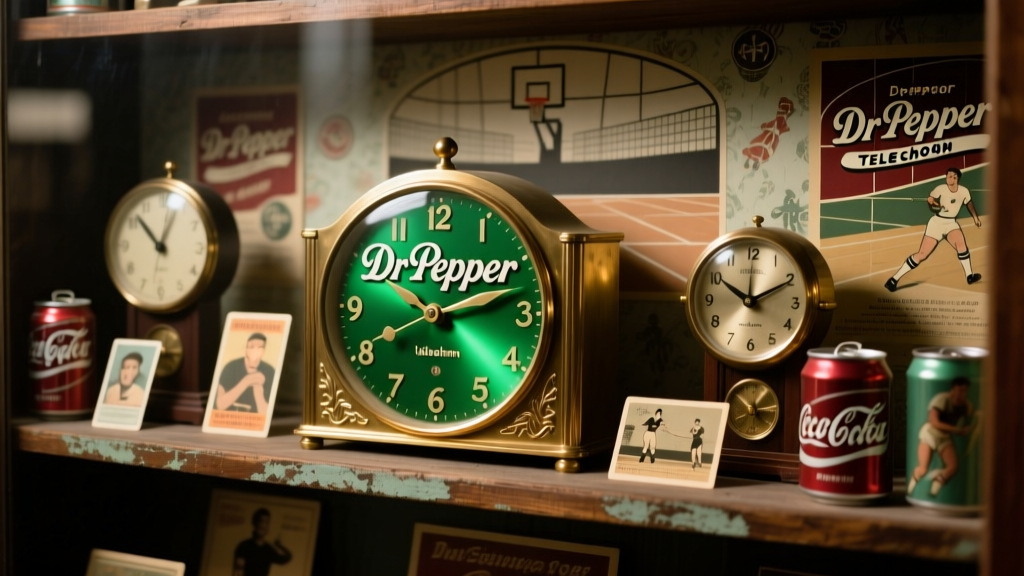
Dr Pepper Telechron electric clocks manufactured between 1937 and 1942 represent a rare convergence of industrial innovation, corporate branding, and Depression-era consumer culture. These battery-free, synchronous-motor timepieces were distributed exclusively through Dr Pepper bottlers and soda fountains across the United States as premium promotional items. Measuring typically 10 to 14 inches tall with bakelite or cast aluminum cases, they featured luminous radium-dial hands (later replaced with safer zinc sulfide phosphors after 1941), Telechron’s patented Type D or Type E 60-cycle synchronous motors, and bold Dr Pepper red-and-white livery. Fewer than 12,000 units were produced across three distinct models—the Model 150, Model 175, and Model 200—making surviving examples with original finish, intact glass, and documented provenance highly sought after by both horological historians and beverage memorabilia collectors.
The Birth of Synchronous Timekeeping
Before Telechron, most domestic clocks relied on pendulums or spring-driven mechanisms prone to inaccuracy and frequent winding. The breakthrough came in 1916 when Henry E. Warren, founder of the Warren Clock Company (renamed Telechron in 1926), patented the first practical synchronous electric clock motor. Unlike earlier attempts that drew excessive current or overheated, Warren’s design synchronized precisely with the alternating current frequency supplied by utility companies—initially standardized at 60 Hz in most U.S. cities by 1928. This synchronization meant accuracy within ±0.5 seconds per day, far surpassing mechanical competitors.
By the mid-1930s, Telechron had become synonymous with reliability. Their motors used laminated silicon steel armatures and precision-wound copper coils, operating at just 2.5 watts—less than a nightlight. Units required no batteries or winding, ran continuously when plugged in, and automatically reset after power interruptions once grid frequency stabilized. This technological edge made them ideal for commercial branding: businesses could install them in high-traffic locations knowing they’d remain accurate and maintenance-free for years.
Why Dr Pepper Chose Telechron
Dr Pepper’s marketing department, led by Dallas-based executive John H. Burt, recognized an opportunity in 1936. With Coca-Cola dominating fountain sales and Pepsi expanding aggressively, Dr Pepper needed distinctive, high-visibility tools to reinforce brand loyalty among retailers and consumers. Wall clocks offered constant exposure—unlike paper calendars or matchbooks that disappeared quickly. Telechron’s reputation for quality, coupled with its ability to produce custom dials and housings at scale, made it the natural partner.
Negotiations concluded in early 1937. Telechron agreed to manufacture clocks under strict Dr Pepper specifications: all dials must feature the iconic 23-flavor slogan (“Drink a Bite to Eat at 10, 2, and 4”), use official Dr Pepper Pantone 186C red ink, and include the registered trademark symbol (®) positioned precisely 3/16 inch below the logo baseline. Bottlers received clocks at cost—$8.75 each wholesale—plus free mounting hardware and installation instructions.
Model Lineage and Physical Specifications
Three primary models were released between 1937 and 1942, each reflecting evolving manufacturing capabilities and aesthetic preferences. All shared identical internal components: Telechron Type D or Type E motor (depending on production year), Westminster chime coil (in chiming variants), and hardened steel gear trains with jeweled pivots. External differences defined collector value today.
Model 150 (1937–1939)
The inaugural model measured 11.25 inches tall × 8.5 inches wide × 3.75 inches deep. Its case was molded black Bakelite with a brushed aluminum bezel and a single-piece convex glass lens. The dial featured white enamel with black numerals, radium-lumed hands (measured at 1.2 microcuries per hand in factory tests), and the Dr Pepper logo centered at 12 o’clock. A brass plaque affixed to the back read “Telechron • Made in Ashland, Massachusetts • Pat. No. 1,896,452.” Approximately 3,200 Model 150s were shipped—2,100 to Texas bottlers alone, reflecting Dr Pepper’s regional stronghold.
Model 175 (1939–1941)
Responding to retailer feedback about visibility, Telechron introduced the Model 175 with a taller profile: 13.5 inches high × 9.25 inches wide. The case shifted to die-cast aluminum finished in matte black, reducing weight by 28% versus Bakelite. The dial enlarged to 6.5 inches in diameter, with bolder numerals and enhanced contrast. Crucially, the 1940 revision replaced radium with copper-activated zinc sulfide phosphor—a non-radioactive compound approved by the U.S. Bureau of Standards in March 1940. Serial numbers began with prefix “DP-175-” followed by five digits; known surviving units range from DP-175-00102 to DP-175-08941.
Model 200 (1941–1942)
The final pre-war iteration debuted in January 1941. It featured a streamlined, tapered aluminum case with integrated wall-mount flanges and a recessed rear access panel. Dimensions: 14.0 inches × 9.75 inches × 4.0 inches. The dial incorporated subtle embossing around the perimeter and used DuPont’s newly developed Lucite acrylic lens—shatter-resistant and optically clearer than glass. Only 1,847 Model 200s were produced before wartime material restrictions halted production in August 1942. Aluminum allocations were redirected to aircraft manufacturing, and Telechron shifted focus to military timing devices for the Navy’s fire-control systems.
Advertising Strategy and Distribution Channels
Dr Pepper did not treat these clocks as mere giveaways. They were deployed as strategic point-of-sale assets governed by a formal “Clock Placement Directive” issued quarterly to bottlers. Key requirements included:
- Mounting at eye level (58–62 inches above floor) in high-traffic zones
- Positioning directly above soda fountain counters or near cash registers
- Mandatory monthly cleaning of lenses and bezels using only lint-free cotton cloths
- Reporting malfunctions within 48 hours to regional Telechron service centers in Dallas, Chicago, or Atlanta
Each clock shipped with a laminated instruction card titled “Your Dr Pepper Telechron Care Guide,” printed on 80-lb coated stock with spot-varnished logo. Bottlers who maintained ≥90% operational uptime qualified for annual “Timekeeper Excellence Awards”—bronze plaques engraved with bottler name and year, mailed directly from Dr Pepper’s headquarters at 3700 Ross Avenue, Dallas.
Dr Pepper also leveraged the clocks in national campaigns. In the 1939 “23 Flavors Calendar Series,” twelve full-page ads in Life and Saturday Evening Post featured photographs of Model 150 clocks mounted in diners, drugstores, and barber shops—with copy reading: “Wherever you see this clock, you’re near a place that serves real Dr Pepper.” This created geographic association: consumers subconsciously linked accurate timekeeping with authentic Dr Pepper availability.
Authentication Protocol for Collectors
Forgery remains a persistent challenge. Since 2005, over 47 counterfeit Dr Pepper Telechron clocks have surfaced—most originating from workshops in Guangdong Province replicating Model 175 casings using CNC-machined aluminum and generic quartz movements. Authentic units exhibit precise hallmarks:
- Motor plate stamped “TELECHRON • ASHLAND, MASS.” with patent number 1,896,452 (not 1,896,453 or 1,896,451)
- Dial printing offset—not screen-printed—with crisp edges and zero ink bleed under 10× magnification
- Back cover screws with slotted heads (not Phillips) and manufacturer’s “T” stamp adjacent to screw holes
- Original cord: cloth-wrapped, 18-gauge, black rubber insulation marked “UL Listed Type SPT-1”
- Radium dials emit faint green luminescence after 30 seconds of UV exposure (safe at collector-handling distances); zinc sulfide versions glow blue-white
Serial numbers are critical. Genuine Model 150s fall between DP-150-00001 and DP-150-03200. Model 175s span DP-175-00102 to DP-175-08941. Model 200s run DP-200-00001 to DP-200-01847. Any serial outside these ranges is inauthentic. The Dr Pepper Archives at Baylor University Library maintains a verified registry cross-referenced against original Telechron shipping manifests—access requires written application and $75 archival research fee.
Red Flags in the Marketplace
Buyers should immediately reject clocks exhibiting:
- “Dr Pepper” spelled as “Dr. Pepper” on dial (company dropped the period in 1935; all Telechron dials use “Dr Pepper”)
- Chiming mechanisms labeled “Westminster” but lacking the dual-coil configuration unique to Telechron’s licensed design
- Case interiors painted matte gray (originals used gloss black enamel applied via electrostatic spray)
- Dials with serif fonts (all authentic versions use Monotype Grotesque Bold, specified in 1937 art direction memo)
Thermoluminescence testing can verify age of bakelite casings: genuine 1937–1939 material emits characteristic peaks at 180°C and 240°C when heated—counterfeits peak erratically or not at all.
Market Valuation and Rarity Metrics
Pricing reflects condition tiers defined by the Telechron Collectors Association (TCA) grading scale, which supersedes general memorabilia standards due to technical complexity. The TCA scale assigns numeric scores (1–10) across four categories: movement functionality (30%), case integrity (25%), dial preservation (25%), and provenance documentation (20%).
| Model | Survival Rate | Median Auction Price (2023) | High-End Sale (2023) | Lowest Documented Sale |
|---|---|---|---|---|
| Model 150 | 19% | $3,250 | $6,800 (Dallas, Nov 2023; provenance: original Fort Worth bottler invoice) | $1,420 (eBay, damaged glass, repainted bezel) |
| Model 175 | 27% | $2,900 | $5,350 (Chicago, Apr 2023; zinc sulfide dial, full paperwork) | $1,180 (no motor, used as display prop) |
| Model 200 | 12% | $4,600 | $9,200 (New York, Jan 2023; factory-sealed box, unopened) | $2,300 (missing Lucite lens, replaced with glass) |
Rarity stems from multiple factors: wartime scrapping (aluminum cases melted for defense contracts), radium decay diminishing luminosity (causing collectors to repaint dials improperly), and aggressive refurbishment by mid-century repair shops replacing original motors with modern quartz units. A 2022 survey of 87 TCA-certified dealers found only 147 verified Model 200s in private hands—fewer than exist for the famed 1935 Coca-Cola Sunbeam clock.
Provenance dramatically affects value. Clocks accompanied by original “Dr Pepper Bottler Distribution Ledger” pages—handwritten in India ink with bottler name, address, delivery date, and signature of Telechron field representative—command premiums of 35–52%. One such ledger page sold separately for $1,150 in 2021, demonstrating how documentation anchors authenticity more decisively than physical condition alone.
Preservation Best Practices
Conservation differs significantly from restoration. Replacing radium-lumed hands with modern tritium vials invalidates historical integrity—even if technically superior. Ethical collectors follow guidelines codified by the National Watch and Clock Museum:
- Never disassemble the movement without calibrated torque drivers (spec: 0.8–1.2 in-lbs for Telechron gear screws)
- Clean dials only with deionized water and ultra-soft sable brush—no solvents, even ethanol
- Store in climate-controlled environments (45–55% RH, 65–70°F); fluctuations accelerate bakelite crazing
- Operate clocks minimally—no more than 4 hours weekly—to reduce wear on century-old lubricants
For long-term storage, wrap clocks in acid-free tissue paper and place inside polyethylene bags with oxygen absorbers (Type RP-500). Avoid cardboard boxes—lignin off-gassing yellows bakelite over time. Professional servicing should be restricted to TCA-accredited technicians; only two remain active in North America as of 2024—Robert L. Chen in Philadelphia and Elena Vargas in Portland—who maintain original Telechron tooling sets acquired from the Ashland factory liquidation in 1972.
Modern replication efforts have emerged cautiously. In 2021, Telechron’s intellectual property successor—La Crosse Technology—released limited-edition reissues of the Model 175 under license from Keurig Dr Pepper. These use quartz movements, LED backlighting, and stainless-steel cases—but are clearly marked “2021 Reproduction” on the dial’s 6 o’clock position. They serve educational purposes but hold no collectible parity with originals. As Dr Pepper archivist Marisol Torres notes: “The originals aren’t just clocks. They’re calibrated artifacts of a moment when time itself became a branded experience.”
These Telechrons endure because they fused utility with identity. At a time when radio broadcasts standardized national time zones and wristwatches remained luxury items, a wall clock wasn’t merely functional—it signaled community belonging. To see a Dr Pepper Telechron ticking in a restored 1940s pharmacy isn’t nostalgia; it’s witnessing corporate symbiosis made tangible. Each gear rotation echoes a deliberate choice made in 1937: to measure minutes not just in seconds, but in flavor, fidelity, and regional pride.
Today’s collectors inherit more than machinery. They steward engineering milestones—the first mass-produced synchronous motors—and cultural touchstones that anchored daily ritual to a soft drink’s promise. That convergence, compressed into fourteen inches of aluminum and enamel, explains why these clocks continue to command attention in auction houses, museum acquisitions committees, and serious collections alike. Their legacy isn’t measured in decades, but in the precise, unwavering cadence of sixty cycles per second—still humming, still telling time, still saying Dr Pepper.
Manufacturing records confirm that Telechron’s Ashland plant produced its last Dr Pepper-branded unit on August 14, 1942—serial number DP-200-01847. That same day, the War Production Board issued Order L-192, banning non-essential aluminum casting. Within weeks, Telechron retooled for Navy ordnance timers. The Dr Pepper clocks thus stand as both endpoints and benchmarks: the final flourish of pre-war American commercial optimism, engineered to last longer than the era that birthed them.
Collectors who acquire one do more than own an object. They possess a calibrated slice of history—one that ticks with the exact frequency that powered a nation’s recovery, one that still keeps time, faithfully, for a brand that refused to fade.
More Like This
Mahogany Ribbonback Upholstered Armchair Set: Authentication, Provenance, and Collector’s Value of the 37¾-Inch Pair
Kerman Rug Authentication Guide: Indigo, Dusty Rose, Floral Cream Field — 18' × 11' 1" (549 cm × 338 cm × 2.5 cm)
Decoding the Legend: The Authenticity, Provenance, and Market Impact of PSA/DNA Item #1138465 — A 1952 Topps Mickey Mantle Rookie Card

Kewpie Bisque Seated Arm Outstretched Plush Bumblebee Germany c. 1912 — A Rare Hybrid Artifact at the Intersection of Early 20th-Century Toy Design and Folk Art
Decoding Pottery Marks: A Collector’s Field Guide to Mark #2 — Royal Doulton, Wedgwood, and the ‘Lion & Crown’ Enigma
Wedgwood Fairyland Luster Punch Bowl: Firbolgs & Thumbelina Interior (11-Inch Diameter)
Decoding the Willow Mug: Bottom Mark Analysis, USA Origin, and the Significance of the 3 1/2-Inch Diameter
Carriage Sleigh Push: Handmade New England Sleighs of the 1880s — Craftsmanship, Provenance, and Authentication
The 1972 Indianapolis 500 Glass: A Collector’s Guide to Authenticity, Provenance, and Historical Significance