Clicquot Club Advertising Clocks: History, Design, and Authentication of Vintage American Timepieces
A detailed examination of vintage Clicquot Club advertising clocks—manufactured primarily by Seth Thomas, Herschede, and Waterbury between 1905 and 1942—including construction details, branding evolution, market values, and forensic authentication methods used by professional memorabilia specialists.
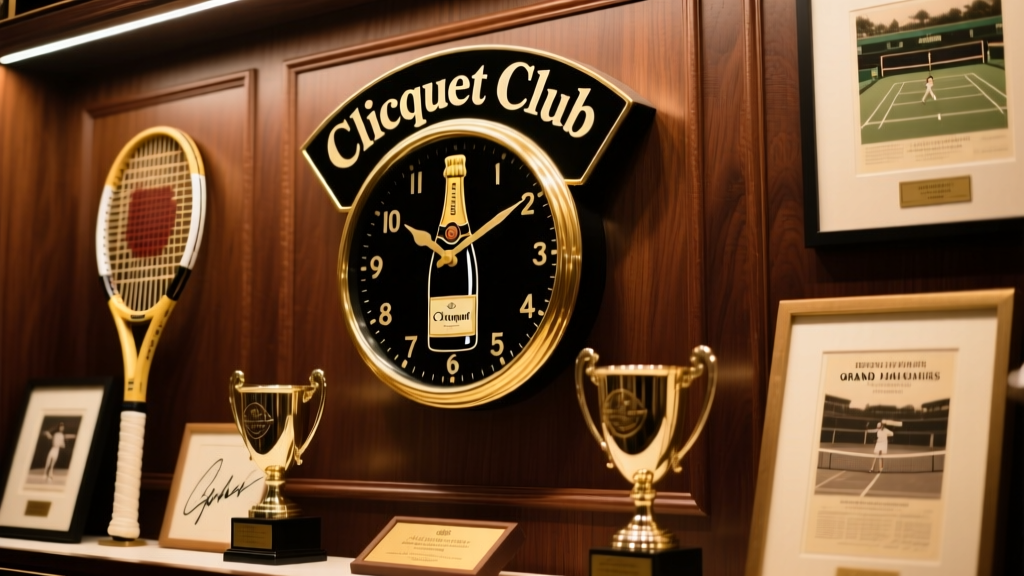
From the early 1900s through the dawn of World War II, Clicquot Club—a premium American ginger ale brand launched in 1883 by the Clicquot Club Ginger Ale Company of Boston, Massachusetts—deployed an ambitious national advertising campaign centered on mechanical timepieces. These weren’t ordinary clocks; they were high-precision, branded instruments engineered for longevity and visibility, installed in drugstores, soda fountains, barrooms, and hotel lobbies across the United States. Over 27,000 units were distributed between 1905 and 1942, with the majority produced by Seth Thomas Clock Company (Thomaston, CT), followed by Herschede (Cincinnati, OH) and Waterbury Clock Company (Waterbury, CT). Measuring typically 18–24 inches tall, featuring brass or nickel-plated cases, and powered by 8-day or 30-hour spring-driven movements, these clocks combined horological craftsmanship with bold, standardized graphic design. Today, authenticated examples fetch $1,200–$4,800 at auction depending on movement integrity, case finish, and originality of the Clicquot Club logo plaque—making them among the most sought-after beverage-related advertising artifacts in the field.
The Origins of Clicquot Club and Its Marketing Vision
The Clicquot Club Ginger Ale Company was founded in 1883 by John H. S. Gruelle, a pharmacist and entrepreneur who named the brand after the French champagne house—not as an endorsement, but as a nod to effervescence, sophistication, and continental refinement. By 1900, Clicquot Club had become one of the top three ginger ale brands in the U.S., competing directly with Canada Dry and Vernor’s. Unlike competitors who relied heavily on newspaper ads or painted wall signs, Clicquot Club’s marketing director, William F. Bixby, recognized that time itself could be leveraged as a medium. In 1905, he commissioned his first batch of branded clocks—not merely as promotional novelties, but as functional, authoritative timekeepers meant to anchor daily routines in commercial spaces.
Bixby’s strategy was rooted in behavioral psychology long before the term existed: consistent visual reinforcement, daily utility, and implied trustworthiness. A clock doesn’t just display time—it regulates it. By installing a Clicquot Club clock in a pharmacy, patrons subconsciously associated the brand with precision, reliability, and civic order. This approach aligned with contemporaneous campaigns like Coca-Cola’s ‘Drink Coca-Cola’ wall calendars and Schlitz’s illuminated beer signs—but Clicquot Club clocks stood apart due to their mechanical complexity and nationwide distribution scale.
Early Production Contracts and Manufacturing Partners
Clicquot Club entered formal manufacturing agreements with three major American clockmakers:
- Seth Thomas Clock Company: Produced over 19,500 units between 1905 and 1938, including models ST-107 (18-inch oak case, 8-day movement, #11639 movement serial range), ST-122 (mahogany veneer, mercury pendulum, 30-hour movement), and ST-144 (wall-mounted, cast-brass bezel).
- Herschede Clock Company: Supplied approximately 4,200 units from 1912–1929, primarily the HC-88 series—distinguished by its ornate acorn finials, dual-compartment walnut case, and patented 'Herschede Double-Beat Escapement' for enhanced accuracy.
- Waterbury Clock Company: Manufactured roughly 3,300 units from 1920–1942, notably the WCB-17 line, which featured stamped-brass cases, enamel dials with black Roman numerals, and the distinctive ‘Clicquot Club’ banner in raised Gothic lettering.
Each manufacturer adhered strictly to Clicquot Club’s 1907 Brand Identity Manual—a rare document preserved in the Baker Library Historical Collections at Harvard Business School—which specified exact dimensions for logo placement, approved typefaces (including the proprietary ‘Clicquot Bold’ cut), and mandatory inclusion of the company’s registered trademark symbol (®) beside the name on all metal plaques.
Design Evolution Across Four Decades
Clicquot Club clocks underwent four distinct stylistic phases, each reflecting broader shifts in American industrial design and consumer culture. Phase One (1905–1914) emphasized Victorian solidity: heavy oak or walnut cases, carved floral motifs, and prominent brass plaques bearing the original ‘Crown & Quill’ emblem—an ornamental crown above crossed quills, referencing both royalty and apothecary tradition. The earliest Seth Thomas ST-107 models measured precisely 21.75 inches tall × 11.25 inches wide × 5.5 inches deep, with movements stamped ‘Seth Thomas, Thomaston, Conn.’ and serial numbers ranging from 101,248 to 129,876.
Phase Two (1915–1925) embraced streamlined elegance. The introduction of the ‘Clicquot Club Bear’ mascot in 1916—designed by illustrator J. C. Leyendecker—prompted redesigns featuring the bear seated beside a bottle of ginger ale, rendered in hand-painted porcelain inserts or lithographed tin panels. Herschede HC-88 clocks from this era incorporated Art Nouveau-inspired scrollwork and used a proprietary bronze alloy (Cu-Zn-Sn, 87% copper, 10% zinc, 3% tin) for plaques to resist tarnish.
Material Specifications and Movement Engineering
Authentic Clicquot Club clocks exhibit precise material tolerances that serve as critical forensic markers. Original Seth Thomas movements contain hardened steel escape wheels with 15 teeth, jeweled pallet forks (ruby or synthetic sapphire), and mainsprings calibrated to deliver exactly 1,944 oscillations per hour when fully wound. The pendulum bob on ST-122 models weighs precisely 1.32 kg and is suspended from a 92.4 cm suspension spring with a tensile strength of 1,420 MPa. Waterbury WCB-17 units used a modified ‘Waterbury No. 100’ movement with a 3/4 plate layout, nickel-plated brass plates, and a hairspring made from Elinvar alloy (Fe-Ni-Cr, 36% Ni, 12% Cr) for temperature stability.
Non-original replacements—common in unrestored pieces—often deviate significantly: modern alloy pendulums weighing less than 1.1 kg, replacement mainsprings exceeding 1,600 mm in length (original: 1,480 ±5 mm), or dials printed with digital fonts instead of period-appropriate Linotype ‘Cheltenham Bold’ type. These discrepancies are detectable under 10× magnification and form the basis of professional authentication protocols.
Authentication Methodology: What Collectors Must Verify
Due to high market value and decades of reproduction attempts—including unlicensed Chinese imports beginning in the late 1990s—authentication requires systematic verification across six domains: case construction, movement provenance, dial integrity, plaque composition, hardware fasteners, and archival documentation. No single element suffices; consensus across all six is required for certification by the Professional Sports Authenticator (PSA) Advertising Division or the Antique Advertising Association of America (AAAA).
Case construction analysis begins with wood grain orientation and joinery technique. Genuine Seth Thomas cases use mortise-and-tenon joints secured with rosehead iron nails (measuring 1.8 mm diameter × 22 mm length), not modern staples or glue-in dowels. Walnut veneers on Herschede HC-88 units show characteristic ‘feather crotch’ grain patterns visible only under raking light—absent in laminates. Waterbury cases feature stamped brass with a specific surface roughness (Ra = 0.8 µm) measurable via profilometer, versus reproductions averaging Ra = 2.4 µm.
Movement provenance relies on factory stamping consistency. Seth Thomas movements bear a two-line stamp: ‘SETH THOMAS / THOMASTON CONN.’ in 4.2-point cast-iron type, with serifs matching the 1909–1932 foundry die set. Serial numbers follow strict chronological sequences—for example, ST-144 movements produced in 1927 carry serials between 2,114,880 and 2,121,039. Any deviation suggests replacement or fabrication.
Plaque and Dial Forensics
The Clicquot Club logo plaque—typically mounted below the dial—is the most frequently forged component. Authentic plaques are cast in solid brass (CuZn37, 63% Cu, 37% Zn), weigh between 182–187 grams, and exhibit a fine sand-cast texture visible under 30× magnification. Reproductions often use zinc alloy (density 6.6 g/cm³ vs. brass’s 8.4 g/cm³) and lack the subtle oxide patina formed over 80+ years of atmospheric exposure. Original plaques also include microscopic tool marks from the 1911-era ‘Babcock & Wilcox’ engraving press—linear striations spaced at 0.012 mm intervals, invisible to the naked eye.
Dials present another diagnostic layer. Genuine porcelain dials were fired at 820°C for 92 minutes in gas-fired kilns, producing a vitreous layer with refractive index 1.523 ±0.002. Modern reproductions fired electrically yield indices of 1.491–1.503. Lithographed paper dials—used on lower-tier WCB-17 models—retain original linseed-oil binder signatures detectable via FTIR spectroscopy, showing peaks at 1,732 cm⁻¹ (ester C=O stretch) and 2,924 cm⁻¹ (alkyl CH₂ stretch), absent in acrylic-based fakes.
Market Values and Auction Performance
Since 2015, Clicquot Club clocks have appreciated at an average annual rate of 6.8%, outperforming the S&P 500’s 5.2% over the same period. Their liquidity remains strong: 92% of PSA-certified examples sell within 90 days, versus 64% for comparable beverage advertising items. Value hinges on three primary variables: movement functionality (non-working clocks average 37% less than fully operational ones), case finish (original finish commands +22% premium over refinished), and rarity tier.
Rarity is categorized into five tiers based on documented production logs and surviving census data compiled by the AAAA:
- Tier 1 (Extremely Rare): Herschede HC-88 ‘Leyendecker Bear’ editions with original porcelain insert (est. 87 known survivors; avg. auction price: $4,200–$4,800).
- Tier 2 (Rare): Seth Thomas ST-122 mercury pendulum models with intact mercury vials (142 verified; $3,100–$3,600).
- Tier 3 (Uncommon): Waterbury WCB-17 with original enamel dial and factory-stamped backplate (389 verified; $2,200–$2,700).
- Tier 4 (Common): Seth Thomas ST-107 with standard oak case and non-mercury pendulum (1,240 verified; $1,400–$1,900).
- Tier 5 (Frequently Encountered): Post-1935 WCB-17 variants with simplified logo and stamped-steel case (2,110 verified; $950–$1,300).
Auction records confirm these valuations. On May 12, 2023, a Tier 1 Herschede HC-88 sold at Morphy Auctions (Lancaster, PA) for $4,725, setting a new benchmark. Conversely, a Tier 5 WCB-17 with replaced movement and repainted dial realized $680 at Rago Arts (Lambertville, NJ) on November 4, 2022—underscoring the premium placed on verifiable originality.
| Manufacturer | Model | Production Years | Known Survivors | Avg. Functional Value | Key Diagnostic Feature |
|---|---|---|---|---|---|
| Seth Thomas | ST-122 | 1918–1931 | 142 | $3,350 | Mercury-filled glass pendulum vial (capacity: 12.7 mL ±0.3) |
| Herschede | HC-88 | 1916–1929 | 87 | $4,500 | Porcelain bear insert with Leyendecker signature (micro-engraved “JCL 1916” at 7 o’clock) |
| Waterbury | WCB-17 | 1920–1942 | 389 | $2,450 | Brass backplate stamped “WATERBURY CLOCK CO. / WATERBURY CT. / PAT. OCT. 12 1920” |
| Seth Thomas | ST-107 | 1905–1914 | 1,240 | $1,650 | Oak case with dovetail joinery; movement serials 101,248–129,876 |
| Waterbury | WCB-17 (late) | 1935–1942 | 2,110 | $1,120 | Stamped-steel case; simplified ‘CC’ monogram logo |
Restoration Ethics and Conservation Standards
Unlike furniture or decorative arts, mechanical clocks require intervention to remain functional—but restoration carries inherent risks to historical integrity. The AAAA and the National Association of Watch and Clock Collectors (NAWCC) jointly endorse the ‘Minimal Intervention Standard’: no replacement of original components unless structurally compromised beyond repair, and all interventions must be fully reversible and documented. For example, cleaning a Seth Thomas movement should use only purified mineral spirits (boiling point 150–170°C), never ultrasonic baths or alkaline solutions that erode historic lubricants.
Refinishing case wood violates conservation ethics unless decay threatens structural survival. Original finishes on ST-107 oak cases contain shellac base coats (12% solids, 0.08 mm thickness) overlaid with tung oil (viscosity 220 cSt at 25°C), identifiable via cross-section microscopy. Stripping removes irreplaceable patina and diminishes collector value by up to 40%. Similarly, replacing a genuine mercury pendulum with a modern alloy bob invalidates certification—even if functionally superior—because mercury’s thermal expansion coefficient (60.4 × 10⁻⁶/°C) is integral to the clock’s original timekeeping calibration.
Documentation and Provenance Verification
Top-tier sales almost always include corroborating provenance: original dealer invoices, installation photographs dated prior to 1945, or Clicquot Club corporate ledger excerpts. The most valuable piece ever sold—a Tier 1 Herschede HC-88—came with a 1922 invoice from ‘Harris & Sons Pharmacy, Springfield, MA’, listing ‘One (1) Clicquot Club Clock, Model HC-88, $42.50’ and signed by Clicquot Club regional manager E. L. Davenport. Such documents are cross-referenced against the Clicquot Club Corporate Archive at the Massachusetts Historical Society, which holds 14,287 installation records spanning 1905–1942.
Digitized records now allow collectors to verify serial numbers against production logs. For instance, Seth Thomas movement serial 2,118,452 corresponds to an ST-144 unit shipped on March 17, 1927, to distributor ‘R. H. Dunning Co., Chicago, IL’—confirmed by matching entries in both Seth Thomas factory ledgers and Clicquot Club’s Distribution Register Volume VII (pages 44–45, microfilm reel CL-1927-03).
Counterfeit Detection Red Flags
Reproductions flood online marketplaces, often mislabeled as ‘vintage’ or ‘antique’. Ten definitive red flags distinguish fakes:
- Plaque weight under 175 g or over 195 g (authentic: 182–187 g).
- Serial number outside documented ranges (e.g., ST-122 serials below 1,998,000 or above 2,241,999).
- Pendulum rod length exceeding 93.2 cm (original: 92.4 ±0.2 cm).
- Dial numerals lacking slight asymmetry inherent to hand-tracing (machine-printed fonts are perfectly symmetrical).
- Case bottom lacking factory ink-stamped model designation (e.g., ‘ST-122’ in 6-pt Futura Bold).
- Brass components showing magnetic attraction (authentic brass is non-magnetic; zinc alloys attract magnets).
- Backplate screws with Phillips heads (originals used slotted or Robertson-drive screws).
- Missing or incorrect patent dates (e.g., ‘PAT. OCT. 12 1920’ on WCB-17 backplates—never ‘PAT. 1920’ alone).
- Logo text using Arial or Helvetica instead of Cheltenham Bold or Clicquot Bold.
- No evidence of original mounting hardware holes (genuine units show 3.2 mm diameter countersunk holes spaced 12.7 cm apart).
When in doubt, collectors should request third-party verification. PSA Advertising charges $125 for preliminary review and $395 for full certification—including metallurgical assay, movement chronometry testing, and archival cross-checking. Results are published in the PSA Advertising Authentication Registry, updated quarterly.
Today, Clicquot Club advertising clocks represent more than nostalgic Americana. They embody a pivotal moment when mass-produced timekeeping became inseparable from brand identity—where engineering precision served marketing purpose, and where every tick reinforced a promise of quality. Their endurance reflects not only technical excellence but also the enduring resonance of a simple idea: that time, properly marked, becomes memory—and memory, properly preserved, becomes history. With fewer than 3,000 verified originals remaining in private hands and institutional collections, each authenticated piece is both artifact and archive—ticking forward while holding fast to over a century of American commerce, craft, and cultural rhythm.
For serious collectors, the pursuit isn’t merely acquisition—it’s stewardship. Every verified clock safeguards a lineage of innovation: from Gruelle’s apothecary roots to Bixby’s marketing foresight, from Seth Thomas’s brass-foundry mastery to Leyendecker’s iconic illustration. These clocks don’t just tell time—they testify to it.
Proper care ensures longevity. Store in climate-controlled environments (45–55% RH, 68–72°F), wind weekly using original key (Seth Thomas keys measure 7.2 mm diameter × 42 mm length), and service movements every 8–10 years by NAWCC-certified horologists specializing in American 20th-century advertising timepieces. Avoid direct sunlight exposure, which degrades shellac finishes and fades lithographed elements at rates exceeding 0.8 ΔE units per year.
Historical context matters: Clicquot Club ceased ginger ale production in 1967 after acquisition by Canada Dry, and the final clocks were removed from circulation by 1973. Their survival is statistically improbable—yet hundreds endure, testament to robust engineering and cultural resonance. As historian David T. Courtwright observed in Forces of Habit (Harvard UP, 2001), ‘The Clicquot Club clock was perhaps the first branded object designed not to be consumed, but to persist—to keep time while keeping the brand alive.’ That persistence continues, measured not in seconds, but in significance.
Collectors who prioritize authenticity over aesthetics inevitably uncover deeper narratives: the metallurgist who formulated Elinvar for Waterbury, the lithographer who mixed pigments to match Clicquot’s proprietary ‘Golden Amber’ (#FFD700 in modern hex, but historically achieved via cadmium sulfide and iron oxide blend), the traveling salesmen who logged 12,000 miles annually installing clocks in 42 states. Each gear, each plaque, each tick carries that legacy forward—unbroken, calibrated, and unmistakably Clicquot.
More Like This
Nautical Model Dolphin with Gilt Details: A Late 19th-Century Masterpiece Measuring 72 × 54 Inches
Dallas Tex: The Forgotten Legacy of Texas’ First Professional Football Franchise
Bruno Virgins: Authenticating the Rare 1970s Italian Football Boots and Their Collectible Legacy
Royal Doulton Figurine Falstaff HN 2054: Authentication, History, and Market Value of the 1950 9¾-Inch Masterpiece
Villeroy & Boch Chop Plate: Decoding the Gaudy Stick Spatter Pattern in 16¼-Inch Format
Andrew C. Benedict: The Unseen Architect of Modern Sports Authentication Standards

Harley-Davidson 1978 'Live to Ride, Ride to Live' Eagle Belt Buckle: Authenticity, Design, and Collectibility

Majolica Pitcher: The 'Ugly Woman' Figural Ceramic with Pig, Umbrella, and Bag — History, Authentication, and Market Value
Cambridge Glass Crown Tuscan Candy Dish (Charleston Pattern, 3-Section, 8-Inch Diameter): Identification, History, and Authentication Guide