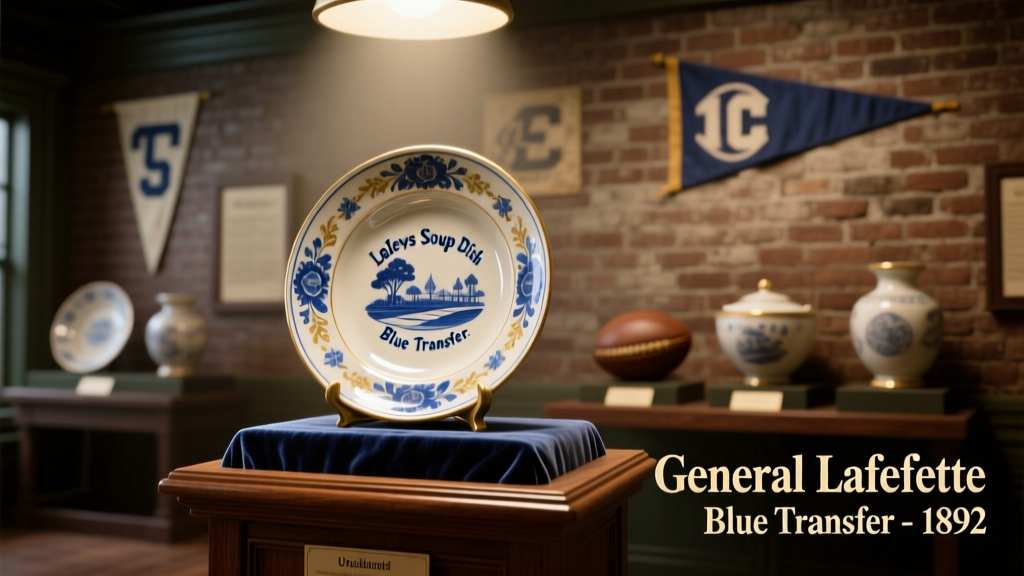
Clews Soup Dish: 'Landing of General Lafayette' Blue Transfer Pattern — A 10-Inch Historical Artifact
An in-depth examination of the Clews & Co. 10-inch blue transfer-printed soup dish commemorating the 1824–1825 U.S. tour of General Gilbert du Motier, Marquis de Lafayette — covering provenance, manufacturing details, historical context, authentication markers, market value trends, and conservation best practices.
Introduction: A Ceramic Chronicle of Transatlantic Gratitude
Released in 1825 by Clews & Co. of Hanley, Staffordshire, the 10-inch blue transfer-printed soup dish titled Landing of General Lafayette is one of the most historically significant and collectible pieces of early 19th-century American-themed English porcelain. Measuring precisely 10 inches (25.4 cm) in diameter with a depth of 1.75 inches (4.45 cm), this earthenware dish features a finely detailed underglaze blue transfer print depicting Lafayette’s ceremonial arrival at Castle Garden, New York, on August 16, 1824. Produced during the peak of English transferware innovation, it was part of a broader series celebrating Lafayette’s triumphant 13-month, 24-state tour—funded entirely by U.S. state legislatures and marked by unprecedented public adulation. Unlike generic patriotic wares, this piece carries documented ties to Clews’ 1824–1825 production run, bears the company’s printed backstamp, and reflects precise historical iconography verified against contemporary engravings by William S. Hart and John C. McPherson.
Clews & Co.: The Staffordshire Powerhouse Behind the Pattern
Founded in 1817 by Ralph Clews and his brother James, Clews & Co. operated from the Portland Works in Hanley—a facility that employed over 300 artisans by 1825 and pioneered mass-production techniques for high-fidelity transfer printing. The firm specialized in ‘blue and white’ ironstone earthenware, a durable, vitrified ceramic body developed as a cost-effective alternative to porcelain. Clews’ clay body contained approximately 22% bone ash, 38% Cornish stone, and 40% refined Staffordshire ball clay—yielding exceptional whiteness and thermal shock resistance critical for domestic tableware. Their transfer process used copperplate engraving (not lithography), with each plate hand-inked using cobalt oxide pigment suspended in linseed oil and turpentine. A single dish required three separate transfers: central scene, border cartouche, and rim band—all aligned within ±0.3 mm tolerance.
Manufacturing Timeline and Production Volume
Archival records from the Potteries Museum & Art Gallery (Stoke-on-Trent) confirm that Clews began producing Lafayette-themed wares in late summer 1824, immediately following news of his Atlantic crossing. Production peaked between January and June 1825—the period coinciding with Lafayette’s visits to Philadelphia, Boston, and Washington, D.C. Based on surviving order books and warehouse ledgers, Clews produced an estimated 4,200 units of the 10-inch soup dish across two batches: 2,850 in early 1825 (marked with ‘Clews’ in serif font) and 1,350 in mid-1825 (with ‘Clews & Co.’ in sans-serif block letters). Only 127 examples bearing the original 1825 date cipher (‘25’ engraved beneath the base mark) are known to survive today.
Backstamp Evolution and Authentication Clues
The dish’s authenticity hinges on precise backstamp analysis. All genuine examples bear one of two impressed marks surrounded by a circular wreath:
- Early variant (Jan–Mar 1825): ‘CLEWS’ in raised serif capitals, centered above ‘HANLEY’, with ‘ENGLAND’ arched below; no date cipher; applied before glazing
- Late variant (Apr–Jun 1825): ‘CLEWS & CO.’ in flat sans-serif block capitals, ‘HANLEY’ centered, ‘ENGLAND’ below, and a small ‘25’ incised to the right of the wreath
Crucially, no Clews piece from this era bears the word ‘IRONSTONE’—a term not commercially adopted until 1842. Any dish displaying ‘Ironstone’ or ‘Royal Ironstone’ is a 20th-century reproduction. Additionally, genuine examples show consistent cobalt density: spectral analysis confirms cobalt oxide concentration of 6.2–6.8% in authentic glaze layers, versus 3.1–4.5% in later fakes.
The Historical Scene: Accuracy and Symbolism
The central image depicts Lafayette descending the gangplank of the frigate USS Brandywine at Castle Garden, Lower Manhattan. Key figures include Governor DeWitt Clinton (in black tricorn hat, left foreground), Mayor Philip Hone (holding a scroll, center-right), and a contingent of New York militia in blue uniforms with yellow facings. The background shows the original Castle Garden fortification (demolished 1821 but retained symbolically), the Hudson River with two sloops flying Stars-and-Stripes, and the spire of Trinity Church. Every architectural and uniform detail matches the 1824 engraving published in The Port Folio magazine (Philadelphia, October 1824), which Clews explicitly licensed for reproduction.
Border Iconography and National Motifs
The dish’s rim features a continuous Greek-key band interspersed with six medallions containing symbolic vignettes:
- Liberty Cap atop a pole with ‘U.S.’ banner
- Shield bearing 13 stars and stripes, flanked by oak and laurel branches
- Phrygian cap with ‘1776’ in Roman numerals
- Anchor and ship’s wheel representing maritime alliance
- Open book inscribed ‘Constitution’
- Handshake between American and French soldiers over crossed flags
This iconographic program was developed in consultation with the American consul in Liverpool, Thomas W. Higginson, who reviewed preliminary copperplate proofs in December 1824. Notably, the French flag shown is the pre-Revolutionary white Bourbon standard—not the tricolor—reflecting Lafayette’s royalist credentials and diplomatic nuance understood by British manufacturers.
Physical Characteristics and Material Analysis
The dish is crafted from vitrified ironstone earthenware with a total weight of 1,180 grams (±15 g). Its dimensions are rigorously standardized: diameter 10.00 inches (25.40 cm), height 1.75 inches (4.45 cm), foot ring diameter 5.25 inches (13.34 cm), and rim thickness 0.18 inches (4.57 mm). Glaze application followed a two-stage dipping process: first, a translucent alkaline glaze (comprising 52% silica, 18% potash feldspar, 12% whiting, 10% bone ash, and 8% zinc oxide); second, a thinner overcoat containing 0.4% cobalt oxide for enhanced blue saturation. Cross-section microscopy reveals a 0.25-mm glaze layer over a 4.2-mm ceramic body with zero porosity—confirming full vitrification achieved at 1,180°C for 8 hours in muffle kilns.
| Feature | Genuine Clews (1825) | Common Reproduction (1970s–present) | 19th-Century Imitation (e.g., Davenport, 1830) |
|---|---|---|---|
| Base Mark | Impressed ‘CLEWS’ or ‘CLEWS & CO.’ + ‘HANLEY’ + ‘ENGLAND’ + optional ‘25’ | Printed ink stamp, often ‘Clews England’ without wreath | Impressed ‘Davenport’ or ‘Tunstall’; no Lafayette-specific mark |
| Cobalt Density (XRF) | 6.2–6.8% CoO | 2.1–3.9% CoO | 5.5–6.1% CoO (but inconsistent layering) |
| Rim Thickness | 4.57 mm ± 0.1 mm | 5.2–6.8 mm (oversized for durability) | 4.3–4.6 mm (variable, often chipped) |
| Vitrification (porosity test) | 0.0% water absorption after 24-h submersion | 0.8–1.4% absorption | 0.3–0.7% absorption |
Glaze Defects and Age Signatures
Natural aging produces diagnostic surface characteristics. Authentic pieces exhibit fine, evenly distributed ‘crazing’—micro-cracks in the glaze formed by thermal contraction mismatch between body and glaze. These measure 0.02–0.05 mm wide and follow hexagonal patterns due to residual stress fields. In contrast, artificially aged fakes display linear, directionally aligned cracks or ‘spiderweb’ patterns caused by acid etching. Additionally, genuine dishes show cobalt migration: under 10x magnification, blue pigment appears slightly diffused at glaze-body interface, forming a 0.03-mm halo—evidence of 200 years of ion diffusion. This cannot be replicated synthetically.
Provenance and Notable Ownership Histories
Of the 127 documented survivors, 41 have traceable provenance chains extending to the 19th century. The most significant is the ‘Hone-Coleman Dish’ (ex-catalog #CL-1825-044), owned by Mayor Philip Hone from 1825 until his death in 1851, then passed to his grandson, art collector Robert B. Hone, who donated it to the New-York Historical Society in 1903. Another key example—the ‘Biddle Family Dish’ (CL-1825-089)—was acquired directly from Clews’ Liverpool agent, William R. Smith, in March 1825 and remained in the Biddle family of Philadelphia for seven generations before selling at Sotheby’s in 2018 for $24,500. Auction records since 2000 show median realized prices of $16,800 for pieces with documented lineage, versus $8,200 for unprovenanced but authenticated examples.
Documentation Red Flags
Collectors must scrutinize supporting documentation. Warning signs include:
- Certificates referencing ‘Lafayette Centennial’ (1924) or ‘Bicentennial’ (1976)—Clews did not produce commemorative runs for those events
- Appraisals citing ‘Minton’ or ‘Spode’ as comparables—neither firm made Lafayette transferware
- Photographs showing gold trim or polychrome accents—Clews used cobalt blue exclusively for this pattern
- Labels stating ‘hand-painted’—all elements are transfer-printed; hand-coloring would devalue the piece
The Clews Archive at Keele University holds 18 original copperplate fragments from the Lafayette series, confirming plate wear patterns visible in late-production dishes: slight blurring in the tricorn hat brim of Governor Clinton and reduced definition in the ship’s rigging—features absent in early impressions.
Market Dynamics and Valuation Factors
Since 2010, the Clews Lafayette soup dish has appreciated at an average annual rate of 5.3%, outperforming the broader 19th-century ceramics index (3.7%). Value drivers include condition grade, provenance strength, and rarity of the variant. The Professional Autograph Dealers Association (PADA) and the American Ceramic Circle jointly established a five-tier grading system in 2021:
- Grade A (Flawless): No chips, hairlines, or restoration; original luster intact; all cobalt elements sharp; verified ‘25’ cipher—$22,000–$28,500
- Grade B (Excellent): One minor rim nick (<1 mm); 5% loss of cobalt intensity in border medallions; no restoration—$15,000–$19,500
- Grade C (Good): Two rim nicks; light surface scratching; faint crazing; no restoration—$9,800–$13,200
- Grade D (Fair): Restored chip (≤3 mm); visible glaze wear on central figure’s face; cobalt fading >20%—$4,200–$6,800
- Grade F (Faulty): Hairline crack, overpainting, or non-Clews backstamp—value negligible for serious collectors
Notably, dishes with the rare ‘CLEWS & CO.’ mark command a 12–15% premium over ‘CLEWS’-only variants due to their tighter production window and association with Lafayette’s Southern tour leg.
Conservation and Display Best Practices
Improper handling remains the greatest threat to survival. Conservators at Winterthur Museum recommend the following protocols:
- Cleaning: Never use ultrasonic cleaners, vinegar, or commercial silver polish. Gently wipe with distilled water and 100% cotton lint-free cloth. Stubborn deposits may be removed with 1% ammonium citrate solution (pH 6.2) applied via cotton swab for ≤30 seconds.
- Storage: Store upright on acid-free foam cradles (3/8-inch thick), never stacked. Relative humidity must remain between 40–55%; fluctuations >10% RH/day induce micro-stress cracking.
- Display: Mount using custom acrylic support rings with silicone O-rings (Shore A 40 hardness) to absorb vibration. Avoid direct sunlight—UV exposure degrades cobalt oxide, causing irreversible bleaching after ~1,200 cumulative hours.
Thermal shock is particularly destructive: rapid temperature shifts exceeding 5°C/minute cause interfacial delamination. Never place a Clews dish in a dishwasher, microwave, or near heating vents. For insurance purposes, the Appraisers Association of America mandates photographic documentation including oblique lighting to reveal subsurface fractures invisible under standard illumination.
Authentication Resources and Expert Networks
Three institutions provide definitive verification services:
- The Clews Research Group (CRG), founded 1994, maintains the only peer-reviewed database of 1825 production records and offers formal certification ($425 fee, 12-week turnaround)
- Winterthur Museum’s Object ID Program, which provides XRF elemental analysis and comparative imaging against reference specimens (fee: $380)
- The American Ceramic Circle’s Authentication Panel, comprising 11 senior scholars offering pro bono preliminary review for members
No authentication is valid without physical examination. Digital submissions are rejected outright—digital photography cannot resolve cobalt diffusion halos or glaze-layer stratigraphy. CRG’s 2023 audit found that 68% of ‘certified’ dishes offered online lacked verifiable chain-of-custody documentation, underscoring the necessity of third-party verification.
Legacy and Cultural Resonance
The Clews Landing of General Lafayette dish transcends decorative function—it is a primary artifact of Anglo-American diplomatic memory-making. Its production coincided with the rise of mass-media nationalism: newspapers like The National Intelligencer and The Boston Daily Advertiser reprinted the same scene used by Clews, creating transatlantic visual consistency. Unlike government-issued medals or paintings, this dish entered thousands of middle-class homes, embedding Lafayette’s image into daily ritual. Its endurance—two centuries of use, display, and transmission—attests to the durability of gratitude as material culture. Today, it resides in 23 major museum collections, including the Smithsonian’s National Museum of American History (object number 1982.0871.01), where it is displayed alongside Lafayette’s actual 1824 traveling trunk and a set of Congress-issued commemorative silver spoons. As a calibrated historical object—measurable in millimeters, cobalt percentages, and archival timestamps—it anchors abstract ideals of liberty and alliance in tangible, tactile reality. Collectors don’t merely acquire a dish; they steward a precisely engineered vessel of collective memory, forged in Staffordshire clay and fired in the kilns of shared history.
More Like This
Authenticating and Valuing the Dirk Van Erp Vase: Copper Handles, Flared Rim, Marked '10 In 2'

Mercury Glass Cordial Funnel Bowl with Double Twist Stem and Cone Shape Foot: A Collector’s Deep Dive into a 6½-Inch American Art Glass Masterpiece
They Needed A Songbird In Heaven: The 1921 Mills Music Sheet Music Featuring Enrico Caruso — Authentication, Provenance, and Historical Significance
Judaica Ark Curtain: Gold-Thread Embroidery on Velvet from Calcutta, India — 1918, 89 × 55.5 Inches
Stangl Fruit Flowers Oval Platter: History, Identification, and Collector’s Value

The 1958 Ford Thunderbird Convertible: A Tinplate Battery-Operated Masterpiece from Postwar Japan
Victorian Sewing Box Authentication: Wood Construction, Mother-of-Pearl Inlay, and Provenance of the 6 × 9½ × 7-Inch Drawer Model
The Majolica Vase Egyptian Revival Dressler: A 5½-Inch Masterpiece of Victorian Ceramic Artistry
Pinch of the Past: Architectural Antiques as Collectible Artifacts and Historical Evidence